
Text and photos by Vincen Gregory Yu
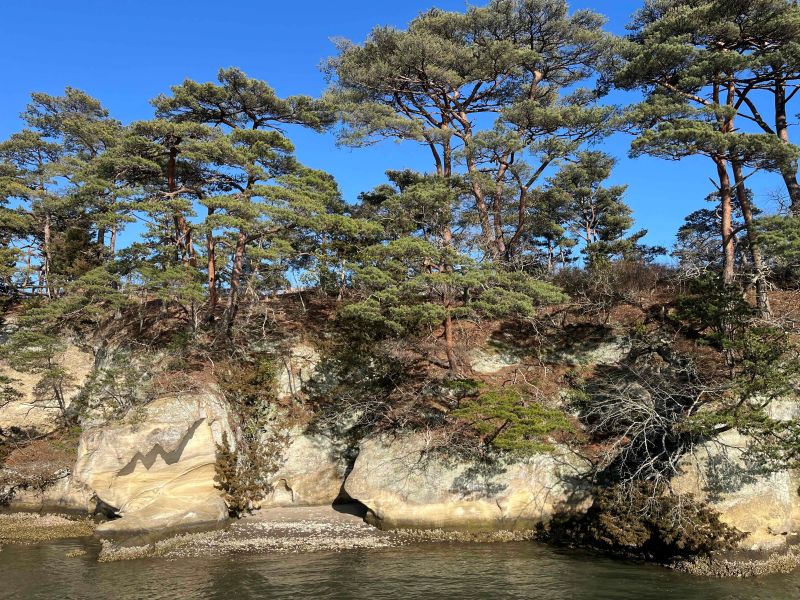
The famed Japanese pines of Matsushima.
Imagine El Nido, but more subdued, less imposing, fun-sized: That’s Matsushima Bay in a nutshell.
Traditionally counted among the Three Views of Japan—a canonical trio of coastal locations on the main island of Honshu that supposedly best represent the country’s stunning natural scenery—Matsushima is most famous for the pine-covered isles scattered across its bay—around 260 in total, according to popular estimates. Some of the smaller ones are attractions in themselves—rock formations hewn by wind and tide over the centuries, jutting from the water like rugged, sand-colored sea creatures.
But it’s the larger ones, mantled in pines, that give the bay its distinct character, as well as its name—“matsu” is Nihongo for pine tree, “shima,” island. These trees barely resemble their towering, conical counterparts in Baguio; they’re relatively short, their branches layered like horizontal lines drawn one atop another and thickened with leaves around the tips, as if some painter god had played with his brush but called it a day after a few, intentional strokes. Imagine bonsai, but bigger—and in the wild.
I went at the tail end of winter earlier this year, lured precisely by the promised spectacle of those islands, with my usual group of káladkárin friends from med school. Armed with the JR East Tōhoku Area Pass, we had five days of unlimited access to the extensive Shinkansen and local train networks spanning much of Honshu’s northern third. For two nights, we based ourselves in Sendai, the largest city of Tōhoku region. Filipino readers might recognize it as one of the main casualties of the 2011 earthquake and tsunami that led to the Fukushima nuclear disaster (the now-disabled power plant sits only 100 km south of the city).
From Sendai, Matsushima Bay is only a breezy half-hour train ride away, an idyllic day trip best paired with a brief stop in the nearby fishing town of Shiogama, which claims to have one of the highest concentrations of sushi restaurants per square kilometer in the country. In the local fish market, we feasted on humongous oysters and loads of sashimi.
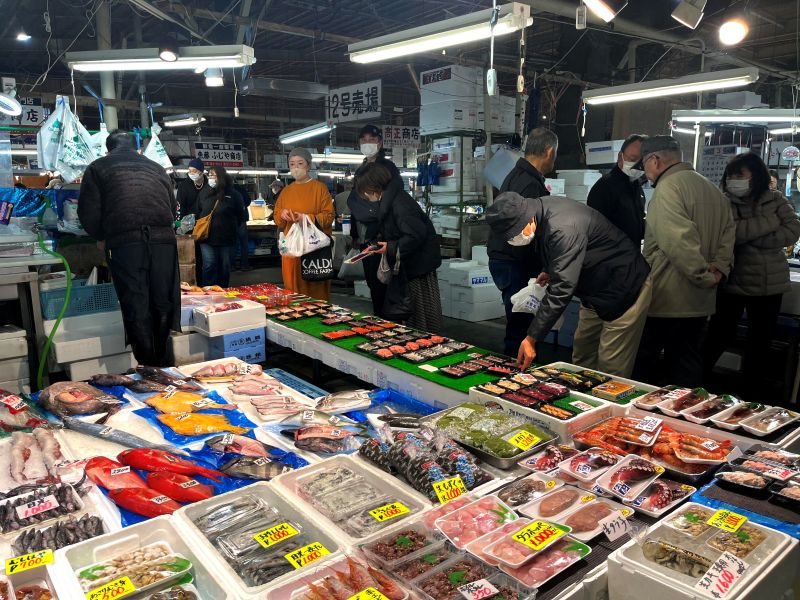
Fresh ‘sashimi’ being prepared and for sale at the Shiogama fish market
Matsushima, however, seemed poised to deliver a more novel sensorial jolt than fresh raw seafood. Aboard a double-decker sightseeing cruise, we spent close to an hour circling the bay, taking in its islands from a relatively close distance, the weather nothing short of perfect.
Almost 400 years ago, the Neo-Confucian scholar Hayashi Gahō was apparently so bowled over by this vista of sky, sea, isles, and trees, that he was moved to declare it one of the Nihon Sankei—the renowned Three Views. As far as I could tell, Gahō wasn’t just making stuff up. My introduction to his trifecta, in the spring of 2024, was an absolute knockout: Amanohashidate, on the country’s western coast. Viewed from a hilltop observatory reached by a charming funicular, its 3.6-km pine-laden sandbar resembled a dark green serpent slicing through the placid blue of Miyazu Bay, forested hills rising all around, and the Sea of Japan peeking through where the undulating land parted and the bay emptied into the distance.
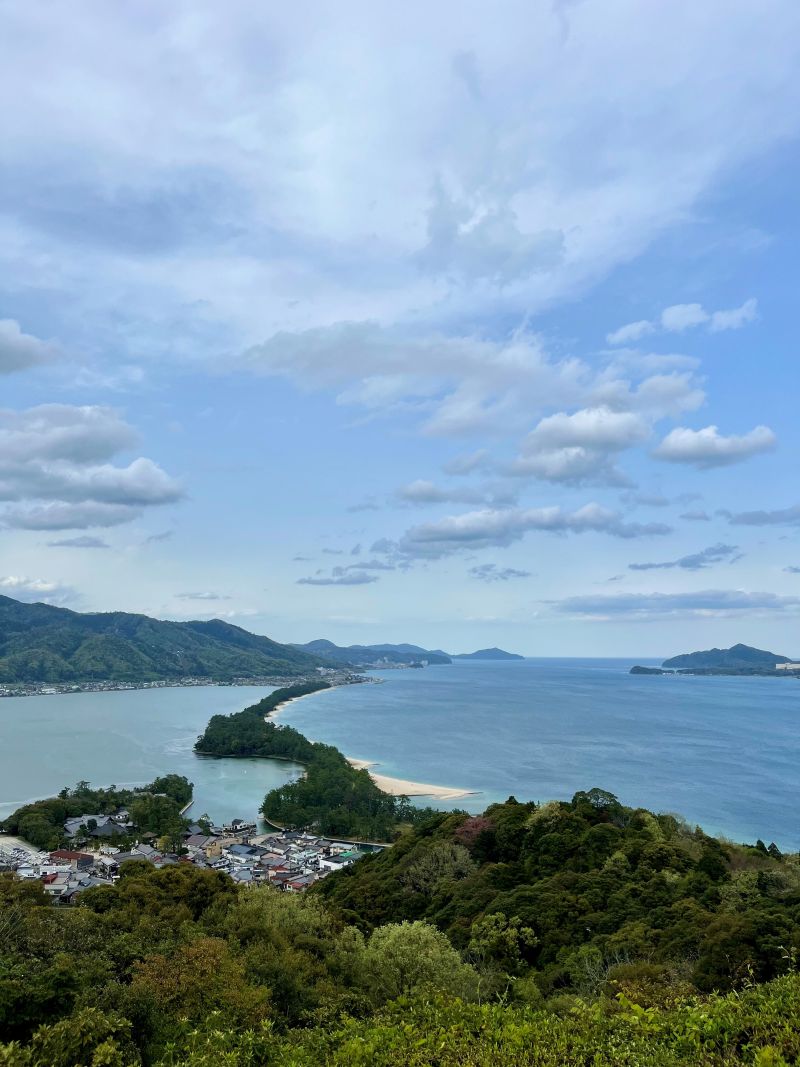
Amanohashidate’s pine-laden causeway surrounded by Miyazu Bay, with the Sea of Japan in the distance
Next to Amanohashidate, Matsushima Bay seemed dialed down. Don’t get me wrong—it’s definitely worth venturing beyond the usual landing hubs and favorite Pinoy vacation haunts of Tokyo, Osaka, and Sapporo (I’d argue that any place in Japan is, if one knows only of Tokyo, Osaka, and Sapporo).
Yet, aboard that cruise, I couldn’t help thinking of Palawan’s premiere ecotourism destination. Obviously, Gahō never went to the Philippines—and never beheld the spectacular limestone karsts of El Nido rising dramatically like mountains from the water, the sight of its islands from a distance, silhouetted against a golden sunset, capable of suspending the act of breathing for a few good seconds.
In contrast, Matsushima Bay felt…curated. A less grandiose Asian cousin. A prerecorded audio guide droned from the speakers, directing our attention to this island and that: one that looked like a turtle, another imbued by the elements with a sort of anthropoid head, a temple guardian in Japanese culture. I loved the sea breeze most of all, and took far more pleasure in observing the gathered crowd on the open-air deck aim their cameras this way and that.
Back inside the ferry cabin, the atmosphere was near-soporific—this was Japan, after all, and talking loudly in public was frowned upon. Several passengers had fallen asleep in their seats, defeating the point of the whole excursion. What would Gahō have said about this, I wondered.
We visited two of the islands after the cruise, and that was where the fun truly was for me. Right next to the pier was an islet housing a small Buddhist temple called Godaidō, which ironically means “five big halls”—it houses statues of the five Wisdom Kings of Buddhism, unveiled to the public once every 33 years. (The next unveiling will be in 2039.) The islet overlooked the pier and the bay, and one briefly came closer to imagining what Gahō must have seen back then.
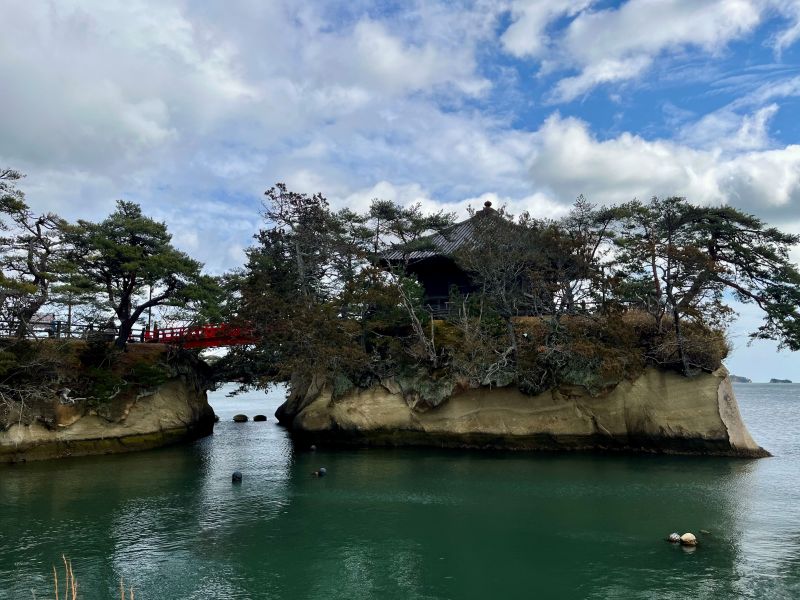
A scene from the islet housing the temple Godaidō
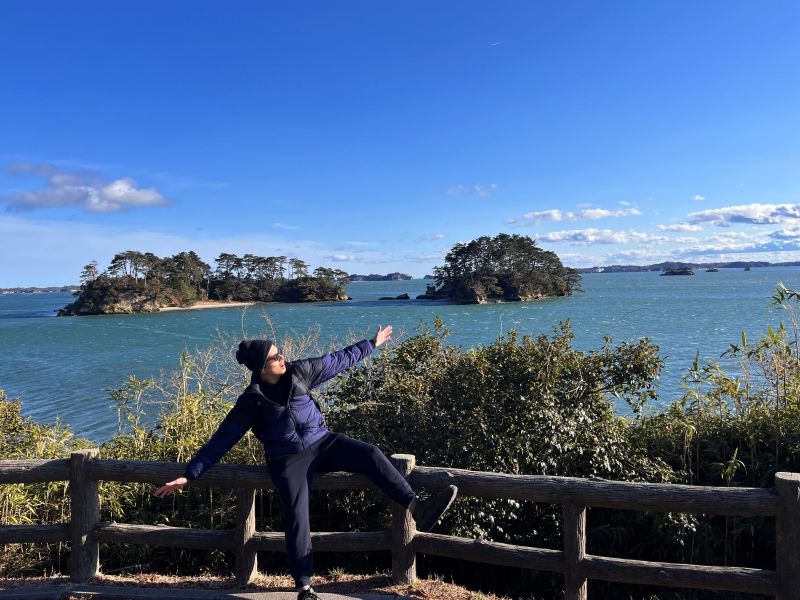
The highlight was Fukuurajima, arguably the biggest of the few islands accessible to the public. To get there, we paid a minimal fee to cross the 250 m-long pedestrianized bridge painted bright red. There were trails to be enjoyed, but even better were the quiet pockets overlooking the bay and nearby islets—places where one could meditate and commune with nature, take in the entirety of the scenery, tune out the throngs of tourists in the town proper. Amid the pines, it sounded like one had chanced upon a raging typhoon, so strong was the wind’s howl. Returning to the mainland in the late afternoon, we contended with even wilder winds—arctic, threatening to throw us off balance. We must have made an odd sight on that bridge: The only clues to the force of the wind were the racing ripples on the water and the endless flutter of our puffed-up jackets.
Walking back in those conditions was the easy part; standing still to have a photo taken was the challenge. In that respect, Matsushima beat El Nido fair and square.
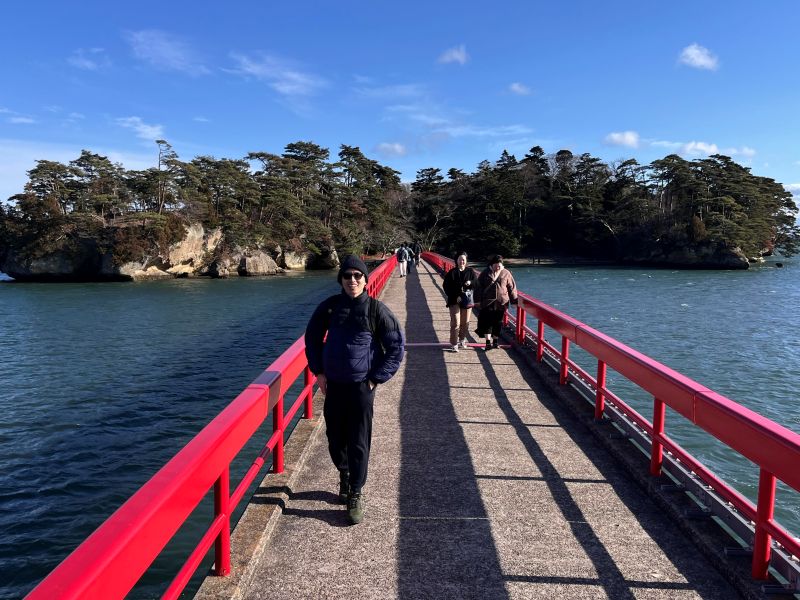
The author on the Fukuurajima Bridge
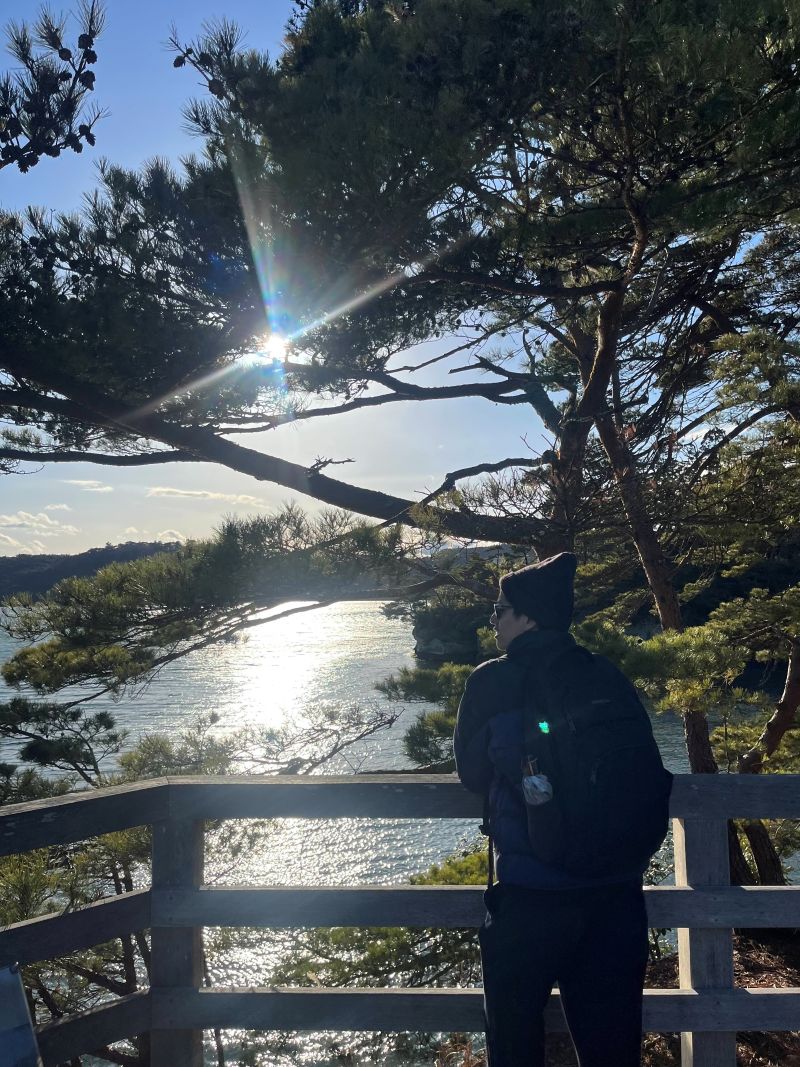
Fukuurajima offers quiet pockets of beautiful scenery.


