
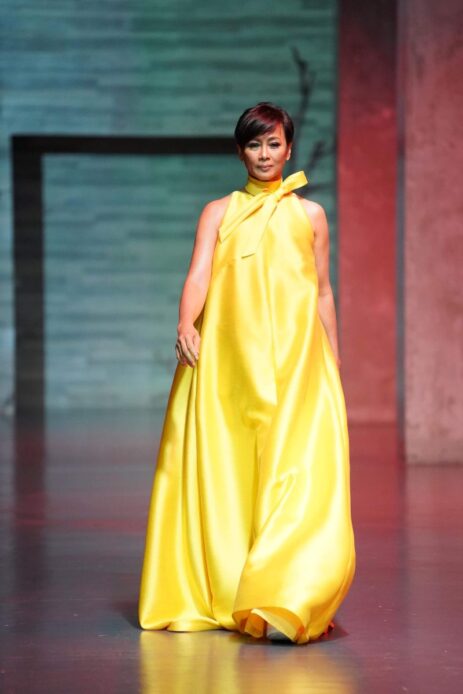
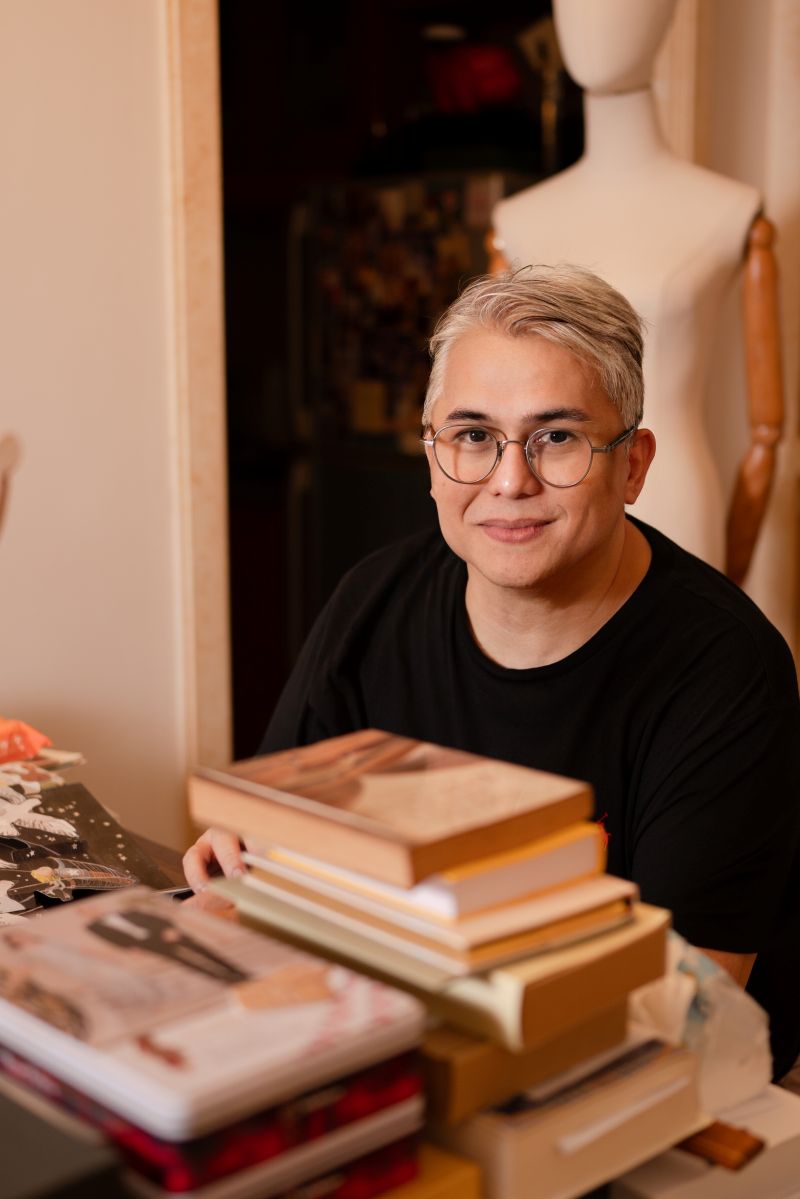
JC Buendia: The forthcoming show is deeply personal.
In a high-key social, designer Julius Cesar Buendia, JC to friends, noticed that many of the women in the ballroom could barely sit down in their gowns. They stood for much of the evening, taking selfies and gathering around VIPs. He even overheard a high-ranking Church official say, “Oh, ladies, you really like taking pictures.”
Some gowns bore huge flower embellishments. Others had expansive trains that required assistance whenever the wearer moved. After the event, Buendia saw one husband helping his wife detach her train.
“I thought, there’s another way to be elegant than being in those,” he now says. “It looked visually beautiful, but the women needed someone to assist them while they moved around.”
It made him think of what his clients had been telling him all along. Many clients are empty nesters who have moved into condominiums from their huge but hardly-filled homes. They no longer have room for big gowns.
Destination weddings bring another set of concerns. “‘Does that need to be ironed?’ clients usually ask. ‘I want something that I can just hang in the bathroom and steam.’ So those concerns were on my mind.”
At the Red Charity Gala on Oct. 3 at The Peninsula Manila, Buendia will present a collection that addresses those concerns. “I thought of offering an alternative luxury,” he says.
Buendia sent us videos of three of the black gowns. All are crepe, but they take very different approaches.
The first has a clean, elongated silhouette, with layers of organdy strips forming the skirt. “They move with the body. It is reminiscent of the grass skirt but in black. I had them subtly beaded for some weight,” he says. The construction also addresses the practical concerns that inspired the collection. He combines the organdy with chiffon for fluidity without making the skirt seem excessively full. It is also designed for real life. “You sit down in the car, when you get out of your car, it’s not wrinkled. And it gives you room to move.”
The second gown is softer. Transparent fabric and a long flowing panel transform its appearance as the wearer moves, while the simple bodice gives it a clean streamlined look.
The third is a sleek black column. As the wearer turns around, the back reveals a sheer black chiffon, a solid panel underneath. The sheer fabric extends into a long overlay.
All this is classic Buendia, restrained but subtly sensual. There is little ornamentation, as the visual interest is achieved by the cut, the sheerness and transparency of fabric, and the movement created by layering.
Buendia draws inspiration from Tina Chow, the late model and A-Lister, and her minimal chic. Chow’s understated elegance was a departure from the exaggerated shoulders, oversized shapes, and excess of the 1980s fashion.
“Tina wore clothes differently. She could be very elegant in a shirt dress, but she’d have bracelets stacked on her arm, all the way down her forearms. She was the one who came to mind when I was conceiving my collection.”
Buendia divided the collection into three parts, beginning with daywear. He traces that structure to the Yves Saint Laurent couture shows he watched when he was starting out. “They always start with daywear, and then ends with a bride,” he says.
The first section has jackets and dresses that go from casual day to dressy wedding, depending on how they are accessorized. The second evokes the dreamy and ethereal, with transparent fabrics. The final section is devoted to black gowns and opera coats.
“The opera coats are for drama,” Buendia says. But the drama does not come at the expense of movement. “It still doesn’t constrict the movement of the wearer.”
His love of cinema is behind his collection. He thinks of Grace Kelly and Audrey Hepburn, and of the way a black gown and coat can create a strong image without making the woman disappear beneath the clothes.
He harks back to his collection as finalist in the Air France Young Designers Competition, which ran in the ’80s and ’90s, while he was a Fine Arts student at the University of Santo Tomas. He was drawn to The Matrix movie’s sleek, stripped-down look, which he translated into a black sheath paired with an ivory opera coat.
He made far more clothes for the Red Charity Gala than the 45 pieces that will appear on the runway. Editing the collection down was part of the process.
The show is also deeply personal. Buendia began working on it last April, soon after his mother Corazon died at age 86.
The show is also deeply personal. Buendia began working on it last April, soon after his mother Corazon died
“I started early, and then I wasn’t accepting client orders because I wanted to focus on the Red Charity Gala. I channeled my grief into the collection. I was afraid that my grief could affect my health.”
His concern was understandable. In 2024, Buendia was diagnosed with prostate cancer that had metastasized. The symptoms had started earlier, which he wrongly dismissed as related to diabetes. “I had prostate check-ups and it was okay. But the pandemic happened. I didn’t do check-ups.”
After the pandemic, the symptoms persisted until subsequent tests showed the spread. But his urologist told him not to think of the diagnosis as a death sentence. “Prostate cancer can be benign,” Buendia recalls the doctor saying.
Buendia now does immune therapy treatment. His doctor didn’t put him through chemotherapy. He turned to friends and family for support, but did not tell his mother.
“It’s back to normal,” he says of his prostate.
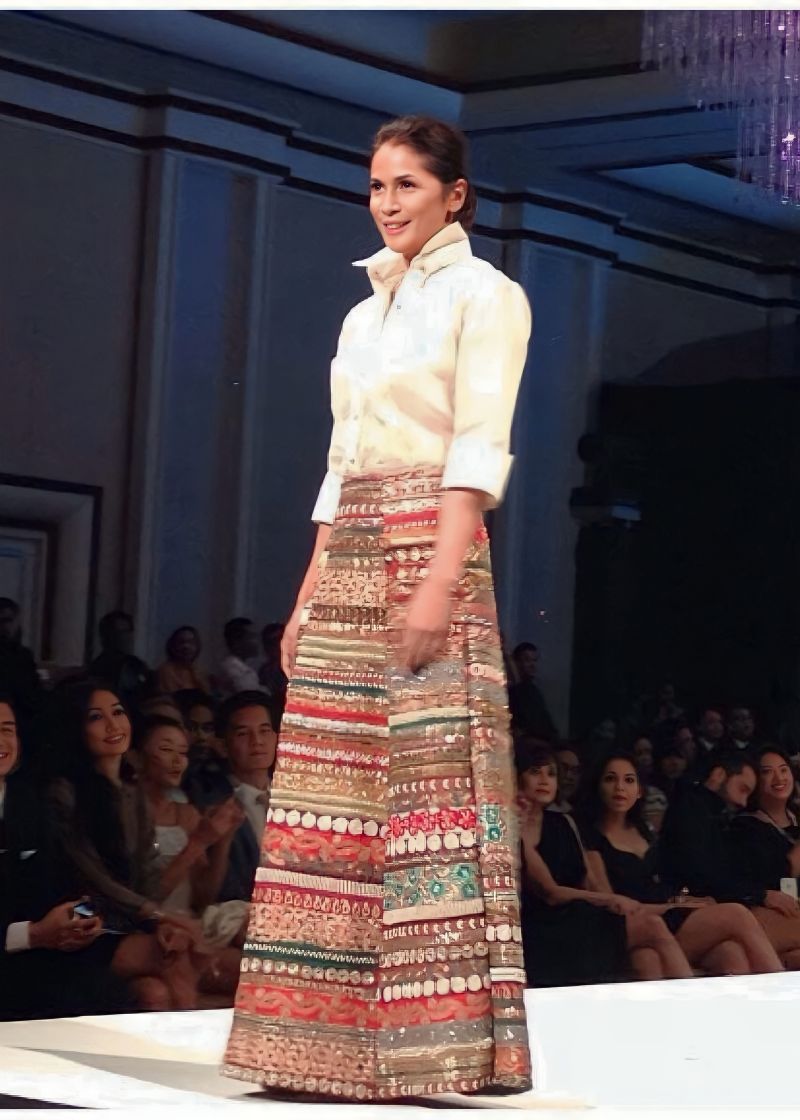
Agot Isidro in ‘barong’ top and fully beaded patchwork skirt by JC Buendia
The experience has made him more conscious of time. In more than three decades in fashion, Buendia has dressed a prominent clientele, from then President Noynoy Aquino, his sister Kris Aquino, actors-turned-politicians Vilma Santos-Recto and Cesar Montano, to actresses Maricel Soriano and Agot Isidro.
One of the biggest shifts in his career came in 2018, when he became one of the mentors of the inaugural TernoCon, a fashion competition created to promote contemporary interpretations of the Philippine terno.
The finalists and mentors presented their collections at the Cultural Center of the Philippines (CCP) Main Theater, with the makeshift runway built on the orchestra seating and the audience seated onstage.
Buendia thought about how his collection would stand alongside those of fellow mentors Cary Santiago, known for fabric manipulation, and Len Cabili, whose work highlights indigenous embroidery and beadwork from partner communities.
Then he remembered an old photograph of his great-grandmother wearing a traje de mestiza, with its blouse, long loose butterfly sleeves, pañuelo, skirt, and tapis.
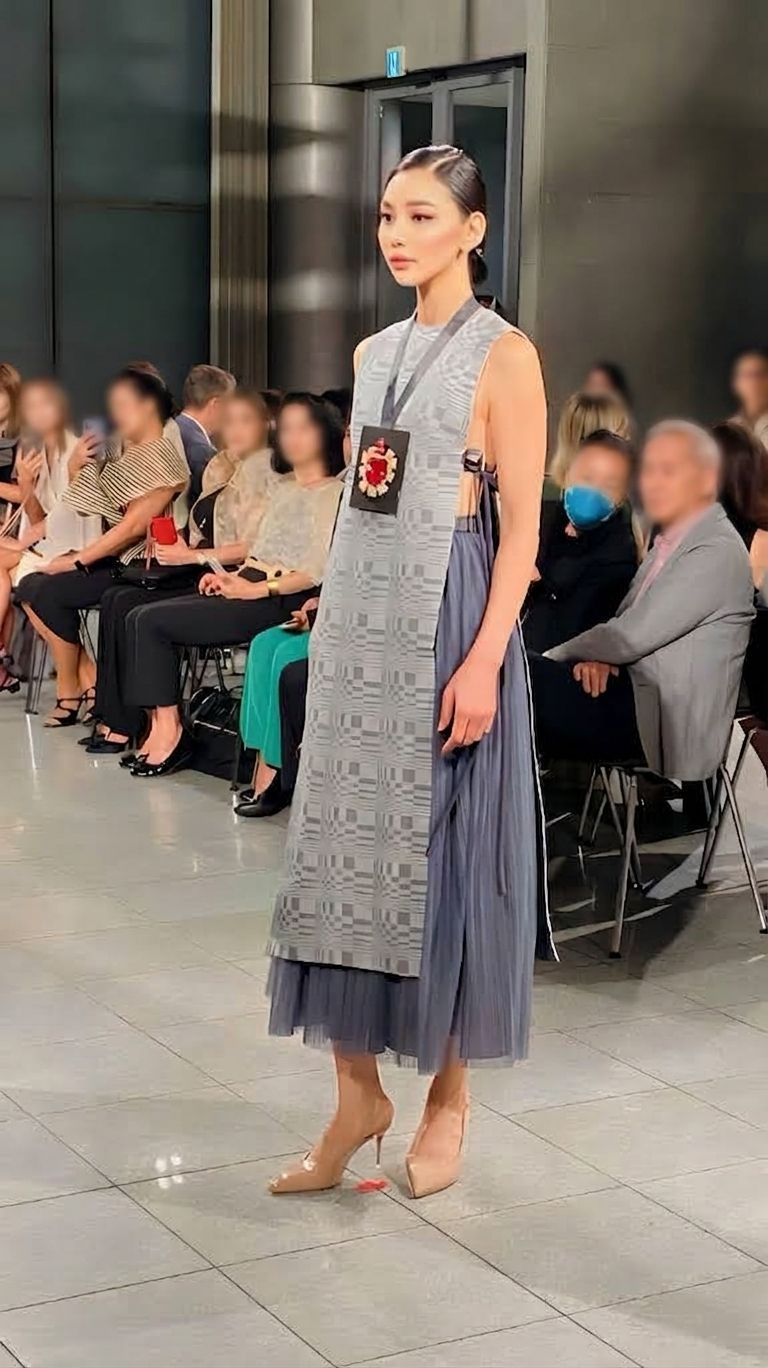
‘Inabel’ bib worn over pleated tulle skirt by JC Buendia for Tokyo Fashion Week 2023
He took the familiar silhouette and reduced it to a cropped terno top with smaller butterfly sleeves and a mid-calf skirt. To represent Luzon, he worked with inabel, piña, and luxury fabrics.
The Buendia collection proved to be pivotal point in Philippine fashion—it helped change the way people viewed the terno. Gino Gonzales, TernoCon’s project director, says Buendia started a trend. Before TernoCon, he says, people largely associated ternos with inaugural gowns.
“Irene Marcos approached me and said, ‘That’s what we need.’ She said, ‘It’s for everyday use,’” Buendia recalls.
There was another reason his terno sleeves worked differently and exceptionally. Buendia had inherited the sleeve mold of the late designer Joe Salazar. Months before Salazar died of throat cancer in 2004, Buendia had worked with him. Salazar had made ternos for First Ladies Imelda Marcos and Loi Ejercito and for President Gloria Macapagal-Arroyo.
There was another reason Buendia’s ‘terno’ sleeves worked exceptionally. He had inherited the sleeve mold of the late designer Joe Salazar
Buendia was assigned to make Arroyo’s terno for her 2003 state visit to Washington DC. She wore his deep magenta terno with a chartreuse sash to the White House state dinner hosted by then President George W. Bush. After Salazar’s death, his longtime assistant Nora brought the sleeve mold to Buendia.
“Forty days after Salazar’s demise, Nora, the girl Friday, and his angels came to me. And they said, ‘Sir requested that this be given to you.’ So, I was able to use Joe Salazar’s mold for my ternos.” The mold gave the sleeve enough space for the arm, allowing women to move more freely. “My clients really noticed the difference, because with the mold, they could move their arms. It’s not clipped, because there’s space for the arm.”
The smaller sleeves Buendia introduced in TernoCon were based on the pattern he had developed for Arroyo. “That TernoCon gave me a second wind in fashion. Before that, I was happily doing godmother clothes,” he says.
Then the pandemic happened, and the terno became a way for him to keep working. With weddings and social events canceled, Buendia made terno tops that clients could wear for Zoom meetings.
Now he is deliberately stepping away from the terno for the Red Charity Gala. “Clients might think that is the only thing I could do. I want to show my range,” he says.
After the lockdowns, his mother’s death, and his cancer treatment, Buendia says he takes life one day at a time. His mother’s ashes are inurned in their parish columbarium. “I visit her almost every other day, whenever I hear Mass, I get to visit her,” he says.
At 61, he feels it is time to give back. He teaches fashion and color theory at Joji Lloren’s FAB Creatives.
“I also learn from the young designers, from their way of thinking. More than the learning theories and techniques, they like hearing my stories about me as a young designer,” he says.


