
This September, the De La Salle–College of Saint Benilde’s Hub of Innovation for Inclusion (HiFi) holds REVERIUM 2025: Designing a Creative Economy, a month-long celebration of creativity, innovation, and collaboration to mark the Philippine Creative Industries Month. This will be at Benilde HiFi, Peter D. Garrucho Jr. Innovations Institute, Sept. 11–25, 2025.
Its goal is to explore how the creatives sector can move beyond showcasing creative talent into building systems, enterprises, and ecosystems that sustain creative enterprise.
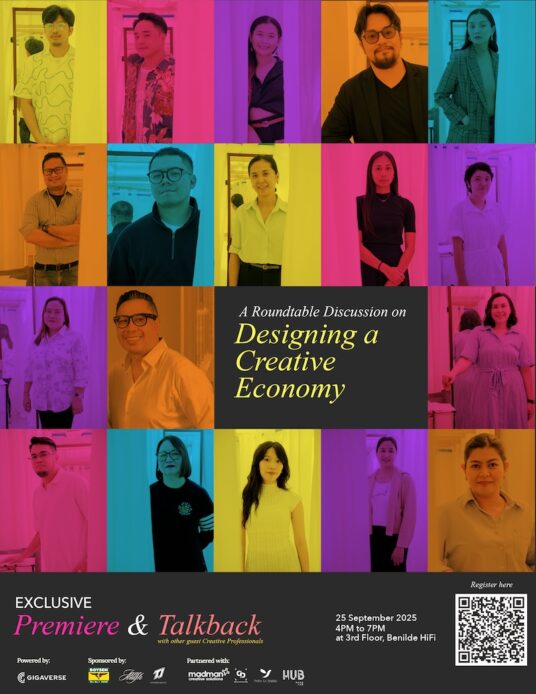
The celebration dovetails a roundtable discussion held August 28 by Benilde Hi-Fi among prominent figures in the Philippine creative industry. They discussed the theme Designing a Creative Economy. The experts came from a wide encompassing field: publishing, fashion, visual arts, performing arts, music, esports, and intellectual property management.
In a free exchange, the participants shared their insights, experiences, prognoses of the industry’s current landscape and its trajectory.
The sessions revealed a collective sense of cautious optimism about the creative economy as an emerging force of innate talent but hampered by infrastructural gaps and uneven access.
The dialogue revealed a community deeply interconnected through past collaborations and shared networks, highlighting how informal ties often pave the way for professional synergies. The group noted the impact of inspiration arising from everyday unpredictability, fueling innovation across disciplines.
Today’s emerging talents enjoy vast opportunities, the group acknowledged, given the proliferation of digital and physical platforms, expressing concern with saturation. One of the speakers, Eric de la Cruz, said that the abundance of outlets, while democratizing access, results in a cluttered environment where genuine expression is challenged by pressures created by algorithms and superficial trends. Such saturated environment can dilute artistic integrity.
The Philippine creative industry has enjoyed significant strides, thanks to recent legislative frameworks that recognize creative work as economic driver.
However, this initial progress, according to participant Thelma San Juan, is overshadowed by deficiencies in support systems—unlike in countries like South Korea which have been wielding the so-called soft power. The absence of robust infrastructure, from funding mechanisms to distribution networks, leaves many sectors, including music and visual arts, suffering from underinvestment and exploitation.
Another roundtable participant, Atty. Janice Tejano, focused on how intellectual property rights have emerged as a critical safeguard. The discussions emphasized the need for greater awareness and institutional policies to protect creators, particularly in educational settings where student innovations often go unsecured.
Personal narratives brought to light the varied pathways into the industry—early passions nurtured through mentorship, internships, and extracurricular involvement. These stories bared a common thread: the transition from hobbyist pursuits to professional careers demands not only skill but also resilience against skepticism (for instance, of family) and market barriers.
Fashion and performing arts professionals, led by Eric de la Cruz and Tal De Guzman, stressed the value of hands-on experiences like workshops and incubators, which bridge academic training with real-world application. Educators in the roundtable discussion stressed the challenge of guiding graduates toward sustainable livelihoods amid limited job pipelines.
Looking forward, the roundtable analyzed the Philippines’ potential to forge a resilient creative economy within the next decade, recognizing talent as an abundant “natural resource” that requires strategic cultivation.
According to Pauline Juan and Dexter Ding, the key to this is integrating business acumen with artistic vision, to be able to shift from supportive roles to global leadership.
Inclusivity was deemed essential, particularly the equitable representation across urban-rural divides, genders, and marginalized groups, to enrich diversity and broaden market appeal.
Hubs like Benilde Hi-Fi were praised by Jodinand Aguillon and Micah Pinto for their role in fostering long-term sustainability. They also pointed to broader needs: policy reforms, cross-sector collaborations, and scale-ready models to ensure that the economy not only grows but also endures, ultimately to transform cultural output into a cornerstone of national development.
The public can join this vital conversation at the premiere showing of the roundtable discussion on Sept. 25, 2025, hosted by Benilde HiFi. Attendees can register to exclusively watch the session and participate in a talkback with other creative professionals and audience members, to continue this dialogue on the future of the creative industries in the Philippines.
The public can follow Benilde HiFi to check their other activations and flagship talks. This event promises to deepen the exploration of how entrepreneurship, innovation, and inclusivity can shape a sustainable creative economy, to help Filipino creators thrive on both local and global stages.
What to expect this month:
HiFi Unveiled (Sept. 16, Benilde HiFi, 4-7pm)—A showcase of trailblazers and the story behind HiFi’s journey, with the mural unveiling, startups’ exhibit, and incubation agreement signing.
Creative Talks—Engaging sessions with artists, innovators, and industry leaders: ▸ Sept. 13— Localized Access to Support (Benilde HiFi)
▸ Sept. 18—Capstone to Business (DAC Theatre)
▸ Sept. 25—Designing the Creative Economy, Premiere & Talkback (Benilde HiFi)Maker’s Market (Sept 15-25, Benilde HiFi)—A lively showcase of student projects, startups, and local makers.
Mavericks’ Night (Sept 25, Benilde HiFi) – A finale of live music, performances, and creative showcases.
The future of our creative economy is a collective story. By participating, you’ll:
✔ Connect with fellow creatives and innovators
✔ Gain insights from experts and leaders
✔ Celebrate the incredible talent that makes the Philippines a hub of imagination and impact
This celebration is free and open to all — students, alumni, faculty, and even non-Benildeans. Admission is free, but slots are limited.


