
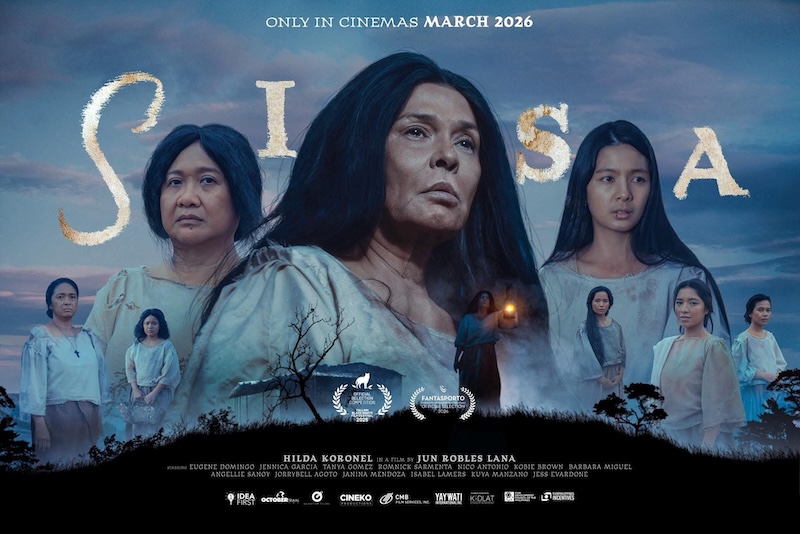
Sisa is still running in major cinemas.
There are two women whom Jun Robles Lana’s new film, Sisa, uses as symbols to evoke the Philippines’ cyclical history of violence and resistance. One is, of course, José Rizal’s madwoman character from Noli Me Tángere—Sisa being the ever-relevant representation of society’s most underprivileged enduring the greatest suffering. But there is also Hilda Koronel herself, as both star and conduit for Philippine cinema’s tradition of righteously furious social realist films. Appearing in a string of classics (most notably, in Lino Brocka’s Tinimbang Ka Ngunit Kulang, Maynila sa mga Kuko ng Liwanag, and Insiang), she has become synonymous with the Second Golden Age of Philippine cinema and its fearlessness in the face of the Marcos dictatorship.
Lana understands Koronel’s power. And through her, he assembles a stunning parade of images—expressive, potent, and tapping into a collective Filipino cinematic memory. But at the same time, with its intense focus on evoking this iconography, Sisa has difficulty housing its themes within a narrative about life in a reconcentrado under American military occupation. Its story is a collection of rousing ideas that nevertheless end up scattered.
So much of Sisa is about the presentation of its world. This corner of the Philippines in 1902 is one of vibrantly painted skies and shadowy contrast, with Lana and cinematographer Carlo Mendoza framing the drama in Dutch angles, shifting aspect ratios, and stylized camera movements. Something is inherently askew; even the surrounding wasteland is marked by unmoving American soldiers exerting their authority over stolen land.
These choices (with a horror-tinged score by Teresa Barrozo) bring the film out from the realm of pure historical fact and into something closer to allegory. When Lana replicates shots from classic cinema—eyes framed in a rectangle of light, or half of Koronel’s face sliding into a shot—we see the violence inflicted on these characters as a familiar, recurring event for every generation of Filipino.
As Koronel’s character (nameless except for the titular moniker given to her by the women around her) hears whispers of rebellion brewing in neighboring towns, Lawrence Ang’s editing keeps us within her limited point of view. This means that the film’s idea of reconcentrado life doesn’t really get the chance to feel fully realized, but it also deliberately keeps us at a distance from Sisa’s inner thoughts, and keeps her just out of reach of understanding the bigger picture. Ang emphasizes that partial information is all that people can rely on sometimes before the fires of change must be ignited.
In a way, the freedom and playfulness of Lana’s direction also seems to be his conscious effort to buck any overly polite ways of viewing our history. The film totally rejects the notion of the Americans giving us anything we didn’t already have, and refuses to give them the dignity of proper characterization—so much so that, unfortunately, the actors playing these soldiers ring surprisingly amateurish. If parody or satire was the aim with these American characters, they come off disinterested rather than sinister.
The Filipina women in this cast, on the other hand, turn in strong individual performances, even when they don’t always seem to be on the same wavelength. As the women’s de facto leader Delia, Eugene Domingo buries her perpetual worry underneath a hardened exterior and a fierce maternal instinct. Jennica Garcia’s Leonor is all foolish hope and naivety that still elicits pathos because of how cruelly the possibility of salvation has been dangled before her by her American lover. Then there is Koronel, whose complete emotional restraint isn’t just a result of Sisa’s own pain but also a strategic maneuver—her “madness” becoming the perfect disguise. The longer we look into Koronel’s eyes, the more calculating Sisa becomes. And the more she gazes at the other characters, the more they’re shaken from their belief that everything will work out if they simply comply with the foreign invaders.
The characters often come across as mouthpieces for certain perspectives rather than people interacting in a dynamic, human way
Sisa has plenty of compelling ideas assembled on the board, and to the credit of Lana’s script, it manages to expand its conflict beyond colonization and finds a common thread of women constantly being marginalized even when there seems to be progress. But when the film comes to an end, it can’t help but feel as if these ideas haven’t led to much of a story. With dialogue frequently spelling out the film’s beliefs, the characters often come across as mouthpieces for certain perspectives rather than people interacting with each other in a dynamic, human way.
It’s admirable that Sisa doesn’t follow the beats of a typical narrative on screen, but for a film that’s all about lighting the spark of revolution, its conclusion doesn’t have the catharsis it seems to promise. Yes, there is something to be celebrated in helping one’s community understand the reasons for their oppression, but because the rest of the film doesn’t establish its characters and their circumstances beyond the broad strokes, it’s hard to see their ending as empowering.
This isn’t to say that our stories should steer clear of tragedy; in fact, the movies that made Koronel the legend she is today were also crushingly sad. It’s just that this story in particular lands somewhere in an awkward middle, confident in the boldness of its ideas but without allowing them to really drive its characters forward.


