
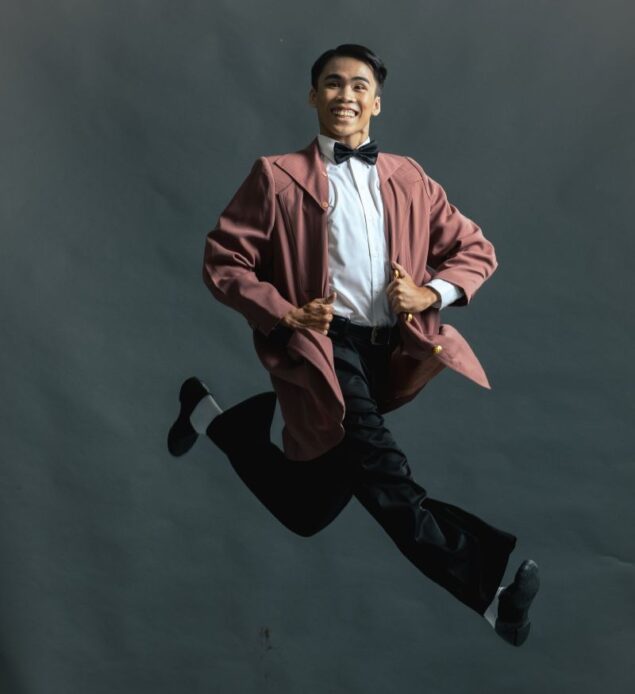
Kenkoy will be staged by Alice Reyes Dance Philippines Sept 18 to 20 and Sept 25-26, 2026 at Hyundai Hall, Areté, Ateneo de Manila.
At the Metropolitan Theater studio, dancers in 1940s-style clothes crisscross a narrow strip of floor to lively band music, skipping, kicking and throwing up their legs in a rush of high-energy movement. It looks almost chaotic until the traffic scene and Kenkoy emerge. Renzen Arboleda, in bright red top and aqua trousers, hams it up with angular arms, high knees and rubber-legged steps.
Upstage, Dan Dayo as Kenkoy’s sidekick Binong, in cream top and grayish trousers, jumps and lands seated, his legs bent at odd angles, then scoots towards Kenkoy. He then trails Kenkoy, reacting to every gesture.
Alice Reyes Dance Philippines has built its repertoire around a mix of neoclassical ballet, contemporary dance and classical modern, bringing together works by established choreographers and younger talents. ARDP’s upcoming concert pushes that range in a decidedly different direction.
On Sept. 18, 2026, at Hyundai Hall, Areté, ARDP will premiere Kenkoy, based on the iconic comic character created by illustrator Tony Velasquez and writer Romualdo Ramos. The work moves into a vaudeville-inspired world of high-energy steps, quirky movements and broad physical comedy.
Video mapping is integral to the production, giving the dance a cartoon-like quality and helping create its world from beginning to end.
Following the success of the children’s ballet, Mga Kuwento ni Juan Tamad, choreographed by Erl Sorilla, National Artist for Dance and company founder Alice Reyes forges another collaboration with Areté, the arts hub of Ateneo de Manila. Its artistic director, Dr. Jerry Respeto, suggested Kenkoy, the 97-year-old Filipino komiks character known for his misadventures and fascination with Americana.
ARDP artistic director Ronelson Yadao began his research on Kenkoy last year, in the National Historical Commission and libraries for source material. But because the comic strip debuted in 1929, he found little that could be readily accessed. He turned to online searches, which led him to Ian Velasquez, the grandnephew of Tony Velasquez. Ian had been working to keep his granduncle’s creation alive, and had been promoting Kenkoy for several years hoping that the legendary illustrator be recognized as worthy of the Order of the National Artist.
Yadao tracked Velasquez down at a Comic Con at Robinsons Galleria and pitched the idea for the production. He invited him to watch ARDP’s Kalayaan at Foro de Intramuros last June, giving him a sense of the company’s work. Impressed by the dancers and production, Velasquez agreed that the project would be in good hands.
The meeting opened up access to more material. Yadao was shown reprints of important Kenkoy strips and The Life and Art of Tony Velasquez, Father of Philippine Comics, a coffee-table book by Ian that helped him delve deeper into the character and his creator.
The story draws on bits and pieces of the original comics, focusing on the 1930s and 1940s, particularly Kenkoy’s trip to the United States and his being duped into performing in a circus.
Yadao worked with librettist Guelan Luarca and dramaturg Jerry Respeto to keep the story faithful to history while interpreting the intent behind Velasquez’s work.
Kenkoy begins with the scene of the funnyman, his inamorata Rosing—a modern idealization of Maria Clara, his rival Tony and his best friend Binong. Kenkoy’s wanderlust takes him and Binong to America, where they are dazzled by the carnival. An American woman pretends to be charmed by Kenkoy and invites him to Hollywood, only for him to discover that he has been set up as part of a circus act with monkeys.
The episode recalls the 1904 St. Louis World’s Fair, where Filipinos were exhibited as uncivilized natives. Kenkoy and Binong escape and return to the Philippines. Kenkoy is disappointed that adopting American clothes and ways has not spared him from Western prejudice. Rosing reminds him of his own worth.
Meanwhile the production traces Kenkoy’s legacy as an archetype of the Filipino comedian, with a visual nod to the slapstick tradition of performers such as Dolphy, Chiquito and Panchito.
Yadao’s choreography for Kenkoy has the broad physicality of vaudeville and the flair of an old Hollywood musical. Set in the 1930s, the piece draws on the big-band jazz sound of the 1930s and 1940s, with music by Krina Cayabyab.
Its movement also recalls the Hollywood numbers of Fred Astaire and Gene Kelly that influenced Filipino musicals in the 1950s.
Yadao translates the comic-strip personalities into movement through exaggerated gestures, wacky poses and quick reactions. Eye contact is crucial as the dancers constantly watch and respond to one another, turning their exchanges into physical dialogue. A gesture or reaction can carry the story as effectively as a spoken line or, in the comics, a speech balloon.
The choreography mixes social dance, jazz, theatrical movement and occasional ballet passages that show off the dancers’ classical training. The vaudevillian quality comes through in the broad gestures, rubber legs and comic timing, a vocabulary well suited to Kenkoy, where personality and interaction drive the action.
The rest of the repertoire shows the wide and deep range of ARDP. The program opens with these:
Holberg Suite
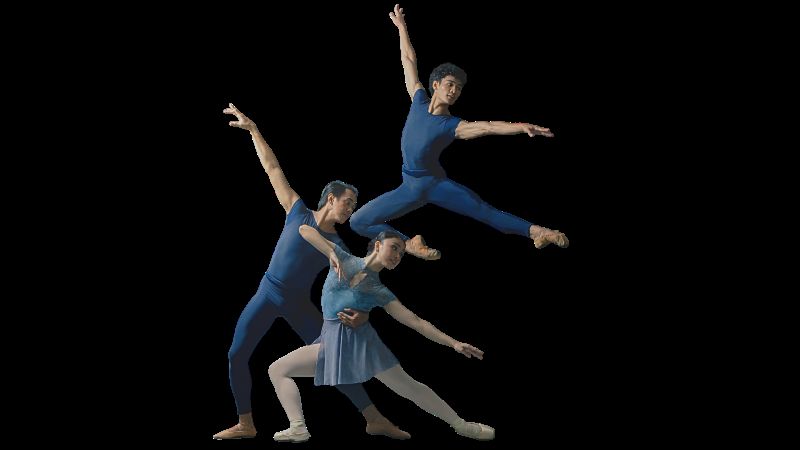
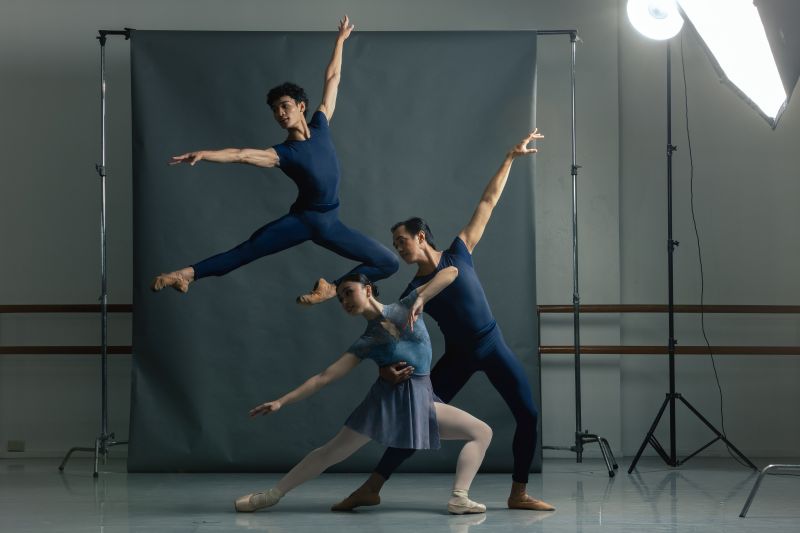
Adam Sage’s Holberg Suite, set to Edvard Grieg, uses a bright, buoyant classical score with a clear pulse and strong melodic line. Its light orchestral texture gives the abstract choreography a steady framework. The work is firmly rooted in classical ballet, with traditional positions, turns and traveling jumps, while the dancers move through connected phrases, diagonals and changes of direction. The larger jumps bring an athletic edge, while softer passages reveal its lyrical side. The dancers’ different positions and levels also give the ensemble depth.
Lester Reguindin’s Somewhere, by contrast, is grounded in contemporary movement. Set to Max Richter’s reinterpretation of Vivaldi’s Summer, it moves to a driving mix of percussion, bass and electronic sounds. The dancers work against the insistent pulse, stretching phrases and delaying movements to build tension. Off-balance tilts, sweeping arms, rolls and floorwork repeatedly take them from standing to the ground and back. Ballet lines surface in long extensions, balances and arabesques, only to be broken apart.
The lone solo, Norman Walker’s Soliloquy, is a showcase of virtuosity. Originally choreographed for Conrad Dy Liacco in the ’90s to highlight his dynamic jumps, the revival will be performed by Dan Dayo, with jumps landing in splits and kneeling positions and demanding floorwork. The piece draws on the powerful, grounded movement associated with Martha Graham, including sharp contractions and weighted use of the floor.
Now on its sixth year, ARDP continues to produce great works even without a permanent studio, planning each season around available funds and stage availability. Many of its pioneering staff and dancers have moved on to better opportunities, while others have stayed because they believe in ARDP.
The company began during the pandemic as the Professional Dance Support Program of the Cultural Center of the Philippines, providing projects and teaching jobs to dancers displaced by the lockdowns. It became Alice Reyes Dance Philippines in August 2022 and continues to operate under the CCP’s arts education program. Its staff remains lean, with everyone taking on multiple roles.
ARDP survives through sponsorships, including support from board chairman Greg Banzon through Century Tuna and Birch Tree, as well as CCP projects, local government units and companies. It also depends on what the company calls its “angels,” who step in when needed.
For a company carrying the name and legacy of Alice Reyes, every sponsor, partner and individual supporter helps keep the dancers working and the productions onstage. Without that support, some of these seasons simply would not happen.
Kenkoy will be shown Sept 18 to 20 and Sept 25-26 at Hyundai Hall, Areté, Ateneo de Manila.


