
Most of these books came to me as gifts. I somehow feel that I owe it to the giver to give their selection the respect and enthusiasm they deserve. Since it will be Book Lovers Day on August 9, this list also serves as a recommendation, that is, if you can find any of them, as they are only available in selected bookstores, directly from the publishers, or from online sellers.
Mga Bulawan nga Bulak, translated as Golden Showers and published by Pawikan Press in Davao City, is John Iremil Teodoro’s collection of poems about Thailand where he received the Southeast Asian (SEA) Write Award in 2019. Also known by his pen name Panay Sirena, Teodoro was once a visiting scholar of the Mahidol University in Salaya, Thailand.
This slender book of 98 pages is rendered in three languages (hurray for diverse, rich, multi-lingual Philippines): Kiniray-a, Filipino, and English. Poet-travel writer Alice M. Sun Cua acted as translator, a task she undertook because “Teodoro’s poems are always a joy to translate…Couched in deceptively simple language that mirrors the child-like wonder of the persona, the words hold deeper meanings that can only be understood by slow and mindful reading.”
The golden showers referred to in the title are the blossoms of the Thai ratchaphruek tree. They are mentioned in the poem Wisdom, and as the translator earlier said, Teordoro’s language is as deceptively simple as him taking a walk, seeing the fallen flowers on the ground and arriving at the conclusion that: “Golden is the color of fire / that lights up the love / of the fruits of the imagination / that shall sate the soul / of many more generations.”
It’s a trick, for want of a better term—perhaps a discipline is more apt—that the poet has mastered, taking an everyday occurrence, then finding something more profound as he moves to the later stanzas. Somehow it brings memories of college-era discussions of the W.H. Auden poem Musee des Beaux Arts, where the narrator reflects on the nature of suffering.
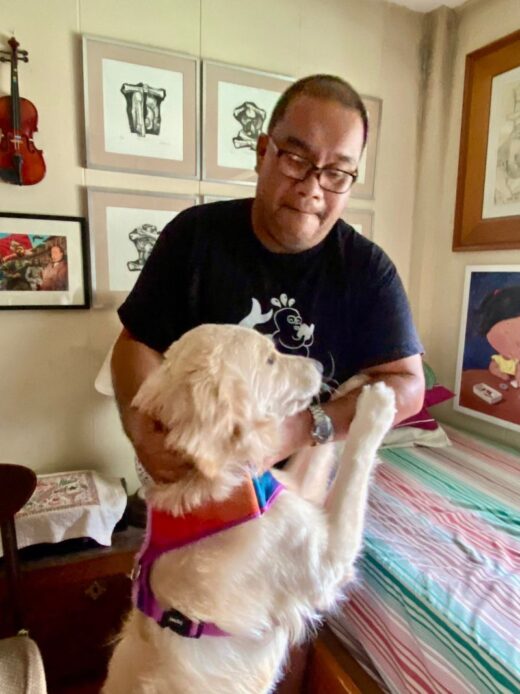
In April this summer, Teodoro visited our home, but before he arrived, I asked if I could buy another copy of Mga Bulawan nga Bulak, since my dog Yoshi, who never got over his teething stage, got hold of the original and tore it to shreds. The poet was kind enough to replace it. Mortified me tried to make it up by cooking a filling lunch.
Later, he went up to our library to meet Yoshi, who welcomed him with the enthusiasm of a long-lost friend. Later, when he had left, Teodoro posted this poem about that meeting in his Facebook account.
ANG ASONG KUMAKAIN NG TULA
(Para kay Yoshi ni Babeth Lolarga)
Sa isang bahay sa Baguio
na punô ng mga libro at likhang-sining,
may isang malaking aso
na kinain ang libro ko ng mga tula
tungkol sa mga bulawang bulaklak.
Inamoy niya ang pabalat,
dinilaan ang mga pahina,
at ginutay-gutay ng kaniyang
mga pangil saka kinain
ang mga salita.
Sabi ko sa may-ari,
huwag na niyang pagalitan.
Masisisi ba siya namin
kung sarap na sarap siya
sa aking mga tula?
Binisita ko ang asong ito kanina.
Talon siya nang talon
at yakap nang yakap sa akin
na para bang matagal na matagal
na kaming magkaibigan.
Pero tingnan ninyo ang mga itim
na pigura ni Ang Kiukok sa dingding.
Sa isang bahagi may mga babae
ni Onib Olmedo. At sa pasilyo
may mga kuwadro ni Neil Doloricon.
Sa dalawang dingding
lumulundo ang mga estante sa Filipiniana.
Sinong aso ang hindi kakain ng tula
kung sa silid na iyon nakatira?
Benitez Legacies: Art, Culture, Education, Governance, and Business—Stories of Five Generations (Erehwon Artworld Corporation) features the somber portrait by Simon de la Rosa Flores of patriarch Higinio Ortega Benitez on the cover, a sight that made one think of the university yearbooks from a vanished era.
But this was Judge Benitez, after all, and even though his father’s origin was unclear, on whether or not he originated from the Philippines or Spain, Higinio made good despite being orphaned early. He rose to become a lawyer and later a delegate that helped draft the 1899 Malolos Constitution, the first Constitution of the Philippine Republic.
In this book, the living members of the prominent Benitez family tell their stories to writers Amanda dela Cruz, Cynthia Alberto Diaz, Portia Placino, Regina Samson, and Chuck Smith. The rest of the family’s history, especially from the first to the third generations, was culled and put together using references from the Philippine Women’s University Library and the MiraNila Heritage House and Library and from interviews of surviving relatives, friends, and colleagues.
It was Higinio’s example that his descendants have tried to emulate, with some surpassing him. But, as Jose “Butch” Y. Dalisay Jr. wrote in his foreword, “No family is ever perfect, and there will surely be dissents and demurrers over the role of this and that Benitez in particular junctures of our political and social history.”
The Benitezes, however, whose names rang a bell in my youth and childhood were Sen. Helena Benitez and noontime TV show co-host Leila Benitez of Student Canteen. Writer Placino noted that Helena’s life may have seemed idyllic, but she “lived through the American colonization, Japanese occupation, Martial Law years, EDSA revolution, restoration of democracy, and the fast-paced life of the present…(S)he kept on going, pragmatically working for education, legislation, women’s rights, art and cultural development, and environmental protection.” She lived to the ripe old age of 102.
Helena Benitez’s life may have seemed idyllic, but she ‘lived through the American colonization, Japanese occupation, Martial Law years, EDSA revolution, restoration of democracy…’
Leila’s “looks, her finishing school manners, and her American diction” turned her into a popular radio, then TV host. The book chronicled how she, Eddie Ilarde, and Bobby Ledesma walked out of their show after a dispute with production people. Although ABS-CBN, through Pete Roa, replaced them with other talents, it wasn’t quite the same again.
I remember how starstruck I was while my teenaged siblings, cousins, and I were hanging out after a movie at Leila’s, the first coffee shop adjacent to the Rizal Theater at the Makati Commercial Center. In came Ms. Leila, made up, coiffed and wearing the friendliest smile, checking in on her customers if we were enjoying the food.
There are other profiles of family members who all made good as they carved their pathways to success. For many of them, it wasn’t just the Benitez name that ensured their place in society. They worked especially hard, too. Some even shared their setbacks along the way. This is the book’s value—not so much the recitation of positions attained, awards, and distinctions, but also the hurdling of struggles to be worthy of leaving a legacy.
You Won’t See Me: When the Beatles Ghosted Imelda (Penguin Books) is author David Guerrero’s well-researched account of that memorable blip in the Beatles’ history—when they visited the Philippines in 1966 at the height of their fame, and how they left the Manila International Airport after two performances in one day, swearing never to play or sing to a live audience again after they were roughhoused by Filipino goons with loyalties to the new First Family (Marcos Sr. just won his first term of office in ’65).
The headlines of newspapers after the group’s twin shows read: IMELDA STOOD UP: FIRST FAMILY WAITS IN VAIN FOR MOPHEADS; FUROR OVER BEATLES SNUB DAMPENS SHOW; BEATLES SNUB PRESIDENT.
The snub referred to was Mrs. Marcos’ invitation to the Fab Four to have lunch with her family, including staff, relatives, friends, and their children, at Malacañang, and play a few songs for them afterwards. The band was a no-show. There was a communication glitch, with parties at both ends fault-finding on who did or didn’t pass on the official invite.
Guerrero wrote of this juncture in pop music history: “For the Beatles, the 48 hours they spent in the Philippines represented a moment for them at a critical turning point in their story: a before-and-after kind of episode, which took them from cheeky mop tops with screaming teenage fans to counter-culture visionaries making some of the most inventive pop music every written. It also marked the midpoint in their musical career as a band, if also the end point of their touring days.”
The book also follows obsessed fans who stalked the Beatles who were billeted at The Manila Hotel. There is a chapter on how a group of teenage girls managed to slip into the band’s room after Paul McCartney let them in so long as they went two by two. There they found George Harrison listening to sitar music on a reel-to-reel tape recorder.
At this point, I thought that I would’ve risked the same thing as these fans did. Or, as fan Betty Ponce said, “Pwede na akong mamatay (I can die now). I’ve been in the same room as the Beatles.” Sixty years after, she lived to tell the tale.


