
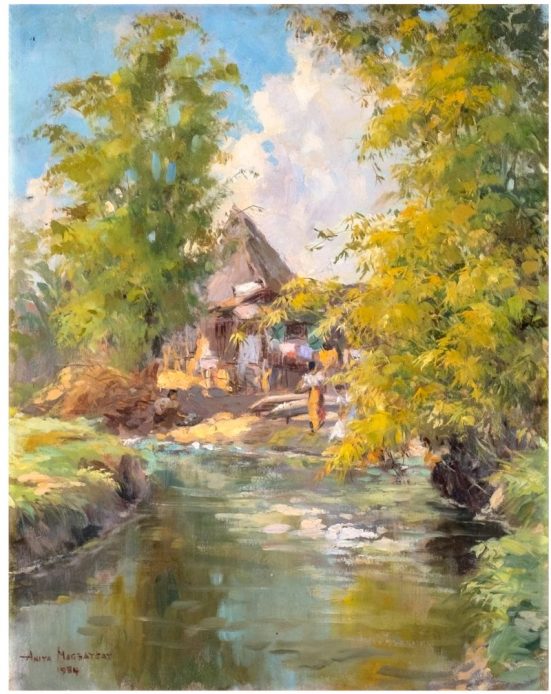
The 1934 masterpiece, Lavanderas by the Stream, considered to be the earliest known painting of “The Queen of Philippine Auctions” Anita Magsaysay-Ho, will be the stellar feature of Leon Gallery’s year-end The Kingly Treasures Auction 2024 on Nov. 30, 2024 at 2 p.m.
The masterpiece was deeply influenced by her former professor and the “Grand Old Man of Philippine Art” Fernando Amorsolo.
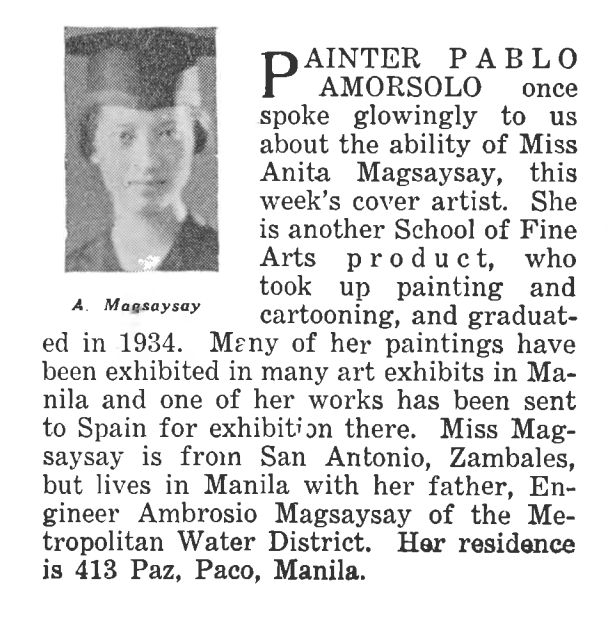
A clipping from the March 5, 1936 issue of the Graphic, the leading weekly English magazine in pre-war Philippines, showing a photo of a young Anita wearing her graduation toga in 1934.
On Sept. 21, 1958, the era’s popular magazine This Week released its selection of “Six Outstanding Filipino Painters,” chosen by a panel of judges from the arts. Anita Magsaysay-Ho was the only woman who made it to the highly publicized list. What earned her the spot? Her depiction of women in their glorious delight, which has been always evident in her works since the beginning of her career.
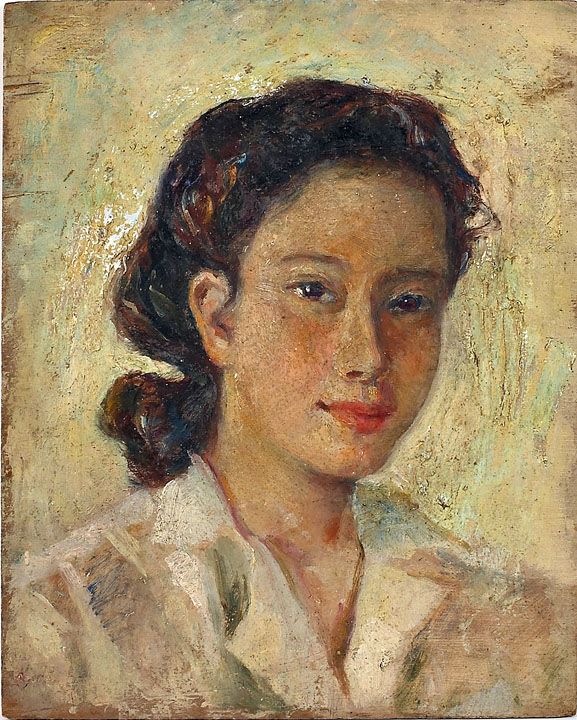
Anita’s self-portrait in her twenties/thirties
As a fitting culmination to the celebration of Anita’s 110th birth anniversary and the recognition of her maiden participation in the recent 60th Venice Biennale—through her 1944 Self-Portrait—the earliest known work by the revered modernist has been repatriated to the Philippines. In it, Anita’s now iconic women make their grand debut in an idyllic piece highly influenced by her esteemed professor, Fernando Amorsolo.
Lavanderas by the Stream is a rarity. Every monograph written about Anita has started the chronological presentation of her works in the 1940s, missing a gap—her earliest works from the 1930s. This work fills in that gap, a veritable window into her conservative beginnings before she evolved into a pioneering Filipina modernist.
When Anita created this work, she was in the final year of her studies at the UP School of Fine Arts. Students in their fourth year were required to take up the course “Advanced Landscape Painting,” conducted by Amorsolo. According to the 1932-33 General Catalogue of the University of the Philippines, classes in this course were conducted in the nearby open localities selected by the professor.
Anita wrote in her memoirs published in 2000 that Amorsolo sent off his students to different locations around the School of Fine Arts environs to paint there on the spot.
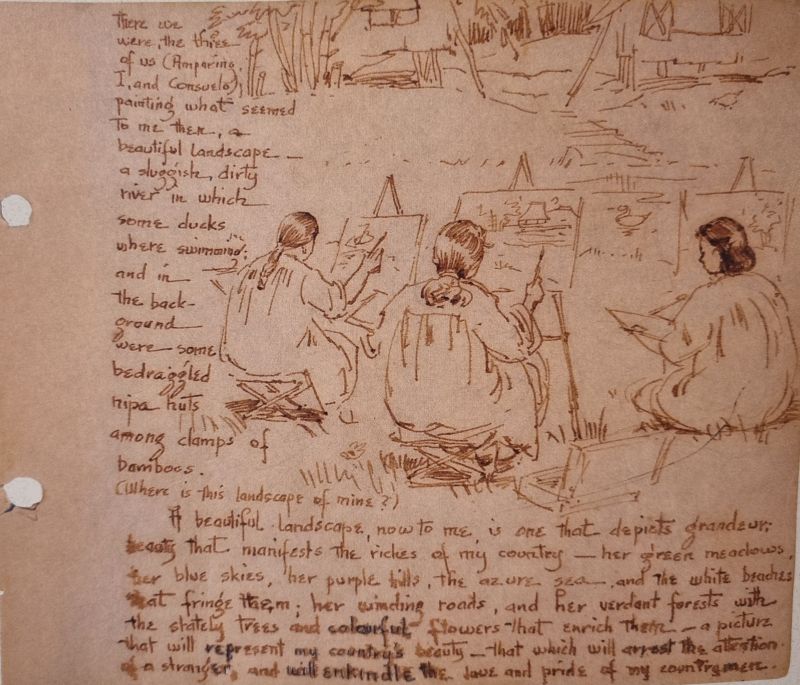
A page from Anita’s old diary depicting her with friends/ UP classmates Amparing and Consuelo painting in an idyllic locale, the scenery which most likely inspired the setting of Lavanderas by the Stream.
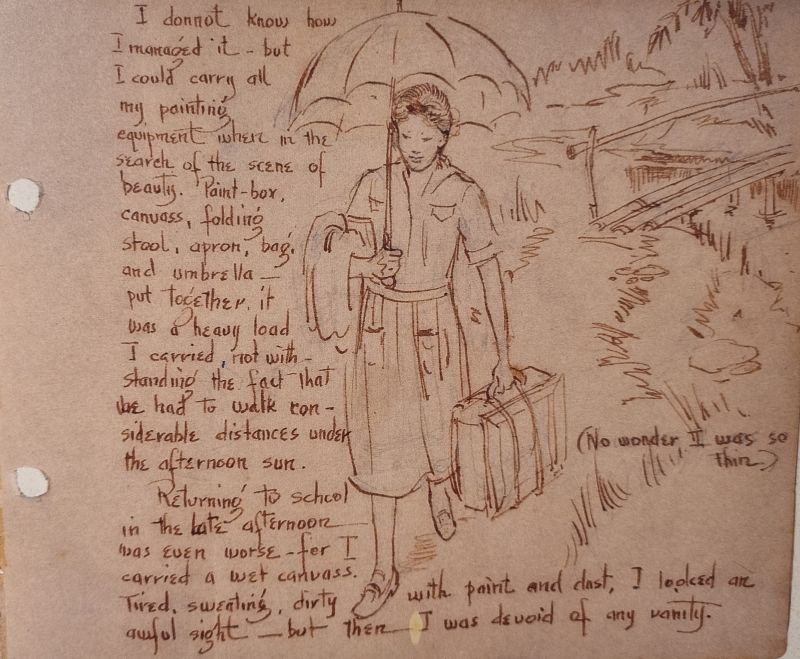
Anita’s sketch of herself walking to the UP School of Fine Arts while carrying all her painting equipment; Amorsolo would assign his students to go to various places in the environs of the UP School of Fine Arts to paint landscapes.
Anita depicts in Lavanderas by the Stream—painted en plein air—a scene in rural Malate, particularly the vicinity of nearby De La Salle College, a less than 2-km walk from the School of Fine Arts and “at the time was still a rural area,” she recalled. Anita wrote in her old diary about a moment when she and her classmates/friends, Amparing and Consuelo, painted “a beautiful landscape” with “some bedraggled nipa huts among clamps of bamboos” in the background. That diary entry is accompanied by Anita’s sketch reminiscing about that moment, a drawing of a scenery similar to Lavanderas by the Stream. Its setting is related to an anecdote in Anita’s 2000 memoirs, where she told of the time she waited for Professor Amorsolo in the vicinity of La Salle to come and critique a painting she did of the locale.
‘When my two friends and I painted in a vacant lot in front of the La Salle College, the place was still rural…. This time, Professor Amorsolo never showed up. When I think of it now, how could dear Professor Amorsolo have managed?’
Anita recalled in her memoirs: “He taught landscapes during the day and drawing at night. For a living, he painted portraits and landscapes for his patrons. When my two friends and I painted in a vacant lot in front of the La Salle College, the place was still rural, marked by a typical nipa house among trees. To keep myself amused, I added chickens, then a monkey. This time, Professor Amorsolo never showed up. When I think of it now, how could dear Professor Amorsolo have managed? His students were sent to paint landscapes all over the city—some in the ruins of Intramuros and other places.”
One can also imagine in Lavanderas by the Stream how Anita enthusiastically painted this piece, all the while waiting for Amorsolo to assess her progress. Amorsolo’s influence can be heavily discerned, especially when viewed in the context of his plein-air landscapes. There are human figures outlined in colors and candid impastos; the short and swift strokes that seemingly pulsate and breathe life into the composition; and the contrast of areas of light and shadow achieved through the manipulation of texture and tones. Of course, there are the lavanderas—a favorite of Amorsolo and the theme of humans living in harmony with nature.
“During our time, I would think Amorsolo was the most influential,” she told Cid Reyes in an October 1984 interview in the landmark book Conversations on Philippine Art. “We all used to paint like him. We had no basis…of what good art really was…We had no museum at all. Since Amorsolo was our teacher, and his paintings were so beautiful, we all painted like him.”
Anita also learned from Amorsolo the practice of priming the canvas with gray paint, resulting in a pastel-like quality that complements the luminosity of oil paint. “All of us painted our canvases in grey,” Anita said to Reyes. Furthermore, Anita learned the value inherent in total commitment and perseverance to one’s art, the source of an artist’s living and breathing.
Even as a modernist, the “Amorsolo effect” was still apparent in the way Anita depicted her women as delightful and serene in their labor, emphasizing the dignity inherent—and that should be endowed—to the most precious of all endeavors. This is much like Amorsolo, who blessed his dalaga with all the world’s exuberance.
With the sheer warmness of its tones, the composition of Lavanderas by the Stream naturally exudes the vitality of living.
While she eventually forged her formidable path to modernism, Anita never renounced her conservative upbringing. “She staunchly believes that one can learn true art only by studying the basic principles set down by the classicists,” writes an article in The Sunday Times Magazine following her historic win at the 1952 AAP.” For Anita, a good painting is a good painting, whether conservative or modern.
Anita would say in an interview seven decades later, in May 2005: “In my works, I always celebrate the women of the Philippines. I regard them with deep admiration, and they continue to inspire me—their movements and gestures, their expressions of happiness and frustrations; their diligence and shortcomings; their joy of living. I know very well the strength, hard work, and quiet dignity of Philippine women, for after all, I am one of them.”
Here in this work is presented—for the very first time in Anita’s canvas—the peasant and rural women whom Anita exalted, and who would also put her at the forefront of Philippine post-war painting, perfectly materialized in her historic First Prize win at the 5th AAP Annual in 1952 for her now iconic The Cooks.
Reprinted from the catalogue of The Kingly Treasures Auction.
The auction is on Nov. 30, 2024, 2 PM, at Eurovilla 1, Rufino corner Legazpi Streets, Legazpi Village, Makati City. Preview week is from November 23 to November 29, 2024, from 9 AM to 7 PM. For further inquiries, email info@leon-gallery.com or contact +632 8856-27-81. To browse the catalog, visit www.leon-gallery.com.
Follow León Gallery on their social media pages for timely updates: Facebook – www.facebook.com/leongallerymakati and Instagram @leongallerymakati.


