
León Gallery’s The Spectacular Mid-Year Auction 2026 will be held on June 13, 2026, Saturday, at 2 pm. The preview exhibit runs June 6 to 12, 9 am to 7 pm, at G/F Eurovilla 1, Rufino corner Legazpi Streets, Legazpi Village, Makati City.
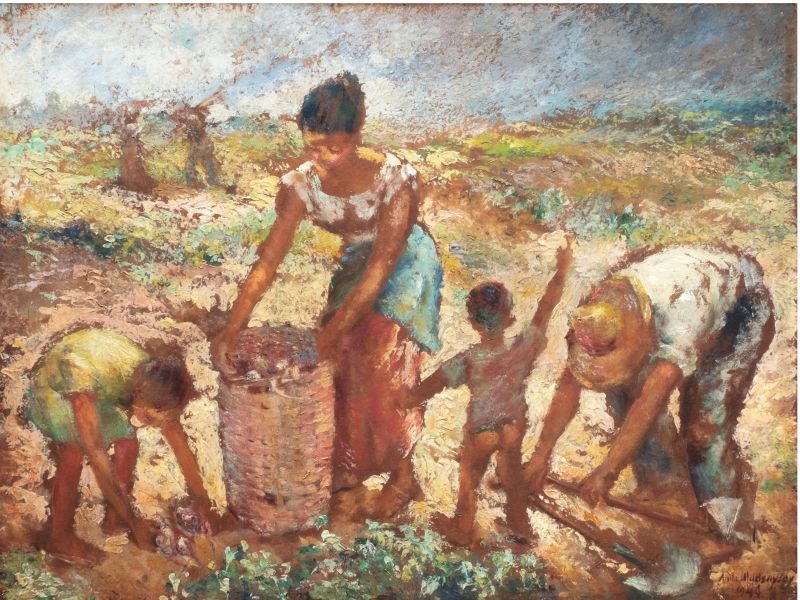
A rare wartime painting by Anita Magsaysay-Ho, In the Farm, captures both an idyllic environment removed from the war and a hopeful longing for return to peacetime.
The work depicts a family in a vast field, the mother about to carry a basketful of kamoteng kahoy (cassava) gathered by her daughter, a crucial source of sustenance during World War II when food was scarce and the greater populace was suffering from hunger. The father is packing up his pick and shovel, as they are about to go home and endure many more days and nights surviving while keeping hope in the face of uncertainty.
The work, alternatively titled Digging Camotes, was among the highlights of Anita’s debut solo exhibition at the United States Information Library at Plaza Cervantes, Binondo, in early 1946, immediately after the war.
Painter Galo Ocampo notes in the exhibition catalog that Anita’s show was “the first of a series that the Commonwealth Government intends to sponsor from time to time…in hopes to rediscover the cultural wealth of the country and to develop its artistic potentialities for the benefit of the living and as a tribute to those who fought and died to preserve our way of life.
“The choice of Miss Magsaysay to begin a series of art exhibits is doubly significant. She is young. As a girl of promising talent, she was tenderly bred in the Genteel Tradition.”
The exhibition, which featured 47 paintings (39 oils and eight watercolors), became the talk of the town amid the ruins of the once-glorious capital. Approximately 2,000 people viewed the paintings, “of which fully one half were purchased—by all odds, one of the most successful art exhibitions ever put on in this country,” noted Ismael Villanueva “I.V.” Mallari, one of the early prolific writers and art critics, in his article The Philippines Through Undimmed Eyes, published in the periodical The Philippine-American.
‘Digging Camotes (In the Farm)’ was one of the most expensive paintings in the exhibition, priced at P150, a substantial sum at the time
Digging Camotes (In the Farm) was one of the most expensive paintings in the exhibition, priced at P150, a substantial sum at the time. Ocampo lauded Anita’s works as displaying “a remarkable degree of artistic abandon born of confidence and freedom. Her strokes are firm and purposeful. She has grasped the importance of design, of line, space, and color, and of richness in texture.”
Ocampo noted that “although steeped in the traditions of the old school, Miss Magsaysay was able to shake off the fetters of academic art and to achieve individual freedom of expression.” He concluded his praises for Anita by christening her as “an exceptionally gifted artist who will go on hurdling the obstacles that stand on the way.”
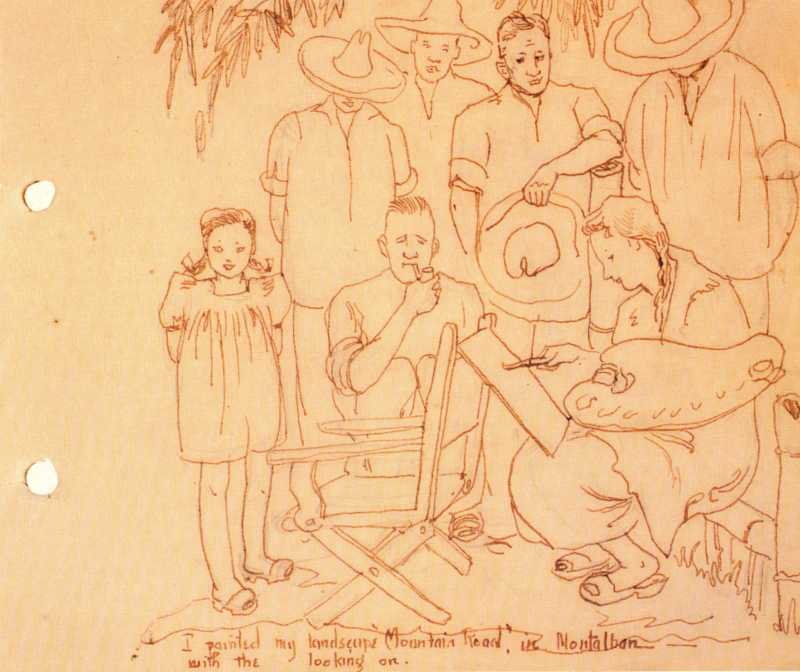
Anita’s own sketch of her painting experiences in Montalban, Rizal during the war. Drawing reproduced in the book ‘Anita Magsaysay-Ho: An Artist’s Memoirs’
In the Farm / Digging Camotes is a post-impressionistic work painted by Anita in Montalban, Rizal, where her family escaped at the height of war. With remaining oil paints, palette knife, and brushes that she brought, Anita utilized a recycled board, as materials became inadequate.
Montalban bore witness to Anita and her family’s great escape from the impending battle of Manila. The Magsaysays hurriedly left their Pasay home on Villaruel Street, as many people started evacuating the city upon hearing the news of the imminent return of the American forces under Gen. Douglas MacArthur.
‘Digging Camotes (In the Farm)’ is a post-impressionistic work painted by Anita in Montalban, Rizal, where her family escaped at the height of war
Anita wrote in her memoirs: “My father’s good friend, Mr. Cueto, invited us to use the second floor of his house in Montalban. Our family, along with Mama’s youngest brother, Tio Ramon Corpus, and family, moved there. At this time, the Japanese Army was starting to suffer from a scarcity of food. They commandeered trucks carrying fruits and vegetables. We would hide our chickens in the bathroom whenever Japanese soldiers were in town.”
“We met many, many, many friends in Montalban,” Anita continued. “Lourdes Reyes Montinola and her sister and relatives were there. Some of my friends wanted to learn how to draw, so I gave lessons in drawing, providing them with baskets and fruits to copy. Some of them actually drew well. During the war years, we wore wooden clogs (bakya), but mind you, our wooden shoes were special-carved and painted with rural scenes of nipa huts and coconut trees.”
Life in Montalban was somewhat subdued, despite the ubiquitous scenarios of people digging camotes as alternative staple food to rice, which was in shortage during the war as production was disrupted in heavily militarized zones. In Montalban, Anita found time to paint, amid the lush fields, the scent of crisp country air, the rhythmic moos of grazing livestock, the staccato clucking of the chickens, and the towering natural corridors of the Sierra Madre mountains, with Mount Irid, Rizal’s highest peak, soaring majestically.
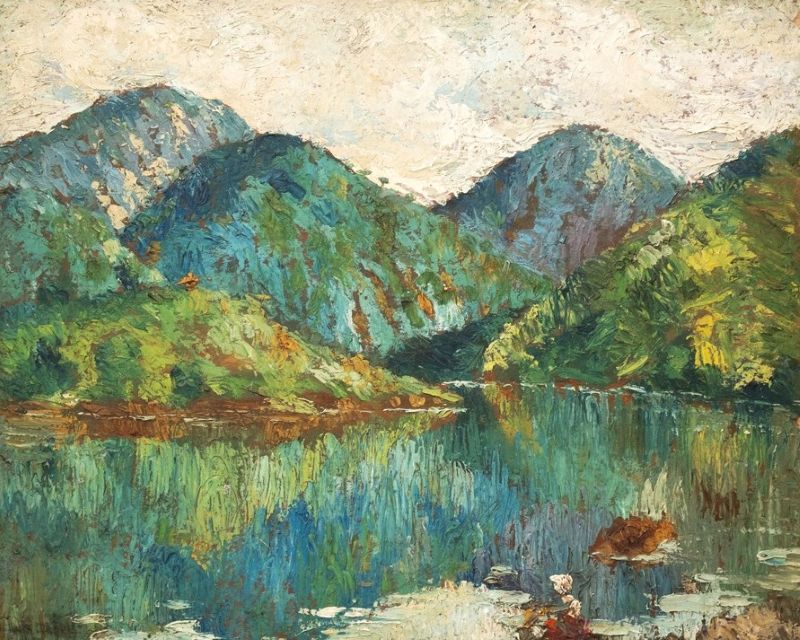
‘Montalban Landscape,’ Anita’s oil painting that poignantly captures her idyllic environs during the height of the war. Leon Gallery auctioned this painting in the special sale ’85 Years of Philippine Art: The Alfredo and Irene Roces Collection,’ in March 2025.
Painter-critic Alfredo Roces recalled this critical juncture in Anita’s life and career in his monograph on the artist. “The war years did not prevent Anta from painting,” Roces wrote. “Her father provided her with thin, smooth, white boards of wood about four inches square, on which she painted portraits. She gave art lessons to friends. When the family evacuated [from] Manila to Montalban, she managed to paint palette-knife landscapes.”
Anita’s life in Montalban was a great contrast to their life in the city. “We hardly stepped out of the house in Pasay, as there were many Japanese sentries stationed in the streets,” Anita wrote. “Luckily, we had a brave cook who went to the market every day for fresh food.”
Anita also recalled that her cousin, Benjamin Rodriguez, survived the infamous Bataan Death March. In December 1941, when news of the Japanese bombing of Clark and Nielson fields was already spreading like wildfire in the streets of Manila, Anita and her sister, Emma, found themselves scrambling to buy first aid kits at Botica Boie in Escolta. There, Anita witnessed people seemingly stripped of their senses and sanity, as stores were being looted and grocery stocks hoarded.
On the other side of the coin, there is a palpable tension in the work resulting from Anita’s use of a palette knife, which gives the painting a dynamic texture and strong contrasts between color, form, and space.
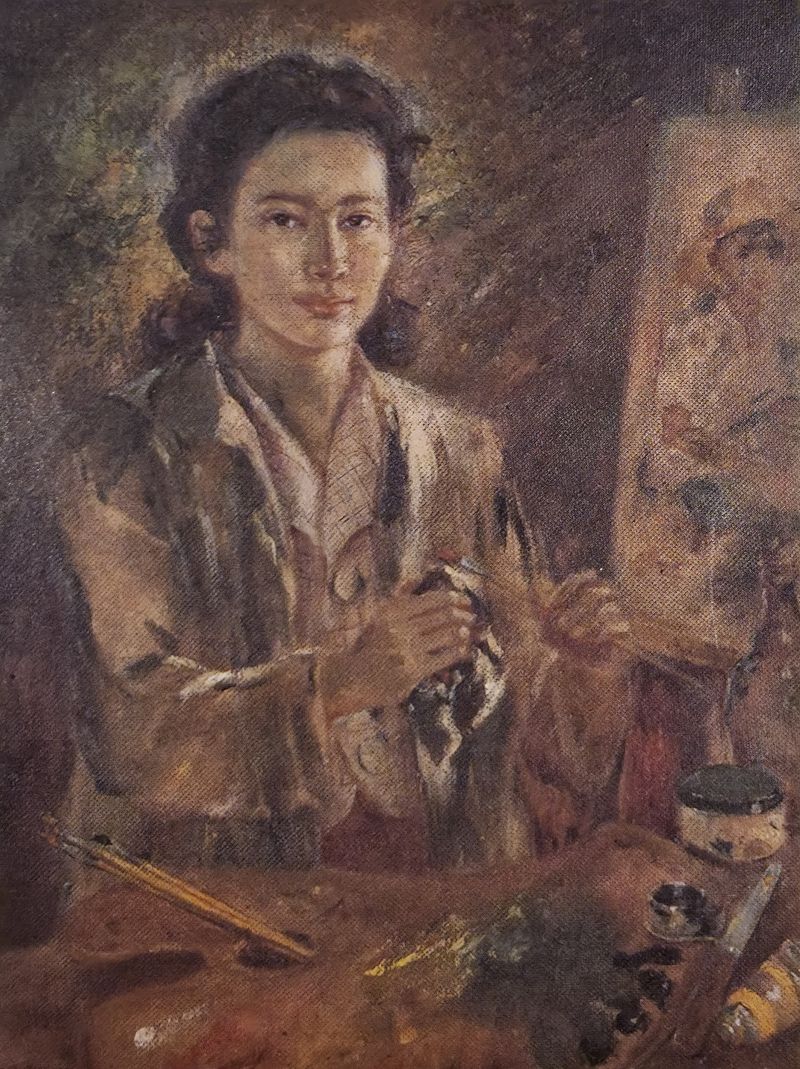
Anita’s wartime self-portrait, 1944. This painting was recently exhibited at the 2024 Venice Biennale. Private collection, painting reproduced in the book ‘Anita Magsaysay-Ho: Isang Pag-Alaala.’
Around the same time Anita painted In the Farm, she penned a poignant poem as a cathartic release from the injustice of war:
“Is it wrong to dream? / To build my castles in the air, / Today when everything is dim / And fate seems so unfair?…
“…To glorify my country’s grandeur, / Her mountains and hills / The valleys rich with harvest / Her rivers and her hills. / To portray her children’s laughter, / The wisdom of the old at home, / And her brave youth that struggle, / Upon this earth we call our own!”
In this painting, Anita’s use of the palette knife induces tension and anxiety. Through the thick impastos that produce a highly textured composition, Anita speaks of her longing for a liberated nation, where she could exalt the glories of the motherland, and articulate and be uplifted by the stories of resilience and freedom. For Anita, there was no freedom of one’s soul if the motherland remained in shackles.
The mother is positioned in the center, her dress symbolizing the Philippine flag; she is the personification of “Inang Bayan,” the motherland. As the painting’s protagonist, she anchors the other figures, who are bowed down in oppression, except the young boy, who looks and points towards the horizon, an allegory for the “brave youth that struggle”: the bright promise of the future, the defenders and hope of the homeland. He clings to his mother’s skirt, an interesting device Anita underscores to make known her stand: that her motherland belongs only to her countrymen, which she symbolically touches on in her poem.
In this work are vestiges of Paul Cezanne, whom Anita counted as an early influence, particularly during her studies at the School of Design co-founded by the modernist patriarch Victorio Edades, who also admired the Post-Impressionist luminary. The highly textured space resulting from Anita’s use of the palette knife evokes a key Cezanne principle: structure over impression, permanent over the fleeting. Anita’s palette knife composition, with its dynamic palpability and tactility, captures a moment frozen in time, a lasting snapshot of her contradicting temperaments during the most tempestuous and apprehensive of times, a longing for peace in the time of war, a transient countryside relief she wished would last.
Anita and her family would eventually return to their Pasay home when food in Montalban grew more expensive, a scenario they would also witness back in the city. She recalled that their cook “had to bring a bayong of money just to buy chicken and pork from the market. Money had become useless, its value going down every passing day.”
As the Battle of Manila raged, causing destruction and deaths, Anita and her family escaped with their belongings through mined roads towards the house of Dr. Veloso, a family friend. That same night, Anita witnessed the sky ablaze and smoke coming from the houses and buildings burned by the escaping Japanese forces. They would find out the next morning that their house and property had been spared.
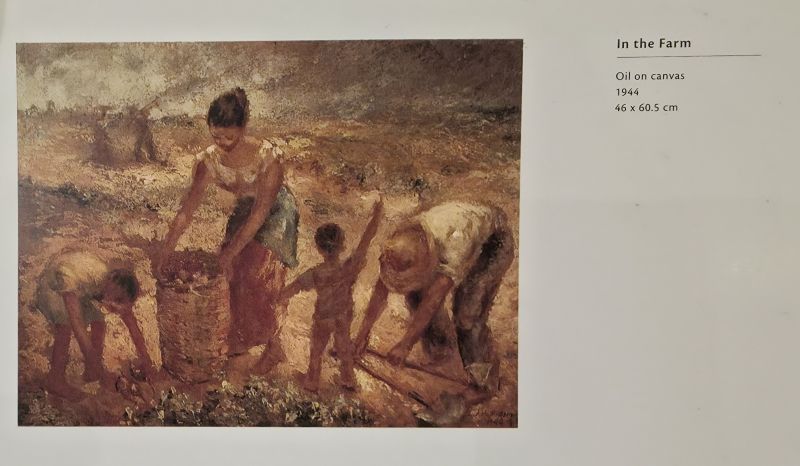
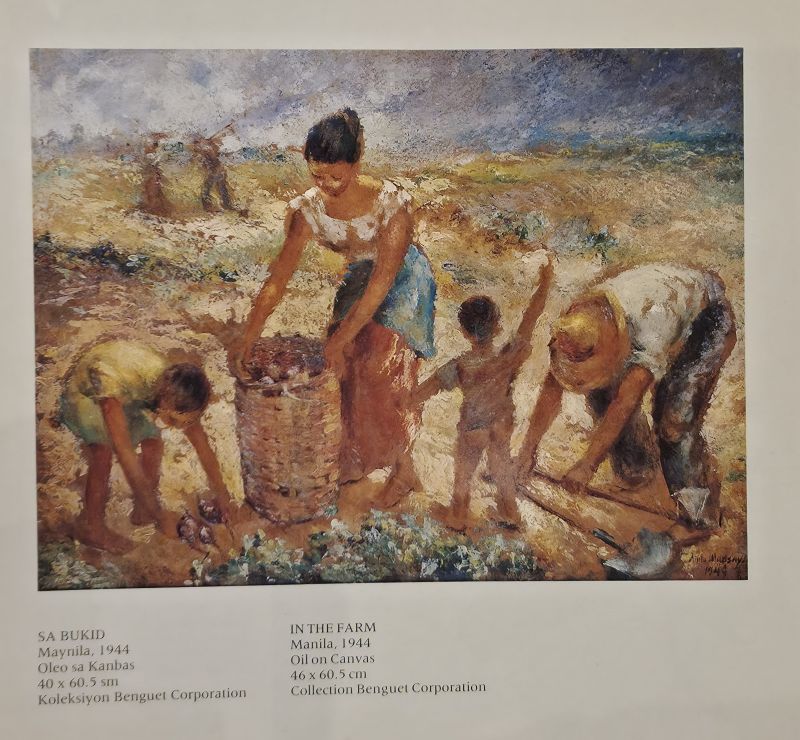
‘In the Farm (Digging Camotes) as reproduced in Anita’s most important monographs, Alfredo Roces’ ‘Anita Magsaysay-Ho: In Praise of Women,’ and the exhibition catalog published to accompany Anita’s first major retrospective at the Metropolitan Museum of Manila from December 1988 to January 1989
In the Farm would be in Anita’s first retrospective exhibition at the Metropolitan Museum of Manila, from December 1988 to January 1989. Poetically titled Isang Pag-Alaala, it was Anita’s first show in 10 years and, most notably, the Philippines’ first large-scale, full retrospective exhibition, capturing in more than 100 works her four prolific decades as the country’s foremost Filipina painter. During this time, Anita and her family had been living in Hong Kong, where she spent 17 years of her life.
The painting would be showcased in Anita’s first retrospective exhibition, held at the Metropolitan Museum of Manila from December 1988 to January 1989
Anita’s retrospective, which also marked her Philippine homecoming, was one of the most important and anticipated shows of that decade.
Maurice Arcache, who captured the glitz, glam, and gossip of Manila’s high society in his column My Lips Are Sealed…Sometimes, dubbed Anita’s show the “Retrospective of the Decade,” writing that the exhibition caused probably one of Manila’s most iconic bumper-to-bumper traffic jams, shutting off a stretch of Roxas Boulevard.
“The cocktails on opening night was so crowded that many of Manila’s toppity-top visibles and rare-visible personalities failed to see Anita’s magnifique and formidable works of art, and had to dash back the following day to really scrutinize the paints (sic),” Arcache wrote. “It was the event of the season as some 500 guests from all over the country trooped to the museum. At one point, the boring traffic jam outside stretched for a quarter of a mile, and many anxious guests abandoned their cars just to get inside.”
Among the VVIPs of the opening cocktails were Manila’s who’s who: Sen. Leticia Shahani, Asia’s Fashion Czar Pitoy Moreno, Purita Kalaw-Ledesma, collector and connoisseur Dr. Teyet Pascual, critic Eric Torres, Judy Araneta-Roxas, Nene Quimson, Maribel Ongpin, Gemma Cruz, Bambi Harper, Bessie Legarda, Federico Aguilar Alcuaz, Baby Fores, Bea Zobel, and Bing Roxas.
“One thing was proven that evening. Our living legend, artist par excellence, the one-of-a-kind Anita Magsaysay-Ho, wherever she may live, will always remain a Filipina whom we can all immensely be proud of, dahlings,” Arcache wrote.
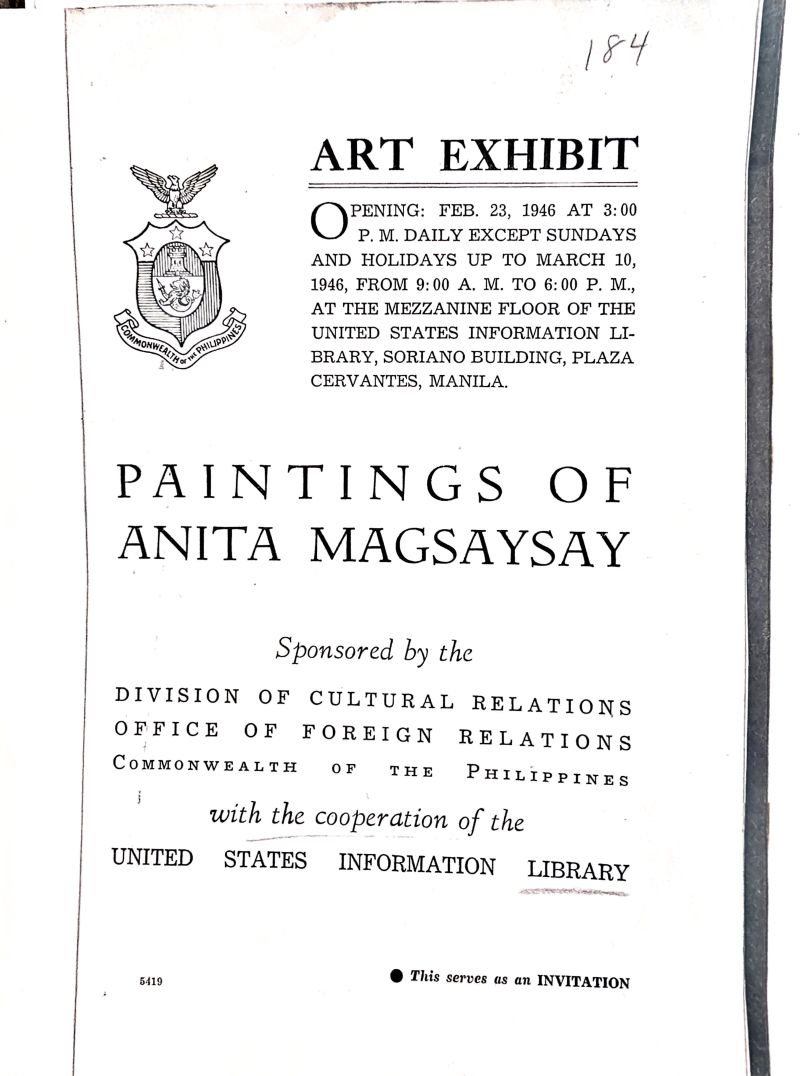
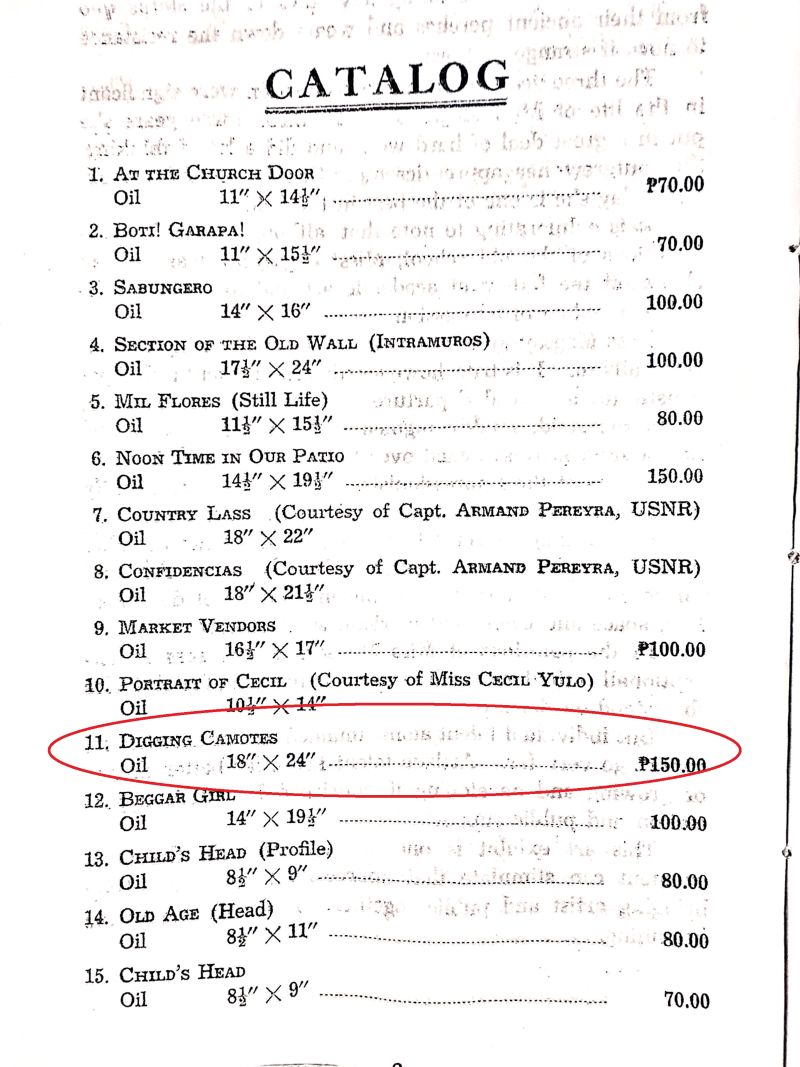
The invitation-cum-catalog of Anita’s debut solo exhibition at the USIS Library in Plaza Cervantes, Binondo, 1946. ‘Digging Camotes (In the Farm)’ is encircled in red. (From the Lopez Museum and Library Archives)
In the retrospective invitation, Anita wrote a personal dedication to the Filipina, her perpetual source of inspiration. “I dedicate this exhibition to the women of the Philippines—the source of my inspiration—their movements and gestures, their expressions of happiness and frustrations, their diligence and shortcomings, their joy of living. I know well, for after all, I am one of them.”
In In the Farm, the woman is the painting’s protagonist. Anita renders her with a kind of dignified grace only a woman could articulate well. Going back to her Zambales roots and its women folk, to whom she was always indebted to for giving her “the depth of impressions” which she “subconsciously drew upon with so much fondness and passion” whenever she painted, the retrospective, a celebration of her artistic legacy, was an homage to the country women of her province, whether they were working in the fields, mending nets by the seashore, or just bonding in lighthearted conversations and gossip. Even in the context of war, In the Farm Anita puts the Filipina front and center as a consummate exemplar of honor and resilience, of struggle and eventual triumphs, whatever one’s life’s circumstances or standing may be.
León Gallery’s The Spectacular Mid-Year Auction 2026 will be held on June 13, 2026, Saturday, at 2 pm. The preview exhibit will run from June 6 to 12, 9 am to 7 pm, at G/F Eurovilla 1, Rufino corner Legazpi Streets, Legazpi Village, Makati City.
To browse the catalog, visit https://leon-gallery.com/. For further inquiries, email info@leon-gallery.com or contact 8856 2781. Follow León Gallery on their social media pages for timely updates: Facebook: www.facebook.com/leongallerymakati and Instagram @leongallerymakati.


