
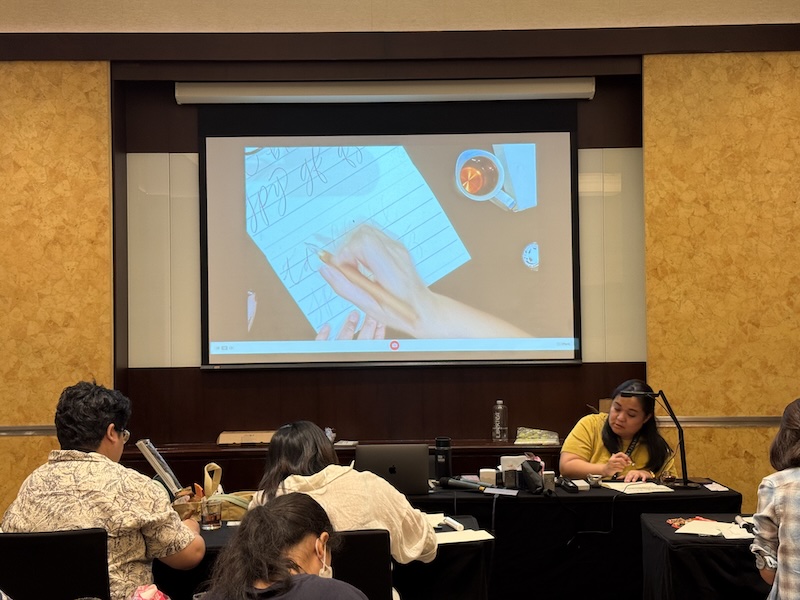
The Manila Pen Show (MPS) is a difficult event for me to write about—not from lack of enjoyment or things to talk about, but because I have a deep love for this event, and I’d hate to do it a disservice.
The Manila Pen Show is Southeast Asia’s biggest fountain pen show, a huge feat for the group that started in regular cafe hangouts. Taking the leap in 2018, Fountain Pen Network Philippines (a Facebook group dedicated to the hobby) mounted the first Manila Pen Show. The event’s attendance boomed post-pandemic in 2023, with over 1,200 attendees, and has continued to grow, with last year’s MPS bringing in over 2,200+ attendees.
In 2023 I attended my first MPS. I had the pleasure of watching the event grow bigger over the years—moving from Holiday Inn to Peninsula Manila, then to its biggest venue to date at Fairmont Makati last March 28-29.
The venue was filled from one end to the other with all sorts of fountain pens, fountain pen accessories, inks, and whatever falls under stationery.
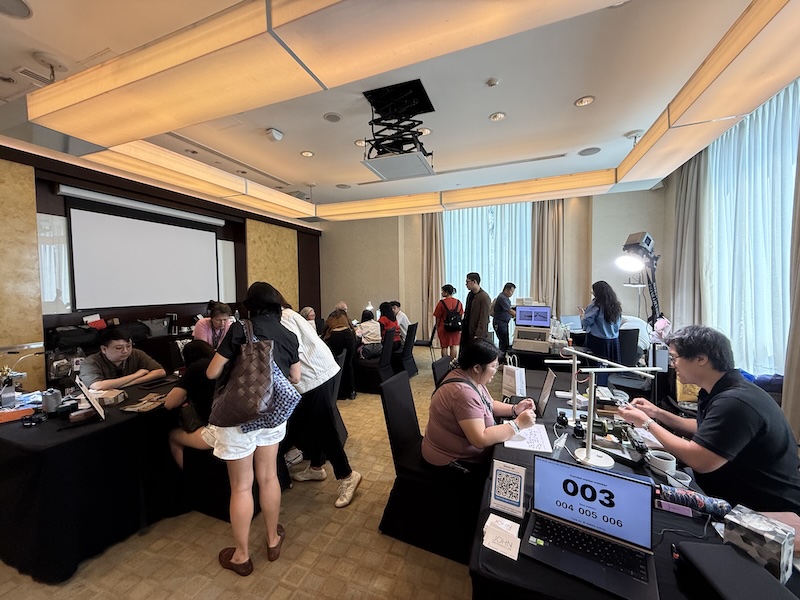
The Nibmeisters’ Hall, where attendees get to have their pens repaired and fine-tuned by experienced nibmeisters
But more than a marketplace, the MPS is a community-centric event to bring together pen hobbyists and anyone else with fountain pen-adjacent hobbies. During the two-day event, you not only met other fountain pen enthusiasts, but also attended workshops and even had your pens fine-tuned by nibmeisters!
A lot of attention apparently went into planning the event to ensure it runs smoothly. I spoke to Lorraine Castaneda, vice president of Fountain Pen Network Philippines, who said that even as the event grows bigger, the goal has always been to help spread the love of fountain pens to veteran hobbyists and pen newbies alike.
“MPS is always community first,” she said. “If you notice, the Manila Pen Show doesn’t publish our table rates, vendors are brought in mostly by invitation, and we curate to make sure that they’re a good fit for our community.”
And curate they truly did. Chatting with local and international vendors, I realized why MPS is truly special.
For one, all vendors sold small-batch collections of their products, whether handmade glass pens, artisanal journals, or specially hand-painted and designed fountain pens. Everything about the event screamed premium in both price and quality.
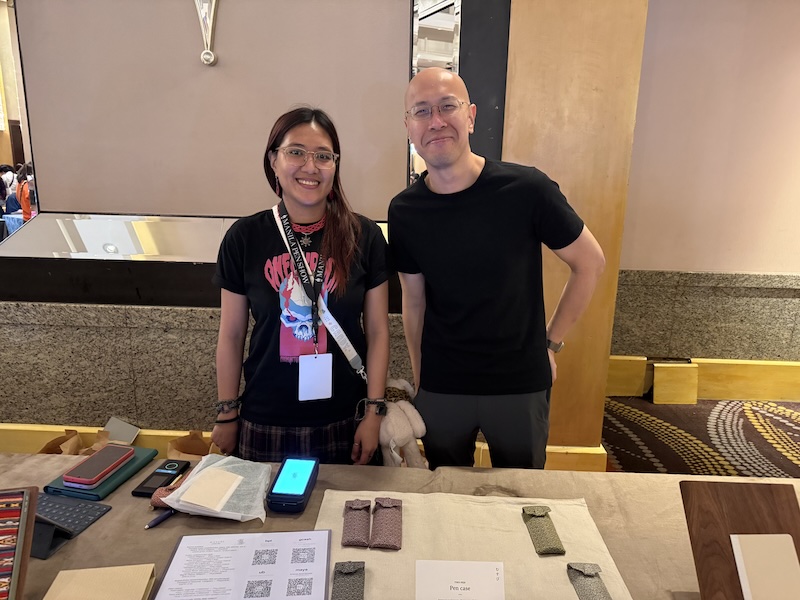
Amanda and Daryl of the Musubi atelier
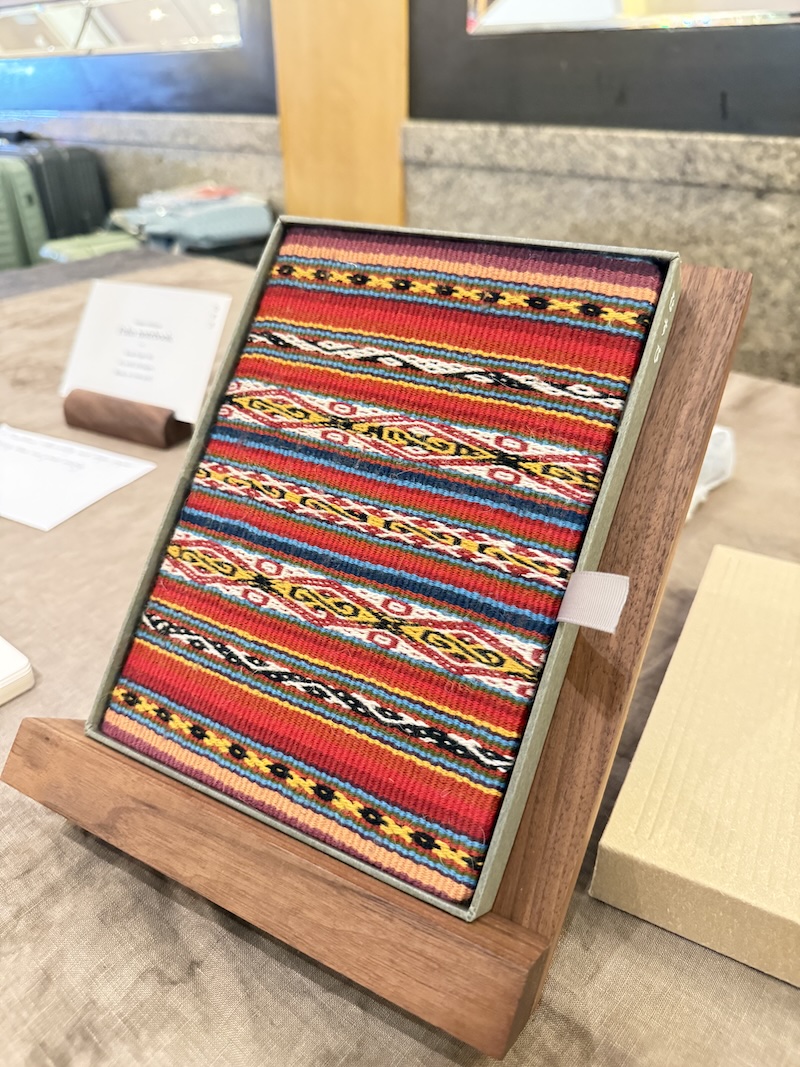
Musubi’s Quechua fabric journal cover
One vendor sold the best handbound journal I ever had the pleasure of purchasing. These journals come from the Singaporean small goods atelier Musubi. They work with artisans who have intellectual and physical disabilities to give them stable employment and opportunities. In another collection of One Musubi journal line, they utilized the indigenous fabrics of the Quechua people of the Peruvian Andes. They work with local activists in Peru to ensure that the community gets the maximum amount possible for their work. They ensure that every product sold is of the highest quality that their atelier can manufacture and the process ethical.
Singaporean small goods atelier Musubi works with artisans who have intellectual and physical disabilities to give them stable employment and opportunities
Daryl, founder of Musubi, has been a vendor since the first Manila Pen Show in 2018. “I think the energy and community is the biggest change that I’ve noticed over the years. When it started out, it was very much for hobbyists. And then in recent years, on top of that, you have more members of the public who are not connected to the fountain pen community who are looking for something cool to do on the weekend. It’s been really interesting to see the evolution of the show.”
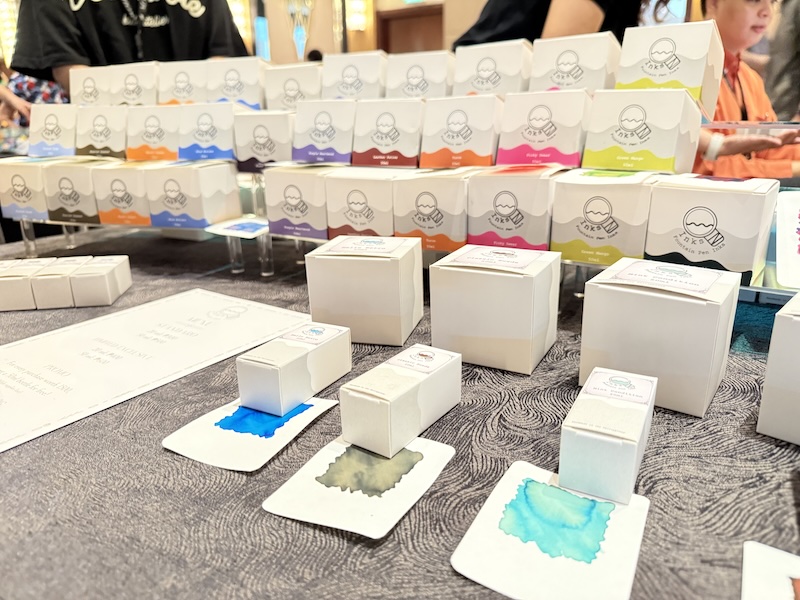
Local ink brand On Inks with its newest and previous collections on display
Another popular vendor was Troublemaker Inks, handmade in the Philippines and well regarded both in the Philippines and abroad. Their inks are sold all over the world, in Germany, the UK, Australia, New Zealand, and even Turkey! Not to sound like a Filipino netizen, but there’s a special feeling in knowing that a homegrown ink manufacturer with distinctly Filipino names, such as Tuslob Buwa, Roxas Boulevard, and Bantayan Turquoise, are sold the world over.
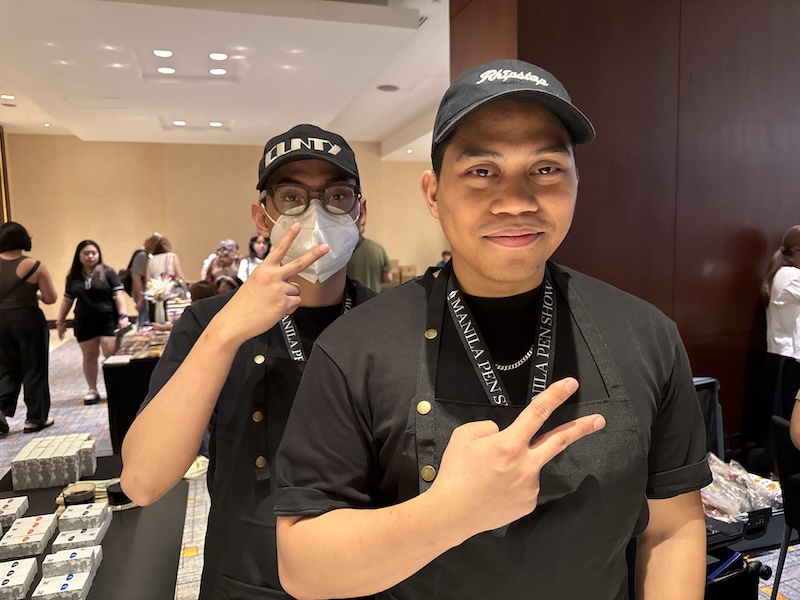
Gab (left) and Kai of local ink maker Troublemaker Inks
Kai from Troublemaker Inks told me that they use references of places and their upbringing in Cebuano and Filipino culture. And because the fountain pen community is so close, he gave the detailed story of the creation of one of their inks, España Boulevard. “This was prompted by another fountain pen enthusiast, when he said, ‘You should do an ink that looks like muddy water.’ So we did!” He said that the ink was inspired by the street lamps reflecting off the water on España Boulevard—indeed a very creative and romantic way to view a daily occurrence otherwise seen as a nuisance.
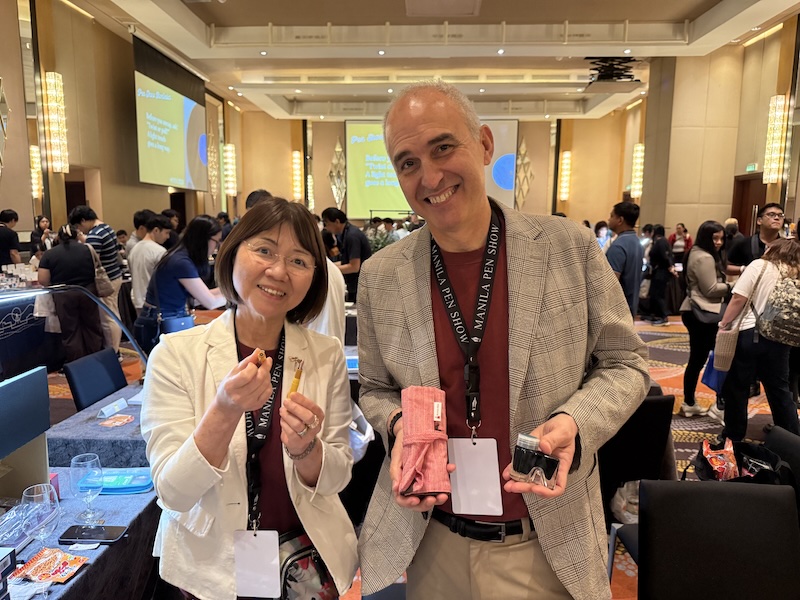
Kaoru (left) and Bruce of Tokyo’s bungubox with their specially mixed inks, handprinted fountain pens, and specially-made pen holders.
Over the years, a vendor that has always caught my eye is bungubox, with their handpainted fountain pens. Based in Tokyo, Bungubox works with well-known companies such as Sailor, Platinum, and Esterbrook to release limited-edition pens. Owner and designer Kaoru Yamagishi was drawn to the beauty of ink and handwriting with fountain pens, and wants to bring back the art of handwriting in modern-day society. She mentioned that, compared to the fountain community in Japan where they are more solitary, she is almost always blown away by the friendliness of Filipinos who come to bungubox’s booth. In the three years since she and her partner Bruce began attending, their stocks have run out faster each year, chalking it up to the boom of interest in fountain pens post-pandemic.
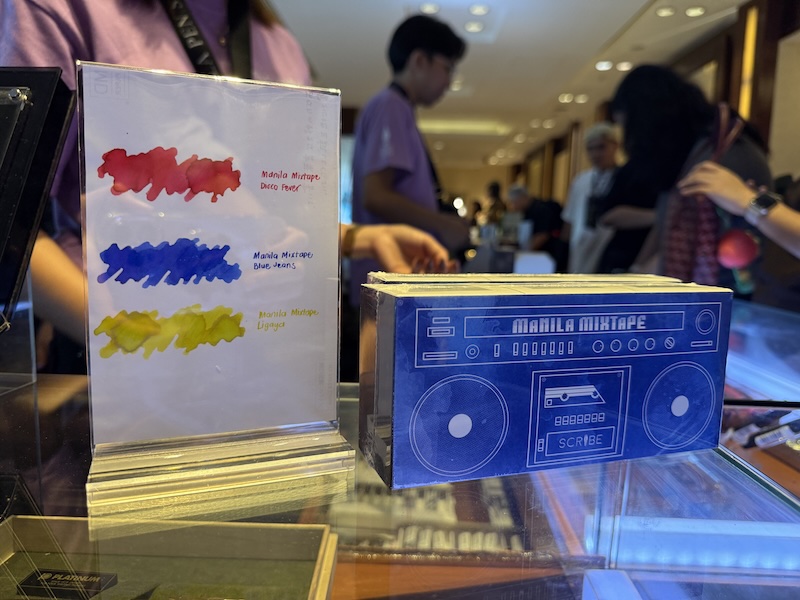
Limited edition fountain pen ink set from stationary brand Sailor, specially formulated and mixed for The Manila Pen Show 2026
If I could have gone to every single booth that day, this would be more of a book than an article. For many of these vendors, beyond the business, the passion they brought to the Filipino fountain pen community was awe-inspiring. Every single piece had a story to tell. For these vendors, it wasn’t just about money or profit, but about making and showing off the best of their wares. For people like bungubox, who painstakingly hand-paint each of their pieces, or Troublemaker Inks, who draw strong inspiration from the sights and scenes of the Philippines—there was no shortage of passion and love for fountain pens.
I remember the warm feeling of being with a community of people I closely identify with. Stationery and fountain pens have served as my bridge to lifelong friends, just as it has been for the founding members of the Fountain Pen Network.
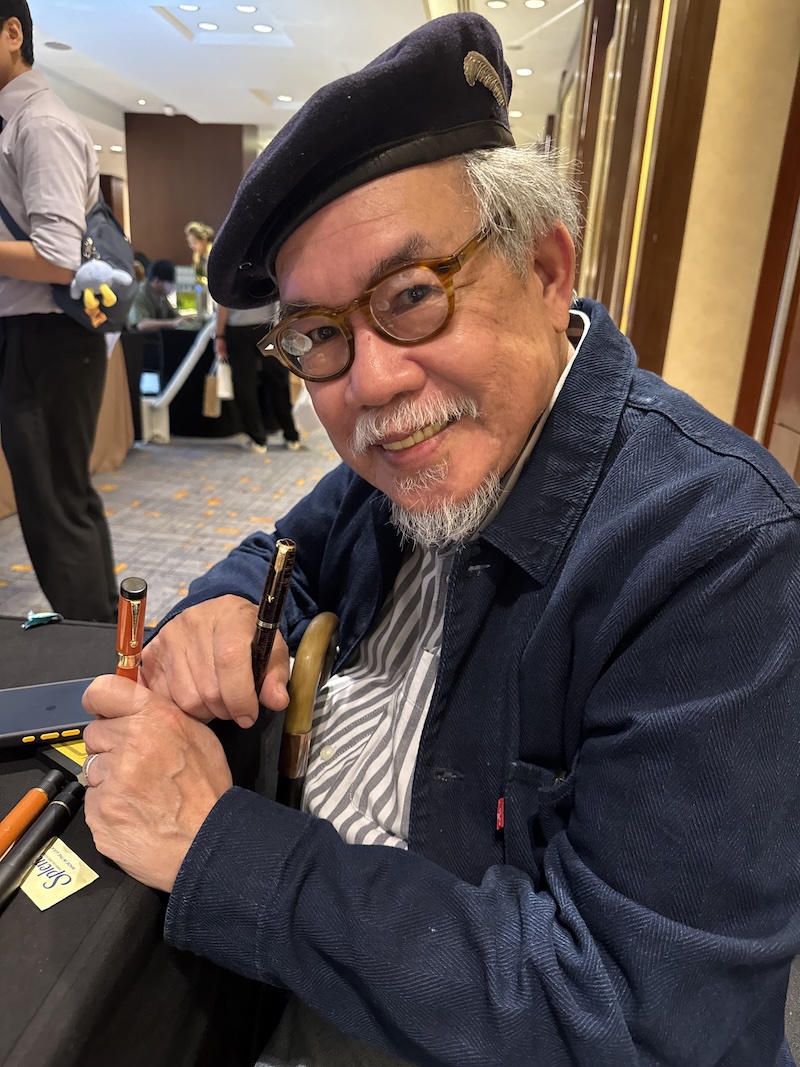
Jose ‘Butch’ Dalisay Jr. with his holy grail fountain pens
One of its founding fathers, the esteemed award-winning author Jose “Butch” Dalisay Jr., explained to us in detail why fountain pen lovers are such a passionate lot: “I like to say that fountain pens are a very personal experience. It’s kind of like a science, you know, you figure out what ink and what nib works well for you. It’s really a way of self-determination: ‘This is me. This color is me. This line is me.’ We don’t write marvels or great literature. We have fun, which is good.”
And it’s true. When you make a journey to the fountain pen community, learn more about its members, and study the differences between a German vs a Japanese nib, you start associating it with the people who collect pens. For every fountain pen friend that I have, I can easily list the pens they like, the colors they choose, and even their preference in paper for their notebooks and journals. Fountain pens are a personal experience, but there is a joy and excitement in getting to share that love with others.
At the end of the day, the Manila Pen Show goes beyond pens and accessories. It is a gathering of talented and passionate people for something that is part of their whole being. There is a spirit of generosity and camaraderie like no other because, unlike other hobbies, the nature of fountain pens calls for us to be reflective and meditative. Considering how detailed the maintenance and care are needed for these pens, it isn’t enough to just switch things when it stops working.
We are meant to actively slow down, study, and curate our tastes over a long period. Dalisay even mentioned how he would fix the majority of his grail pens himself, some of them dating back to the 1930s!
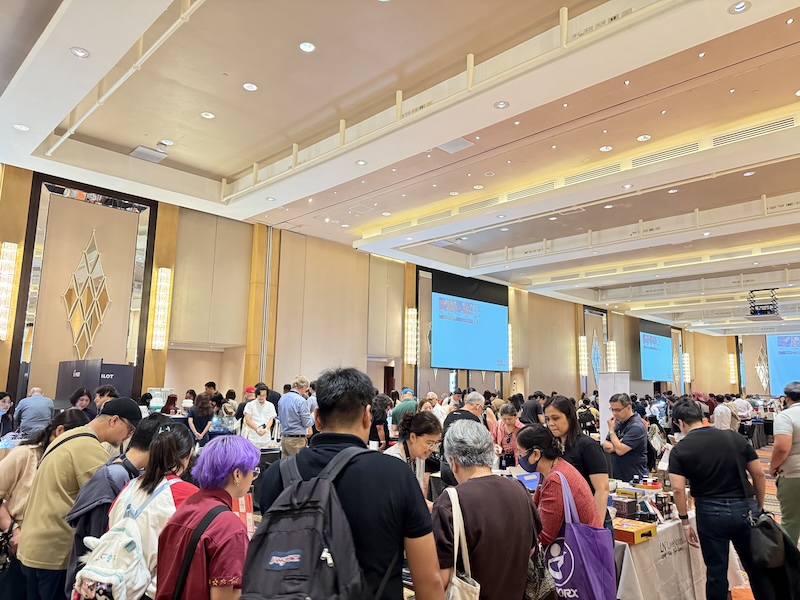
Crowded ballroom of Fairmont Makati in the early hours of the pen show
The Manila Pen Show is a gathering of community like no other. It isn’t defined by physical space or heritage passed on to us. It’s centered around one’s general interest. There is no gatekeeping here. Rather, the community is more concerned about your wallet and your willingness to spend because they, if given the chance, will “budol” you for as long as your bank account can handle it! Though intimidating at first, the Fountain Pen Network is composed of members willing to help a pen newbie. And maybe that compassion is part of someone who is into fountain pens.


