
Master Class runs until May 30 at the Carlos P. Romulo Auditorium, RCBC Plaza, Makati City. Tickets are available via https://ticket2me.net/event/22887.
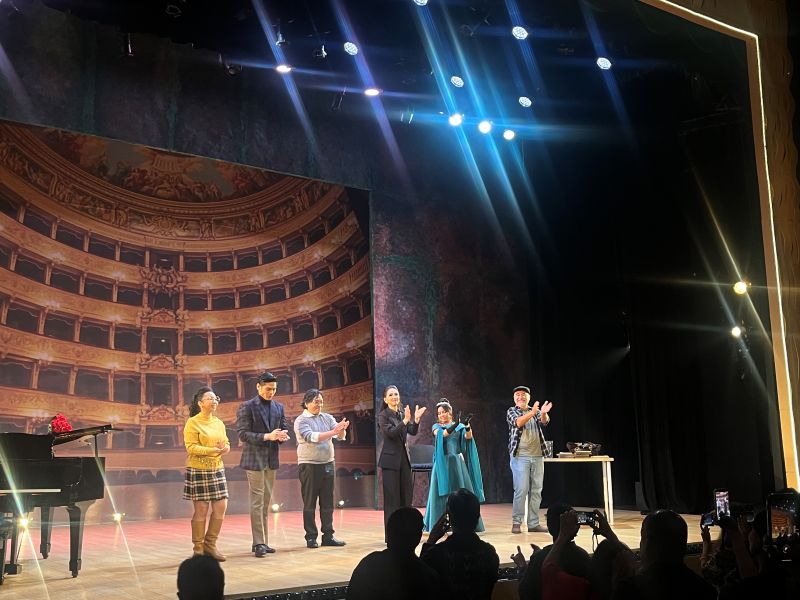
The cast of Master Class during curtain call with director Jaime del Mundo (right). Photo by Vincen Gregory Yu.
Master Class may be about Maria Callas, but Philippine Opera Company’s (POC) revival of this play somehow renders any prior knowledge of the preeminent American Greek soprano unnecessary. This is a good thing.
Written by the late Terrence McNally, the play imagines a literal master class run by Callas sometime in the 1970s, during the final decade of her life, when she no longer performed in opera.
Here McNally finds the perfect occasion for breaking the fourth wall: His Callas—by turns caustic and wistful, temperamental and tender—converts the entire theater into her lecture hall, addressing the audience directly throughout the play with a wink in her eye, even as the ghost of her prematurely aborted career haunts the proceedings.
Three lucky students become her (un)fortunate victims, their one-on-ones with La Divina, as the opera star is lovingly known, furnishing much of the drama and forming the skeleton of the play. Callas torments, goads, and guides these aspiring performers—not necessarily in that order—while the audience sits in the dark watching McNally’s version of this singular artist supposedly at work and at her most vulnerable.
The conceit is rather straightforward; as one discovers fairly early on, the point of the play is the leading role itself: a star vehicle that all but guarantees success for whoever is brave enough to take it on—and wrestle with its self-indulgence.
This time in Manila, it’s Menchu Lauchengco-Yulo, coming after Jay Valencia Glorioso and the late actresses Baby Barredo and Cherie Gil (with whom POC last mounted Master Class in 2008, followed by a rerun in 2010). Watching Lauchengco-Yulo during opening night on May 15, I was struck by how her Callas felt so at home within the kilometric list of theatrical performances dotting her resumé. I mean this to be the highest compliment.
Lauchengco-Yulo is a master of paring characters down to a distinctly human scale, such that they feel undeniably—and unremarkably—flesh and blood. Whether as the bipolar Diana in Next to Normal or the neglected filmmaker’s wife in Nine, the conflicted psychiatrist in Agnes of God or the hyper-religious fanatical mother in Carrie, Lauchengco-Yulo has this precise ability to make it seem as though her characters’ hurts and hopes, their anxieties and anguish, are all emanating from some sacred, immeasurable core. She makes these creatures of the stage feel like they’ve come off the page entirely to exist right next to you.
Her Maria Callas is no different: The intimidating, tyrannical carapace hardened through the decades by the diva’s reputation is largely gone. Instead, the fire and fury all come from within, articulated plainly and directly through a voice that resists even a single, strained decibel. “If you can’t hear me, it’s your fault,” she tells the audience in her opening monologue. “You’re not concentrating.” Theatergoers should consider themselves warned.
More important: Lauchengco-Yulo extinguishes the need for viewers to actually know who Callas was. The actress speaks with a slight accent, but as the play progresses, the question of whether hers is the best impersonation of the soprano swiftly becomes a nonissue. (Admittedly, knowing the basic facts of Callas’ life makes for a more insightful viewing experience, as one understands the script’s references to her past roles, her rivals, or her lover Aristotle Onassis.)
But who needs Callas when you have Lauchengco-Yulo’s full-blooded creation right there—someone plausibly as domineering and daunting and catty, and as secretly wounded and grief-stricken, as the real person? In this vein, I am reminded of Cate Blanchett’s narcissistic and manipulative conductor in Todd Field’s Tár from 2022—a product of fiction so richly imagined, lots of people actually thought the film was a biopic.
It follows, then, that the best parts of Master Class—when the production feels truest and most believable—are those when Lauchengco-Yulo has us viewers in the palm of her hands; when she is alone in front of us—her captive, spellbound audience—speaking to us directly, as if we really were her students eagerly awaiting her every word and, on more than one occasion, bearing witness to her most private sorrows and insecurities. This is Master Class at its most convincing: the actress and the whole theater in communion.
Unfortunately, this also means that whenever everyone else in the production intrudes on the spotlight, the whole affair becomes disturbingly less sincere; even Lauchengco-Yulo—at least, on opening night—is helpless against the ensuing tsunami of artifice.
The main problem with the production directed by Jaime del Mundo is that it appears to be afflicted with some kind of intermittent amnesia. It repeatedly forgets that it is supposed to be a master class, with the fourth wall broken and the idea of a “staged performance” chucked in the bin. Specifically, all three actors portraying Callas’ students keep doing the most, to use the modern slang; they are visibly “acting,” where Lauchengco-Yulo is effortlessly unembellished and present in this make-believe-and-therefore-real master class. They seem oblivious to the fact that the audience are supposed to be there with them, thus shattering the illusion initially summoned by the play’s conceit.
In consequence, the culminating sequences of the play’s two acts struggle to land their emotional payoffs—the first way more than the second. In these scenes, Callas retreats into the past and brings the audience along for the ride; prompted by a student’s performance, she starts recalling pinnacle moments in her life and career, the play—in such meta-theatrical fashion—ceasing momentarily to be a real-life master class, the notion of the tangible classroom now dissolved as the viewer is plunged headlong into the yawning abyss of Callas’ mind and soul.
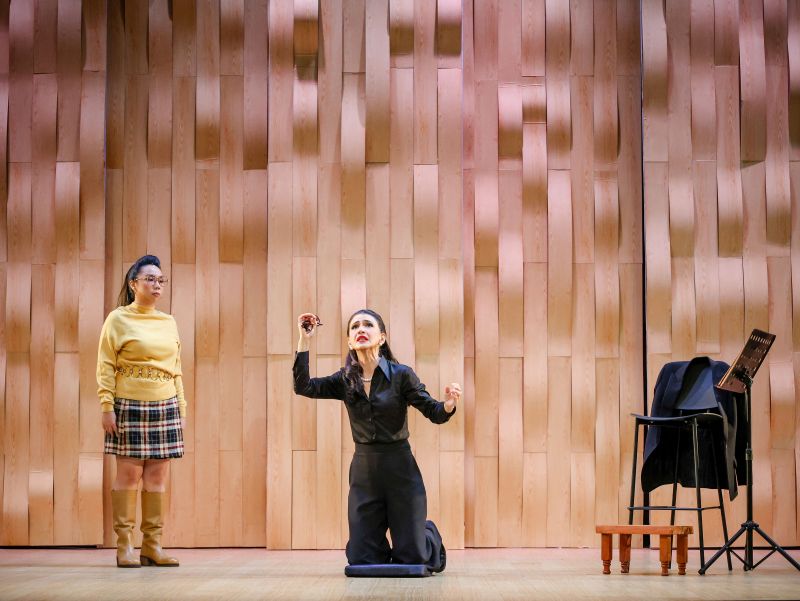
Alexandra Bernas and Menchu Lauchengco-Yulo in Master Class. Photo by Myra Ho
It pains me to say that the first act, in particular, is an arduous slog: We spend almost the whole time with the first student played by Alexandra Bernas, her entire interaction with Lauchengco-Yulo’s Callas a strident clash of technique and sensibility. As a result, the segue from real to imagined happens sloppily, and Lauchengco-Yulo’s act-ending monologue feels jarring, like a placeless psychological breakdown.
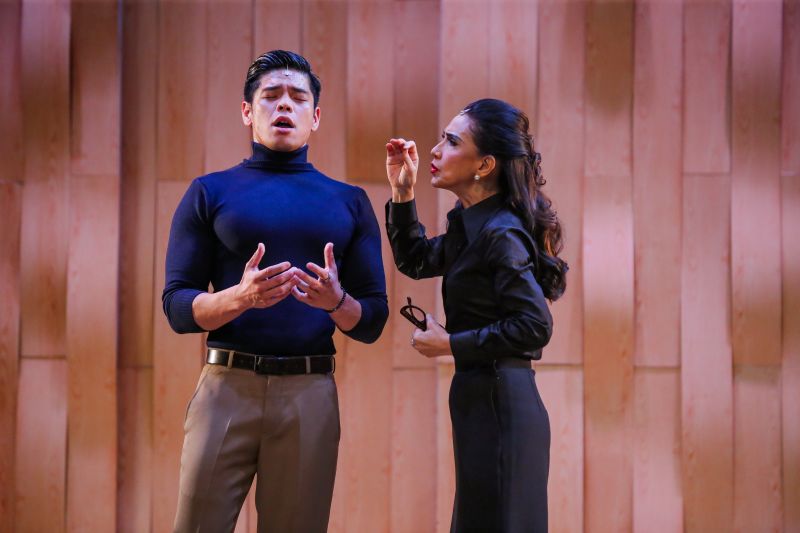
Arman Ferrer and Menchu Lauchengco-Yulo in Master Class. Photo by Myra Ho
Act II fares better, in large part because the students played by Arman Ferrer and Angeli Benipayo at least sing their parts with sweeping emotional ferocity. Still, neither of them are able to fully make you believe they aren’t only pretending to be students of this master class. In fact, among the actors orbiting Lauchengco-Yulo, only Del Mundo, who doubles as the stage hand, comes across as someone who really exists in her world.
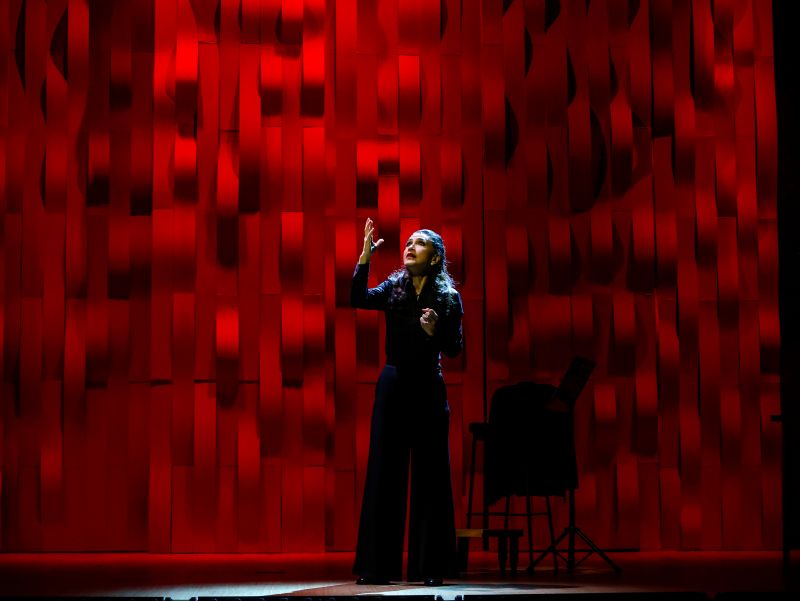
The look of this production is generally cohesive, though the balance of the sound—most crucial in the scenes where Callas is speaking while a student is singing—needs serious recalibration. D Cortezano’s lights manage to fulfill the play’s operatic ambitions, especially when Callas dives into her monologues: For the second act, Cortezano bathes the stage in feral blood red, and the effect is haunting. Joey Mendoza’s set is a realistic spare stage dominated by a wall of vertical, light-hued panels imbued with an interlacing pattern, like the surface of a woven basket—but, at the end, the wall rises to reveal a backdrop of an opera house’s interior, with Callas standing before the multi-level house as if she were looking into the stage and bidding us viewers farewell. It could be a stunning final image, were it not for the strangely overexposed printed backdrop.
I could say the same for the production as a whole. There’s a stunning central performance in it—strong enough that it allows the play to reach the heights of gay fantasia—but only if that performance were left alone. Even the best professors are only as good as their students.
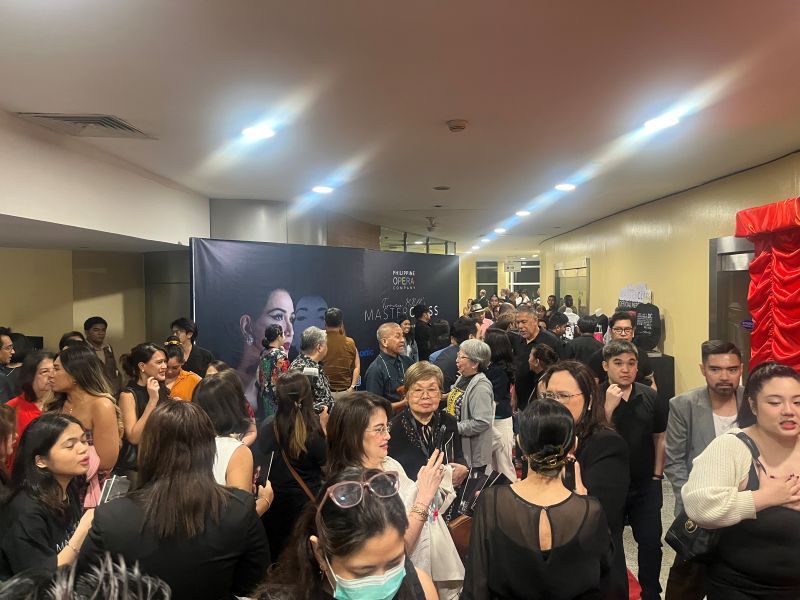
Opening night audience at the theater lobby for Master Class. Photo by Vincen Gregory Yu.


