
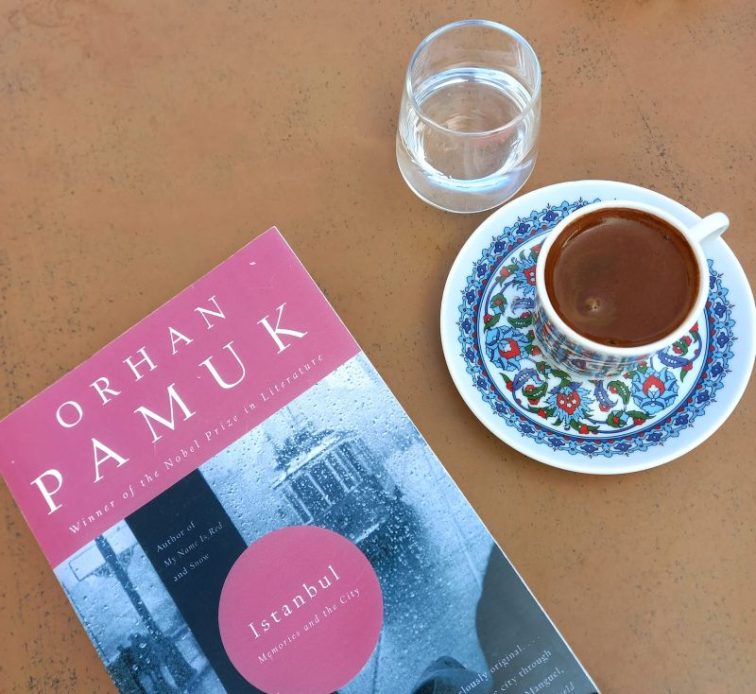
It was my last day in Istanbul, and I was sipping a lovely cup of Turkish coffee on a quiet afternoon. I chose coffee, but two men a few tables away ordered Turkish tea. The delicate sound of their small spoons clinking against the glass filled the room, and quiet chitchat continued as the clinking sound went on.
I worked as a dishwasher for some time during my stay in England in 2003. The town I stayed in was such a tiny remote coastal city that not much nightlife was available, although I remember there was a Victoria Club, where flirting crowds wouldn’t miss their Fridays. One of the must night-out places for youngsters, including foreign students, was a kebab house, near the curving road in front of some empty lots. After part-time work was done, I’d drag my greasy body and soul to the dormitory, but a few times I followed my Shanghainese and Turkish colleagues for night kebab. The kebab house was never empty; it was always full of young people, not caring about time, not minding tomorrow, just enjoying another long, rowdy day.
Aside from the Turkish waiter, who was studying with us, we also had several Turkish students in the school. Come to think of it, it was almost my first time to meet Turkish people. It was one of the countries closest to Korea, as a brother nation who fought during the war, but aside from that, I didn’t really have any special attachment or knowledge about them. It’s a country we studied in world history class—learning how it straddles two continents, Asia and Europe—and its people I had met while studying English, including a Korean girl’s boyfriend, who cried to death when she returned home first. Another thing I remember was a pastor who took a class under me, accompanied by his wife (who always lovingly called him “pastor”), who never stopped grinning. I don’t remember his name, and he was not so excellent in learning the Korean language, but strangely, I still vividly remember his smile.
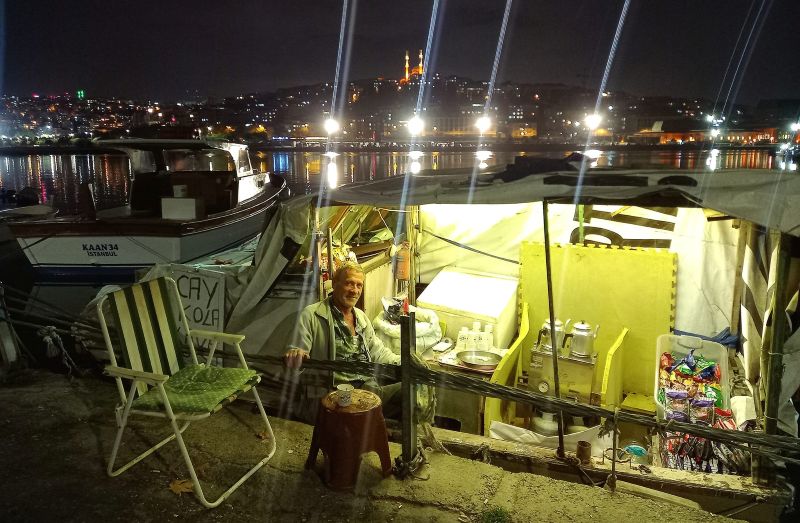
Memet in his banca cafe
And here I was to experience Türkiye, especially Istanbul, for the first time after decades of superficial ideas. Only 3 percent of the land belongs to the European side, yet the city is so cosmopolitan; I’d say it feels way European, or to be honest, my ignorance about this part of Asia makes me clueless about what to feel about being Asian in this continent. Their stout physique, distinct scent in the air, smiling-not-so-smiling face, constant tea drinking—aside from the ruins from the past, aside from the huge gentrification and alleys with hung laundry, I’m so absurdly enraptured by the aura of the people and the city.
And I remember what a waiter in a restaurant we had dinner in said to us. One Sunday, after finishing long hours of shopping at the Grand Bazaar, we chose a random nearby restaurant for early dinner. When we were about to leave, the waiter asked where we were from. Philippines, we said. He smiled: “Oh, Philippines! The best massage! Very good, good massage!” I asked where the massage shops were, and he said there were so many, so many good masseuses, all Filipinos, on İstiklal Avenue. We didn’t have much time in the Taksim area, so we didn’t see İstiklal Avenue that day.
The following day, I made sure I visited and walked all the alleys on the avenue. And I found it quite amusing how these Turkish guys seemed fascinated with Filipino massage skills.
Philippines, we said. He smiled: ‘Oh, Philippines! The best massage! Very good, good massage!’
On the way to Istiklal Avenue by myself, I saw a Lebanese restaurant on the road, and although I didn’t fancy any proper meal, I went in, thinking of Father Dan, who officiated our wedding, and who’s originally from Lebanon. I ordered Beirut chicken wraps, and sat beside two girls who seemed to be Aussies. I didn’t mean to eavesdrop, but their stories were just audible: They seemed to have met in Istanbul by chance, as their life sharing was based on past travels. Quite interesting, as I’m Asian, they seemed fascinated by Asian stuff and one girl’s testimony was almost like Eat Pray Love; she said how it was unbelievable when she witnessed 12 people living under one roof—”Oh my god, what’s going on here?” I didn’t follow their stories, but at some point they opened up about what actually brought them to Istanbul. The same reason, a break-up of sorts. It’s like what happened to me: I’m in Istanbul, which was on my must-visit list, and find myself, to soothe my heart. One girl said something like she was supposed to go to the Philippines, and they kept talking about how fantastic their choice was to be in Istanbul, and how lovely that the two of them had met.
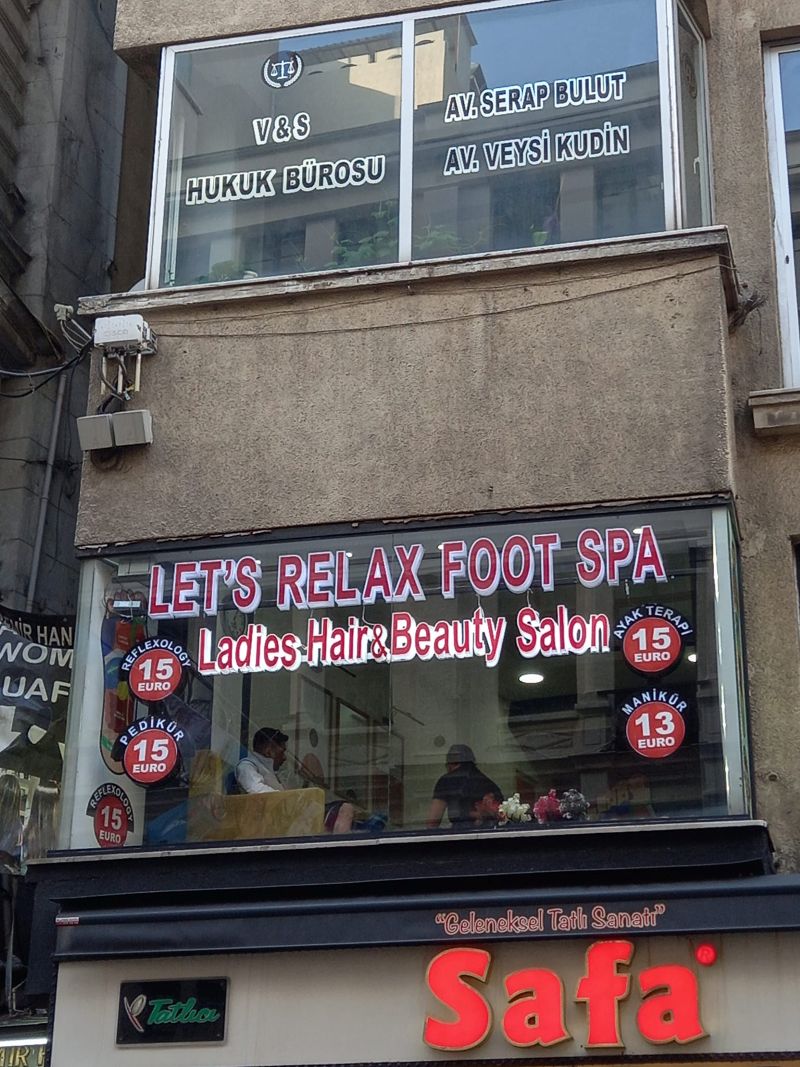
After filling up my tummy, I walked up non-stop to Taksim, and then leisurely walked along the very busy Istiklal Avenue. I looked around everywhere and then saw the signage—foot massage—and remembered what the waiter said yesterday. I took a photo of the signage and when a masseuse turned her head towards the window, in that split second, I saw a familiar face, very Asian, very Pinay. I kept going my way, then saw a Turkish guy delivering glasses of Turkish tea to shopkeepers here and there, as usual. And I wondered if those masseuses from the Philippines would also now order some and enjoy their break time sipping Turkish tea, or would they still prefer their own timplang kape, on the bustling İIstiklal Avenue, the European side of the city?
At night, I went out to catch the sunset over Golden Horn. So many families, children, dogs, and witnessing how citizens loved another day of their life at dusk was just so lovely. It was getting dark, but I just felt it wasn’t enough reason to leave a mesmerizing Golden Horn, so I walked on another side of the park.
And there I met Memet, a grandpa vendor in his banca-cafe at Golden Horn. Being a coffee person, I hadn’t really taken much tea since I arrived in Istanbul, and I thought this tea from his banca should be authentic, brewed in his worn-out kettle. Suddenly, somehow, I wanted to start a conversation with him.
I stopped in front of his store and quickly typed broken sentences in Google translation. I asked how much the coffee was, and he showed me 3-in-1 coffee, so I asked for tea instead. He poured a cuppa, and I showed him my money and he gave me the change. I didn’t want to leave the store so soon, so on a spur of the moment, I introduced myself, that I was from Korea and a turista; he was certainly puzzled to get this information, but he slowly brought out a folding picnic chair for me. I sat, and he also started sipping his tea, and I asked questions like a census lady.
I thought this tea from Memet’s ‘banca’ should be authentic, brewed in his worn-out kettle. Suddenly, somehow, I wanted to start a conversation with him
Memet lives in Istanbul. He sells coffee, tea, chips, and bread. After his business is done around 11 pm, he takes the otobüs home. He doesn’t sleep in the boat. He goes home to sleep. He has two children, one lives in Istanbul, the other lives outside of Istanbul. He has two grandchildren, five and 12 years old, and soon he will visit them in that city. He will bring them gifts, two gifts, as he has two lovely grandchildren. Both are smart, good students. He’s not really a fan of football; he earns okay (he laughed loudly), and he has enough para (money) to buy his grandchildren gifts. He misses them.
I read my questions and he answered, and it was obviously one-way communication, but we somehow laughed at some points. And soon he also asked me questions (when I was ready with my next question to him: Do you like cats?). One thing he asked me was where I was staying, and asked “Otel?” And another question he tried to explain using his two index fingers was something like where my spouse was. The night was getting too dark and there were other customers dropping by. I asked him, “Is it ok to take a photo?” and he generously allowed me, and smiled at my camera. I was endlessly typing broken sentences while finishing my tea, and he gestured that the second cup was his treat. I said no but he insisted, and I accepted his kindness. When his bread delivery came, he wanted to give me one huge piece of bread, and I waved my hands passionately. And I said I’m leaving, see you again, and he said something, and I helplessly nodded, and we both smiled.
Why do human beings want to communicate, use language, and, if possible, verbally interact? A passer-by tourist stops at a tiny banca and talks to a man in Istanbul, all tech-aided broken communication. He somehow understands, I keep being a census lady, and a glimpse of his life is shared with me. Our paths may not cross again, but tonight at Golden Horn, Memet was there, and I was passing by on the other side of the park, and I took my first cup of Turkish tea.
Memet, Filipino masseuse, random passersby—thinking of each one, I ask myself: “Why are we here (in the Philippines)?” Despite them being Turkish, me being Korean—it’s simple yet not so simple if we think about how one’s journey began and ended in the Philippines.
And now back in Manila, but it still feels like I’m in Istanbul. Although after every trip I wonder if I’d ever come back to this destination, if there is one city I’m curious if I’d ever return to, it should be Istanbul. And this is the only city so far where I am so interested to imagine a past of glory and upheavals.
As I was drinking a cup of Turkish coffee next to the Constantinople Walls, I didn’t know then, but later on I’d learn about the practice that after drinking coffee, you must place the cup upside down on its saucer, and have your fortune told. I didn’t have my future told, but if I did, I hope my fortune would say that I’d return to Istanbul, and see many other sides of Türkiye.


