

Violins will not be the only instruments heard; electric guitars will answer them. Ballet Manila opens 2026 with Ballet and Ballads, a free concert featuring the rock band The Dawn, as Lisa Macuja Elizalde, artistic director and CEO of Ballet Manila (BM), celebrates 40 years onstage in the Philippines.
Elizalde was a soloist with the Mariinsky Ballet when she was offered a contract as principal dancer with Sadler’s Wells Royal Ballet in London, considered among the world’s leading ballet troupes. Being offered a principal contract was a mark of her exceptional talent. The company, known for its technical brilliance and artistry, was later renamed Birmingham Royal Ballet after its relocation in 1990.
However, a tangle of legal documents altered that trajectory, and brought her home instead. In 1986, she became artist-in-residence at the Cultural Center of the Philippines. That same year, The Dawn was rising as a force in the local music scene, pioneering alternative rock in the Philippines with a blend of New Wave, post punk, and hard rock.
The Ballet and Ballads series, now 31 years old, was conceived by Fred Elizalde, chairman of Manila Broadcasting Company and a patron of BM. He proposed merging pop culture with what many considered an arcane art form to make ballet more accessible. Over the years, the series has featured OPM artists including Basil Valdez, Lani Misalucha, Ariel Rivera, and Christian Bautista.
On Feb. 20 and 21 at Aliw Theater, Ballet and Ballads will showcase eight songs selected by The Dawn, spanning their 1986 breakthrough song Enveloped Ideas to Saan Ka Pupunta, released just last year.
Associate artistic director Gerardo Francisco takes the helm for the Filipino songs. Known for vigorous, sharp ensemble choreography that carves clean lines across the stage, Francisco builds dances that move as one organism even as they trace individual journeys.
Tulad ng Dati unfolds through four couples whose stories intersect. One pair, separated by circumstance, finds their way back to reconciliation. Another circles through conflict, their back story etched in gestures that repeat and resolve.
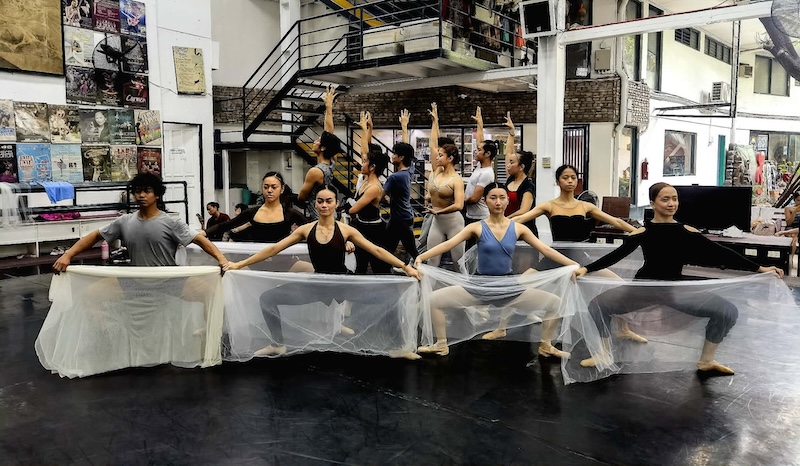
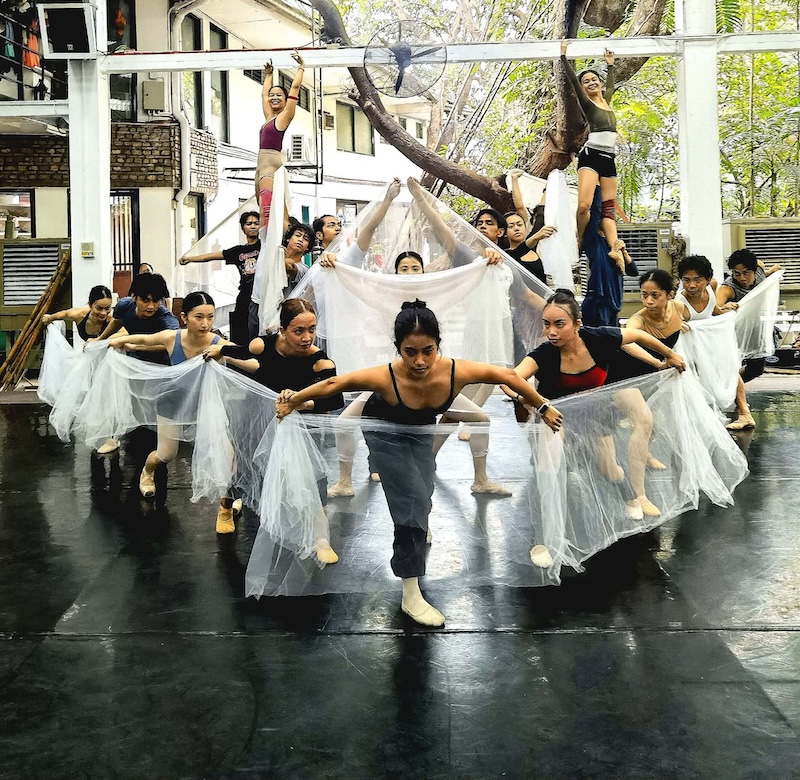
Ballet Manila in ‘Saan Ka Pupunta’ by Gerardo Franciso
Saan Ka Pupunta and Iisang Bangka expand into group works. In the latter, the dancers move as if rowing and steadying a single vessel. Francisco threads obstacles into the choreography, bodies tilting and resisting, yet the formation holds. No matter the storm, it is still one boat.

‘Salamat’ by Gerardo Francisco
Salamat closes in a sweep of collective motion, a dance of gratitude and brotherhood that gathers the company.
British resident choreographer Martin Lawrance handles the English songs, shaping abstract movement from the lyrics. His style is fluid yet precise, driven by clean classical lines that dissolve into unexpected formations, with dancers slipping in and out of clusters like thoughts forming and dispersing in real time.
He treats Enveloped Ideas as a prologue. What do we keep to ourselves? What are we good at? What do we conceal? The piece gathers all 41 dancers, who enter and exit in shifting groupings that echo the song’s introspection. Lawrance leans into that ambiguity, capturing the release in the sweep of the guitar and translating it into motion that feels both searching and unguarded.
I Saw You Coming suggests a band of friends crossing a vast wasteland, led by Joshua Enciso. Shamira Drapete appears almost as an apparition, not quite a conventional partner, but a presence that unsettles and draws him forward. The choreography fractures into trios, quartets, and duets, with Drapete moving as if she were slipping under Enciso’s skin, less a lover than a force that disturbs him.
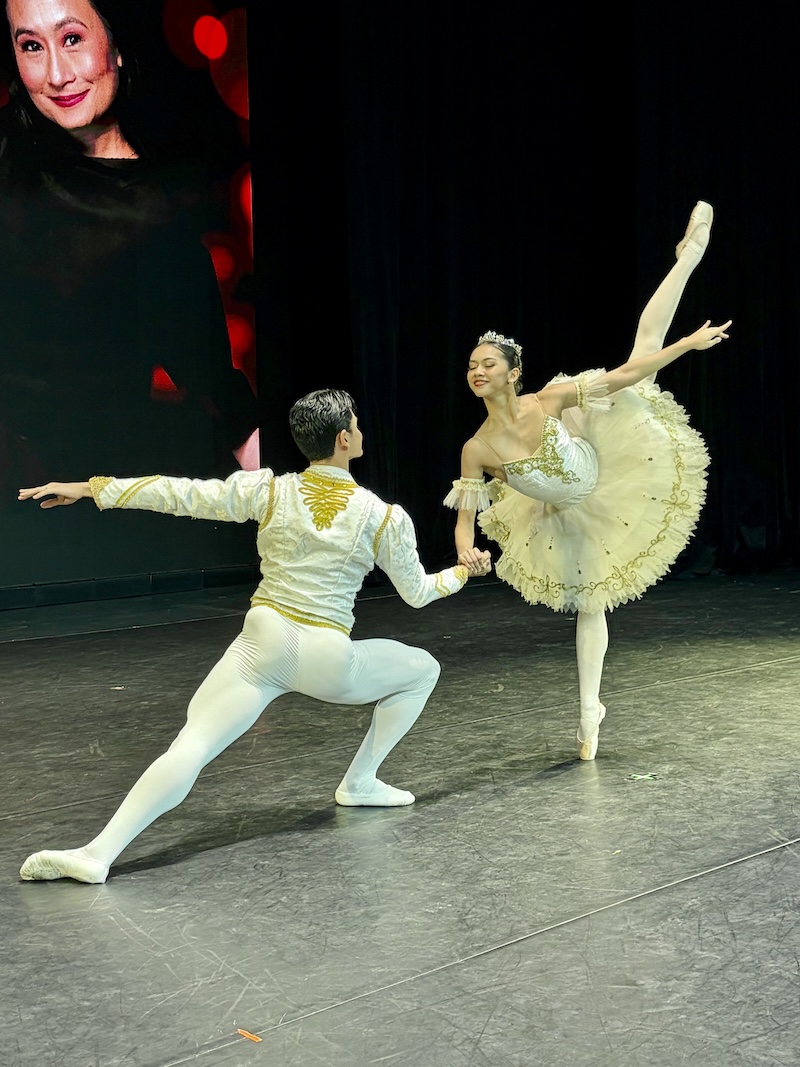
Joshua Enciso and Shamira Drapete in ‘Sleeping Beauty,’ with Lisa Macuja Elizalde’s photo in background
Love Will Set Us Free centers on three principal couples, supported by six more who form the ensemble. The partnering traces tension and release, bodies folding, resisting, and finally yielding. Stand With You narrows the focus to a duet for Mark Sumaylo and Abigail Oliveiro. Four men shadow Sumaylo, embodiments of his doubts and inner turmoil. Oliveiro remains his counterweight, the still point amid the noise.
The real draw of BM’s season is its Prima series, a return to full-length classics that audiences have not seen in years. Sleeping Beauty takes the stage on March 14 and 15, 2026 at Aliw Theater, performed to live music by the Manila Symphony Orchestra under guest conductor Alexander Vikulov. The orchestra, the oldest in Asia, has partnered with Ballet Manila on several major productions, bringing symphonic weight and sweep to the company’s repertory.
The production follows Marius Petipa’s original choreography, though Elizalde folds in touches from her “Princess” ballet series. Cinderella and Snow White appear as guests at Aurora’s wedding, a theatrical flourish that broadens the fairy-tale world without straying from the classical spine of the work.
At its heart, the ballet charts a dancer’s transformation. Aurora begins as an ingénue presented to her suitors, matures into a woman awakened by the Prince, and culminates as a commanding ballerina in the Wedding Pas de Deux. The role demands crystalline technique, sustained balances, and the stamina to carry a three-act arc with radiance intact.
The full-length Sleeping Beauty is rarely performed in the Philippines because of its elaborate production requirements and grand scale. In 1987, Ballet Philippines brought the full spectacle to the Cultural Center of the Philippines stage with Elizalde as Aurora, earning rave reviews for her performance.
On June 20 and 21, 2026, BM will present the Philippines’ first full-length staging of Paquita, the 19th-century classic that has long survived in gala excerpts but rarely in its complete form. Originally created in 1846 by the choreographer Joseph Mazilier with music by Édouard Deldevez, the ballet is set in early 19th-century Spain during the French military occupation, a period of political tension and divided loyalties. At its center is a young gypsy woman who saves a French officer and later discovers she is of noble birth.
Today, Paquita is best known for the Grand Pas Classique that Marius Petipa added in 1881, a brilliant showpiece that has become a benchmark of academic technique. But in its entirety, the ballet is more than a suite of fireworks. It demands stylistic clarity, fleet and intricate footwork, sustained balances, and regal composure from its leads, and absolute precision and stamina from the corps de ballet, whose symmetry and timing define the grandeur of the production. To mount it in full is to measure BM’s command of the classical tradition.
The season closes with La Bayadère on Aug. 22 and 23, featuring the return of Mariinsky Ballet stars Renata Shakirova and Kimin Kim, who made their Philippine debut last year in Don Quixote. Shakirova’s dancing is precise and expressive, each step and gesture carefully shaped to convey character. Kim combines high-flying jumps with rapid, tightly controlled turns, executing each phrase with seemingly effortless power.
Set in India, La Bayadère tells the story of Nikiya, a temple dancer, whose love for the warrior Solor is thwarted by betrayal and jealousy, leading to tragedy and a vision of eternal reunion in the afterlife.
The ballet is notoriously demanding. The principal roles require long balances, fast and intricate footwork, and lifts executed with exact timing. Its centerpiece, the Kingdom of the Shades, calls for 24 ballerinas to descend a ramp in perfect unison, each arabesque and step timed to both the music and one another. Even a small misstep can disrupt the hypnotic effect.
Ballet Manila’s corps de ballet has the training to meet this standard. The company has built its reputation on clean classical placement and disciplined ensemble work, qualities essential in a ballet where geometry and musical timing carry as much weight as drama.
The choice of La Bayadère also honors Elizalde. She last performed the role of Nikiya in November 2013 as part of her “Swan Song Series” at Aliw Theater, before retiring from full-length roles at age 51. In 2014, she celebrated her 50th birthday and 30th anniversary as a professional ballerina (starting in Russia in 1984) with Gold: Lisa Macuja–A Truly Classical Concert, performing excerpts from Sleeping Beauty and Romeo and Juliet to mark her enduring technique and artistry. Closing the 2026 season with La Bayadère pays tribute to her legacy as a performer and her continuing influence as a leader in Philippine ballet.


