
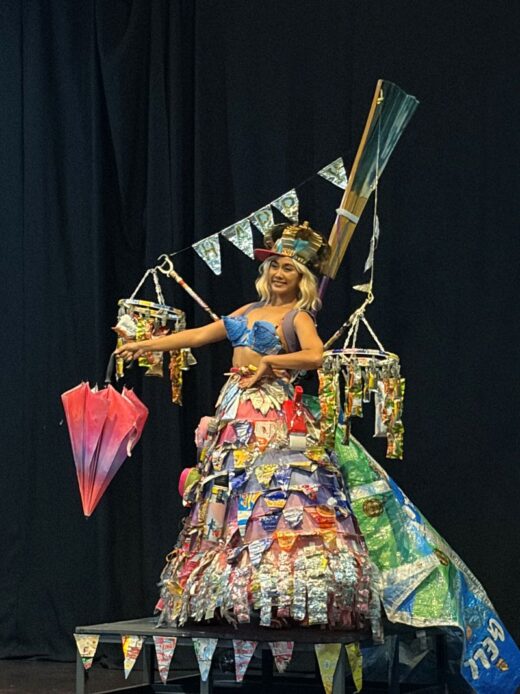
‘Gigil’ runs Oct. 22-25 at NBS Park, Pioneer St., Mandaluyong City
Dancer-choreographer Madge Reyes takes a brave leap in a conservative art scene, bringing experimental artists out from the margins and into public view. Through Fifth Wall VII, she has built a festival where dance collides with film, visual art, and other forms that defy convention. Its seventh edition, titled Gigil, takes its name from a Filipino word for an overwhelming emotion or an urge to break out. Running from October 22 to 25 at NBS Park, the festival will transform a parking garage into a stage, while installations on the ground floor invite visitors to explore the works in different settings.
Fifth Wall began in 2020 as the country’s first international dance film festival. Over the years, it has evolved into an alternative format that creates new contexts for dance through contemporary, cross-disciplinary, and experimental programming. Its flagship event is an annual movement festival held every October, while smaller programs and activations explore both experimental and commercial engagements.
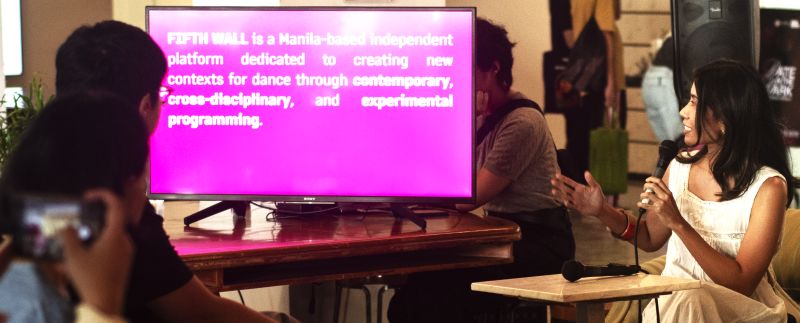
Madge Reyes, Fifth Wall founder and director
Reyes underscored that what makes Fifth Wall unique is the changing format and unconventional venue each year, allowing the festival to try out new ways of presenting art. The inaugural festival screened dance films from around the world, with support from embassies, including 12 Filipino-made works. The program also featured talks, workshops, and a virtual dance party. With theaters closed due to pandemic restrictions, Fifth Wall brought dance into people’s homes while exploring how cameras could change the way dance was made and experienced.
In 2024, the festival was held at the residence of Narcisa “Doña Sisang” V. Buencamino-de Leon, founder of LVN Pictures. Built by National Artist Pablo Antonio, the house became a fitting venue for film screenings, an art exhibition, and performances. The following year, Fifth Wall eschewed performances at RCBC Plaza. Visitors instead toured an emptied office floor with featured artists and creatives as guides. Large-scale installations turned the space into an experiment in how people, whether artists or not, could encounter and take part in art.
This year, the venue is a showcase of adaptive re-use. The central warehouse for National Book Store Group, the 6,000-sqm property on Pioneer Street in Mandaluyong City, has been transformed into NBS Park, a destination for retail, food, and cultural activities.

Adrian Ramos, National Bookstore president and CEO
Adrian Ramos, president and CEO of National Book Store Group, said the pandemic prompted National Book Store to rethink its role in an increasingly digital world. The rise of artificial intelligence added urgency to the question of how the company, known for school books and office supplies, could remain relevant. Its response was to pursue a broader mission of helping people live balanced lives, by making room for analog experiences, creative expression, and face-to-face interaction alongside work, school, and digital routines.
That thinking shaped NBS Park as a “third space,” a decentralized lifestyle mall model, designed like a cultural public plaza, making it a natural setting for Gigil, which invites audiences to encounter experimental dance and art in an alternative site.
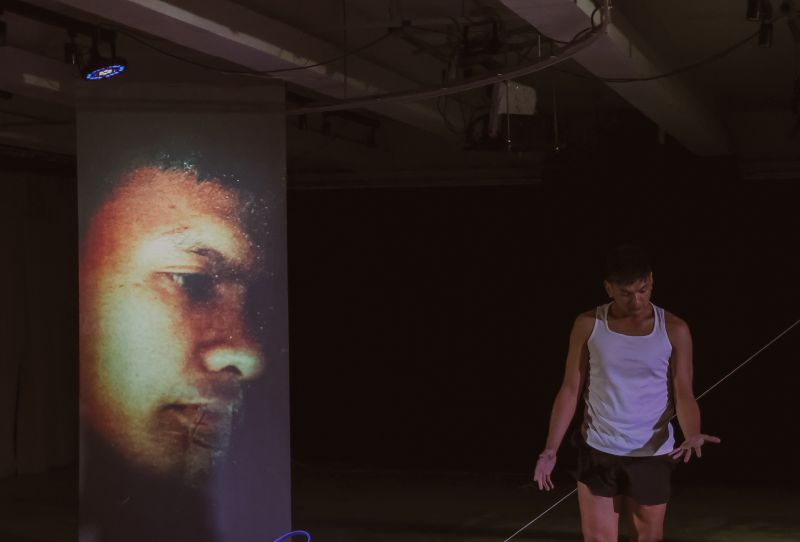
Al Garcia in ‘Lore’
At the press conference, Reyes talked about the seven collaborators—dancers-choreographers Al Garcia, Bunny Cadag, Ea Torrado, and Tohru Utsumi; light and multi-media artist James Clar; and filmmakers Tarzeer Pictures and Timothy Axiba—who will offer distinct interpretations of gigil.
Seven collaborators—dancers-choreographers, a light and multi-media artist, and filmmakers—will offer distinct interpretations of ‘gigil’
In Lore, Al Bernard Garcia brings ancient sky myths into the age of artificial intelligence, using AI to help create the choreography. The piece grew out of his three years living with the Paiwan indigenous community in southern Taiwan, where he learned their language, songs, and dances. He spotted similarities between Paiwan stories of the heavens and myths told by Philippine groups such as the Kankanaey, Bontoc, Bagobo, and Manobo. Garcia majored in folk dancing in the Philippines, and earned his master’s degree in choreography at Nanhua University.
Onstage, Garcia narrates a Paiwan sky myth in the community’s language, dressed in traditional clothing and accompanied by a blue woven basket hanging overhead. He fills the basket with garments, then slowly removes them, each piece bringing to mind the stories and traditions passed down through generations. In the end, he returns the garments to the basket, bringing the dance full circle. Lore asks where we come from, what we carry with us, and where we call home.
Filipino transfeminine artist Bunny Cadag works in theater, film, performance, and installation. Cadag draws on precolonial ideas about gender, traditional songs, and healing practices to create performances that invite people to take part and give marginalized voices a place to be heard. The Singer, making its Philippine premiere at the festival, brings together voice, movement, and theater to explore trans identity and queer history.
In Brown Madonna, Ea Torrado turns her personal story into a dance-theater piece that challenges ballet’s classical ideals of femininity and the way women have been portrayed and objectified. She sets Madonna’s bold sexuality against the Virgin Mary’s image of purity, questioning why women are often expected to be either one or the other. Costumes by multimedia artist Leeroy New, made with found objects and colorful fiesta decorations, add a distinctly Filipino touch to Torrado’s take on womanhood and sexuality.
Japanese dance artist and TikTok and IG sensation Tohru Otsumi, 59, aka Tohru Dance, is known for his playful moves, often performed in a business suit in public spaces. His videos draw viewers with the contrast between his salaryman image and uninhibited dancing. The oldest among this year’s largely millennial lineup, the Generation X management consultant and artist will lead Club Gigil, a free program presented with the Japan Foundation, combining an artist talk with a community dance jam set to a live DJ. Audiences will join the dance floor, turning spectators into participants.
Filmmaker and visual artist Timothy Axibal works with moving images and digital technology to explore how we record and experience time. He returns to the festival with 0001, a follow-up to his analog installation 0000, presented last year. The earlier work used a flip clock to display fragments of time. This time, Axibal turns to the human body, translating poses into a spatial record that captures the body in depth rather than as a flat image. The title continues the sequence, while the Filipino line “Wala tayong oras, meron tayong panahon” translates to “We may not have time by the clock, but we have time.” Axibal also collaborated with the festival last year on a video installation that gathered festivalgoers’ movements into a changing digital composition.
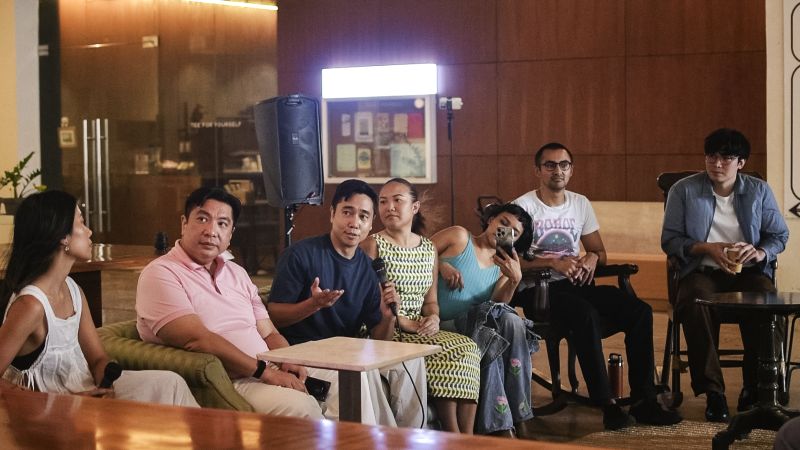
James Clar (center, talking)
James Clar is a light and media artist known for using technology to explore how people understand the world. He makes his first foray into live performance with Manila After Dark, a world premiere co-produced with Madge Reyes, who choreographed the work. An homage to Ishmael Bernal’s 1980 film Manila by Night, the performance inserts a new episode, set in 2026, into the film’s timeline. Through movement, light, and visual media, Clar and Reyes bring the film’s nocturnal Manila into the present, exploring how nightlife offers people a space to escape social restrictions, explore their identities, and find freedom in the city. Clar sees that need as timeless.
At Gallery 125 Projects, creative agency and photography gallery Tarzeer Pictures presents Spectral Spectator, a four-channel video installation that follows its 2024 work, The Rainbow List. Founded by Enzo Razon, Gio Panlilio, and Dinesh Mohnani, Tarzeer expands the earlier piece, which featured one movement artist, to four performers appearing in separate video channels. Rather than a live performance, the installation conjures an afterlife encounter through ghostly figures, miniature sets, makeup, costumes, and movement. The creators connect the work to this year’s theme, Feel the Pulse, through its interplay of emotional and physical sensations. Using imagery, color, and movement, the four performers evoke a sense of euphoria, moving instinctively rather than consciously thinking through each gesture.
Ayni Nuyda, founder of Search Mindscape Foundation, has helped fund and kickstart Fifth Wall since 2020. Initially set up to fund artist residencies abroad, Search Mindscape shifted its focus during the pandemic to projects that galleries and institutions might pass over because they offered little financial return. Its grants have since supported dance, performance, murals, and site-specific installations, with a focus on bringing art to public spaces and giving audiences ways to engage with it beyond buying and selling.
Nuyda, daughter of the late visual artist Justin Nuyda, founded the organization after working in corporate consulting and studying art business at Sotheby’s in Britain. Seeing Filipino artists hold their own in major art centers abroad, she wanted to build stronger links between artists, supporters, and professional practices. Search Mindscape also gives collectors and other arts supporters a way to contribute even after they have stopped acquiring art. Nuyda said she values Fifth Wall’s approach to making art an experience audiences can actively take part in, rather than something they simply watch.
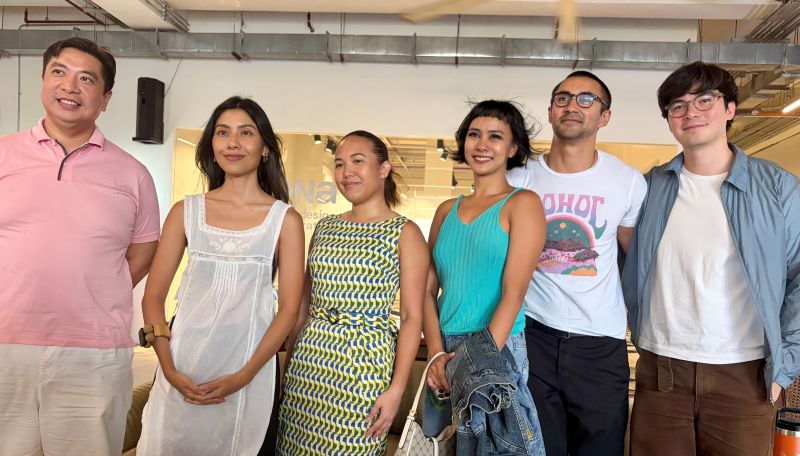
Anton Ramos, Madge Reyes, Ayni Nuyda, Ea Torrado, Enzo Razon, Gio Panlilio
Asked what audiences would take away from the event, Reyes said she wanted to create a fantasy world that anyone could enter and explore. Rather than tell visitors what the works meant, the artists hoped people would find their own meanings and make connections among the artworks and with one another.
Individual festival experiences for ‘Gigil’ will be ticketed online and onsite through HelixPay, with the exception of Club GIGIL with Tohru Dance, which is free entry but requires registration. Visit fifthwall.ph or follow on Facebook, Instagram, and Telegram.


