
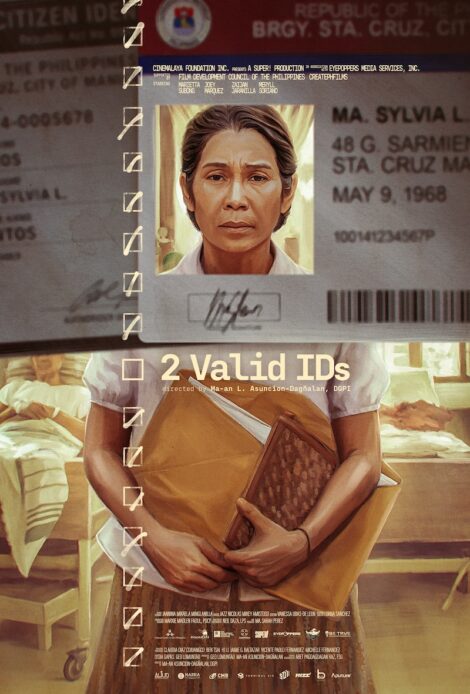
I braved the crowds at Gateway Mall recently to catch the 4 pm show of the indie film 2 Valid IDs. It was the darling of this year’s Cinemalaya Independent Film Festival and was therefore reissued in cinemas two weeks ago. It’s been enjoying excellent audience feedback and word-of-mouth, thus leaving event movies like Forgotten Island, well, largely forgotten.
The title of the film alone hits home to many of us who’ve sought to open a bank account or cash a check. We’re asked to produce two government issued IDs. Any person who doesn’t have them is doomed to be an outcast of our country’s version of humanity.
The film’s lead protagonist Sylvia Ramos (played by comedienne Pokwang) doesn’t have an ID. She’s from an Ilocos province, but she’s in Manila to look after husband Ramon (Joey Marquez). He’s seriously ill and confined in a public hospital. An aunt based in New Zealand has wired money to finance the surgery Ramon needs. Sylvia, however, can’t collect it from the courier unless she presents the two things mentioned in the movie title.
So off she goes on her excruciating journey to get an ID from two government agencies. As we all know, it’s a quest that can turn Indiana Jones into a demented Don Quixote.
Written by Abet Padagdagan Raz, 2 Valid IDs is an authentic rendering of the frustrations the underprivileged endure in a society that traps them in a catch-22 situation. ID applications require applicants to submit an ID! The mere mention of this in the film elicited a big laugh from the knowing audience.
As directed by Ma-an Asuncion-Dagñalan, the depiction of long lines at government institutions are fairly accurate. She also gets the message across with little use of didactics. It’s all there for us to see; red tape has Sylvia and Ramon trapped in the Dark Ages.
The movie barely scratches the actual conditions in the hospital. I witnessed this first-hand last summer when my sister, who’s living alone in an island province, fell ill and needed hospitalization. This was at the height of the Holy Week rush and miraculously, I reached the island with little hassle. I took her to the ER of the public hospital. I was armed with a budget that could have dwindled away in two days had I placed her in a private facility. This city has no BPI ATM, no cinemas, and just one McDonald’s branch.
The TB ward was full and not air-conditioned, but my sister was given a bed by the window where a slight breeze was felt. Entire families watched over their ailing loved ones. They cooked in the ward and slept on the floor. The bathroom was closed, and patients had to use the one in another ward on the opposite end of the wing. That one bathroom had no toilet. Patients did their thing squatting on the floor. Wheeling the patient to that bathroom was a challenge. My driving skills were put to the test as I steered the wing’s only wheelchair through the corridor—a maze of hospital beds occupied by the sick, kin seated on the floor glued to YouTube, phones being charged, mini electric stoves, and battery-operated fans.
I bought myself a little plastic stool—the kind used by manicurists—I could use for my own spot on the floor. But when I returned from the market, my space had been commandeered. It was now occupied by a newly admitted patient lying on a cot. I gave the stool to his wife and spent the nights at my sister’s house.
As with Pokwang’s movie, we became friendly with the kin of the sick. They generously offered assistance in whatever way they could. Aside from having undetectable TB, my sister has long been afflicted with delusions of aristocracy. She tends to treat everyone like her personal maid (including me!). I urged her to practice humility; she was in a public ward, and thus equal in status to fellow patients. It was advice she somehow heard but quickly forgot.
But our ordeal had a happy conclusion. Prior to being discharged, I joined a long line at the Malasakit Center, which thankfully approved my application for financial assistance. We didn’t pay a single centavo, and the always congenial hospital staff happily discharged my sister. 2 Valid IDs strangely omitted this option for its lead protagonist.
I could never forget the people in that ward. For them, such an inhuman predicament was normal. And this was captured with precision by the film director and screenwriter. They also tell Sylvia’s story sans attention-getting techniques. Melodramatic moments are at a minimum.
What makes the film work beautifully is the charming human connections. Sylvia and Ramon strive to live up to their marriage vows even if it’s not always obvious. We’re thoroughly moved when she says it’s her devotion to her husband that’s kept her patiently going through with the ID applications.
Pokwang and Marquez don’t perform; they simply become the characters, real people trapped in dire circumstances
New friendships made at the ward are poignant but not too sentimental. Just when it feels too depressing, a humorous quip eases their pain. Dated slapstick routines are thankfully avoided.
Pokwang and Marquez can make it light with just a throwaway line. They’re two of our most underrated actors. Both are primarily known for comedy, which is harder than drama. They don’t perform; they simply become the characters, real people trapped in dire circumstances. The chemistry between the two stars is priceless.
Also seamless is their rapport with Denver (played by Zaijian Jaranilla), a teener watching over his dying grandfather whose bed is next to Ramon’s. In real life, the talented Jaranilla is being hailed as a hero. He defended his underage co-star (in an upcoming project) from a movie reporter who asked an inappropriate question. Jaranilla’s gallantry adds a new layer to his role in 2 Valid IDs.
This film’s final 15 minutes are brought to the level of art by the leading lady. A frantic situation forces Sylvia to resort to desperate measures, and she’s heartbreaking in every moment leading to the finale. Pokwang delivers without melodramatic lines.
I dare say what this actress does is on par with any Meryl Streep performance. My apologies to Pokwang’s more established acting colleagues for putting her on a level far above theirs. Ask the audience at Gateway, none of whom I suppose had previously seen her on the big screen. The applause at the end was tremendous. It was our salute to a genuine artist.


