
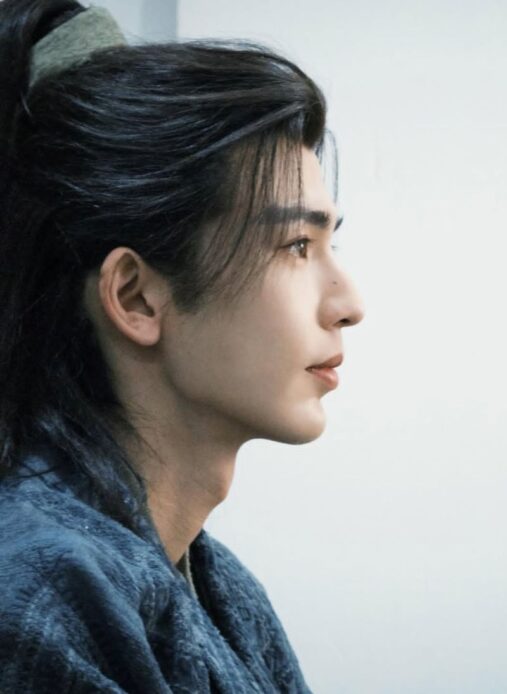
Pursuit of Jade (POJ) may be a global success, but some viewers griped on Threads about the drama series’ deviation from Tuanzi Laixi’s Zhu Yu, the web novel on which the series is based.
Curious, I read the novel (in English) and found that chapters were tweaked or cut out. POJ, for example, omitted Chapter 157, the showdown between Xie Zheng (Zhang Linghe) and Wei Sheng (Cheng Qi Meng), his former martial arts mentor, which would have made a thrilling fight scene in the series.
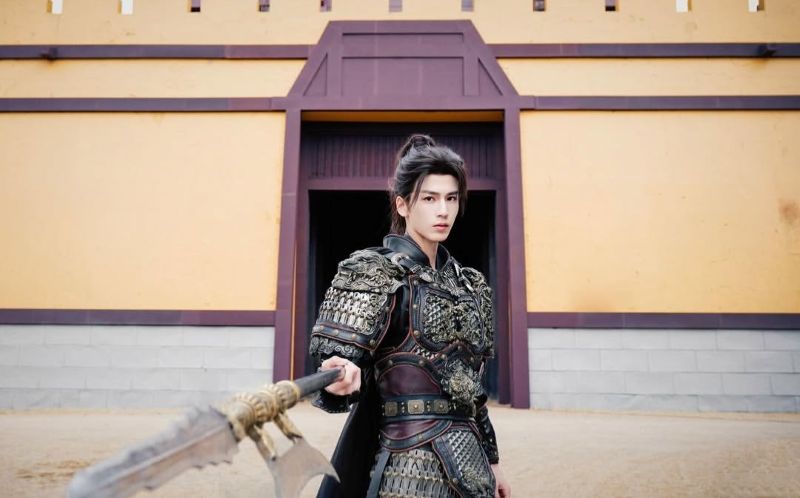
Xie Zheng with his halberd (Image from @zhanglinghe_1230)
This is how the chapter unfolded: Wei Sheng was incensed that his golden mace was parried by Xie Zheng with his long halberd. He retaliated, transforming his mace into a barbed nine-section whip and hurling it at Xie Zheng, who caught it nonchalantly. Wrapping it around his hand, he yanked hard and pulled Wei Sheng off his horse and towards him. Wei Sheng then swung the whip while walking towards Xie Zheng, intending to throttle him. Xie Zheng released the whip, unflinching at the half-inch-long barbs ripping his palm. He lifted Wei Sheng by the neck with his mangled hand.
POJ showed Chapter 158 or Xie Zheng’s duel with Wei Yan, whose 8-foot-long blade was brought to him by two soldiers and which he held with one hand. As uncle and nephew fought—the former losing because of his advanced age—Fan Changyu battled Wei Sheng.
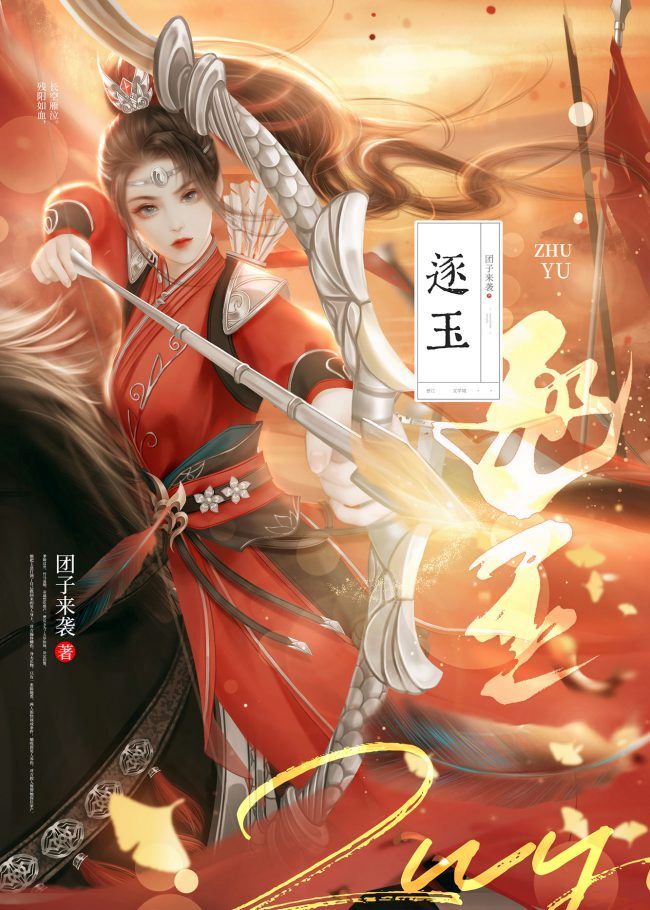
Zhu Yu from novelsupdate.com
The two confrontations of Xie Zheng showed him as the fearsome warrior, which, upon the exclusion of the first duel, convinced some viewers that it minimized his warrior persona. It was proof of POJ’s departure from Zhu Yu.
A series deviating from the original material is nothing new, nor is the question of whether or not it should follow the material to the letter. There are no hard and fast rules.
A viewer’s approach should be to see how well the director and screenwriter translated the novel for screen, and not set one against the other. An adaptation gives them latitude to rework the novel into something that will visually appeal to viewers. And POJ did just that.
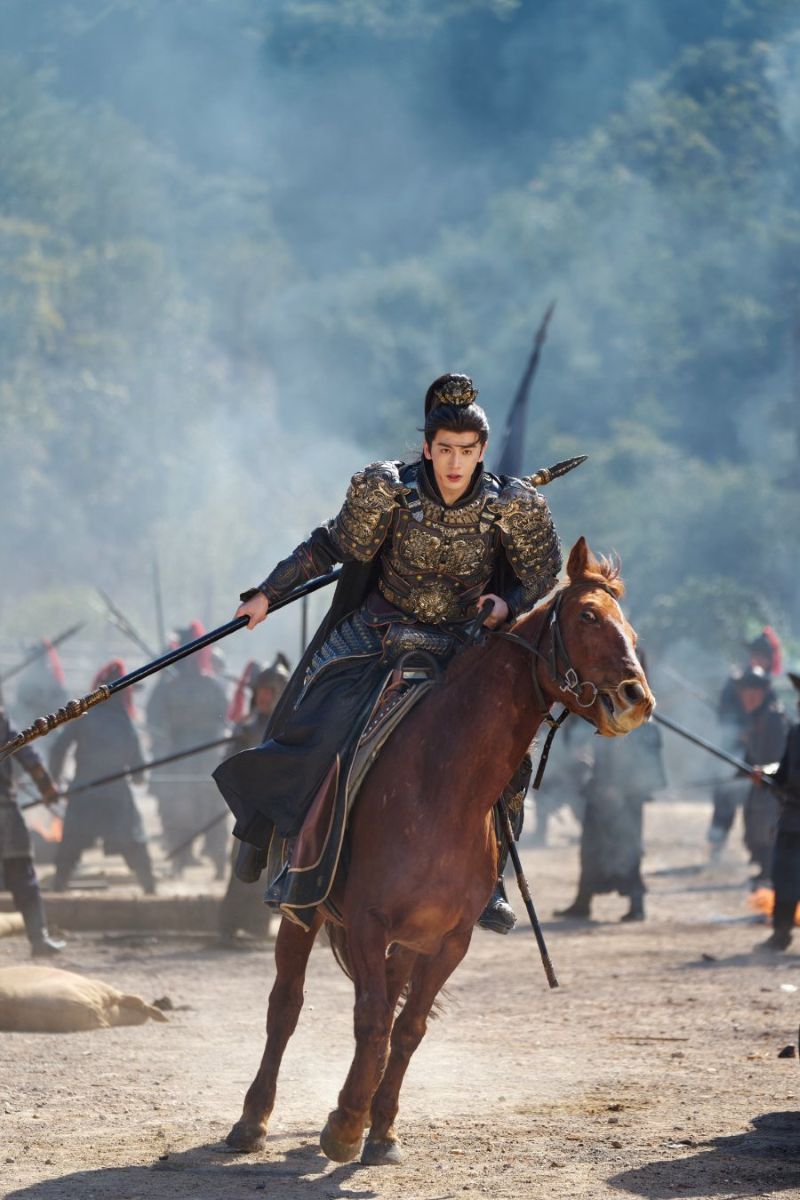
Zhang Linghe as Xie Zheng rides towards Fan Changyu (Image from mydramalist.com)
One prominent element was the shift in focus from Xie Zheng to Fan Changyu while continuing their entwined stories. The gambit of focusing on an orphan who avenges her parents’ death and finds love with Xie Zheng, and coupling it with action-packed pacing, was successful in keeping viewers invested in POJ.
Reimagining Xie Zheng and Fan Changyu’s personas is another key element. Xie Zheng was remodeled from the domineering, maniacal warrior into a gentle, loving man with unparalleled fighting skills, while Fan Changyu was presented as a strong, independent woman. The accolades would have been far less had the screenwriter insisted on Xie Zheng’s red-flag persona and Fan Changyu’s latent docility.
Lastly, love and pent-up desire were realigned with modern love, culminating in the consummation of Xie Zheng and Fan Changyu’s marriage in the tub and thereafter, in a relationship marked by elegant sensuality.
Xie Zheng was gorgeous in the novel and series. Sisters Fan Changyu and Chang Ning were mesmerized by his attractiveness after his face was cleared of blood and muck, prompting the latter to gush, “Big brother is so beautiful!”
The series kept to the novel’s themes that were grounded in Chinese history. Matrilocal marriage, or rùzhu, was practiced in imperial China (www.chineseidioms.com); it reversed the norm of the wife leaving her family and joining her husband’s household. Rùzhu enabled a family with no sons to maintain the family line. However, a man was scorned for not having his own family, wealth, and prospects.
The series kept to the novel’s themes that were grounded in Chinese history
Xie Zheng accepted Fan Changyu’s proposal despite the stigma because it hid his identity while he recuperated from his injuries.
Women on the battlefield without military training wasn’t a whimsical undermining of the gender bias. The women could count only on themselves when the kingdom was in chaos. Historically, Qin Liangyu is the only female general officially recorded as military commander of the formidable White Pole Army in the late Ming Dynasty. Liangyu was Laixi’s inspiration for Fan Changyu, but the general’s elite background was changed to proletarian to make Fan Changyu relatable (news.mydramalist.com).
Fan Changyu was fortunate in being skilled in martial arts, courtesy of her father’s teaching her self-defense.
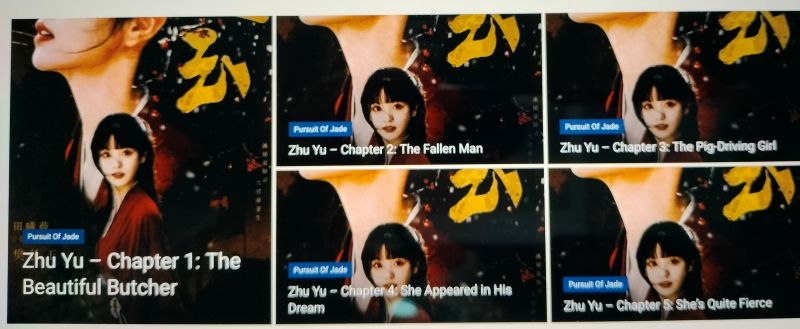
Zhu Yu from mydramanovel.com
Military purges highlighted the paradoxical situation of military commanders: They were needed, yet they posed the greatest threat to the emperor. Historical records show the purges of Zhu Yuangzhang, founder of the Ming dynasty, who had General Lan Yu, one of his accomplished commanders, executed in 1393 along with more than 15,000 people associated with him (www.chineseidioms.com).
Xie Zheng’s immediate family was eliminated by the previous emperor because of Wei Yan’s growing power and influence, and an impudent remark he uttered in a drinking session. Years later, Wei Yan ordered Xie Zheng eliminated (though he survived) because he was becoming a major threat.
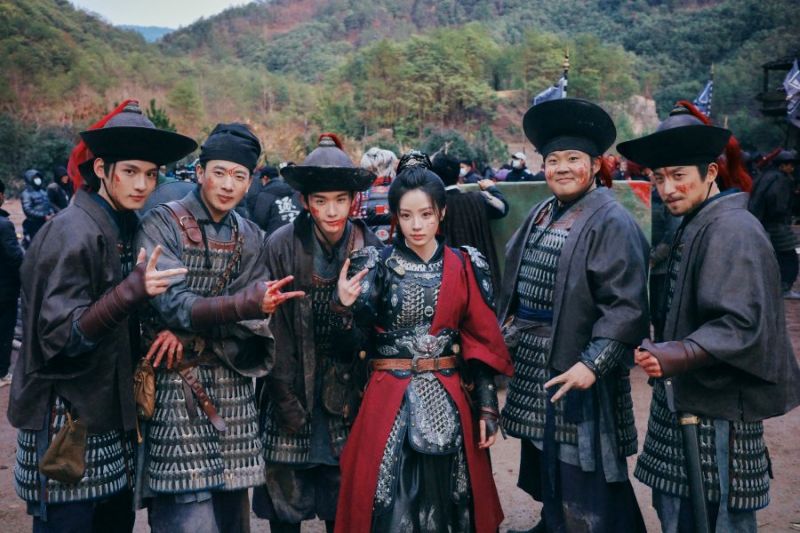
Fan Changyu with the Northwest Pig Butcher Squad (Image from mydramalist.com)
Details in the novel were changed in the series. In Chapter 69, Fan Changyu was alone in a labor camp, but in the series, the Pig Butcher Squad was with her. The village in Chapter 72, where the conscripted laborers lived, was suddenly inundated, whereas in the series, they drew cards to determine who would leave and who would stay in the deliberate flooding of the village.
Chapter 73’s gross detail of Fan Changyu scraping the necrotic tissue from Xie Zheng’s chest was replaced with the more acceptable gentle dabbing of the wound.
Fan Changyu’s great strength was described in Chapter 77, when she took down a “robust black bear” with her butcher’s knife. The series showed her easily hefting pigs on her shoulder, moving boulders up the mountain, and striking down enemies with a weapon.
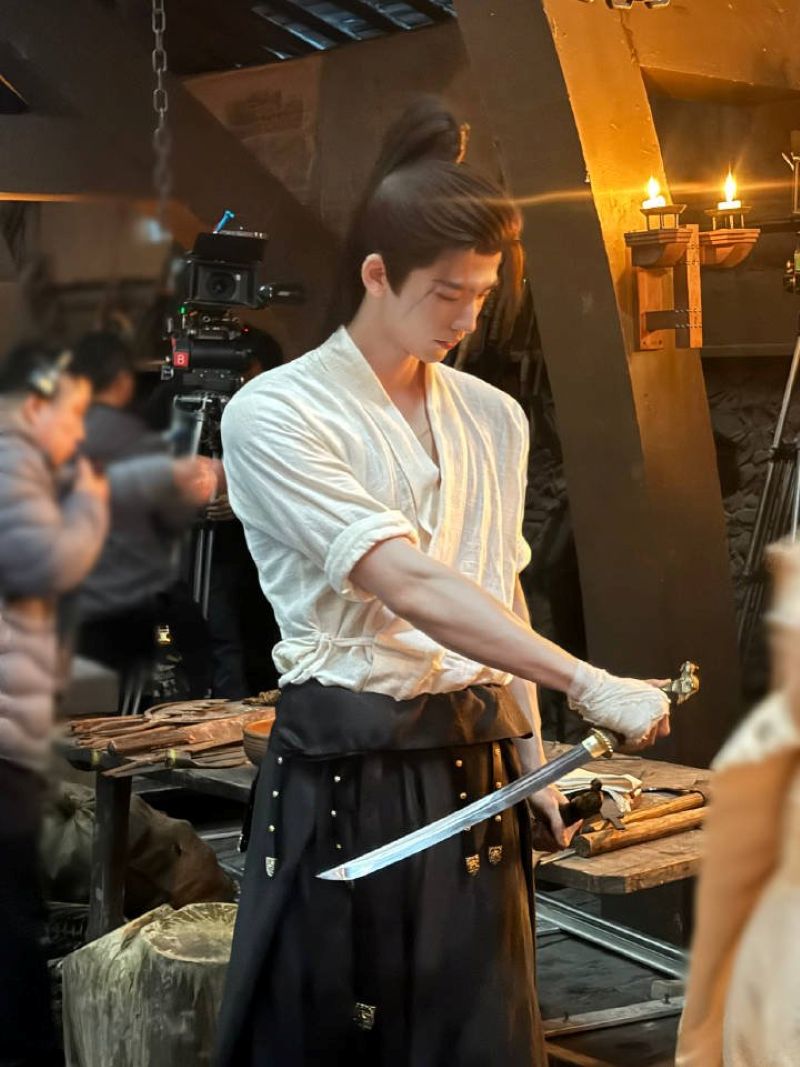
Xie Zheng forges a sword for Fan Changyu (Image from mydramalist.com)
Xie Zheng made Fan Changyu’s new sword, the series showing him consecrating it by rending his forearm. But Chapter 97 narrated that Xie Zheng commissioned a bladesmith to forge the Modao (long-handled sword) and slashed his back to sanctify it.
Chapter 101 related Xie Zheng’s juvenile side, which the series skipped. After learning that Fan Changyu carved dolls for Song Yang when they were young, he wanted one, and she indulged him by carving a figurine.
A glaring alteration was the breakup. The series had Fan Changyu end the relationship because of the vast gap between their status. In contrast, in Chapter 104, Xie Zheng broke up with Fan Changyu because she was the daughter of his father’s murderer. Nonetheless, the series retained Xie Zheng being whipped 108 times as atonement for his love for Fan Changyu, intensifying the romance.
Interestingly, Xie Zheng’s masochist tendency in the extra Chapter 2 wasn’t included in the series. He got jealous after seeing an annotated book given by his rival, Li Huai’an, among Fan Changyu’s belongings. His unhinged behavior towards Fan Changyu, particularly when they were intimate, prompted her to stay away from him for a couple of days. (Those who read the novel noticed the change in Xie Zheng’s fierce temperament into a mild one.)
Chapter 139 presented love and desire in the traditional sense—no physical intimacy—until after marriage. With great restraint, Xie Zheng, who was inebriated, only kissed Fan Changyu passionately then had her taken back to her residence. He told her he wanted to follow the proper betrothal rituals and not dishonor her. The series had Xie Zheng drugged to make him lose his inhibitions and figure in a scandalous indiscretion with the Grand Princess.
Each medium has its own merits. With a book, a reader is privy to the characters’ thoughts through pages of internal monologues. It also doesn’t curtail the reader’s imagination (or budget) in visualizing events, locations, people, etc. Reading the novel is better if one wants to deep dive into Xie Zheng’s character, i.e., his tyrannical warrior side.
Each medium has its own merits. With a book, a reader is privy to the characters’ thoughts through pages of internal monologues
In a novel adaptation, screenwriters delete subplots, overlook or create characters, and turn soliloquies into action, which is paramount to keeping viewers interested, more so if they aren’t keen on talky films. Screenwriter Zou Yue added the four ruffians of the Northwest Pig Butcher Squad. The men trashed Fan Changyu’s home, but eventually became devoted to her when she employed them in her braised-pork shop. The butcher squad provided insights into the main characters’ thoughts, as well as levity when episodes got heavy.
Significantly, a screenplay is a new work on its own, a reinterpretation of the original material that’s visually reimagined by the director. POJ director Zeng Qing Jie’s adept play on light and shadow and general camera work elevated the novel into a cinematic masterpiece, with episodes appearing like music videos, i.e., Fan Changyu and the marquis in the bathtub and Xie Zheng grabbing Fan Changyu, while on horseback, as she ran from him.
Adding to Qing Jie’s brilliance is making Xie Zheng more desirable, and not through heavy filters. He did it with lighting, composition, and camera angles. But his job was obviously made easier with Zhang Linghe’s natural beauty.
There’s no overthinking whether or not to watch the series or read the novel first because they have the same storylines of love and marriage, women, and military life. But whichever you choose, the 40-episode series and 170-chapter novel (though it needs better translation and major editing) somehow take the edge off everyday living.


