
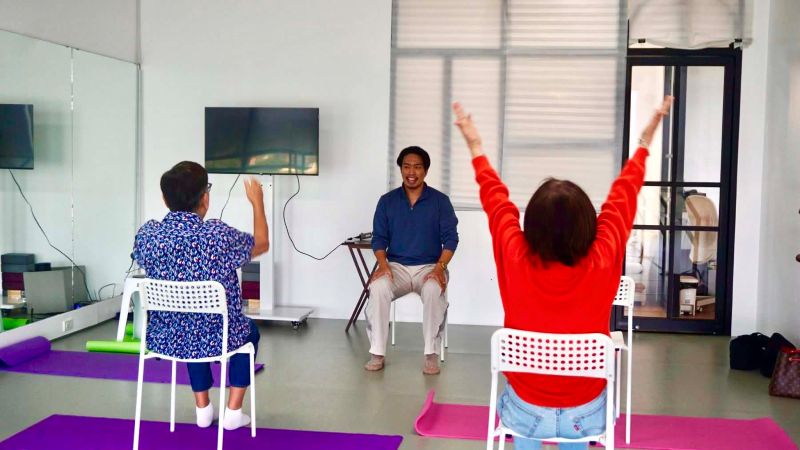
Of all the seven arts, dance allows the artist the shortest professional career, give or take 20 active years max, not counting the basic training from an early age. And yet, the skills honed by a dancer forever remain as muscle memory. On a strength-to-weight ratio, dancers can outdo, say, a professional football player in muscle endurance, balance, stamina, fatigue resistance, flexibility, performance duration, and more.
So then, what is the dancer’s future beyond those performing years?

Richard Yadao with Dr. Jose Antonio Luis Pantangco and Dr. John Paul Cruz
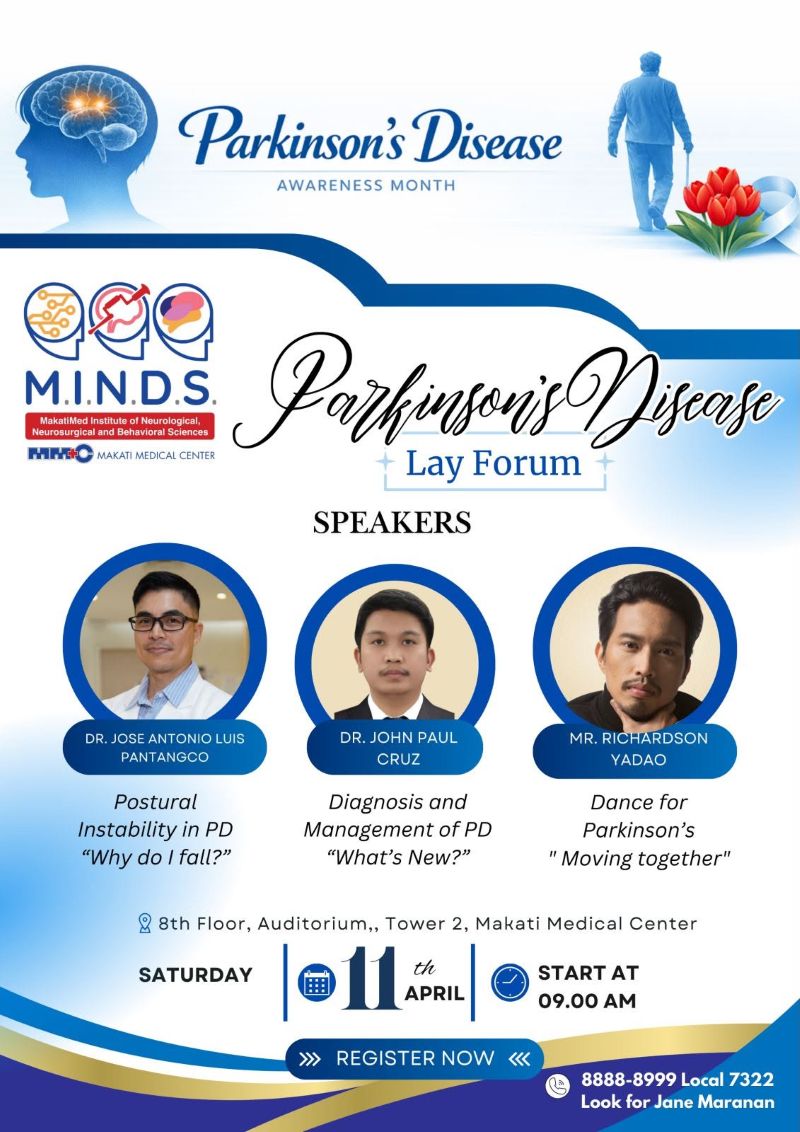
Parkinson’s disease forum
Richardson Yadao, a newly “retired” lead dancer of Alice Reyes Dance Philippines (ARDP), found his alternative niche shortly after “retirement” from professional dance, finding his way to musical theater, bravely auditioning and getting casted as ensemble dancer in The Bodyguard, A Christmas Carol, and most recently, in A Chorus Line, this time taking a speaking, dancing and singing role as Larry, the dance master. Opportunities as these may come few and far between. Richard, forward -thinking, is aware of that.
Dance, and to an extent, theater, has always been central to his life. He was trained in school, later auditioned at Philippine High School for the Arts, where he focused on ballet. In the summer, he took classes at Ballet Philippines. He went to the College of St. Benilde, major in dance, then going into a course in Arts Management. He later joined the Filipinescas Dance Company led by 1976 National Artist for Dance Leonor Orosa Goquinco, whose legacy as one of the most influential figures in the performing arts includes the pioneering interaction of Philippine folk dance in balletic form.
His most recent stint in performing was with the ARDP, as one of the company’s lead dancers.
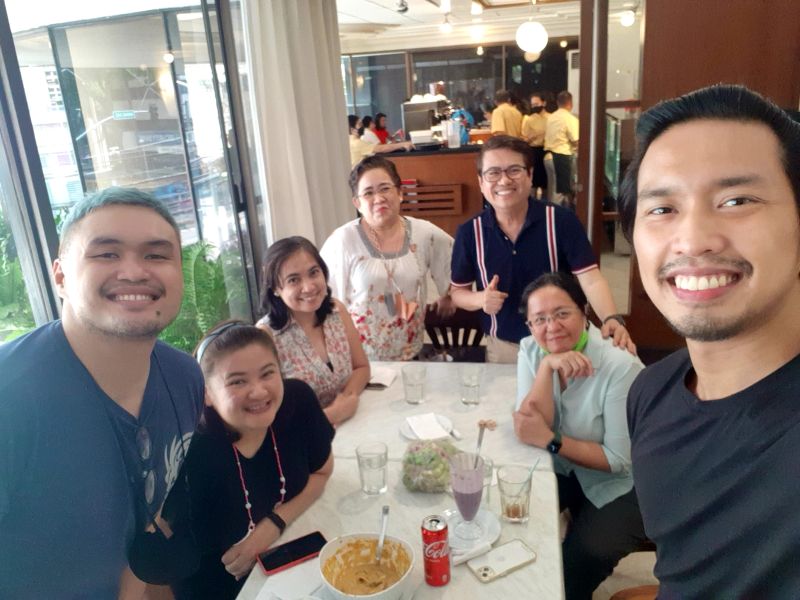
Yadao (foreground right) with CCP Sining Galing team
All these years, he felt healthier when dancing, as movement eliminated stress and anxiety. The discipline required of dance “takes you away from the chaos of the world,” he says. Even while still active in dancing, he accepted the request of the Cultural Center of the Philippines’ (CCP) Arts Education component, called Sining Galing, Sining sa Eskwela for wellness and education skills training.
In December 2021, in the wake of a heavy Typhoon Odette, he became a volunteer for wellness workshops in Surigao del Norte, one heavily devastated area left with a homeless traumatized population. Through movement therapy, the workshop participants slowly recovered, enjoying calm through moves and music. “The absence of movement is death,” he emphasizes.
Based on his experience and observations of how people reacted to the moves, he develped a movement program with a dance syllabus, tailored not for performance, but for awareness of self and calmness of spirit, utilizing space, time, the body and actions, internal energy, and outer movements.
“The use of music is part of it, as it triggers something,” Richard observes.
Another institution where he conducts movement sessions is at The Child’s World: A Growing Center Inc., where Richard choreographed a piece for theater director Karl Jingco’s musical for children with autism of different levels. He included each child’s guardian so that the guardians themselves could translate the instructions to the child. While this activity could prove a trifle challenging, Richard nevertheless loves teaching dance and has dissected ways to adapt movements through dance improvisation and spontaneity.
He also holds online sessions and dance talks at Eva Salvador’s Arts Education Program in Mindoro and Surigao. He also works with Dr. Czarina Diesta in movement, focusing on patients with anxiety and stress disorders, cancer, Parkinson’s disease and autism, and with Dr. Bernadette Terencio, whose specialization is epilepsy.
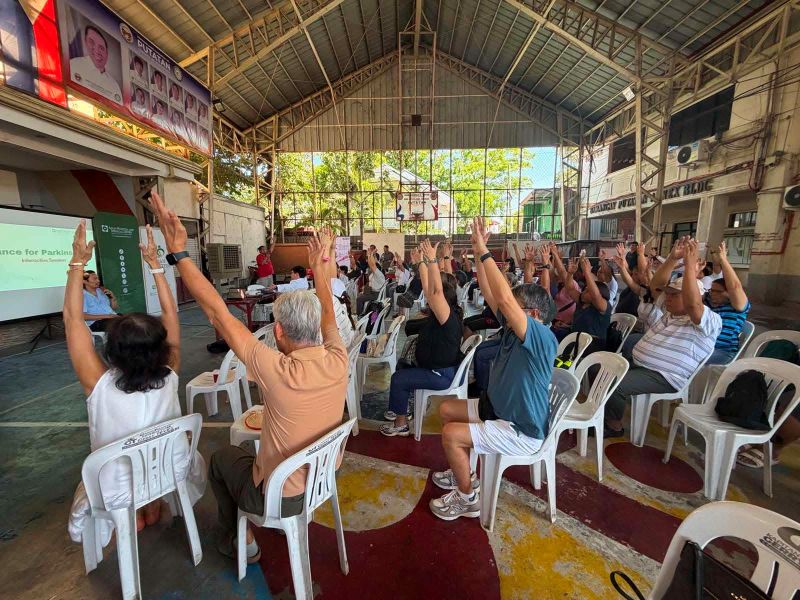
Seated dance moves for patients with Parkinson’s disease
Evaluating the results of his sessions through his attendees and their parents, he has ultimately developed a syllabus based on space, sensation, and timing, according to these dance phrases and elements of dance. From this evaluation and analytical process, he manages to revise or carry on what works best for particular illnesses or conditions. This enables him to further understand how the body works through baseline outputs that may lessen the progression of Parkinson’s disease and other ailments, hopefully leading to long-term results.
On May 17 in Alabang, Richard will hold a recital of his participants who are stricken with autism and epilepsy, cancer, and Parkinson’s disease, along with their respective guardians.
Pushing his program further, he intends to move on to the next level as he looks forward to grants abroad, specifically at the Wertheimer Fellowship Dance for Parkinson’s Disease, whose training syllabus was developed by the Brooklyn Parkinson Group and the Mark Morris Dance Group, a modern dance company founded by artistic director and choreographer, Mark Morris.
The dance company is referred to as “the preeminent modern dance organization” of this time. The company, unlike other companies, has its own Music Ensemble, merging the effects of music and movement to achieve positive results in people affected with these particular conditions. The program aims to provide educational opportunities for people of all ages and abilities, something that may not be far from Richard’s ultimate goals.
To Richard, dance does not stop at knowing the steps and techniques or being graceful. In his language, it goes way beyond for those who are naturally gifted to perform.
May his tribe increase.


