
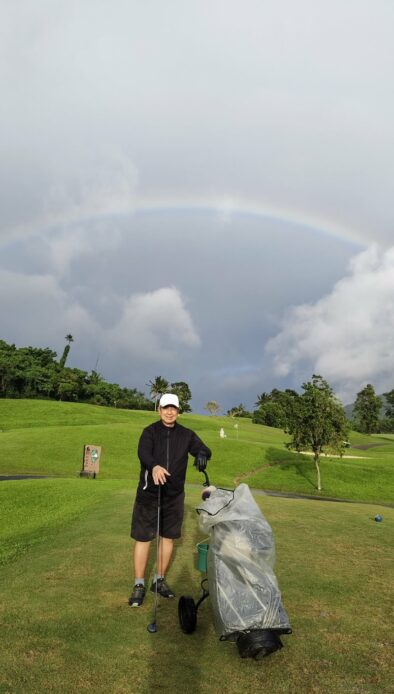

‘Book Haul’ by Cecil Robin Singalaoa, watercolor on cotton rag paper, 2020, 4×6 inches
Not only is this author a friend—so I just have to score his latest title to encourage him further—but his collection has an unusual and puzzling title. The Ruminant Ant & Other Essays by Roderick Toledo compiles his almost 60 short prose written for Philippine Daily Inquirer’s opinion section and the online zine CoverStory.ph. The essays were published from 2016 to 2025.
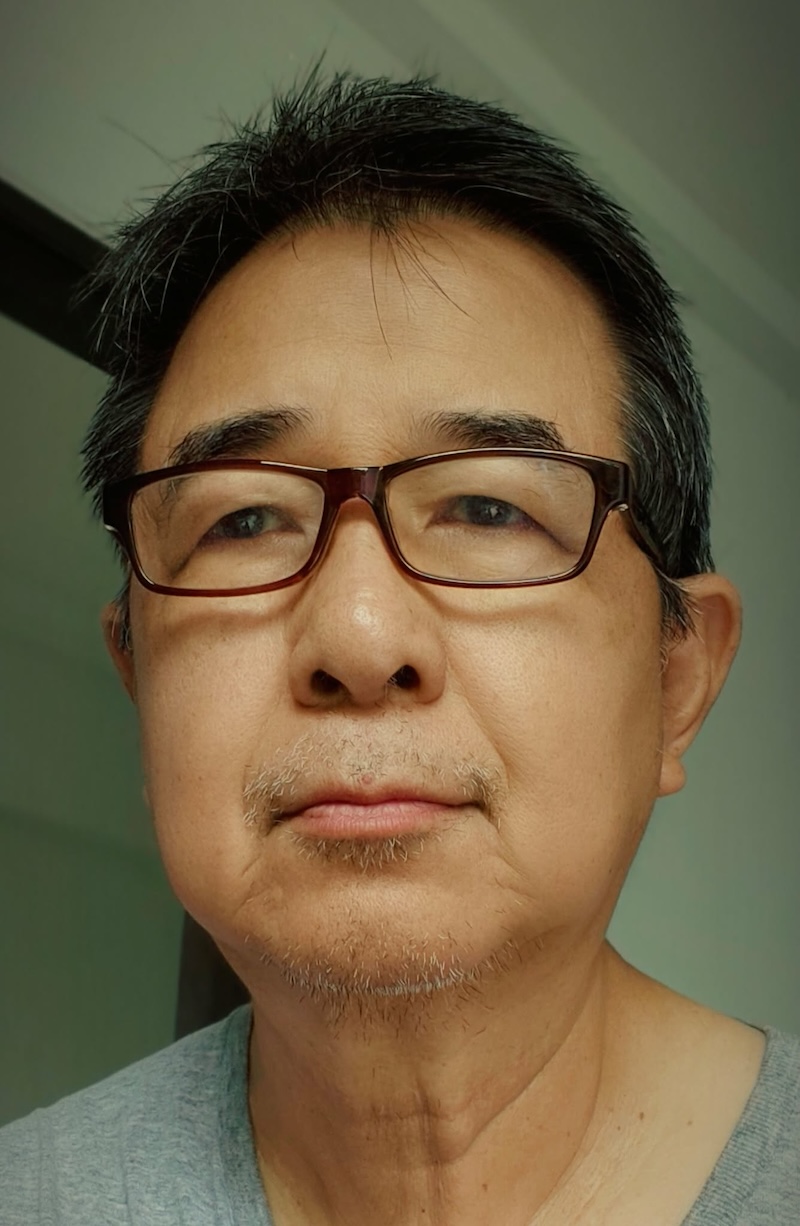
The ruminant author
I know him more as this tall, quiet fellow, who takes photographs of birds (some samples are included in the book to illustrate “Birds flying into manmade things”) and turns them into cards, the dependable ex-colleague who managed a number of development communication and advocacy projects.
But his world view is expansive, too, not just inwardly directed, although foremost essayist Rosario A. Garcellano, in her introduction, sees him as “in constant inner conversation—a stance that suggests a continuing inquiry and, necessarily, an intent to arrive at answers.”
In his search to find “The way to overcoming historical amnesia,” he pinpoints the Filipino’s “capacity to forgive and forget” as “a blessing and a curse. The ability to forgive and forget makes healing possible, just as it makes tolerating abuse possible…It is good not to dwell on what is negative because we must allow our wound to heal and scar over. But the same ability can also make us prone to indifference and tolerant of abuse.”
What happens with a national trait like this is “…You will just get broken up over and over again.” What he suggests is “we must heal to continue fighting.”
It is when Toledo gets especially personal, like when he pays tribute to his Lola Mameng’s cuisine and the culinary discipline she had him undergo that he is most effective. Lucky is his partner in life because this boy, who grew to a man, learned how to descale and clean fish instead of spending idle time reading comics.
Included is how to prepare Lola Mameng’s favorite fish dish: inun-unan (or paksiw na isda the Visayan way). Her propensity for sucking the fish head, he later learned, had a scientific basis: “Fish heads are a good source of vitamin A and omega-3 fatty acids that help maintain good eyesight and boost memory and cognitive function.”
In Finding the quiet, he argues in favor of movies that make the viewer appreciate “scenes of penetrating quiet and introspection” instead of carnage and dystopia. He cites Lost in Translation, “with the turmoil inside the characters” while the two protagonists say their goodbye in a busy Tokyo sidewalk.
He writes, “Whatever else may have been lost in translation, now in this climactic moment, there is nothing to translate. It is pure, quiet and lost forever.”
He goes on to conclude that “we must in our daily lives seek those moments of quiet and keep balanced in our center, in our inner no man’s land, unfazed and unafraid.”
Is it any wonder that the pastimes Toledo indulges in are fairly quiet (not much grunting) sports like Muay Thai and golf? The former is a martial art that makes him feel like, among others, “a Southeast Asian.”
He is also an avid reader, a practice he wants to hand down to his son who uses most of his allowance to buy books. When asked by the younger man what three books the father would recommend, they are Dickens’ A Tale of Two Cities, John de Carre’s The Spy Who Came in From the Cold, and Camus’ The Stranger.
At some point the father realizes that he no longer reads fiction. He reasons, “Maybe because I am no longer young and I no longer need fiction to vicariously experience life and death. It is not only life that seems to hold no meaning at times, but death as well. More so now, living as we do in the time of nightly drug executions, do I realize that fact is more compelling than death.”
He closes the essay with what I feel to be what makes this book worth the price of admission or of opening it: “It is only by loving that we can gain a measure of redemption.”
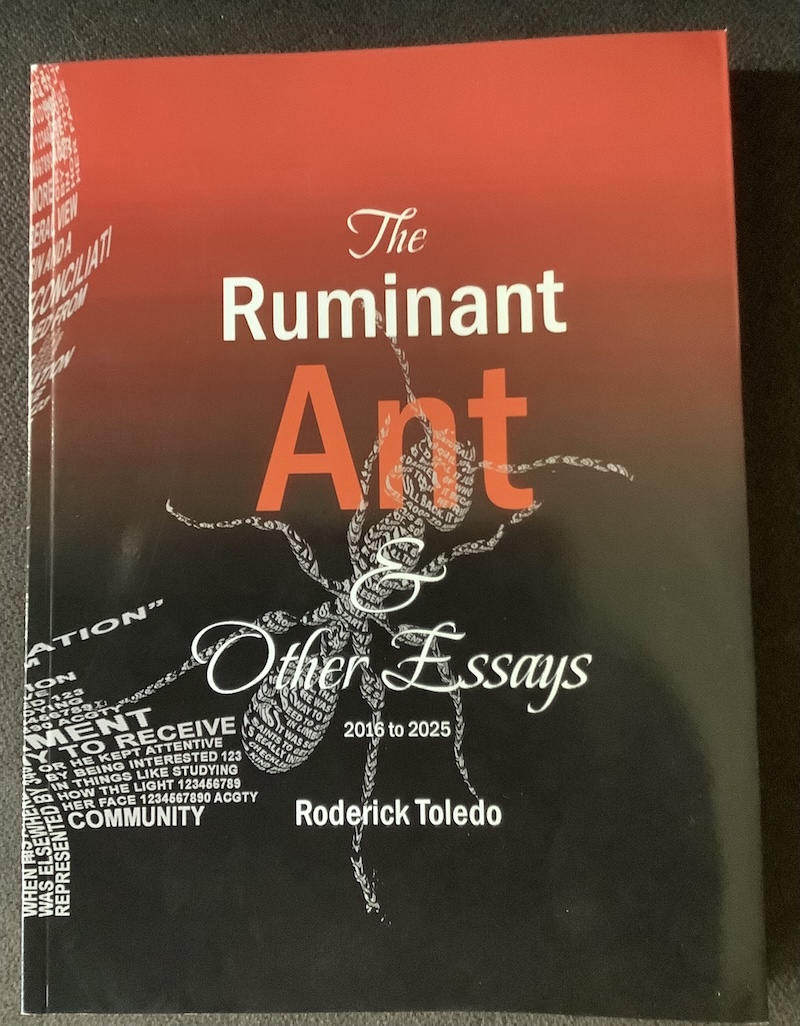
Cover of Toledo book
In a conversation with TheDiarist.ph, Toledo explains his choice of a title, The Ruminant Ant: “For ‘higher’ creatures, ants are mostly considered inconsequential. They do not speak, have no voice. And yet they are highly organized, highly successful. They are barely noticed, except as ‘pests’ and yet they are there, they survive. What do they ‘think,’ really? I as a human live in my head as I try to make sense of myself and of the world, thus the ruminative aspect. The ant survives because its life is not its own. It is immortal, and perhaps my thoughts can also survive as part of the entire human experience, inconsequential though I may be.”
He has written all his life, “beginning with school periodicals, then media communications work. I like best the short form essay because it is like the distillation of a lot of inputs, like an impressionistic work that paints in broad strokes yet captures the essence of a scene. I write to ‘please’ myself, and that is the only standard I need to observe—fairness, accuracy, coherence, readability are integral parts of that standard and which I need not worry about when I write something I am happy and cared to have written in the first place.”
As for the writers he admires, he enumerates Randy David, “for his incisive, clear thinking, a true academic and public intellectual”; Nick Joaquin, for capturing the Filipino soul; Rosario Garcellano, ironic and hard-hitting, no nonsense, an essayist I wish I could be; Albert Camus, for expressing my worldview; William Faulkner, for his density yet clarity of language; Michael Herr and Sebastian Junger for their war reportage.”
The book can be ordered by emailing rextoledo@yahoo.com. A copy costs Php1,200, excluding delivery charge.


