
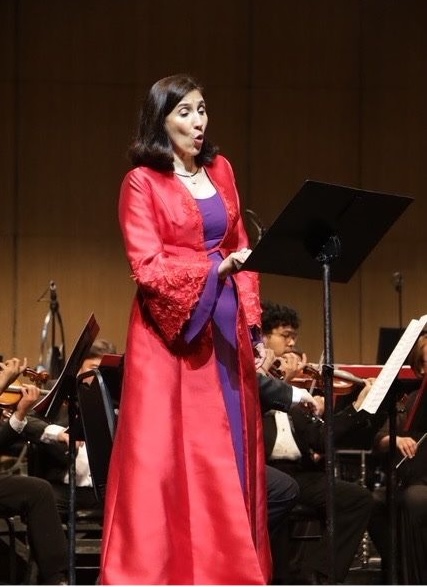
Soprano Andion Fernandez (Photo by Orly Daquipil)
Preludi, the Philippine Philharmonic Orchestra’s (PPO) fifth concert of its current 41st season, under the baton of principal conductor, Grzegorz Nowak, was a standout!
Held at Samsung Performing Arts Theatre at Circuit Makati last January 16, the concert had soprano Andion Fernandez Ching and pianist Szymon Nehring as guest artists.
Rather than the usual overture, Jeffrey Ching’s revised Fenghuang Singing opened the concert and got its Philippine premiere! The prolific composer wrote it in 2019 for the IMPULS Festival for new music in Sachsen-Anhalt, Germany, to commemorate the 30th anniversary of the fall of the Berlin Wall. Composer Ching is the PPO’s composer in residence, and has enriched PPO’s program with his witty, contemporary compositions.
Divided in two parts, the work, the composer explains in his notes, “takes the form of two fugues—a prelude of fugal character” followed by his completion of Bach’s unfinished Contrapunctus 14 from his The Art of Fugue.
Soprano Andion Fernandez Ching surprised the audience coming from the hall entrance as she blasted a powerful high note. The venerable maestro Nowak collaborated on stage with most of the musicians, some of whom were placed in the upper boxes. The hall was engulfed with a sonorous sound that was sung in lament over the bombing of Germany in the second world war, leading to the rise of the Berlin Wall in 1949.
One could feel the angst as the soprano’s voice covered a wide range of registers: earthy low, resonant middle, and floating high notes. She moved from one place to the other, until she reached the stage in the second part of the piece.
One could feel the angst as the soprano’s voice covered a wide range of registers: earthy low, resonant middle, and floating high notes
At one point she was joined by a solo trumpet, eloquently played by Glober C. Calambro. Together they forged a brilliant lament, all the more enhanced by the sonorous playing of the orchestra under Maestro Nowak’s authoritative command. The audience caught the various sound effects produced by the orchestra, notably the hissing sound of a bomb dropping.
On stage, Andion cut a regal figure completing the second part of Fenghuang. A mythical bird, fenhuang symbolizes harmony and good fortune. At long last, the Berlin Wall had collapsed, and Germany was reunited. Such unity was likened by the composer to Mao Zedong’s calligraphy that is both expressive and powerful.
As Bach’s music ran out, composer Ching completed the work with music for the celesta and harp—all scored in modern idiom that made use of microtones, glissandi, chromaticism, and the like. Indeed, the work is quite a feat—a significant new work that extols Germany’s reunification.
Conductor Nowak acknowledged later the presence of composer Ching, who went up the stage to the vigorous applause of the audience. He announced that his new work, an opera titled The Butterflies, will have its world premiere in Shanghai this March, then in Lanzhou and Chengdu in April, with Darrell Ang conducting. He acknowledged the presence of Dr. Milagros Ong-How, a philanthropist, who gave generous support for the writing of the opera.
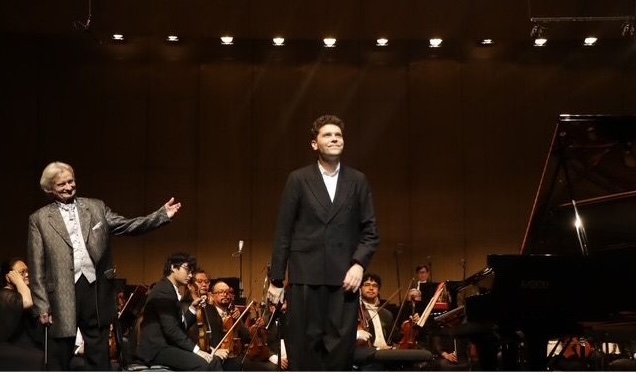
Polish pianist Szymon Nehring being acknowledged by Maestro Nowak
Young Polish pianist Szymon Nehring instantly became Manila’s piano sensation. He showed utmost virtuosity surging through the entire Chopin Piano Concerto No. 1 in E minor, Op. 11. It was such an impressive performance!
At once one noted his virtuoso stance in the first movement. After the long orchestral introduction, he played continually with such vitality. His power did not diminish as he sang his lines, including that long passage in the coda.
In the second movement, he etched those poetic lines, complete with decorative singing phrases. In the last movement, he played with solid dispatch, giving that “native touch,” so to speak, to the Polish dance-like rhythm. His virtuosity was of the highest order. Brilliantly, he played the dazzling coda, with chromatic runs and repeating piano patterns and the like, to the audience’s delight.
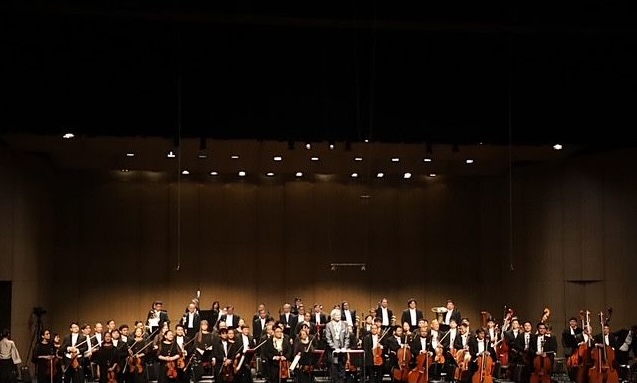
Maestro Nowak with the PPO
He had a strong dynamic rapport with the orchestra. Maestro Nowak, himself a Pole, knew the music by heart. The performance ended to thunderous applause and shouts of bravo.
For encore, he played the Polonaise in E-flat Major, minus the Andante Spianato, and all the more he dazzled the audience.
Franz Liszt’s Les Preludes, the most popular of the composer’s symphonic poems, concluded the program. One savored the composer’s brilliant orchestration that the PPO superbly played. One enjoyed the rich and vibrant symphonic sound that the PPO musicians essayed, passionately depicting the work’s dramatic thematic transformations. The program notes eloquently explained, Lizst wrote it not as an abstract form, but as a “vehicle for ideas, emotions, and philosophical reflection.” Thematically, its inclusion somehow aligns with the Ching opus that was played as an opener, giving the entire program a philosophical dimension expressed brilliantly in symphonic performance.
Congratulations!


