

Winning designers with FFAA officials
The FFAA will hold an exhibition of the winning entries on June 9 at Lucky Chinatown Mall in Manila.
The story about the winners of a footwear design competition involves more than the descriptions of the shoes themselves. Industry leaders say the bigger story is how designers, manufacturers, artisans, and government agencies are working together to strengthen the Philippine footwear sector and showcase Filipino creativity on the international stage.
The shoe industry celebrated two significant achievements. For the first time in 11 years of participation in the 15th International Footwear Design Competition (IFDC) in Guangzhou, China, the Philippines won the grand prize, the Xinhaopan Gold Award. The honor went to Pakan (Spool), designed by Ricmar Agas, which was inspired by the weaving traditions of Northern Luzon.
The industry also celebrated the winners of the inaugural National Footwear Design Competition, where Bon Marter won the grand prize for Tangled (Sala-Salabat), inspired by the snarled electrical wires that have become intrinsic in urban landscapes. Titled Hakbang at Habi | Where Every Stitch Tells a Story, the local contest encouraged designers nationwide to reference their heritage and local narratives.
The Filipino Footwear Alliance Association (FFAA) said the victories reflect the growing strength of the local footwear industry and the support it receives from the Department of Science and Technology (DOST) and the Philippine Textile Research Institute (PTRI). The FFAA, a trade organization representing manufacturers, designers, and suppliers, also marked another milestone with its official participation in the Confederation of International Footwear Associations, a global network of national footwear groups.
In our interview, the FFAA said the competition entries represented the work of an entire ecosystem. Designers collaborated with manufacturers who produced the prototypes, while artisans from different parts of the country contributed specialized skills such as heel sculpting and embroidery. Every entry in the National Footwear Design Competition was also required to use footwear textiles developed by PTRI.
“We incorporate sustainable Philippine tropical fabrics into the footwear entries,” said Liz Melma of PTRI. “These are not ordinary textiles. They are engineered specifically for footwear applications using natural fibers that have been developed from raw material processing to yarn production and weaving. One challenge we addressed was preventing adhesives from seeping through the fabric during shoe production. By developing thicker textile structures, we were able to make the materials more suitable and durable.”
The winning entries demonstrated not only individual talent, but also the collaboration, innovation, and technical expertise that are helping move the Philippine footwear industry forward.
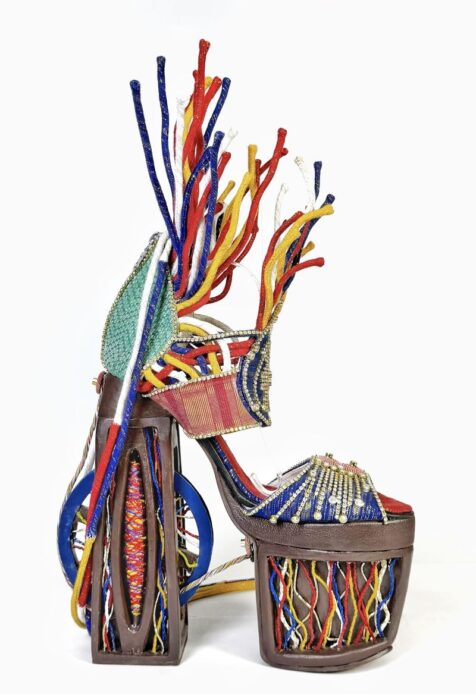
For the international winners, Ricmar Agas, a self-taught designer from Bangar, La Union, won the Xinhaopan Group Gold Prize, First Prize in Female Trendy. He took fashion illustration courses at the Fashion Institute of the Philippines before turning to footwear design. His winning entry, Pakan, looked into inabel, the handwoven textile tradition of the Ilocos region.
Ricmar Agas won the Xinhaopan Group Gold Prize, First Prize in Female Trendy, with his entry ‘Pakan,’ which looked into ‘inabel,’ the handwoven textile tradition of the Ilocos region
Pakan likewise earned Female Trendy Individual Winner, making it the overall champion among all categories. The design pays tribute to his parents working on handlooms in La Union.
The shoe uses pakan, the Ilocano word for spool, which also refers to the colored thread woven into a base fabric. The santol wood heel post and platform symbolize the loom frame. The sculpted heel incorporates elements of the weaving loom, including the wheel used to wind thread and the shuttle that moves back and forth across the loom. The heel’s tapered shape echoes a cone of thread, while colorful shoelaces rising from the counter (back of the shoe) and the strap suggest strands of yarn moving freely. They wrap around the calf, adding movement to the design. PTRI-made cotton and inabel cover the shoe.
Blue, red, and yellow reference the colors of the Philippine flag, while the weaving-inspired details draw attention to a craft that remains part of everyday life in northern Luzon.
The Gold Award in Enterprise went to Bon Marter, a licensed interior and product designer who works as senior industrial design specialist at Design Center of the Philippines. His winning entry, Tangled, plays up on the dense web of overhead electrical wires that crisscross streets in Metro Manila.
Marter said the design reflects the complexity of everyday life. The shoe is wrapped in decommissioned electrical wires arranged to resemble the “spaghetti wires” commonly seen on utility poles. Embellishments reference the many objects that Filipinos hang from these wires, from fiesta buntings and election posters to Christmas decorations, laundry, and even stray kites.
The upper (the top and sides of the shoe) is made of a silver metallic material intended to function like a mirror, reflecting the lives of the people who pass through the city each day. The angled heel recalls a tilted electric pole, while the heel base, crafted from wood but finished to resemble concrete, references the foundations of utility posts. The shoe’s lining uses a banana fiber textile developed by the PTRI.
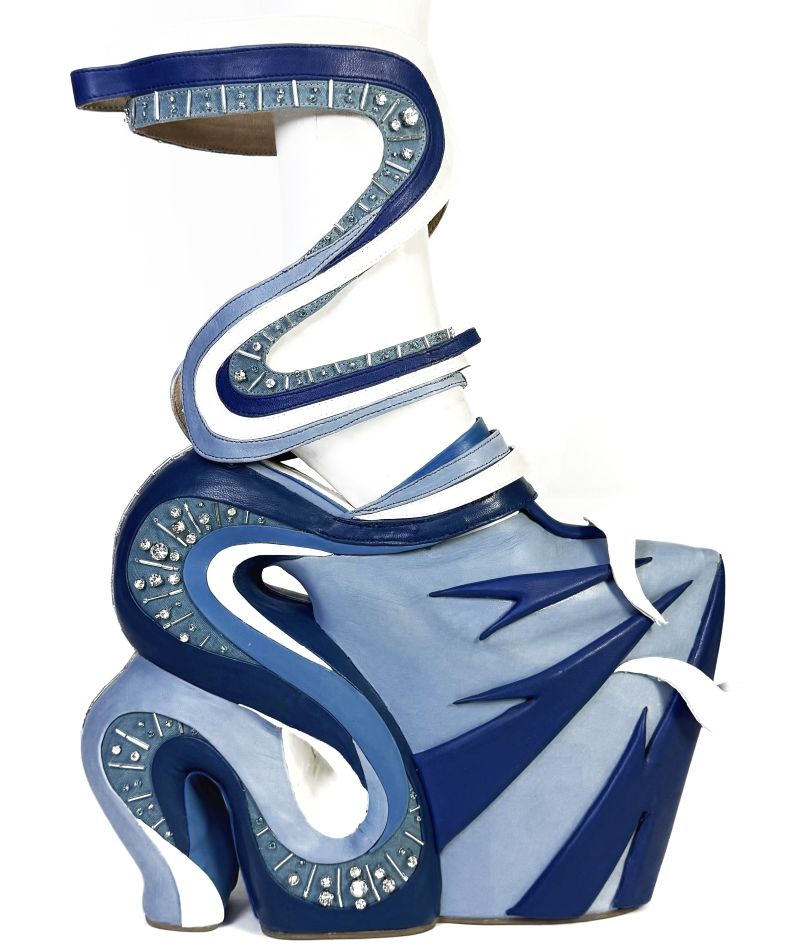
‘Sayaw ng Butanding at ni Mayon’ by Lester Dellosa
Paul Lester Dellosa’s Sayaw ng Butanding, the Second Runner-Up, Female Boot, was shaped by his life in Bicol, where he works in ocean conservation and coral reef rehabilitation while designing on the side.
The shoe draws on Dellosa’s experiences in coastal communities and encounters with whale sharks, locally known as butanding. Its silhouette resembles Mayon Volcano when tilted, creating a dialogue between land and sea. Sharp, angular lines evoke the volcano’s conical profile, while the curved sides and cylindrical heel suggest rolling waves. Blue and white swirling patterns reinforce the maritime theme.
At the core of the design is a modern interpretation of the traditional bakya, carved from santol wood by an artisan from Laguna. The biomorphic wooden structure is integrated in the shoe’s construction, blending traditional craftsmanship with contemporary form. Made of goat leather and pigskin, the shoe is cushioned with layers of cotton textile developed by the PTRI. Bugle beads and crystals on the upper reinterpret the distinctive spots and markings of the whale shark.
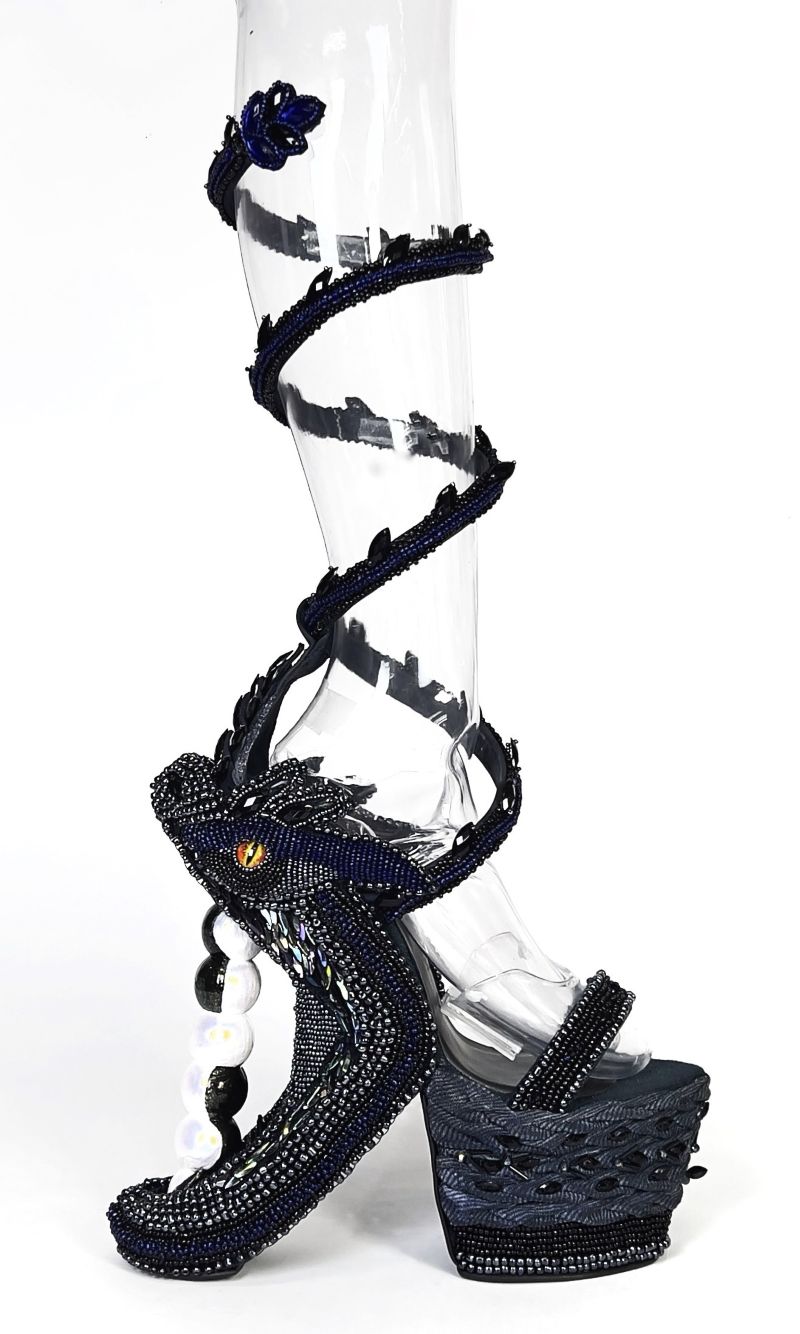
‘Bakunawa ngan mga Kadayaw’ by Karen Mae T. La’o
Karen Mae T. La’O of Northern Samar, the Second Runner-up, Female Trendy, looked into the Visayan folk tale of the bakunawa, the giant sea serpent said to have devoured six of the seven moons that once lit the sky. Legend says the remaining seventh moon is the one seen today, while eclipses occur when the bakunawa attempts to swallow it.
Bakunawa Ngan Mga Kadayaw fuses serpent and moon imagery, reinterpreting traditional lore through contemporary materials and fabrication, culminating in a fully beaded platform shoe. The heel takes the form of the serpent’s open mouth eating the moons, created from PLA 3D-printed plastic. The shoe is engineered to support weight during walking. Metal bearing concealed within moon embellishments provides structural strength. Beaded details form the serpent’s eyes, while straps coil upward to secure the shoe around the calf.
La’O, whose background is clothing technology, incorporated zero-waste patternmaking techniques into the PTRI textile used in the design. To ensure the concept could move beyond a visual statement, she collaborated with a creative laboratory to develop a design that was both wearable and structurally sound.
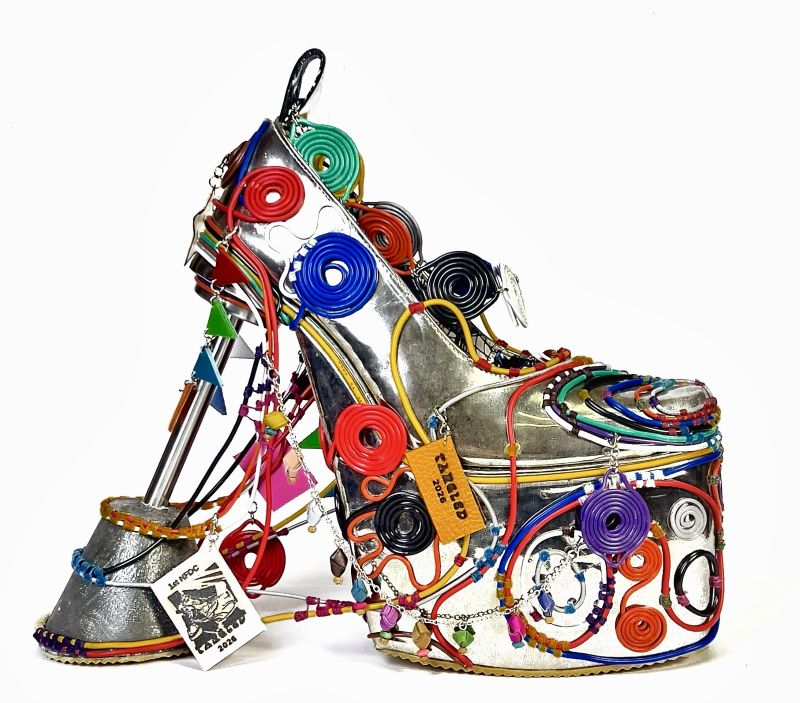
‘Tangled’ by Bon Marter
Tangled (Sala-Salabat), the grand prize-winning design by Bon Marter, emerged as one of the competition’s most decorated entries, also taking top honors in Best Footwear Innovation and Best Story Execution. The shoe transformed the familiar image of tangled electrical wires into a commentary on the complexities of urban life, expressed through meticulous construction.
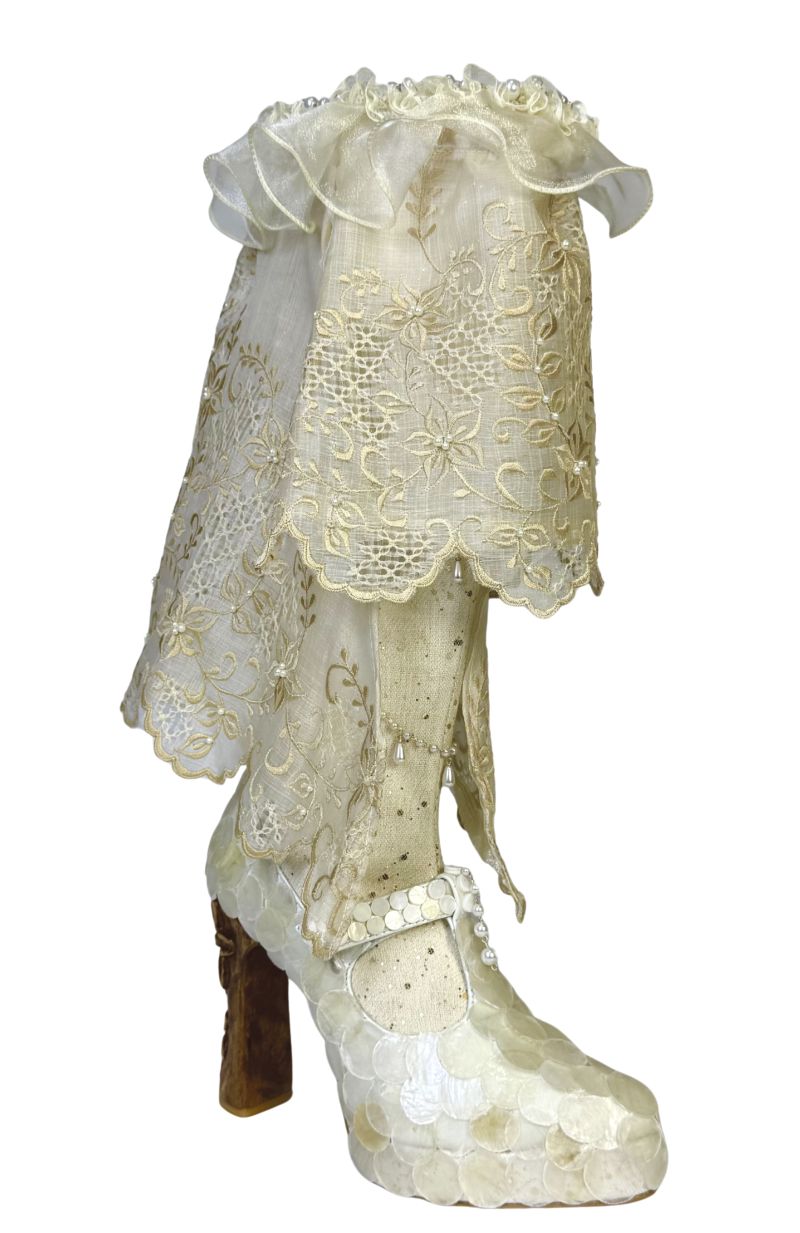
‘Mutya Ng Panay’ by Pamela Foronda 1
Pamela Foronda’s Mutya ng Panay, First Runner-Up among the local winners, takes inspiration from the gold mines of Panay Island in Western Visayas, drawing on the region’s history of gold craftsmanship and ornamentation. The influence appears in the shoe’s luminous textures, pearl accents, and jewel-like detailing that evoke treasured heirlooms and ceremonial adornments.
Designed as a bridal boot, Mutya begins with a classic T-strap shoe covered in capiz shells. A PTRI cotton fabric and a special mesh overlay extend upward to hug the calf, creating the shaft of a boot. Aside from capiz shells, the design is adorned with pearls, reflecting Panay’s island geography and long association with marine materials.
The heel is carved from gnarled santol wood, while panels of piña from Aklan with sampaguita motifs add a distinctly Filipino touch. Foronda incorporated traditional bridal elements such as veils and a band of pearls inspired by a bride’s garter. Detachable veils allow the shoe to be transformed after the ceremony, making it suitable for the reception and after-dinner celebration. The result is a three-in-one design that adapts to different stages of a wedding day.
Pamela Foronda’s ‘Mutya ng Panay’ has a heel carved from gnarled ‘santol’ wood, while panels of ‘piña’ from Aklan with sampaguita motifs add a distinctly Filipino touch
Hazel Roldan, a medical technologist and aspiring designer, received the Juror’s Choice Award and the DOST-PTRI Choice Award for Oryol. Inspired by the shape-shifting serpent from the Bicolano epic Ibalon, the design translates the mythical creature into a sculptural wedge boot that balances fantasy with technical craftsmanship.
The shoe features a translucent blue wedge heel produced through 3D printing and filled with resin to create an aquatic effect. Embedded within the heel is a realistic eye that appears to watch from within the structure, reinforcing the presence of the legendary serpent. Gold-toned overlays wrap around the shoe like scales, while embroidered blue, black, and white patterns flow across the upper in wave-like forms that suggest a creature moving through water. Hundreds of beads and pearls cluster along the surface, creating texture and depth while highlighting the serpent motif. PTRI cotton fabric forms the foundation of the upper and is manipulated to resemble scales.
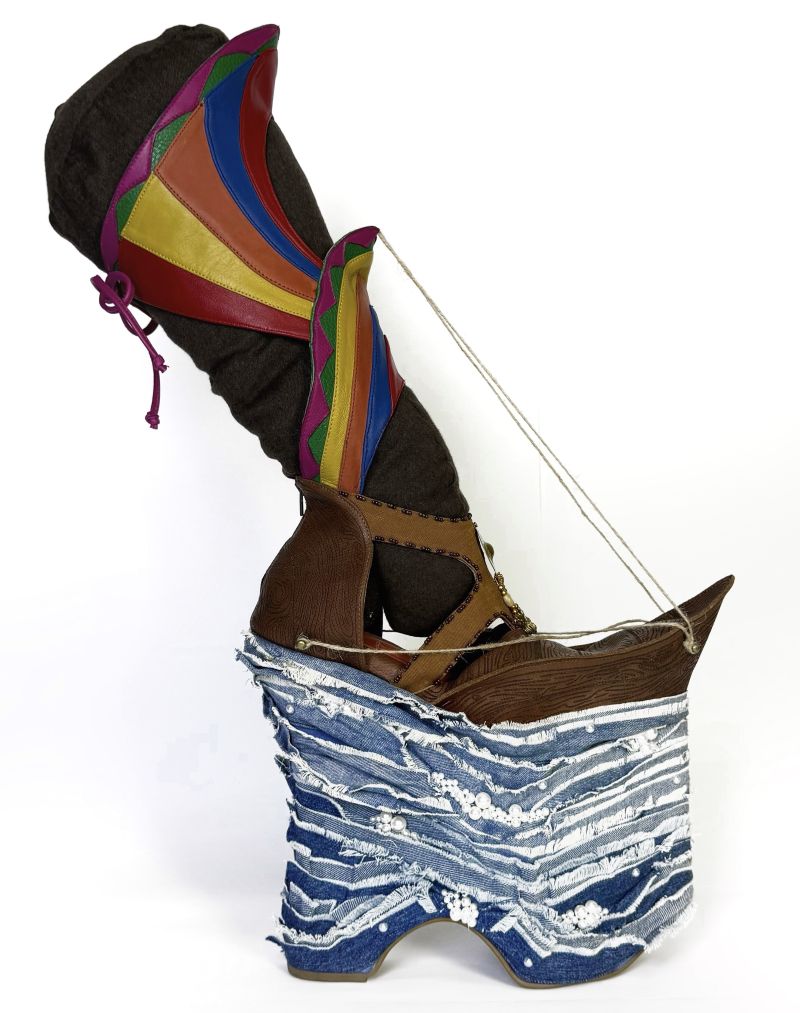
‘Balangay’ by Renegade Limpin
Renegade Limpin of Quezon City won Thirds Place and was the People’s Choice Award for Balangay, a boot inspired by the ancient seafaring vessels of Austronesian Filipinos. The design references maritime history with materials drawn from sustainable craft traditions.
The most striking feature, the oversized platform, resembles ocean waves supporting a wooden boat. Built from santol wood and covered with layered scrap denim, the platform creates a textured surface that mimics moving water. White beads scattered across the frayed denim suggest sea foam dotting the waves. Rising from the platform is a carved wooden structure shaped like a balangay, a wooden plank boat.
Above the boat sits a colorful leather upper inspired by the sails of the vinta, the sailing vessel of Mindanao. Panels of red, yellow, blue, green, and purple sweep upward like wind-filled sails, creating a sense of motion. The shaft incorporates bamboo-cotton textile developed by PTRI, while brass discs reference the hammered gongs used in Mindanao. Limpin said the lining is microfiber rather than pigskin, a deliberate choice made out of respect for Muslim culture.
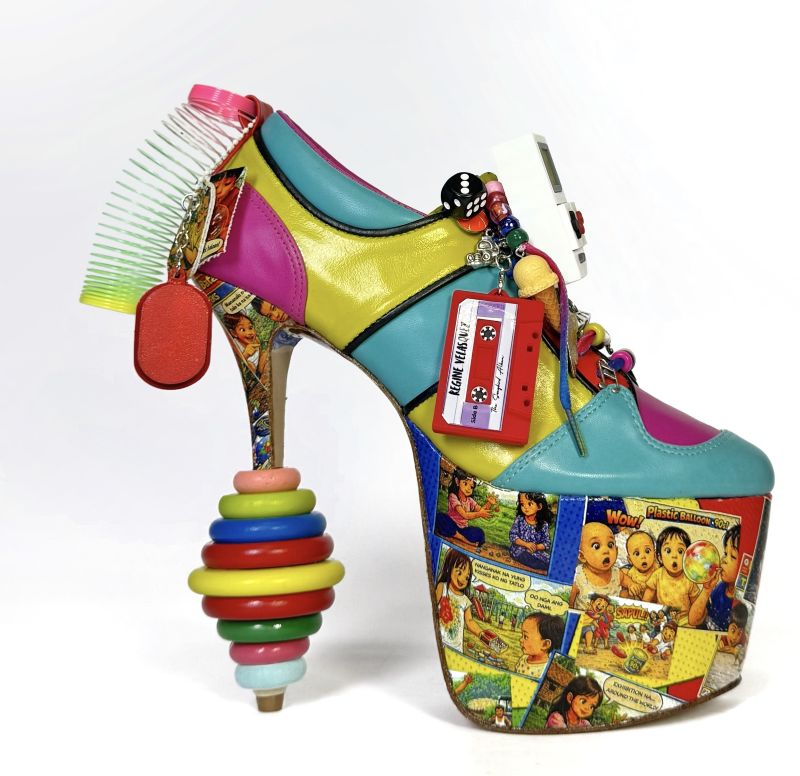
‘Batang ’90s’ by Florsheila Santos-Budoso
For Best in Execution, Batang ’90s: From Larong Kalye to Success, Florsheila Santos-Budoso, a shoe manufacturer known for custom-made bridal and high-fashion footwear, reminisced on her childhood in the ’90s.
Designed as a wearable tribute to the decade, the shoe incorporates familiar toys, games, and pop culture references. The heel takes the form of spinning top, while other details reference pogs, bottle caps, sipa and other childhood pastimes. Miniature charms, including a bicycle, wristwatch, and marbles, are scattered throughout the design. Images of family members and references to icons of the era, including singer Regine Velasquez, appear alongside motifs inspired by cassette tapes, Game Boy packaging, and even the small ice cream containers that were a fixture of neighborhood stores.
To capture the visual culture of the period, Santos-Budoso used retro color combinations and incorporated the Ben-Day dot technique commonly associated with comic books. The upper is made of genuine leather printed using direct transfer film technology, while PTRI fabric was used as a covering material for selected elements. Although highly decorative, the shoe was engineered to remain wearable, with a 6.5-inch fiber stiletto supporting the body weight.
The international recognition carries significance for an industry that is often overshadowed by larger sectors, said the shoe manufacturers. Although the Philippines has participated in the International Footwear Design Competition for years, this was the country’s first appearance since the FFAA became an official member of the Confederation of International Footwear Associations in 2025. Filipino designers emerged on top in a field of 148 entries from 19 countries.
Industry leaders also credit DOST-PTRI for helping elevate the competition entries. Aside from supplying the materials, these organizations provided technical guidance.
The alliance is looking beyond the competition stage. Plans are underway to secure intellectual property rights for the winning designs and adapt them to commercially viable footwear. The goal is to transform the conceptual pieces into wearable products and eventually launch them under the designers’ own brands.
“The FFAA wants designers to have continuity. It doesn’t end when they win,” said Mia Santos, founding president of the Filipino Footwear Alliance Association. “If they don’t have factories, FFAA comes in. Our member manufacturers in Marikina can bridge the gap between designers and producers so they can develop their collections. Many of these designers already have their own niche markets.”
For Santos, the competition’s success is not only about awards, but also about creating opportunities for Filipino designers to build sustainable businesses and bring their ideas from the exhibition to the retail market.
The FFAA will hold an exhibition of the winning entries on June 9 at Lucky Chinatown Mall in Manila.


