

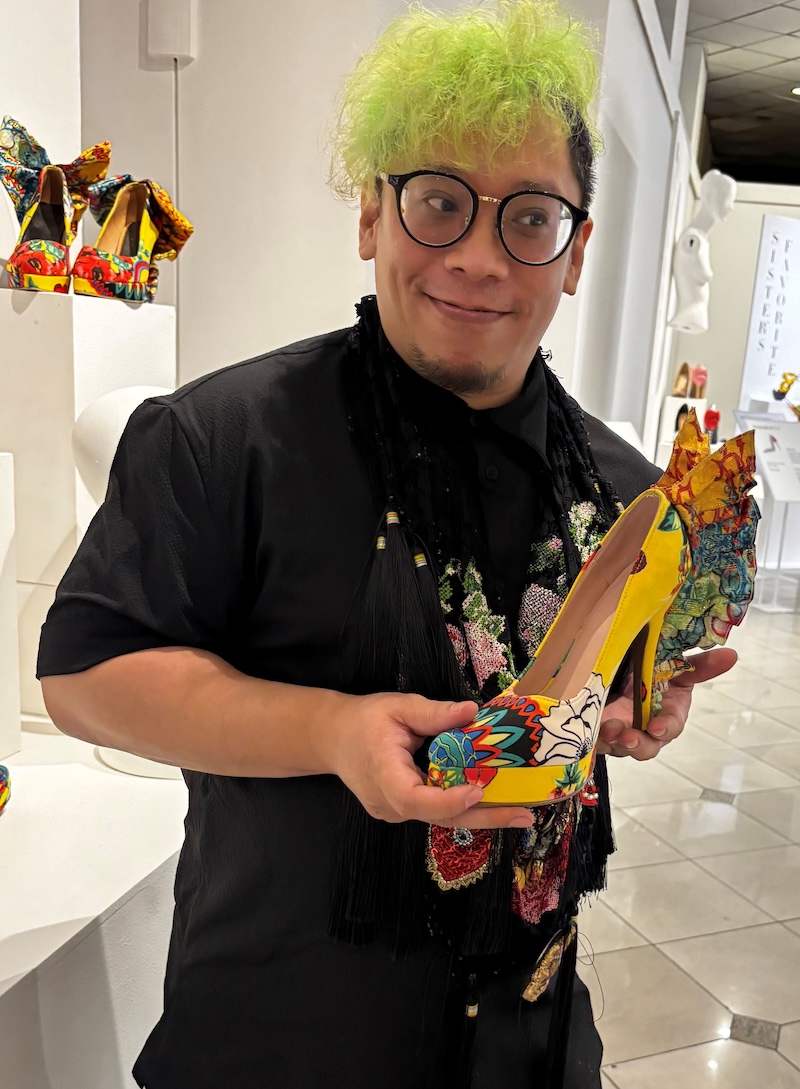
Joel Wijangco shows the ‘Maritess’ shoe, which echoes his grandmother’s duster while gossiping.
“Art2Wear” runs until Oct. 24, 2025 at Yuchengco Museum, RCBC Plaza, corner Ayala Avenue and Sen. Gil J. Puyat Avenue, Makati City.
Threads, fabric, and leather can reflect more than style; they can carry stories. In Art2Wear at Yuchengco Museum, artist-designer Steve de Leon and shoe designer Joel Wijangco transform fashion into vessels of memory, faith, and social commentary.
Long before sustainability and collaborations with local artisans became trends, de Leon was already working with indigenous weaves, recycling scraps of vintage Filipiniana, and layering beads, antique accessories, and natural materials into his designs. His maximalist style reveled in texture and ornament, treating garments as sculptural canvases rich in symbolism.
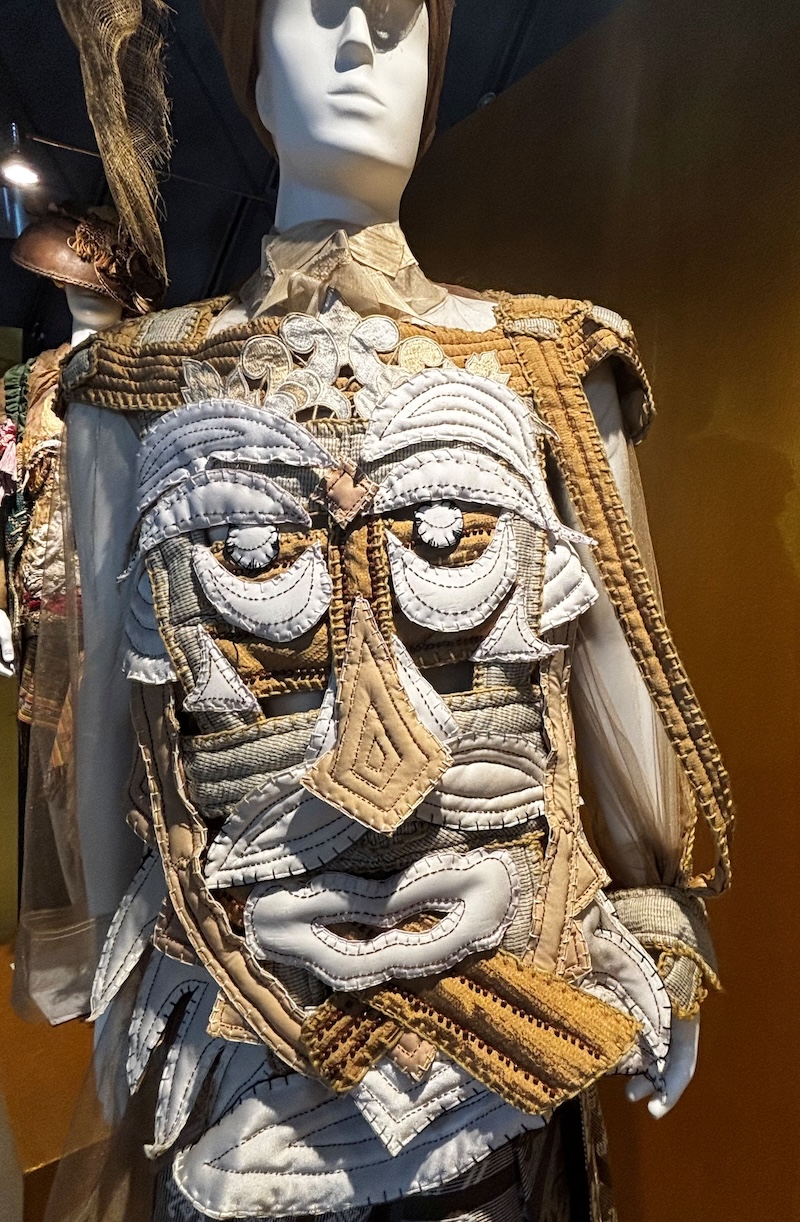
Steve de Leon’s ‘Baptism of Jesus on the Jordan River’ is armor made of appliqués of Tinguian weaves.
His work pushed boundaries in silhouette, texture, and the way garments occupied space, often becoming sculptural forms in themselves. It preserved culture by sustaining local weaving traditions. It challenged fashion norms by rejecting minimalism in favor of abundance, embracing imperfection through layering, weight, and contrast. And it showed how fashion could be both deeply personal—rooted in his heritage and spirituality.
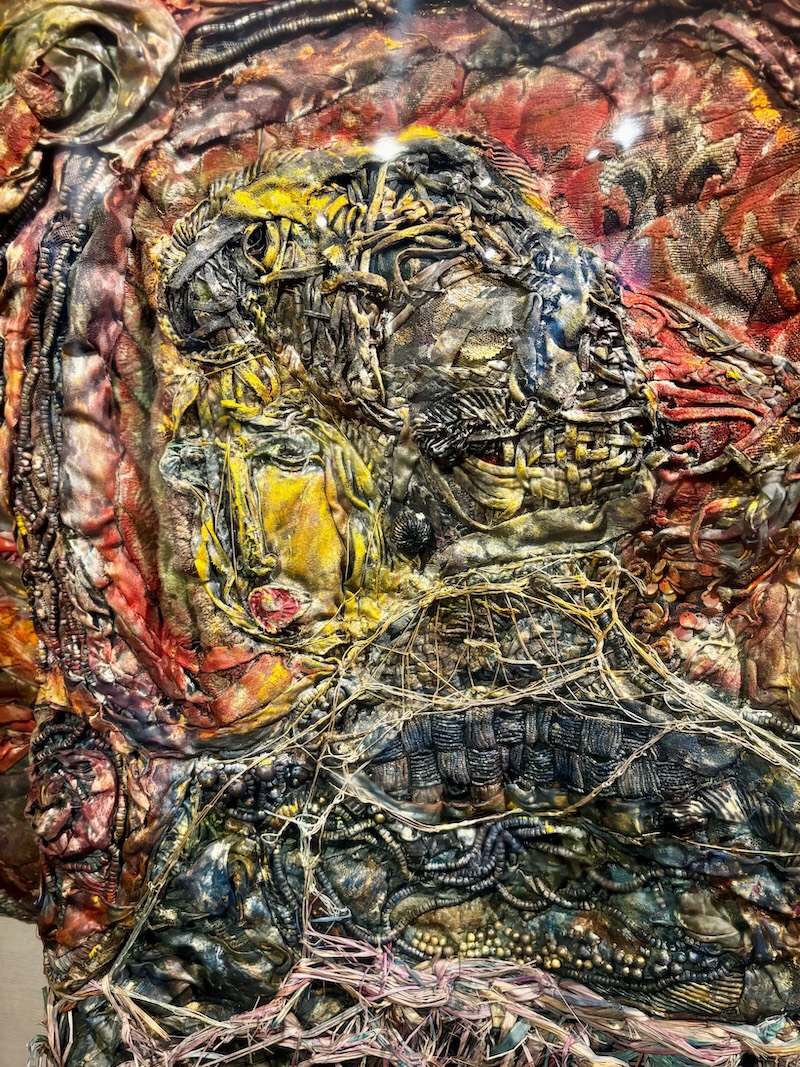
Close-up of Steve de Leon’s award-winning robe and tapestry made with mixed media
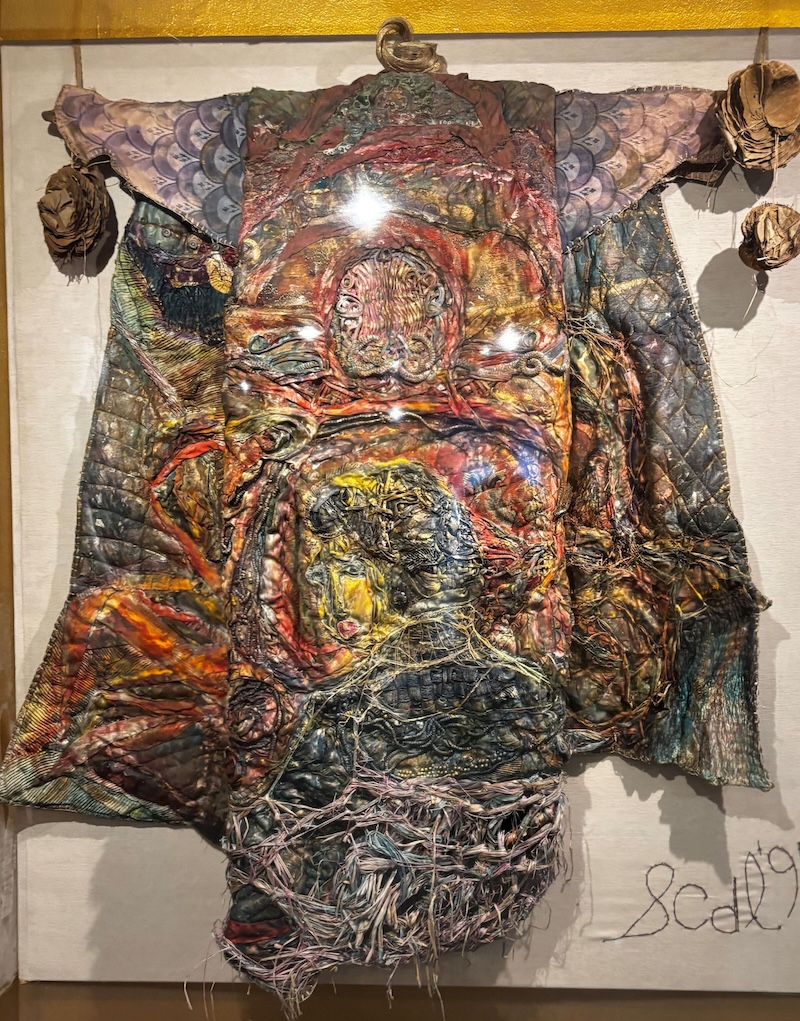
Steve de Leon’s robe won the Juror’s Award in the 1995 Philippine Arts Award. The piece was his turning point into expanding into tapestry from garments.
De Leon’s exhibit opens with My Conscience in Painting through a quilted robe crafted with mixed media—paint, cords, and metal wires that add depth and texture. To achieve special effects, he coated the surface with polyurethane and exposed it to the elements. The piece earned him the Juror’s Choice Award at the 1995 Philippine Art Awards. Displayed hanging on a rod to emphasize its sculptural dimension, the robe is also a tribute to his mother, Leonida Sunga Cortes, who taught him dressmaking.
“My mother was already famous in Aklan before she moved to Manila to study home economics,” he recalled. “There were no tape measures then, so she used a rope instead.”
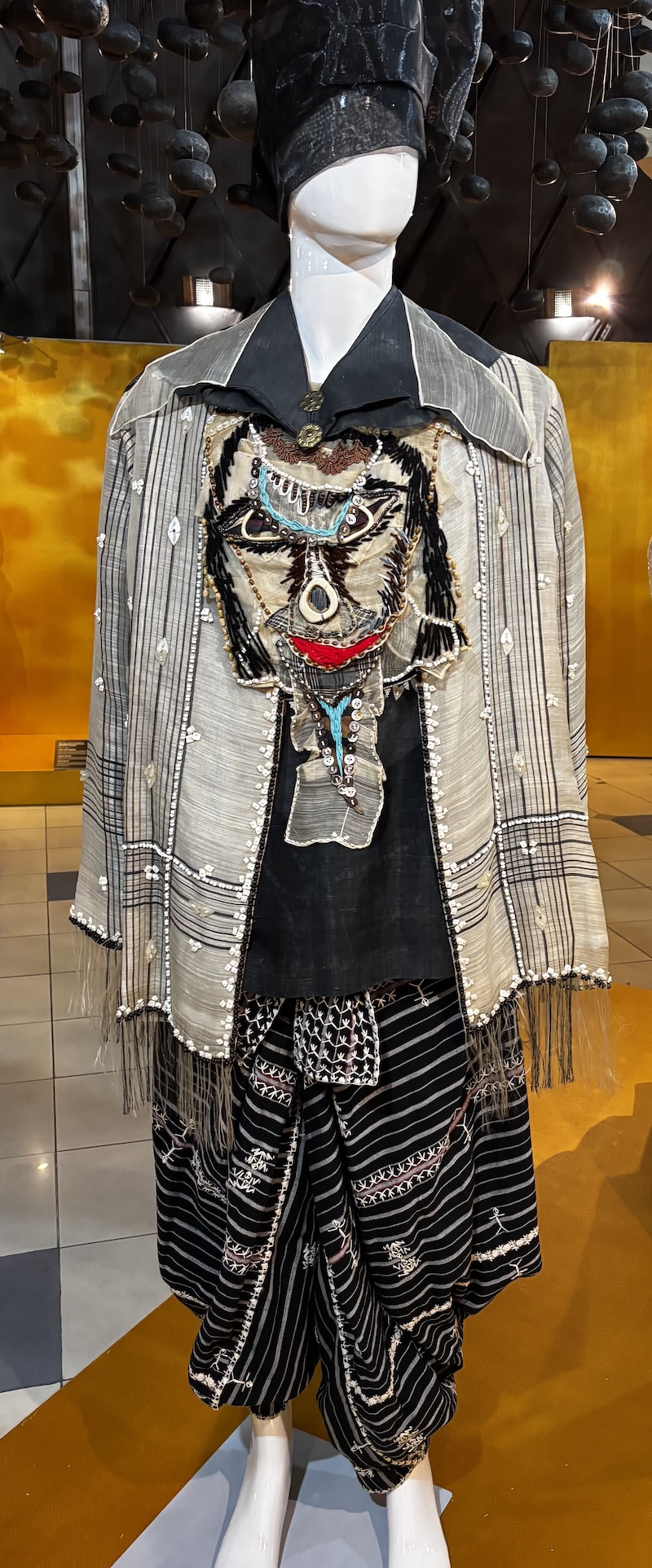
Steve de Leon’s ‘Judas Iscariot’ with appliqués of his face on the front and back to show his hypocrisy
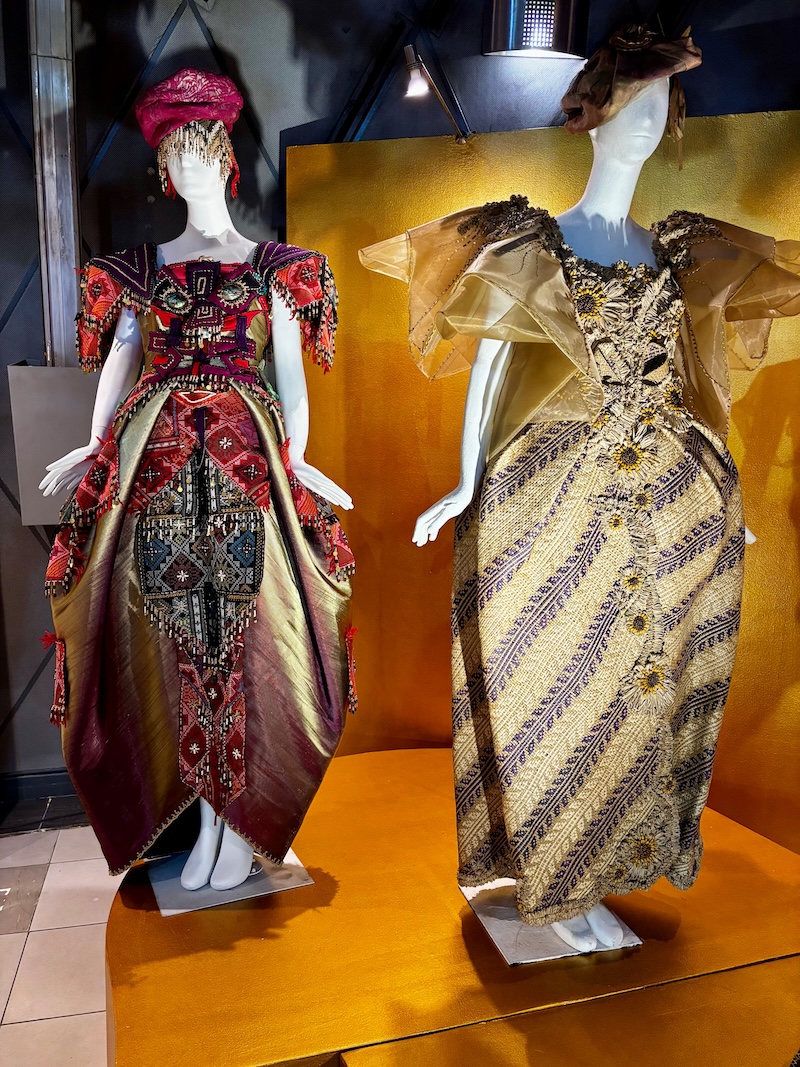
Steve de Leon’s gowns inspired by the miraculous amphora jars, using weaves from all over the country and bulbous skirts made of stiffened cotton
In his youth, de Leon honed his skills by doing beadwork for wedding gowns and embroidering casual dresses. Weekends were spent in antique stores, where he used his earnings to buy ethnic beads and vintage accessories. These elements would later become signatures in his designs.
Theater also left a mark on his imagination. His father, Edwin Ancheta de Leon, a farm manager and lumber businessman, often took him to the Manila Grand Opera House and other theaters to watch zarzuelas and variety shows. The magic of the theater was translated into his clothes. Though de Leon longed to study fine arts, his father discouraged him from formal training: “Your artistry is already within you. Keep it raw.” Obediently, he pursued a commerce degree in accounting. Yet the tension between his father’s advice and his artistic impulses surfaced years later in My Conscience in Painting. The robe’s discordant patterns embodied his struggle between discipline and freedom, paint and thread, art and convention.
By the late 1970s and 1980s, de Leon was designing costumes for Viva and Regal Films. His interest in indigenous fabrics was nurtured by National Artist for Dance Ramon Obusan, who supplied him with handwoven textiles and commissioned him to recreate costumes. Cultural historian Basilidez Bautista later tapped him to design for a nine-part documentary series on 19th-century Philippine life, produced by Sampaguita Films for First Lady Imelda Marcos.
In 1989, he presented a heritage collection for the Manila Hotel, built around three themes: as a Filipino, using indigenous materials, from abel Iloko from Northern Luzon to piña, abaca from the Visayas, and inaul from Mindanao; as a fashion designer, interpreting works of Filipino masters into wearable art; and as an artist, exploring spirituality and sacrifice. His spiritual awakening was born from a visit to Japan. At the Yokohama Exposition, where he subsisted on bread and water, he experienced visions of the Mysteries of the Holy Rosary while riding a bullet train to Tokyo.
Felice Sta. Maria, then president of the Metropolitan Museum of Manila, saw his work as “soft sculptures” that existed independently of the body, creating volume and shape through fabric manipulation. She invited him to exhibit, making him the first fashion designer to be featured at the Metropolitan Museum. His 1990–91 show, Misterio ng Birhen Maria, presented tapestries, evening gowns, ternos, and baro’t saya arranged in tableaux of the Joyful, Sorrowful, and Glorious Mysteries.
De Leon’s 1990-91 show, ‘Misterio ng Birhen Maria,’ presented tapestries, evening gowns, ternos, and ‘baro’t saya’ arranged in tableaux of the Joyful, Sorrowful, and Glorious Mysteries
“I work with indigenous fabrics, always respecting their sacredness. I try not to cut them, which is why I developed the origami-like method of tucks and folds. Threads are my paint, stitching faith and fashion into stories,” he said.
Cultural icon Gilda Cordero Fernando was among de Leon’s admirers, praising his fashionable assemblages. In 2000, she invited him to collaborate on her book and fashion show, Jamming on an Old Saya, where he transformed scraps of vintage Filipiniana into playful, contemporary pieces.
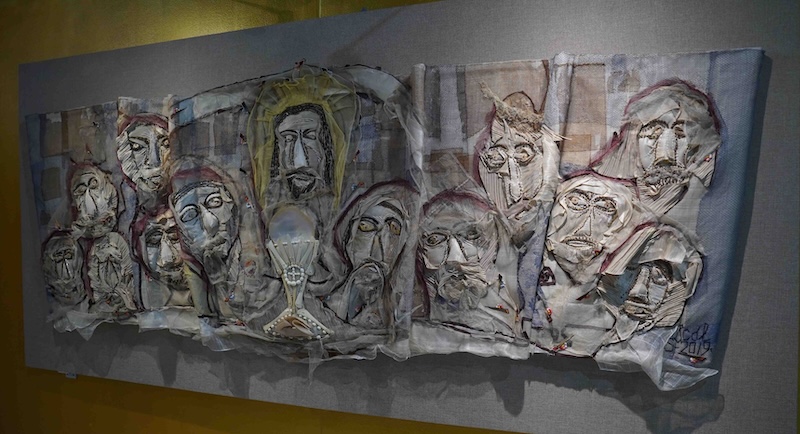
Steve de Leon’s ‘Tapestry of the Last Supper’ using ‘pinukpok’ and mother of pearl
When Pope John Paul II introduced the Luminous Mysteries in 2002, De Leon felt compelled to interpret them through both clothing and tapestry. He spent years creating barongs and ternos that narrated the miracles of Christ’s life. In Art2Wear, a highlight is his vision of the Second Luminous Mystery—the Miracle at the Wedding Feast in Cana. The gown’s silhouette echoes the rounded belly of an amphora jar, symbolizing the vessel where water was turned into wine, and draws inspiration from his mother’s 1950s “Goya skirt,” with its balloon shape structured by pleating, boning, and a stiffened cotton base.
For de Leon, every design is ultimately an offering, a way of glorifying God through the language of fashion.
Joel Wijangco, 47, keeps a flexible schedule in operations management at a BPO, which allows him time for shoe design. He once worked as an account manager and events organizer for a media agency, but design was always at the back of his mind. In high school, while his friends sketched pageant gowns, he paid closer attention to shoes.
In his 30s, he approached bridal shoe designer Emmie Jorge at her Rockwell shop. Eager to break in, he emailed her sketches, but she bluntly said, “Your designs won’t make it. They’re too strange.” Still, she gave him a chance if he could create something for her conservative but stylish clients in their 40s. For one client, the owner of Polecats Manila, Wijangco observed women spinning on poles in platform heels and imagined how to capture that motion. He came up with a hidden-platform pump with a laser-cut heart at the back. From afar it looked like a slash of red, but up close it revealed its true shape. The design sold, though an assistant was later caught reselling pairs on the side.
He stopped designing for nearly a decade, then returned in midlife, determined to face the doubts of Marikina shoemakers who said his work was “too hard to make.” In 2015, he enrolled in a shoemaking class at SOFA under Tal de Guzman of Stride Collective. He then joined the Filipino Footwear Design Competition, partnering with Zapateria to produce his first official piece, “Palengkera.” The boot was made of yellow napa leather, much like the yellow plastic boots worn by market vendors in his native Malabon. Its black-and-white patent accents mimicked the splashes of rainy season floods—a stylish nod to everyday survival.
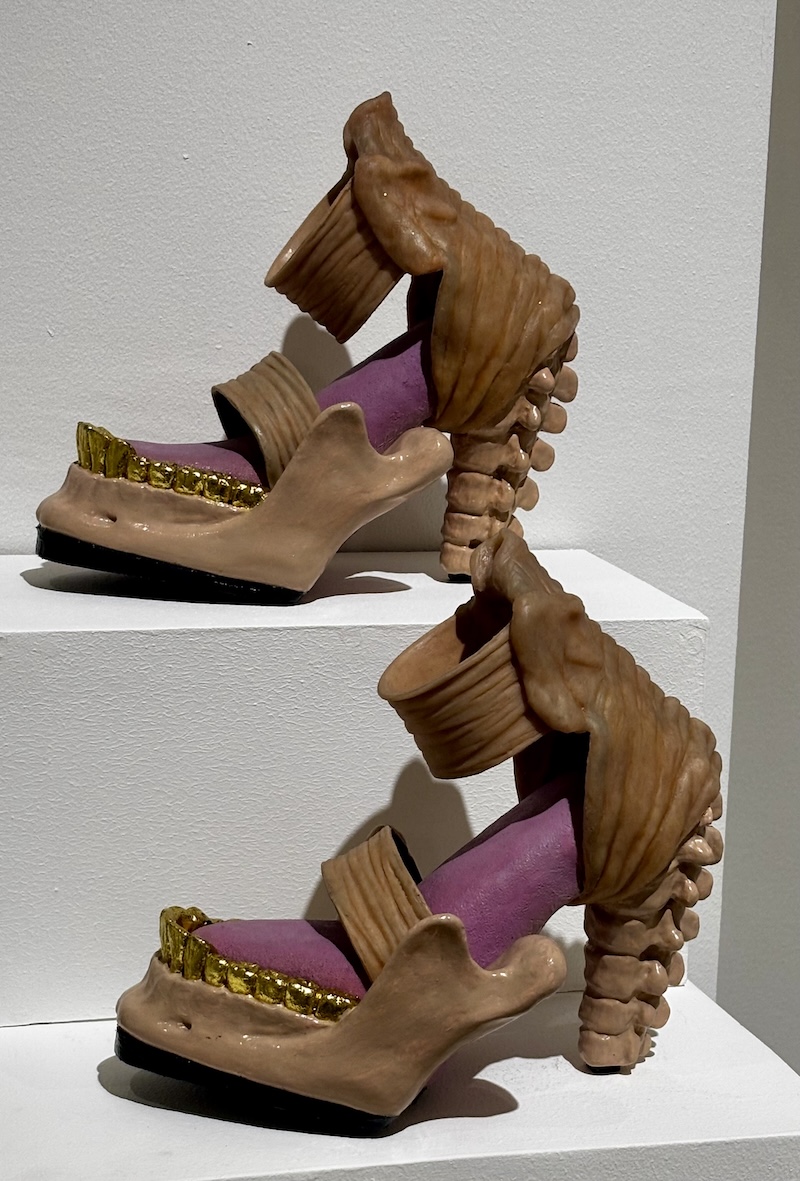
Joel Wijangco’s ‘Body Horror’ shoes recalls the trauma of the designer’s eating disorder.
From there, his shoes became increasingly personal, often veering into confessional art. “Body Horror” or “Boho” was his way of narrating his eating disorder. At 13, he developed bulimic dysphoria. Growing up as a “charity case” in his grandmother’s home, his meals were rationed and monitored. If he ate too much, she made faces of disapproval. He learned to gorge in secret, then purge out of shame. The footwear bears teeth—yellowed, like his own, from bile. The teeth on the shoes turned his pain into art through rubber and silicone.
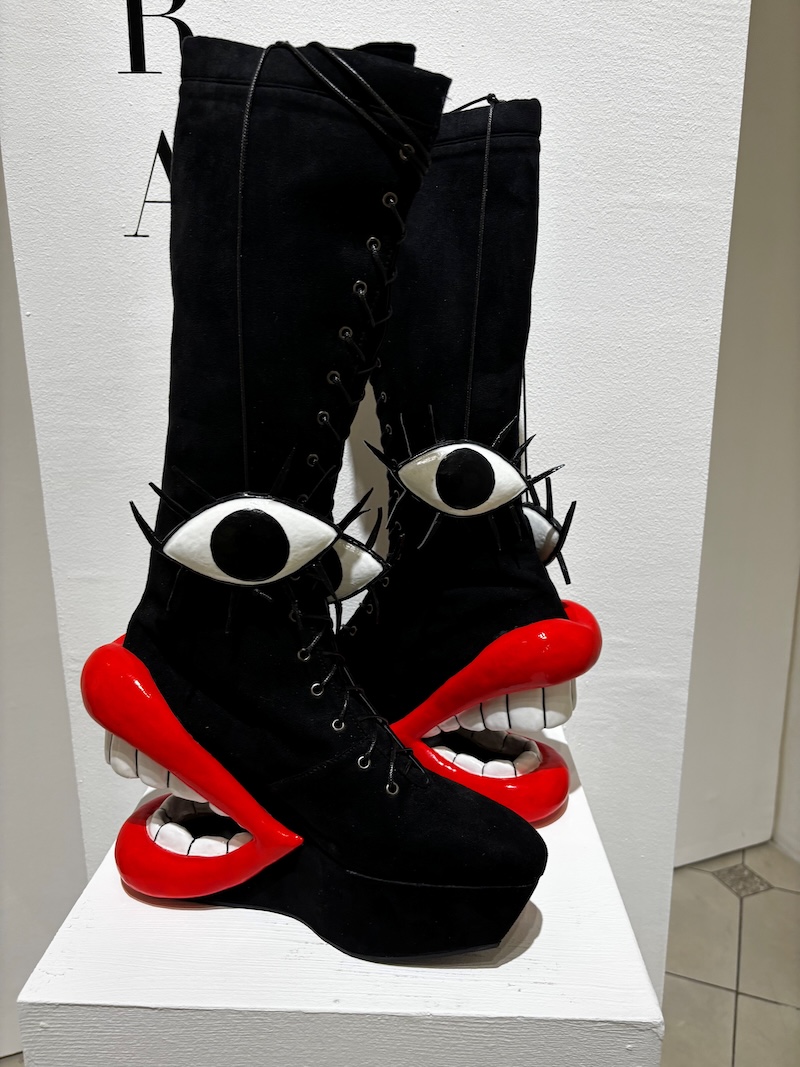
‘Mahadera,’ a social commentary on the women who are deemed villains when they assert themselves
“Mahadera,” a suede boot, carries a red open mouth with teeth stretching into the platform. Its story began on a jeepney ride, when Wijangco overheard a wife quarreling with her husband over rent. Though he insisted he had already given her money, she continued to press him with worry for their family, her voice trailing on even as she stepped off. Dismissed as a nagger, she became the inspiration.
For Wijangco, “mahadera” is not an insult but a social role forced by circumstances. “We should all be mahaderas,” he said. “Nagging is born out of anxiety and fear for the family’s future. Women are placed in the unfair role of villain, when it’s society itself that’s forcing them to do this. Their voices are reminders of men’s responsibilities.”
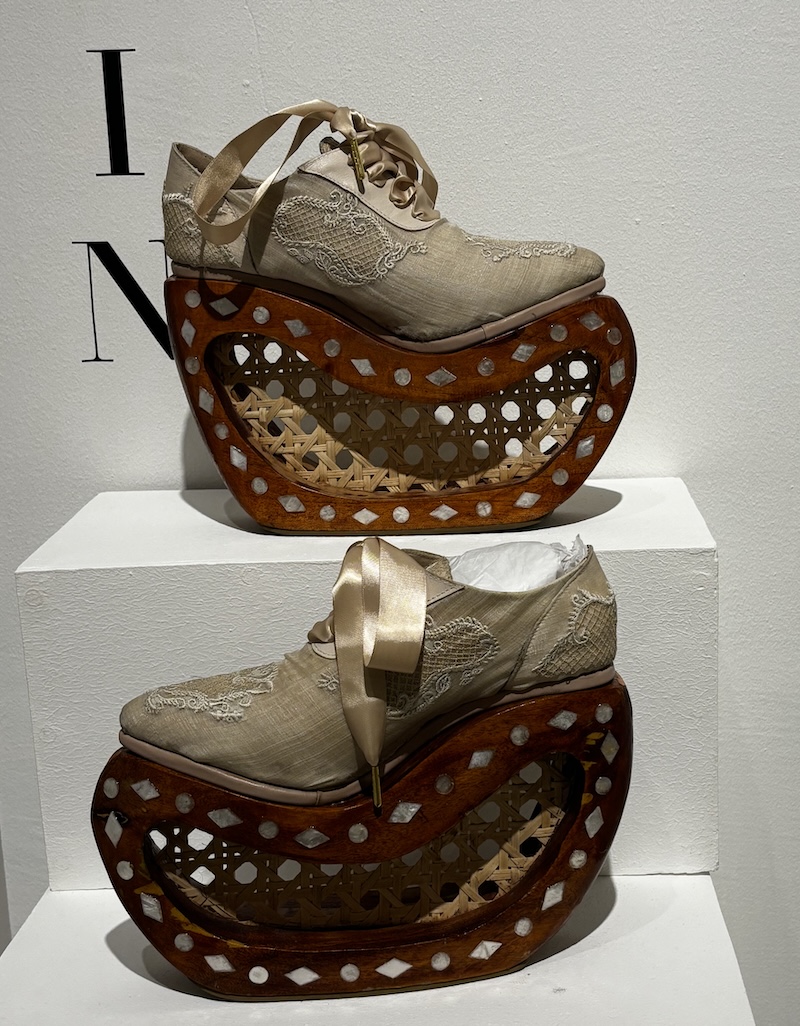
‘Bobeng in Repose’ platform inspired by the rocking chair with ‘solihiya’ and ‘capiz’ inlays. The ‘barong’ upper is an homage to Wijangco’s grandfather, Roberto or Bobeng
“Bobeng in Repose” is an homage to his grandfather, Roberto Wijangco Sr., nicknamed Bobeng, who often fell asleep in a solihiya rocking chair wearing a barong. The platform recalls both bakya and geisha clogs, while capiz inlays echo the family’s Bulacan furniture. The barong uppers were made in Lumban and Quezon City; the shoe itself was crafted in Marikina.
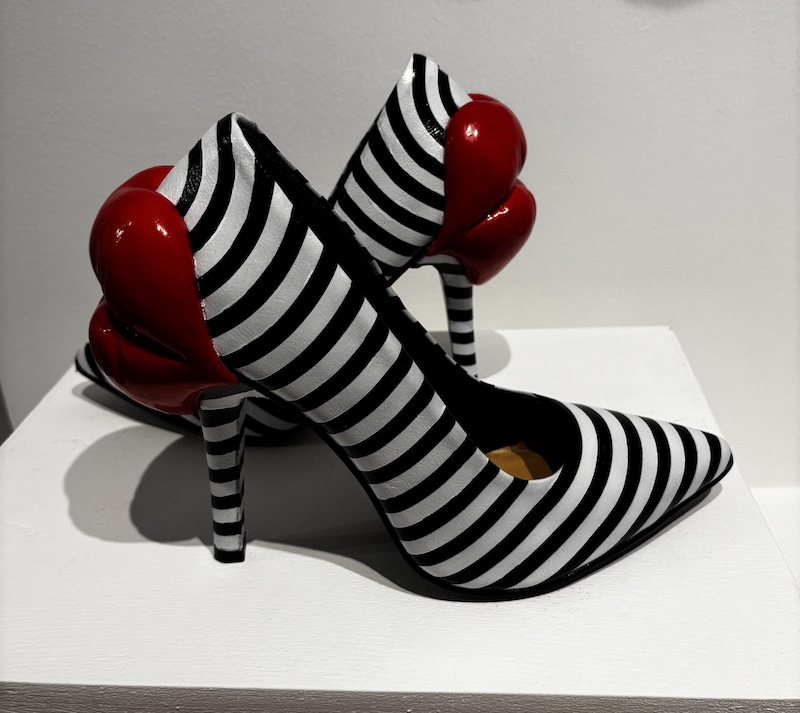
‘Maharot, ‘inspired by Crazy Horse shoes and flying kisses
“Maharot,” with red lips on the heels, evokes balik alindog—the playful reclaiming of allure. Spirals of painted leather curve around the shoe, creating a hypnotic lift that mirrors the heady spell of a kiss. Made in Laguna and Marikina, the design is both playful and seductive.
‘We should all be “mahaderas,”’ Wijangco said of the name of his boot design. ‘Nagging is born out of anxiety and fear for the family’s future. Women are placed in the unfair role of villain’
“Kabaong ni Oswang” is a series of stilettos and a pair of pointed black brogues with red sampaguita embroidery. The red ribbon accents were inspired by the vivid lining of open-faced caskets at wakes. The shoe also nods to a colonial friar who once documented Philippine demons—and misspelled “aswang” as “oswang.” From there, Wijangco imagined what such a creature would wear: Gothic black, velvet details, mortuary-red lining sourced from funeral suppliers, and carnal red sampaguita blossoms in place of white. The result is equal parts mourning and menace.
“Maritess” was made from floral-printed fabrics bought in Divisoria. The pleats echo the sleeves of his grandmother’s duster, while its name nods to the archetypal gossip trio: Marites, Marife, and Marilou, dressed in house clothes. “The instigator, the enabler, and the spreader,” Wijangco said, recalling how neighborhood women traded stories while doing housework. “It’s Filipino life for me. In Japan, gossip is forbidden. But here, chismis is free—even if you dislike it.”
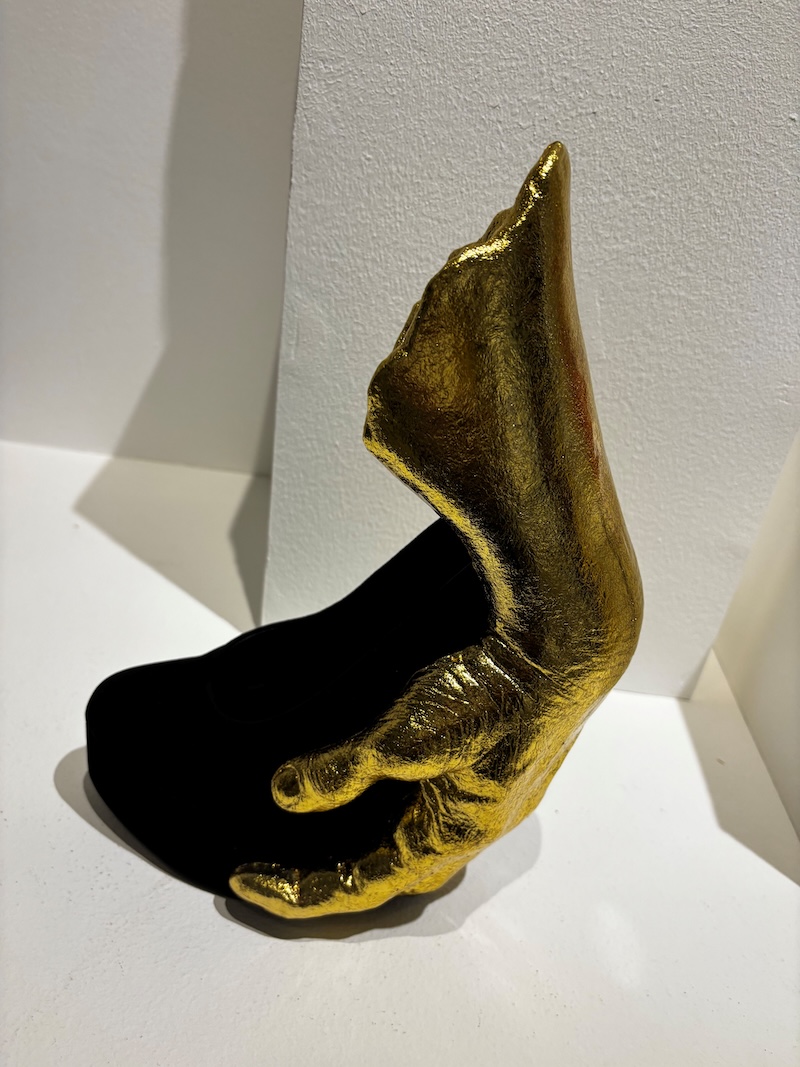
‘Fitting ni Sioning’ demonstrates how a fitter’s hand on Sioning’s foot softened her harshness.
“Fitting ni Sioning” recalls a shoe fitting with his grandmother Asuncion, whose sharpness of tongue softened in rare moments of tenderness. He remembered the subtle eroticism of the fitter’s hand cradling her foot in a satin zapatilla. Made of velvet for the shoe and polyurethane and resin for the hand, the shoe pays tribute to both her contradictions and the origins of his passion for shoes.
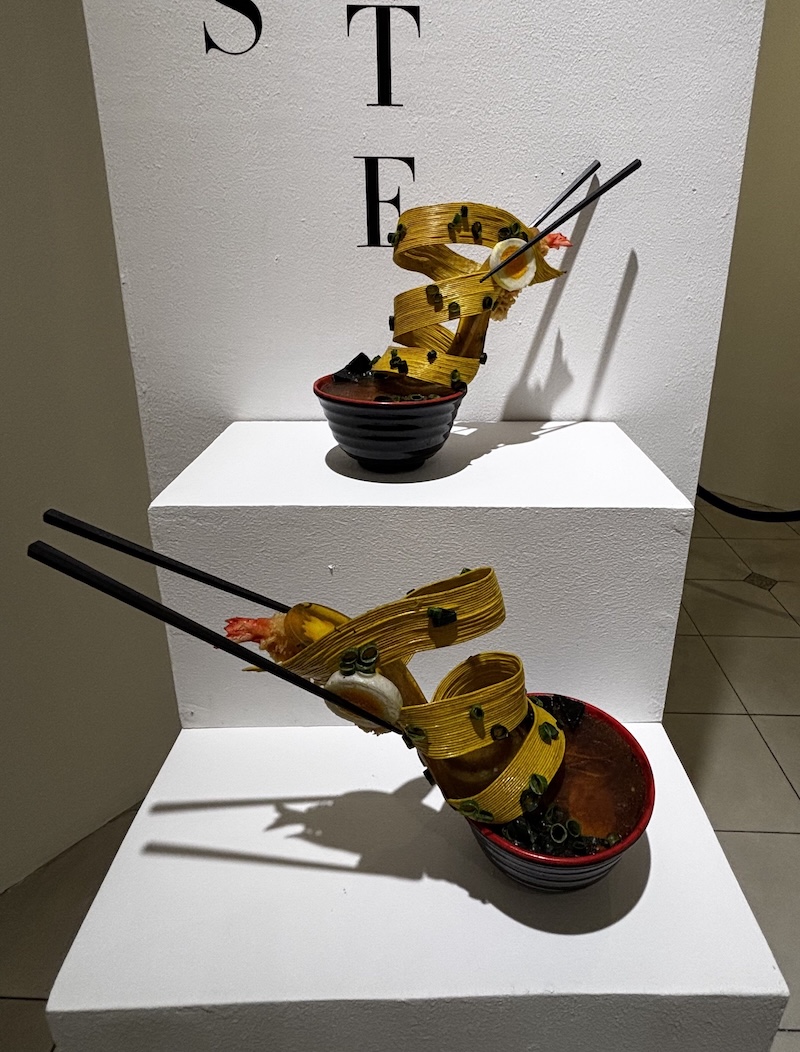
‘Ramen Shoe,’ inspired by a cancer patient’s comfort food between therapies
His most personal creation is “Sister’s Favorite” or the “Ramen Shoes.” His sister Erlinda battled breast cancer that metastasized three times. Whenever they met, the siblings ate at Japanese restaurants, where she ordered ramen with tempura. He turned that memory into a heel-less platform with yellow noodle straps, a fried egg accent, and a pair of chopsticks. The shoe was an engineering feat: Hidden weights shifted the balance from heel to ball, forcing the wearer onto demi-pointe, with ankles and back straining under the pressure. Difficult and punishing, yet spectacular—just like the love that inspired it. The resin has since grown brittle, but the shoe remains a portrait of devotion. Erlinda is a semi-retired high school teacher in Japan, benefitting from its healthcare system.
Most of Wijangco’s early clients were drag queens who discovered him online. “Not fashionistas—because I wasn’t known,” he admitted. His first recognition came abroad, at the Indian Council of Leather Export Designers Fair, which sponsored his airfare when he participated four times. An Indian manufacturer even proposed a collaboration for 300 pairs, but Wijangco declined for not having the capital. Most of his money goes into research and development.
Wijangco now collaborates with prominent Marikina shoemakers such as Stride Collective, Mia Santos of Nifty Shoes, and Buddy Tan of Black Wing, depending on the style. Every design goes through multiple prototypes. Some pairs are reworked at least six times. But he admitted shoe design isn’t his livelihood.
“I’m more of an artist than a designer,” he says. “I used to wrestle between art and commerce. Commerce asks: Will it match my clothes, is it worth my money? But in art, you let the work resonate with a part of yourself.”
Ultimately, the museum gave Wijangco’s shoes what they always needed: an audience that understood his stories.
‘ART2WEAR’ runs until Oct 24 at Yuchengco Museum, RCBC Plaza, corner Ayala Avenue and Senator Gil J. Puyat Avenue, Makati City.


