

In Tempest, storms are not metaphors—they are inheritances. They sweep through the lives of diplomats, politicians, and operatives, stripping away pretense until only conviction remains. The series, one of Disney+’s most ambitious K-dramas to date, positions itself in the space where politics meets intimacy: power as something both public and deeply personal.
At its center is Seo Mun-ju, played with controlled brilliance by Jun Ji-hyun (aka Gianna Jun), who returns to the small screen after a long and much-anticipated hiatus. The years away have done her craft good; she carries herself here not as a star returning for spectacle, but as a woman with gravity.
Mun-ju, once a UN ambassador, finds her life shattered when her husband, Jang Jun-ik (Park Hae-joon), a presidential candidate, is assassinated. What follows is part investigation, part reckoning—with truth, with power, and with the ghosts of loyalty.
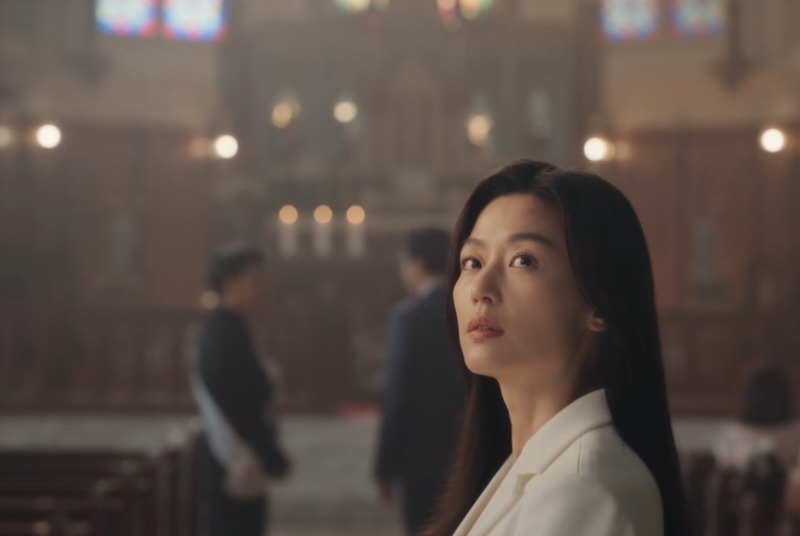
Jun Ji-hyun returns with force in ‘Tempest,’ commanding the screen in a comeback that proves worth the wait.
Jun’s performance is deliberate and interior. Her Mun-ju does not shout or flail. Instead, she measures every silence. Even in stillness, you sense the hum of calculation, the ache of disbelief. It’s a performance rooted in restraint—the kind that draws you closer rather than pushing emotion at you. The actress, who once made impulsiveness charming in My Sassy Girl, and confidence magnetic in My Love from the Star, now turns quiet endurance into a kind of power.
Her counterpart, Gang Dong-won as Paik San-ho, is another reason Tempest feels like an event. Long celebrated in Korean cinema (Broker, Master, The Priests), Gang brings to television a presence that’s both elegant and wounded. San-ho is a covert operative of uncertain allegiance, tasked to protect Mun-ju but carrying his own buried agenda. Their partnership begins in suspicion and evolves into something taut and almost tender—the intimacy of two people who recognize each other’s solitude. Gang plays San-ho like a man used to shadows, whose instinct for violence has dulled into melancholy.
But Tempest is not content to orbit a single woman’s turmoil. It expands the frame to include the powerful, the calculating, and the quietly ruthless women who surround her.
There is Im Ok-seon (Lee Mi-sook), Mun-ju’s mother-in-law and the chairwoman of Aseom Shipping, whose influence reaches well into the corridors of government. She is the sort of matriarch who knows that survival in politics depends less on sentiment than on leverage. Her grief over her son’s fate curdles into strategy; her affection for Mun-ju is sincere, but conditional. Lee plays her with the grace of someone who knows she is feared—the tilt of her head enough to suggest judgment or pity.
Then there is Chae Kyung-sin (Kim Hae-sook), the sitting head of state whose warmth is often indistinguishable from calculation. Kim, a master of layered authority, makes the president a study in composure: kind when the cameras roll, formidable in private. Hers is not villainy but conviction—the dangerous belief that she alone understands what is best for her country.

‘Tempest’ storms the charts—the political thriller becomes Disney+’s latest K-drama hit.
Together, these women form the series’ true constellation of power. The men, for a change, circle their gravity. The show’s political machinations—the cover-ups, the negotiations, the covert diplomacy—all unfold as extensions of the female will. This is not a story about women surviving men’s games; it is about women who have long since mastered them.
The creative pedigree behind Tempest explains its precision. The script, by Chung Seo-kyung (The Handmaiden, Little Women), moves with quiet assurance, layering intrigue with introspection. Directors Kim Hee-won (Vincenzo, Queen of Tears, Light Shop) and Heo Myung-haeng (Badland Hunters) bring balance—scenes of shadowy elegance punctuated by bursts of kinetic action. The international scale of the production—complete with John Cho as an American diplomat drawn into the crisis—adds another layer of credibility, proof of how far K-dramas have evolved from their once-domestic focus.
Yet what distinguishes Tempest from the average political thriller is its refusal to treat power as spectacle. Its beauty lies in what it withholds—in glances across a negotiation table, in the moral fatigue behind an order given, in the loneliness of a woman who has learned to lead without trust. Even the show’s pacing mimics a storm’s rhythm: a slow gathering of tension, sudden bursts of devastation, the uneasy calm that follows.
If the show has a weakness, it lies in the occasional sprawl of its conspiracy. The web of betrayals—spanning governments, corporations, and foreign entities—can at times feel over-engineered. Certain episodes momentarily lose their emotional core under the weight of layered subplots. But Jun anchors the narrative. In her, the drama finds its conscience: the diplomat who learns that justice, in the real world, is often indistinguishable from survival.
By midpoint, Tempest begins to feel less like a spy story and more like an elegy for integrity. Every character, even the so-called villains, reveals not corruption but compromise. The women who seem most formidable are also the most scarred; their ruthlessness is a kind of armor, polished through years of being told to wait their turn.
And perhaps that is why Tempest resonates. It understands that storms do not simply destroy—they reveal. They strip away illusions until what remains is what has always been true: that power is rarely pure, that goodness requires endurance, and that the calm, more than the chaos, is what must be earned.
In the end, Tempest is not about weathering the storm. It is about learning to wield it—to recognize that the wind can be both a threat and a weapon, and that sometimes the most dangerous thing a woman can do is stand still and let the world bend around her.
Tempest streams on Disney+ (9 episodes)


