
Photos by Roland Rabang
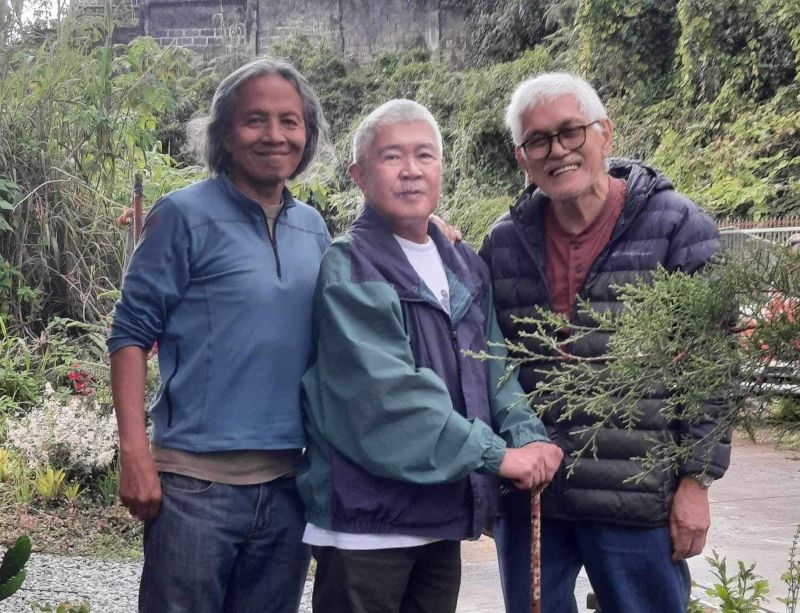
When Ben Tapang, who went by the nickname “Lolo Ben” even before he retired from the University of the Philippines Baguio as an economics professor, gently reminded our Viber and Facebook chat groups that soon his long-time house partner-companion Professor Emeritus Delfin Tolentino Jr. was about to mark his first-year death anniversary, we were mobilized into quick collective action.
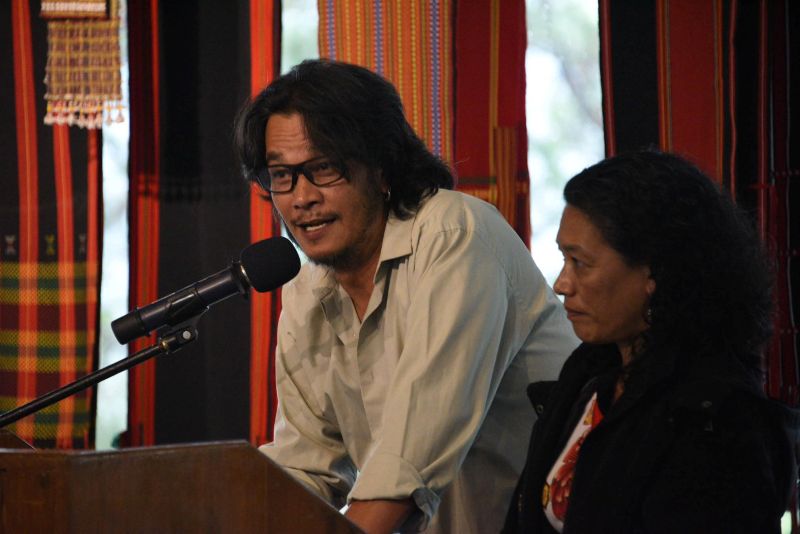
‘Lolo’ Ben Tapang, center
Just as Del would’ve wanted us to move—quickly, deliberately, leaving no stone unturned. There wasn’t cause to malinger by postponing the babang luksa to a more appropriate time when a representative from the Tolentino family could come for the occasion.
But I couldn’t help but pause, sigh, and rue on my FB status that I was still in a state of denial at his untimely passing on May 16, 2025. To which our common friend in Chicago, retired bank employee and full-time gardener and collage artist Augusto “Ogot” Sumulong, replied by email with this poem:
On Babeth Remembering Del
Just like you,
I’m still in denial.
Maybe an ocean
still separates me
from dealing
with the reality.
But the post office
sends no more
Baguio postcards,
no more poetry
of ordinary days
and language of
fugitive memory
on decolonized notes.
Just still silence,
making excuses for
the Chicago mailbox.
Previous to that poem, Ogot also sent something he had written when he earlier received a huge bundle of 10 postcards from Del’s Mirador Hill residence. Ogot wrote in his message to me and other orphaned friends from Del’s UP Diliman years: “Del…collected a trove of postcards on his trips; some of them found a home in Chicago. For each card, he’d typically select his postage stamps from an array of designs at the philately section of the Post Office and write, in cursive with a fine-nibbed fountain pen, little stories about his myriad projects, interests, and journeys.”
Araw na Umulan Dito
Ngumiti ka nang
natanggap ang isang
tungkos ng sulat
isang umagang
di mo inakala.
Pero iglap lang
ang tuwa ng araw.
Umulan kasi
dito kangina,
binuhos nito ang
sampung postcards
mula sa Mirador Hill,
tila mga patak sila ng
bigat ng biyaheng
buong tibay niyang
tinatahak mag-isa.
At sumagi sa
isip kung paano
nga ba pinapanday
ang pandiwa ng
daan papauwi.
Del was not just the compleat scholar, writer, teacher, book art artist, collage maker, collector of art and artifacts, gourmand, and analog communicator. He was as mischievous as a kid let loose in a playground. He was capable of practical jokes, his eyes crinkling and twinkling as he made ready to utter another pun. (When I became a grandmother and I announced that I would henceforth be addressed as Booboo, his comeback was his nickname for me would be “Baboobska,” and in his every email and text he addressed me that way.)
As Ben said while speaking on behalf of the Tolentinos, “A year after his untimely passing, we who have known Delfin, remember not only how gifted he was, but how enjoyable he was to be with. He took ideas seriously. Himself? Not much. He had that gift of making intelligence alive, playful, and slightly subversive. Conversations he made sharper, gatherings livelier, the generous food tastier (he cooked), the drinks headier (‘Complex vitamins,’ he called them), and friendships richer. He gave his mind, certainly—but also his humor, his warmth, and his wonderfully unruly, playful spirit.”
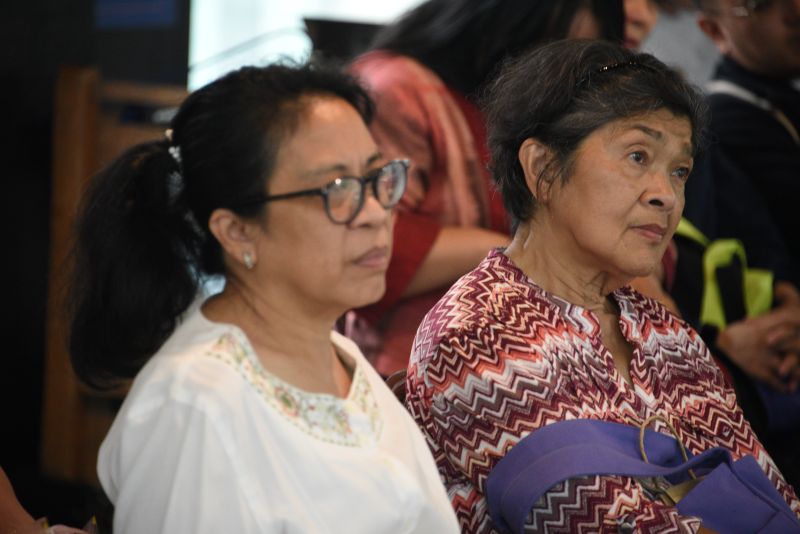
Prof. Grace Subido and Del’s neighbor and friend Mina M. Rimando
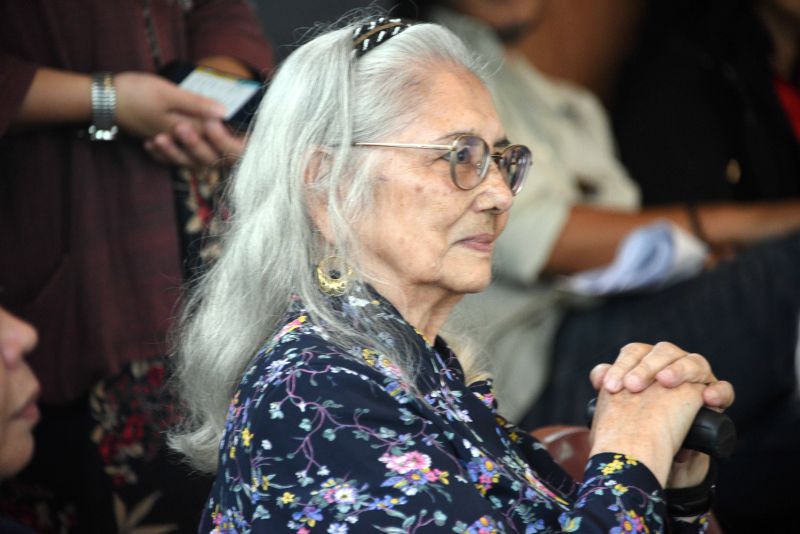
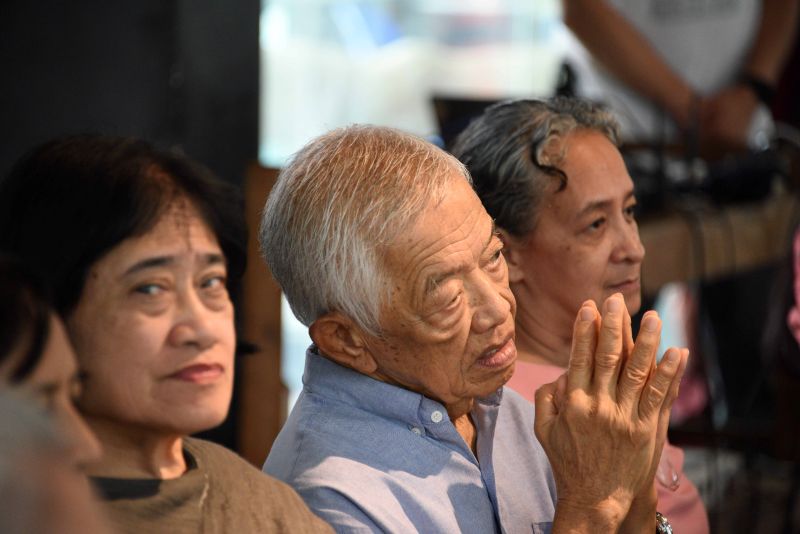
Professor Emeritus June Prill Brett, who lends her eminent presence to an important UP Baguio gathering
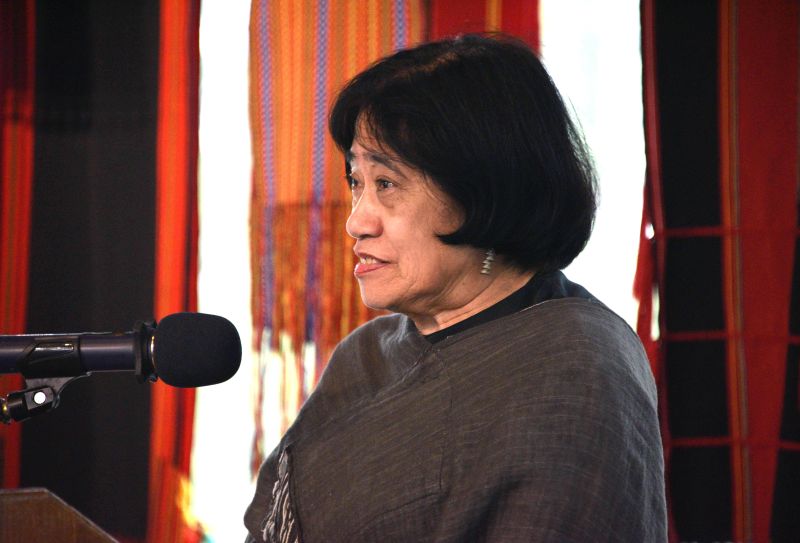
Retired Prof. Vickie Rico Costina reads ‘Not What the Heart Elects’
How did we honor his memory? Our Iskulumbing team (that being Del’s pet name given by his older bro Nilo), led by Ben and Perfecto T. Martin, suggested a program of music and poetry, two things the deceased loved. Who could forget his vast collection of CDs? And the books and bookmarks that another retired professor of English, Vickie Rico Costina, and I still look at with covetous eyes?
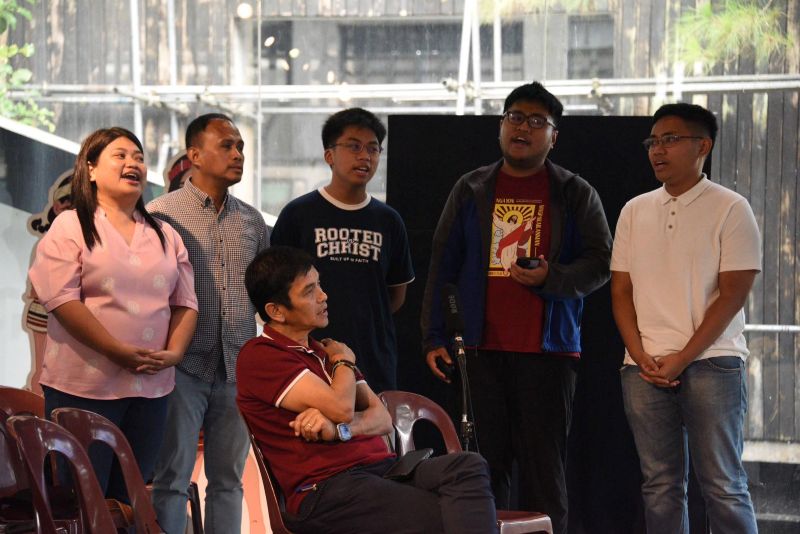
Chancellor Joel Adawe of UP Baguio, seated, with the Magallon family singers
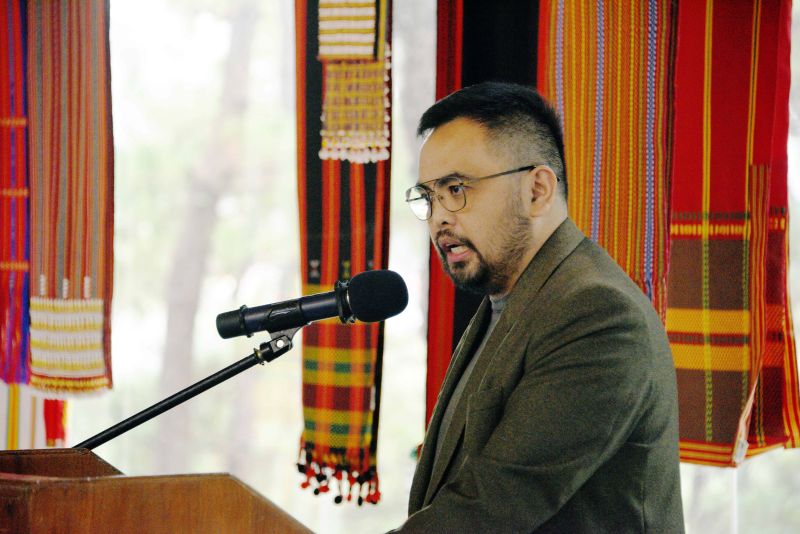
Dean Io Jularbal
Del’s mentee, Dr. Ikin Salvador-Amores, found the priest, Fr. Manny Flores, to offer the commemorative Mass, and the suki caterer, Gil Diaz, to do the merienda buffet of boiled bananas and kamote (standard fare for even a modest Cordillera feast), assorted kakanin, banana turon, free-flowing coffee, and hot tea. She also coordinated the program that included short speeches from UPB officials: Chancellor Joel Adawe, College of Arts and Communication Dean Io Jularbal, and Museo Kordilyera director Tala Salinas-Ramos.
Dean Io at one point naughtily modulated his voice to bedroom level to say how some titles of Del’s academic papers read like sexy literature.
Vickie read a 1985 poem by Del which is shared here in full. This brings me to Del’s command of English, which his friend and former Ateneo classmate, book designer-curator Manny Chaves, likened to Gilda Cordero-Fernando’s rich vocabulary.
Not What the Heart Elects
Too often we do
Not what the heart elects.
No matter how profound
We murder the secret intent.
Reason intrudes, civility gets in the way
And so the pat that should fall
Gently upon your shoulder
Converts into a limp of the hand
That descends in defeat.
And the oral lore of our passion
Translates into limericks of despair,
Muffled by loud discourses
On the metaphysics of routine.
When we meet we seem to unsee each other,
Diaphanous filaments wafting stealthily away.
But what is there to fear?
Our hearts are manacled to a history of pain
As dogs are leashed to pipes and posts.
Either that or we are servile
To many tomorrows we cannot divine,
Detainees in the spectral pit
Of clever clowns, or, perhaps
Perfect dreamers drowning
In the stupor of the most hollowed bliss.
What differentiates Del from Gilda is he was raised in Bulakeño Tagalog. His facility in that language enabled him to translate many poems—from Japan to Latin America to the African continent—using English as a bridge or relay language. And, like an ambidextrous tennis player, he easily shifted from English to Filipino in his prose.
My assignment was the poem Doors, which Del turned into a handmade book with a limited edition of five in 2002 and exhibited at the Maryknoll Ecological Sanctuary. Doors is the verse I would have wanted associated with my own body of work for its combination of depth and lightness. There’s an initially formal voice that at some point turns so intimate.
Doors
Strange are the ways of doors,
cryptic the
words they say
in silence.
An open door may deceive,
deft as the
laughter of a
harlequin.
And a closed
door may just
be timorous.
Some doors
may drawl
and drive away
the officious
fool;
others may
whoop to wile
the witless
passerby.
Incredible
how a door
can mystify,
like when it
makes the heart
quiver
at the sound of
footfalls
drawing near.
Or when the
unfamiliar tap
heralds some
ambiguous
surprise.
Doors also have
uncanny ways
of shattering
desire,
like, for instance
when they lock
and not even the
heresies of love
would dare
touch the
doorknob.
But a door may
also wrench
away the
coldest fear
by opening just
a bit, enough
to whisper a call
tender and coy
to anyone
who knows
the ways
of doors.
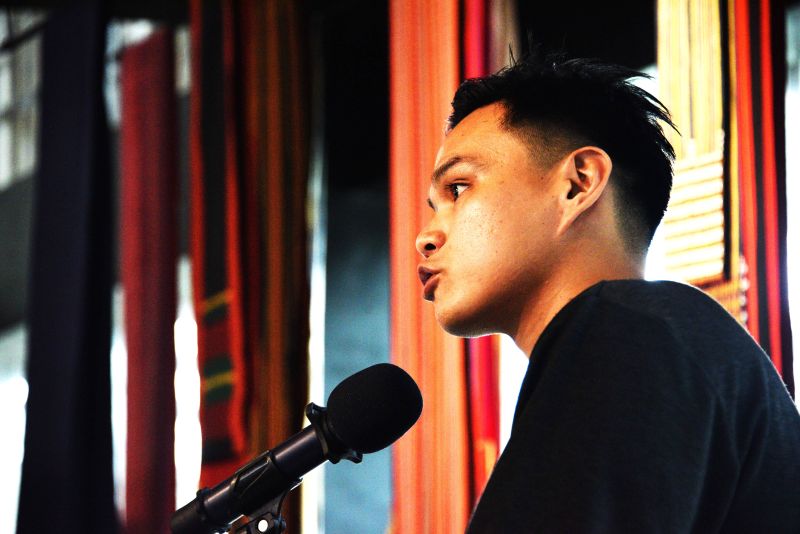
Benjamin Meamo III
Among other poems, Benjamin Meamo III, a communication instructor also at the university, read Salamangka ng Dapithapon sa Guesset or, as roughly translated by me, The Magic of Evening in Guesset.
Salamangka ng Dapithapon sa Guesset
Saglit lamang na dumampi ang ambon
sa katitıngkal na tumana.
Saglit lamang na nagpakita ang martines
na nagmula sa mga palumpong.
Sa dakong itaas ng libis, ginhawa
ay sandaling nalasap ng pagal na isip.
Di man lang namalayan, wala na
ang kangina’y esmeraldang kapaligiran.
Simbilis ng pagtikom at paglupaypay
ng mga makahiyang nahalikan ng yabag,
Naglaho sa payapang ilog ang anino
ng mga magsasakang nanggaling sa bayan.
Sa dako roon, ilang bibig ang naghihintay
sa biyayang dulot ng kabebentang tabako?
Gaano katagal bago muling magsahog sa kanin
ng bagoong at katas ng kalamansi?
Wala pang sandaang kurap ng mata,
lubog na ang araw sa Cordillera.
Karlo and Rl Altomonte read from Del’s essay ‘Cordillera Blues.’
Capping the readings were excerpts from Del’s 1995 essay Cordillera Blues, subtitled Ang Paghahanap ng Musa sa mga Guho ng Nilindol na Lunsod, interpreted by the husband-and-wife theater team of Karlo and Rl Altomonte.
It starts with the premise that it is extremely difficult to be a writer in Baguio because of the distractions of the pretty scenery like mountains that almost kiss the sky.
It continues with Del’s near-confrontation with a former professor who, when the latter learned that his brilliant, newly graduated student would move to Baguio, shouted, “Ano, magtuturo ka sa Baguio? Mabubulok ka roon (You’re moving to Baguio? You’ll rot there)!”
It lists the traditional stuff tourists go for in the city: crisp lettuce, strawberries, peanut brittle, everlasting lei, even the so-called kulangot ng Intsik, man-in-the-barrel figurine, polyester ponchos, giant rosaries, and so on.
And it ends with the discovery that by going beyond the superficial charm of this city, one could learn to indeed write and not be distracted. What was more, the one who relocated like Del later found it hard to leave the place.
Providing musical interludes were the Magallon family singers, who sang gospel music, and New Zealand-based Myriam Benito, Del’s former executive assistant in the school’s public information and publications office, who interpreted with small dance gestures a Maori song.
Del’s unpublished manuscript of prose and poetry, Cordillera Blues, will hopefully find a publisher by his 76th birthday in August.


