
There are times in Philippine theater when performances of Western texts can come across as affectation: accents fluctuate between places of origin, words are over-enunciated to the point of caricature, appearing “foreign” is mistaken as a mark of quality. This doesn’t mean that every adaptation or foreign work produced here needs to be “Filipinized.” It’s just that, when these shows are done poorly, they can feel self-satisfied with their foreign-ness rather than focused on the stories they’re telling.
Thankfully, not only does CAST PH’s (Company of Actors in Streamlined Theatre) production of The Effect—a 2012 play written by British playwright Lucy Prebble—avoid exaggerating any British-isms in the material; it succeeds in universalizing Prebble’s script for 2026 and bringing urgency to its wide range of themes. The four-hander follows two people who begin to develop a romance while volunteering for a clinical drug trial, and the two doctors overseeing their experimental treatment.
The Effect had an all-too brief two-weekend run at Ateneo de Manila University’s Doreen Black Box Theater from September 19 to 27—and stands as a strong entry in an impressive year for straight plays. This is a production that wisely resists resorting to easy spectacle, and instead devotes all of its energy to baring the concealed wounds of its characters and continuously unspooling the threads of its thought experiment.
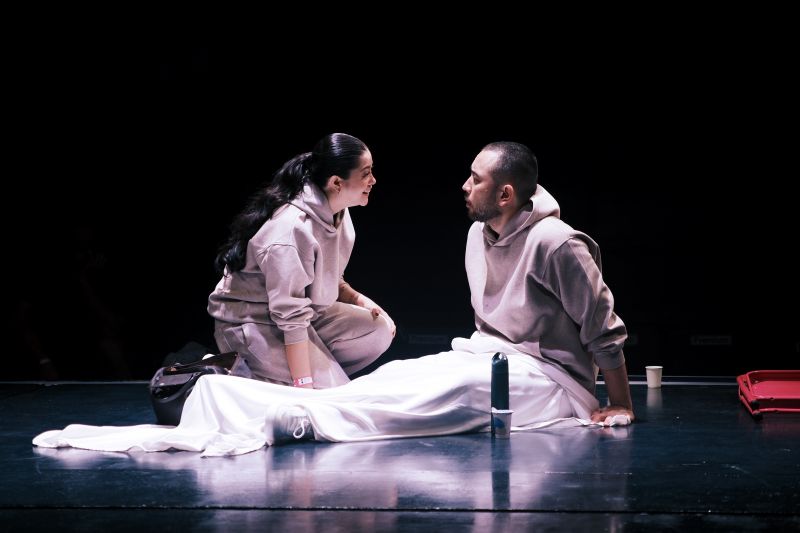
Much of the fun to be had with this show is in its constant complication of the dynamics between each of its “couples.” What starts out as a premise that could easily belong to a quirky young adult story becomes a much darker, much thornier situation in which every person’s true intentions are constantly called into question. As the clinical trial proceeds, it only grows more unclear if Connie (played by Sue Ramirez) and Tristan (Brian Sy) are genuinely interested in one another, or if their feelings are just a result of their isolation or the antidepressants they’re taking. Whenever Prebble reveals crucial new information, these twists never register as unnecessary escalations of conflict but as opportunities to uncover the characters’ greater desires, and to emphasize the agency that they still possess.
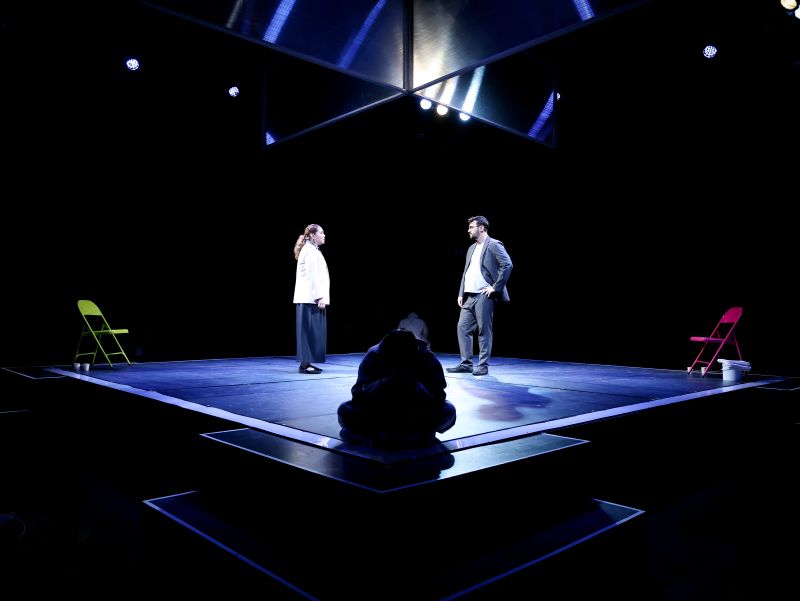
Cathy Azanza-Dy and Dean Daniel Rosen in ‘The Effect’ (Photo by Myra Ho)
There is some suspension of disbelief required as The Effect progresses, however. It’s hard to believe that such a trial would continue without major intervention after Connie and Tristan have started influencing each other—not to mention, after Dr. Lorna (Cathy Azanza-Dy) and Dr. Toby (Dean Daniel Rosen) get into conflicts of their own that could undermine the study’s objectivity. But it’s a testament to the persuasiveness and lucidity of Prebble’s dialogue that the narrative’s plausibility in the real world is less important than how compellingly she weaves her themes together. Here, the nature of love and trauma tests the limits of scientific knowledge and pushes against the established boundaries of medical ethics. And each character, patient and doctor alike, comes to a more honest (but not necessarily positive) understanding of themselves.
Even with this play’s potential to be presented as a full-on thriller or edgy psychological drama, director Sarah Facuri takes a more restrained but no less engaging approach, sensitive to the shifting moods of the characters. D Cortezano’s strikingly minimalist set—a raised platform, two folding chairs, several paper cups, and a plus-shaped fixture overhead—may appear clinical to the point of seeming alien, but Facuri takes care to depict the people on stage as ordinary and familiar. Cortezano’s set isn’t designed like a cage and there aren’t any physical divisions between those observing and those under observation; Facuri lets them move, explore, and dance with relative freedom. As the plot unfolds, this choice becomes clearer: the characters are all simultaneously being tested in some way, and being scrutinized by the audience.
Director Sarah Facuri takes a more restrained but no less engaging approach, sensitive to the shifting moods of the characters
The show also keeps its more technical special effects (no pun intended) to a minimum, never interrupting the drama with flashy storytelling devices. Carlos Hombrebueno’s sound design is pristine, ensuring that every word can be understood, even when Dr. Lorna’s voice is occasionally filtered through a muffled PA system speaker. Jethro Nibaten’s lighting gently nudges the characters along, whether by softly illuminating their paths as they travel outside the testing facility, or letting time pass through quiet fades to black. Facuri recognizes that the ideas presented in the script aren’t exactly novel, and she therefore doesn’t try to sensationalize them. But discussions on depression and healthcare are more widespread and just as urgent today, and this production knows to keep a human face on these issues rather than making them out to be taboo or exotic.
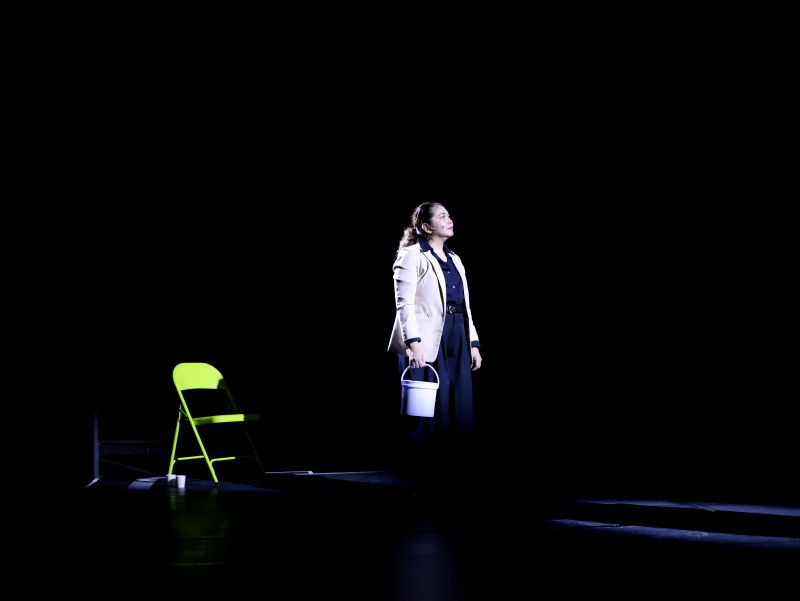
Cathy Azanza-Dy as Lorna (Photo by Myra Ho)
The Effect ultimately expresses the full extent of its humanity in its performances. Ramirez’s Connie presents herself as self-aware, given her background as a psychology student—but this confidence in her youth and her education is exactly what makes her naïve, as well. The maturation that Ramirez allows Connie to go through by the end makes for the play’s most hopeful conclusion. Sy contrasts her effectively, with Tristan being a creature of impulse and passion, and whose sincerity is sabotaged by his own lack of direction. But rather than portray him as a wayward bad boy, Sy makes Tristan likable and disarming, rough around the edges but innocent deep down. The couple doesn’t always sell the possibility of a pure love brewing between them, but this could also just be part of the show’s mystery.
Meanwhile, friction grows between doctors Lorna and Toby, whose stories become just as important to The Effect. Rosen could have easily leaned into Toby’s callousness, but instead makes the doctor’s psychology-above-all perspective earnest and reasonable, if a little stubborn. The actor doesn’t make himself out to be an imposing, superior presence, which allows his character to register as an equal to the others in the play. And starting out as a seemingly secondary character, Azanza-Dy’s Lorna emerges as arguably its most complex figure. Azanza-Dy expresses profound heartbreak and betrayal when her character realizes the ways in which she is being “tested,” the actress falling apart in real time, retreating into a smaller version of herself. It’s a highly accomplished performance in a production that still allows us to see her beyond her tragedy.


