


Chinese women focused on their phones the way the lad in stone is on his book
Text and photos by Elizabeth Lolarga
You were more than fed well. You were stuffed in a banquet that had a maximum of 12 courses awaiting you at every meal stop. You had your fill of roast Peking duck, no matter how bony it could be in some instances. Still, the flesh was succulent and savory.

Contemporary art at Such Mansion where one of the endless banquets was held
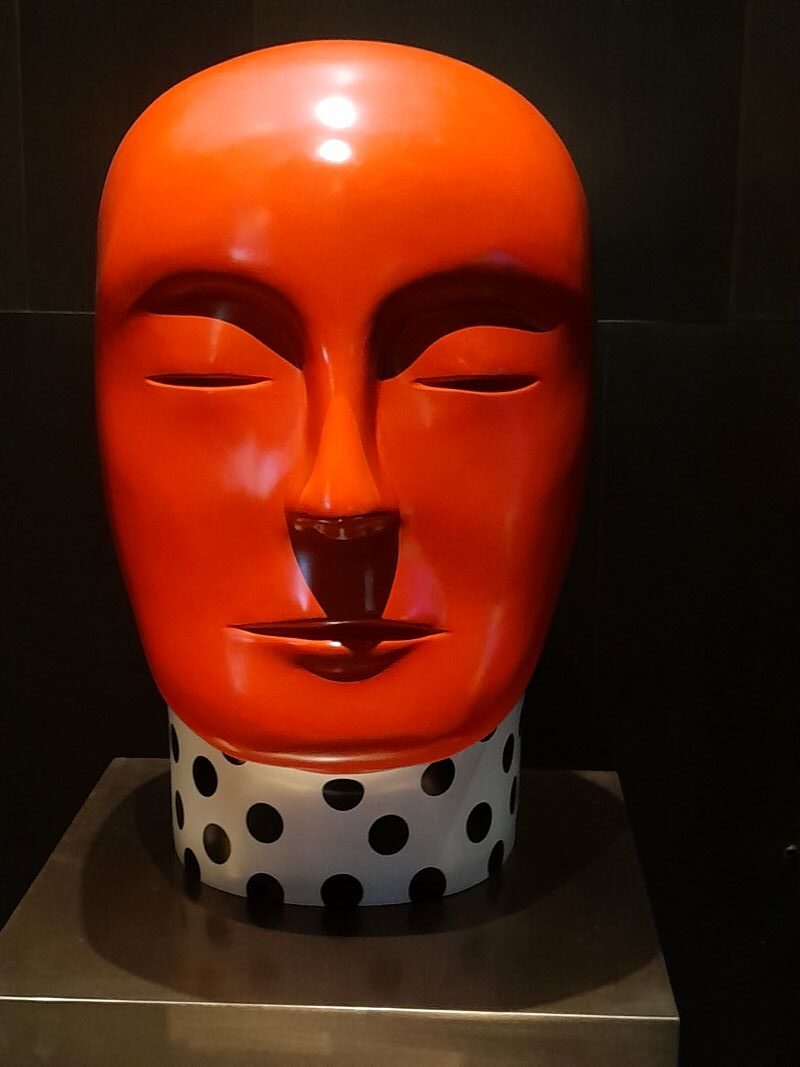
One of two busts flanking entrance of Such Mansion
You think that special treatment of your party, made up of nearly 40 individuals from various backgrounds and professions, was due to your being guests of the Chinese government and Filipino-Chinese friendship associations.
Right now, China is getting a bad rap in the press for bullying our fisherfolk and Navy in the West Philippine Sea (yes, you still believe, “atin ito!,” it is ours!), for the existence of POGOs or Philippine Offshore Gaming Operators in new forms, or—do you dare say it?—an inbred distrust of the Chinese, as contrasted with our more welcoming attitude towards the Americans, despite the latter’s own blood-soaked hands for the massacre of Filipinos during the Fil-Am war.
This trip of nine days and eight nights covered Chengdu, Jiuzhaigou, Chongqing, Fenghuang, and Zhangjiajie, by plane, bus, and bullet trains, the latter sometimes marred by near mishaps, like a missing pink Traveler’s Choice luggage (eventually found before the train doors shut). The view from the window showed both countryside, its greenness preserved, and soaring cities right out of a futuristic dream.
The organizers, led by former Sen. Nikki Coseteng, former ambassador to China Carlos Chan, and Leslie Climaco of Apec 1 Travel and Tours, promised that this maiden voyage had fun, food, and friendships as its main agenda.

The cultural relic called Liberation Monument at the center of a square of high-end stores and buildings
You saw for yourself, most of all, that the socialist system has worked for our neighbors, their logical development from people who once wore uniform brown, blue, or black Mao suits and now sport the most up-to-the-minute and luxury brand threads of the 21st century.
The sleep (or lack of it) wasn’t yet wiped from your eyes—it was a 2:55 a.m. flight from Manila to Chengdu—when it became clear that the pre-departure advice about group tours by fellow traveler China Lim Go was true: “You have to be flexible.”
You thought of staying close to the herd instead of wandering off to investigate this or that curiosity. Your tour guide, who went by the English name Peter, warned, “Please follow me, or else you become Chinese!” (Don’t get lost.)
He told us, too, to familiarize ourselves with chopsticks for meals, since knives and forks were seldom offered in restaurants. Clumsily, you did, with a lot of encouragement from China’s daughter Kazumi.
At the Chengdu airport, Wendell delos Reyes, vice president of Diliman Educational Corp., which runs Diliman Preparatory School and Diliman College, noted at once how the sensor on the bag carousel ensured that the luggage didn’t bump against each other. An open-mouthed “Ohhh!” moment followed, a nod to robotics or AI. Before the next luggage could fall, the carousel ensured it had enough space for it to be accommodated, as the conveyor belt moved along.

Assorted dried fruits, including the bayberries used for dikiam
Peter informed us that post-pandemic China had become a cashless society, with vendors preferring GCash and credit cards. But in your case, tourists from a cash economy, the sellers of magnets, fans, toys, dikiam, and champuy surprisingly accepted paper bills, even as they did a little haggling with calculators. The transaction done, you exchanged nods and xie xies or thank yous.
Post-pandemic China has become a cashless society, with vendors preferring GCash and credit cards. But the sellers of magnets, fans, toys, ‘dikiam,’ and ‘champuy’ surprisingly accepted your paper bills
For the women in the group, a source of discomfort for those used to the Western sitting toilet was the pissoir, no matter how clean it was, or even if it came with a press-on button or foot pedal for flushing. It meant we all had to squat and balance ourselves. Sometimes, the toilet came with a support rail for the PWD or the elderly whose knees were compromised. Nevertheless, squat you and your kabaro (women companions) did. Before or after meals, when the queue to the ladies’ room formed, the question asked of the previous user was always: “Western or squatting?”
From Nikki, you learned a basic: that the Chinese people traditionally used the squatting position for pooing or peeing because they found it cleaner—nothing touched their butts. Super trooper broadcaster Katherine Inocencio, who has a knee problem, retorted as a newbie user, “But what if your aim is poor?”
Jiuzhaigou National Park was your destination after a bullet train ride from Chengdu Railway Station, where another near mishap occurred. Dermatologist Genevieve Lim Huang, who was ensconced in her electronic wheelchair when you last saw her, went missing. The other tour guide, Vito, sometimes addressed as Victor, asked the queued passengers in near panic, “We’re missing the lady in the wheelchair. Have you seen her?” Then he ran the breadth of the station before finally spotting her, emerging from a lift, smiling while awaiting his assistance.

In a Tibetan Buddhist village there are prayer flags and wheels.
On the first day in Jiuzhaigou, known for its Tibetan Buddhist settlements, apart from natural charms, Dr. Huang again gripped your attention when she maneuvered her wheelchair, thinking Vito was behind her, pushed it onto the main road, and steered it at approximately 20 kph or more while other cars overtook her. You and the rest were enjoying a leisurely 20-minute walk to the park entrance when she whizzed by, again with that smile that meant she was embracing life’s risks. When road traffic cleared, Vito hurriedly pulled her and the chair back to the sidewalk.
In the park, the first stop was Pearl Shoal Waterfalls, with over hundreds of señorita steps to descend that you lost count of them. There were lines of domestic tourists before and behind you. At one point, fellow descender Dr. Miko Gozum broke your fall because you couldn’t distinguish one step from the other, and you had to keep pace with the others.
You realized that this country didn’t need to promote its attractions overseas. Just among the Chinese themselves, there was already a boom. Leah de la Rama, Nikki’s sister, observed earlier, “They don’t look like high-class travelers. They look like one of us.” Anybody who saved a year or more worth of wages could enjoy domestic travel. Yes, sana all indeed!
After the descent to the primeval forest with running brooks that made you think of the theme from the film The Sound of Music, there were the pristine falls, water so white, foamy, dropping on age-worn rocks. There were rails to prevent anyone from tipping over. If you were patient, you would get your turn at a selfie or group-fie.
This country didn’t need to promote its attractions overseas. Just among the Chinese themselves, there was already a boom. Anybody who saved a year or more worth of wages could enjoy domestic travel. Yes, sana all indeed!
Annabelle Estepa wasn’t so lucky. She leaned over, and her sunglasses fell into the vegetation. No way could she retrieve it. She shrugged at the loss. China was of the belief that if something precious or valuable got lost or stolen from you during your travel, that loss might have prevented something worse from happening.

Letty Sze, Nikki Baluyut Jimenez and Nikki Coseteng gone native, too, by the Tiger Lake

Gone native: Letty Sze and Annabelle Estepa forsake their travel gear for something different, even just for a few hours.
She and Kazumi were left behind by the tour van, with guide Peter opting to wait for them at the marketplace for souvenirs that we visited after a vegetarian buffet lunch. There were other lakes to view: Five-Mirror Lake, Long Sea Lake, the highest in Jiuzhaigou, and Tiger Lake, so named because its waves remind one of a tiger’s stripes. By this time, some of the women were dressed in rented (for 150 RMB) traditional costumes of the area, including the two Nikkis (the second was broadcaster Veronica “Nikki” Baluyut Jimenez), Annabelle, Victoria Assad and Letty Sze. The attire served them well while they posed by the green-blue lakes.
Dinner at Happy Kitchen Restaurant was another lauriat with an automatic lazy susan in the middle that almost made you dizzy from its non-stop turns. The group was seized with a collective fit of coughing as you all reacted from the spiciness of the food, including the steamed fish. Nikki requested fried chicken with no add-on spices, but it wasn’t possible, Leslie said. The cook was slow in understanding the request for mildness.
Those who had counters on their wristwatches or phones realized that the group almost went past 10,000 steps that day. In the following days, this would be the average golden standard for our cardiovascular and circulatory systems, even if one night Wendell was seized with leg cramps from the day’s efforts.

Author enjoys foot spa with herbal leaves steeped in hot water.
You developed new calluses and blisters that healed after some foot care. Your black stretchable Skechers saw you through the more than weeklong walks and lines. At one point, they were muddied from the visit to misty, rainy Tianmen Mountain or Heaven’s Gate in Zhangjiajie, Hunan province.
Katherine advised, “Just wash them with a toothbrush in your room, using mild soap or toothpaste. Use the blow dryer to dry it. It’ll be okay in the morning.” Right she was.
The realization dawned quickly. While there was a desire to whine, this was stifled when an upbeat phrase, a sincerely felt query of “Did you sleep well last night?,” an arm to steady oneself like the one Moira delos Reyes offered on the slippery paths of Tianmen Mountain, came to be. Flexibility wasn’t the only trait required in a group tour; there was everyday kindness, too.

A 999-step climb upward while fighting the wind, rain and mist is this view of Heaven’s Gate, otherwise known as Tianmen Cave, found also in Zhangjiajie, Hunan province.
Vito said, as he smiled proudly while wearing his sterling silver Mao pin, that the founder of the People’s Republic of China remained very much revered. In Mao’s hometown in Hunan, he said, “They still have pictures of him in every house.”
He continued, “Our communism is different from Cuba, Laos, Vietnam. While Mao made us independent, Deng Xiaoping introduced changes and opened us to world trade.”

Skyline of Chongqing with Yangtze River

The train that runs into a residential apartment in Chongqing
Vito, who stayed in Boracay island for three years in an immersive experience, led us to a busy Chongqing area, a bridge above the Yangtze River, where you witnessed a train-swallowing apartment. It wasn’t a novelty. It was actually an existing residential building with businesses on the lower floor, including what one student claimed was the best milk tea in the land. Called the Chongqing Rail Transit Line 2, the train goes through a gap in the higher floors of said building and comes out the other end like something out of a Harry Potter fantasy.

Mom teaching kids the basic mahjong, flanked by panda dolls
The Chongqing Rail Transit Line 2 train goes through a gap in the higher floors of a building and comes out the other end like something out of a Harry Potter fantasy
Meanwhile, down below, the merchants, including a dwarf who wouldn’t let you go until you bought a Sichuan changing-face opera doll from her for 10 RMB, were having a heyday with the tourists. Delegates like Renz Bajar, Drew de Mesa, Jomer Noronio, and Ruzzel Sobrepeña bought anything that could fit their student budgets. Before long, you saw them tucking away panda bear plushies, headbands, fans, and what nots.
What Nikki said was true—China, the country, had everything for every budget. “You see the quality of goods worth from one yuan to thousands of yuan. You get what you pay for, which is the way I like to be respected as a customer.”
Asked how she promoted ties between the Philippines and China, her reply was: “To build better understanding, I do it people to people, like bringing people who have never been to China supported by Fil-Chinese friendship associations. It cannot be a one-shot deal. The mix is of people who have already known China and even of people who are skeptical of or don’t trust China. We didn’t choose a seamless, stress-free itinerary. I know China enough to expect connectivity at a high level by air, sea, land, subway, railway. All are connected. People flow, and everything’s on time.”
She ensured that food would be “something the guests appreciated. It’s beyond the Chinese food we know. Plus the hotels must be comfortable, clean, and safe.”
Someone asked Leslie after another lauriat at Chongqing Taste, “Can’t you feed us less?” The personable travel agent smiled as she apologized, “Sorry, we can’t do that.”

At the Silver Museum (99.9 percent silver) in Phoenix ancient town, also known as Fenghuang for the mythological bird

Girl models silver and indigenous finery under a whimsical parasol beside the Da Giang River

Night view of Phoenix’s Da Giang River
As for the shopping portion, you wandered through the alleys of the ancient Phoenix town where one exit led to the old clear river with just as ancient architecture to marvel at. In one shop, you found postcards, but no stamps were for sale. Scribbled messages to your dear ones back home.
Chinoy businessman Danny Sze pointed out to wife Letty the ornate bridgeway, saying, “That’s part of our heritage.” Together they sat on a stone bench and gazed at the sight as the afternoon waned. It was a rare chance at exercising slowness, for soon the new guide, Gabriel Guo, assisted by students Amelia, Summer, Dora (or it could have been Doris), their chosen English names, roped us in for dinner, then more evening paseo down narrow alleys and viewing of traditional houses all lit up for the night, with an agreement to regroup at the resto afterwards.

Avatar Hallelujah Mountain where part of the James Cameron film was made

Writer Vicky Veloso Barrera escapes the museum, runs into the next shop and finds a baby blue tunic that fits her to a T.
If you’re seated by the panoramic window of the bus or train, your sleep-worn eyes are soothed nearly everywhere in the rural areas at the sight of bridges over water, over mountains, over land, while in the cities, the island separating highways was sometimes planted to roses in pink, red, salmon. Someone commented after last seeing China in 1989, “It’s from gulayan (vegetable farms) to modern metropolis.”

The Zhangjiajie Grand Canyon Bridge suspended between two mountains and partly made of glass
The country seems to enjoy all its “ure” allure: infrastructure, nature, culture—to such an extent that your fellow travelers found yourselves swinging between two mountains, suspended on a glass-bottomed bridge at Grand Canyon while clad in non-slip shoes. Gabriel said the bridge rose 306 m above the ground. One could jump on the glass without it cracking. To prove she came from brave stock, Annabelle lay down on the glass with a full smile while your phone camera clicked and recorded her feat. Some boys dared a jump shot, but most of you walked as though tiptoeing on eggshells.
Coming home, still feeling bloated from the richness of the food and experiences, you tended to agree with the political analyst in the group who observed that a fast-growing country like this is the last one to want war, either with nearby neighbors or with the US. Why would they wish to obliterate what they had worked hard to build?
So should you return when the opportunity arises? There is a poem framed and posted outside Phoenix Ancient City. The ideograms read: “I knew you would come so I waited.”


