
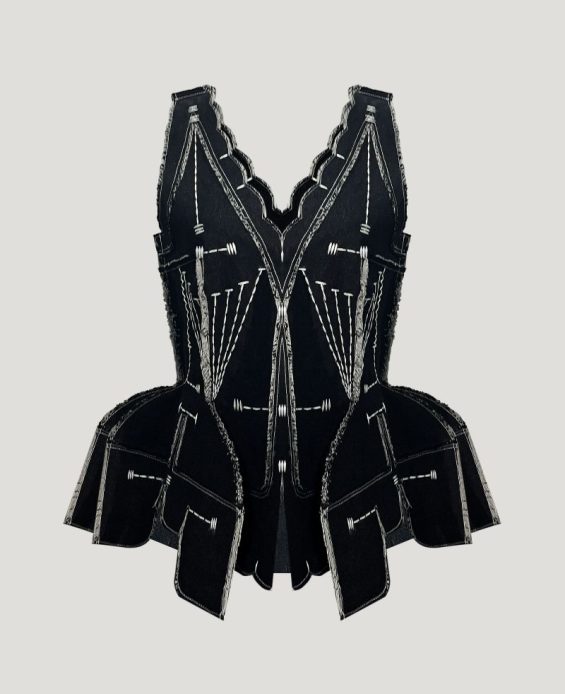

Renz Reyes doing a titting of the peplum top with furniture designer Ria Augousti
Broadcaster Karen Davila, an early bird at Renz Reyes’ three-day solo pop-up at Comme Ci, snapped up the black denim Core Vest, a structured waistcoat with extended sleeves, dangling straps, contrasting V-stripes, and linear stitching. The next day, she confidently wore it at Vogue Threads Manila.

Reyes’ Core Vest with his signature linear embroidery and skirt deconstructed from pants
Reyes considers the Core Vest one of his most popular styles under his namesake label. Comme Ci, a haven for fashion-forward individuals at Rockwell PowerPlant, is showcasing the latest Renz Reyes collection, Codex of Design. This intriguing title seems to draw inspiration from the historic Boxer Codex, a 16th-century manuscript that visually narrates early colonial Philippines.
While Reyes’ collection may not explicitly delve into historical narratives, it shares a similar approach to documentation and curation. Much like how the Boxer Codex meticulously recorded the customs and attire of its time, Reyes’ Codex of Design serves as visual chronicle of his signature styles for his ready-to-wear label. It features core pieces characterized by linear embroidery, subtle fabric ripples, unusual shapes, exaggerated flaps, vents, fabric manipulation, and embroidered cutouts. (He plans to create a hard copy catalog of the collection.)
“The term ‘codex’ resonated when the social media team suggested it,” Reyes explains. “I hadn’t been designing full-time for my brand—just doing a few shows and not complete collections. Those clothes existed only in fashion shows or as pictures. I hadn’t produced clothes that people could actually wear. The inspiration was to revisit my signature pieces from past collections and make them available for purchase. It’s a form of self-referencing.”
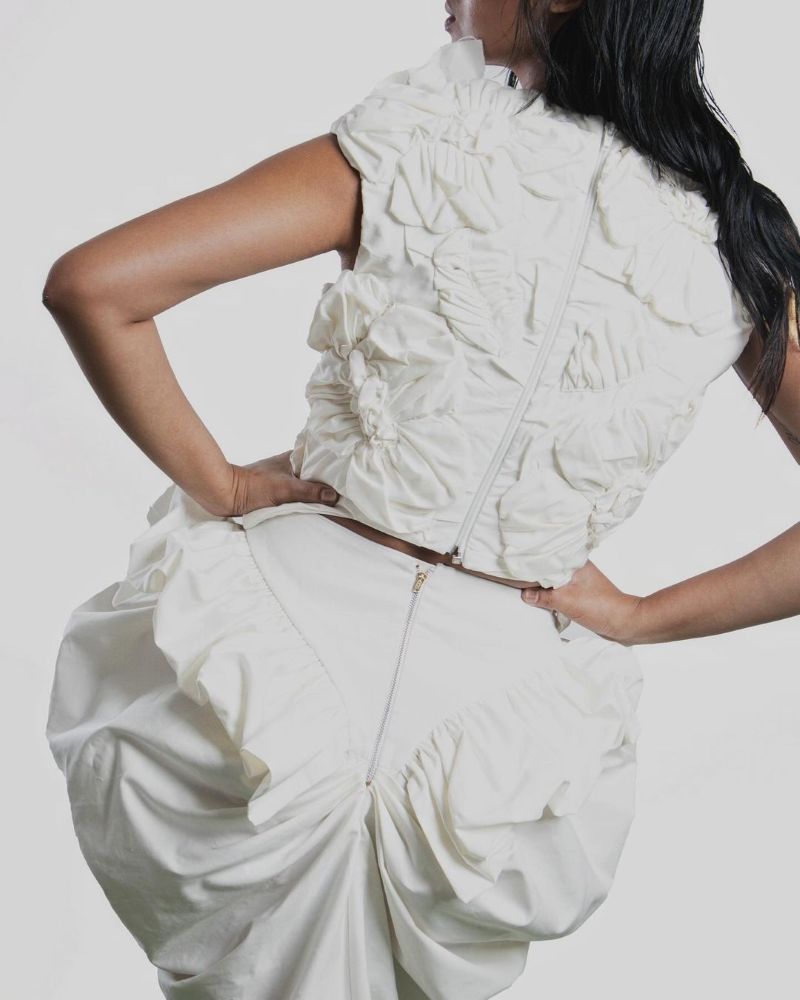
Reyes’ pouf skirt with fabric manipulation to create petals, and a top of bas relief of flowers
Following the solo pop-up, the Renz Reyes label continues to be available at Comme Ci alongside other brands. The first month highlights tops, the second month will showcase more pants and skirts, and the third month will present a complete wardrobe, including outerwear and jackets.
Reyes plans to expand his menswear styles due to increasing demand. “The menswear is unisex because women also love to wear these clothes,” he says.
In recent years, Philippine fashion has experienced a surge in avant-garde designs that challenge traditional notions of clothing. Designers are increasingly exploring deconstruction, a technique that dismantles and reassembles garments in unconventional ways.
Reyes, however, combines conventional dressmaking and tailoring techniques with his unique approach. “I try to base my designs on traditional silhouettes, exaggerating details and adding different cuts or modifications. Even with unconventional silhouettes, the garments remain wearable,” he explains. “There’s a graphic element in my clothes. The embroidery emphasizes the details and highlights the construction.”
The linear embroidery in his designs, depending on its extent, can resemble lines on a map. His 10-year stint at Natori has influenced this aesthetic.
Working his way up from internship to being head of design team, Reyes was constantly exposed to Natori Couture. As the Philippines didn’t produce its own luxury fabrics, Natori used intricate embroidery on imported fabrics to create its signature East-West aesthetic.
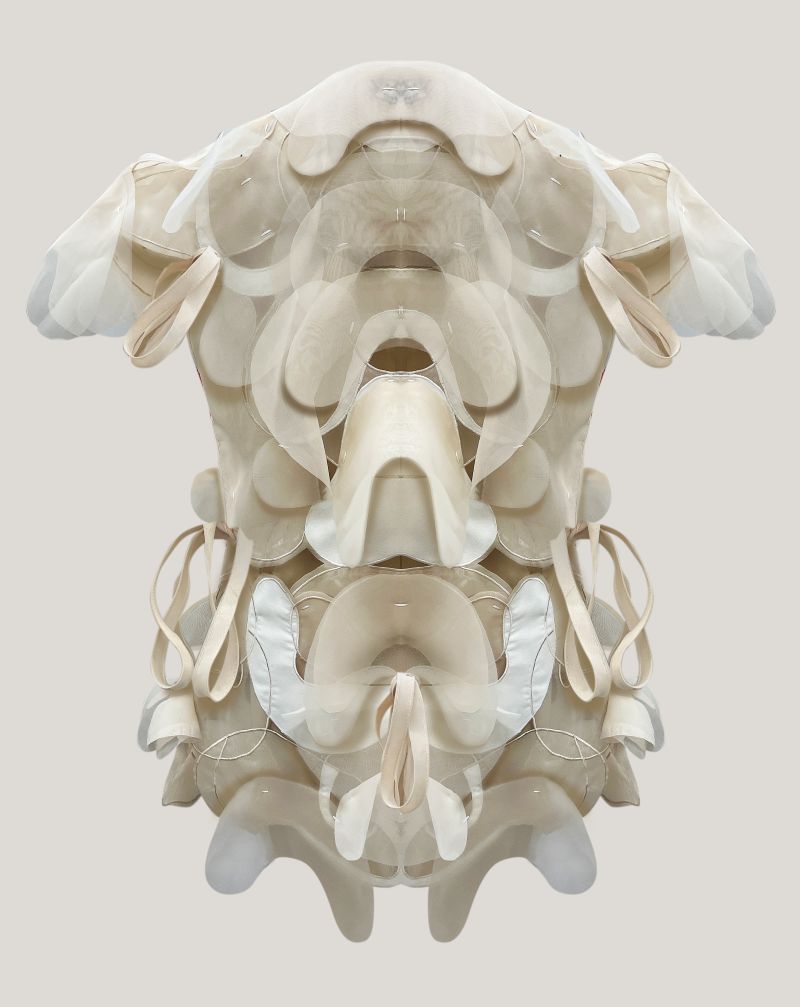
Organza vest with applique embroidery and hand-cut petals. The base was embroidered with three different fabrics to create variations of sheerness.

A fabric developed on the body through hand draping and pleating of flowers
Reyes applies similar fabric manipulation techniques in his designs. The crochet dress, for instance, combines crocheted tablecloths from Tagaytay’s ukay-ukay for the skirt, with hand-embroidered yarn stitching for the top. An organza blouse has a mass of delicate appliqués over a tapestry fabric. His easy denim tops create the illusion of patchwork scallops through contrasting embroidery. “Producing these designs with actual patchwork would be a significant production challenge,” he notes.
Working for Natori, Reyes also learned the importance of branding and how it sets a product apart from the competition. He gained valuable insights into the entire production process, from conception to shipment and store delivery.
“I was exposed to the realities of factory production, so I’m not entirely new to the technical and cost considerations of fashion,” he adds.
Last September, turning 35, Reyes bid farewell to founder and CEO Josie Natori, who then gave him her blessings. While saddened to lose such a talented designer, Natori expressed her support for Reyes’ independent venture. She was pleased that his designs, though distinct from her luxury brand, still carried a sense of relaxed elegance and craftsmanship.
The designer opened his atelier to clients in Salcedo Village, Makati. He also plans to set up a workshop closer to his family in Imus, Cavite.
Reyes works with a lean team of a full-time seamstress who creates samples, and five subcontractor-sewers. Three beaders assist with sewing buttons and labels. “I’ve worked with them for over a decade, and I ensure they receive fair wages to supplement their income,” Reyes explains.
Patternmaking is crucial to his design process. “I approach pattern construction differently,” says Reyes, a graduate of the Fashion Institute of the Philippines. The racks at Comme Ci showcase unique pieces such as bustiers with a gap between the breast and bustline, vests with vertical arm slits and a rippled back, and peplum tops with square-edged flares. “My sewers are sometimes puzzled by my unconventional construction methods, as they’re accustomed to traditional techniques. They often question if there’s a mistake in the pattern,” Reyes says.
Some of his sewers, who previously worked in factories producing specific styles, require additional guidance. “I create detailed guides to help them understand and execute my designs, teaching them new ways to construct shirts or sleeves.”
While some of Reyes’ garments are considered artsy, his recent collection celebrates wearable fashion. His fine arts background from Far Eastern University influences his designs. “Some complex pieces are more artistic, but the ready-to-wear items focus on tailored silhouettes with graphic details,|” he explains.
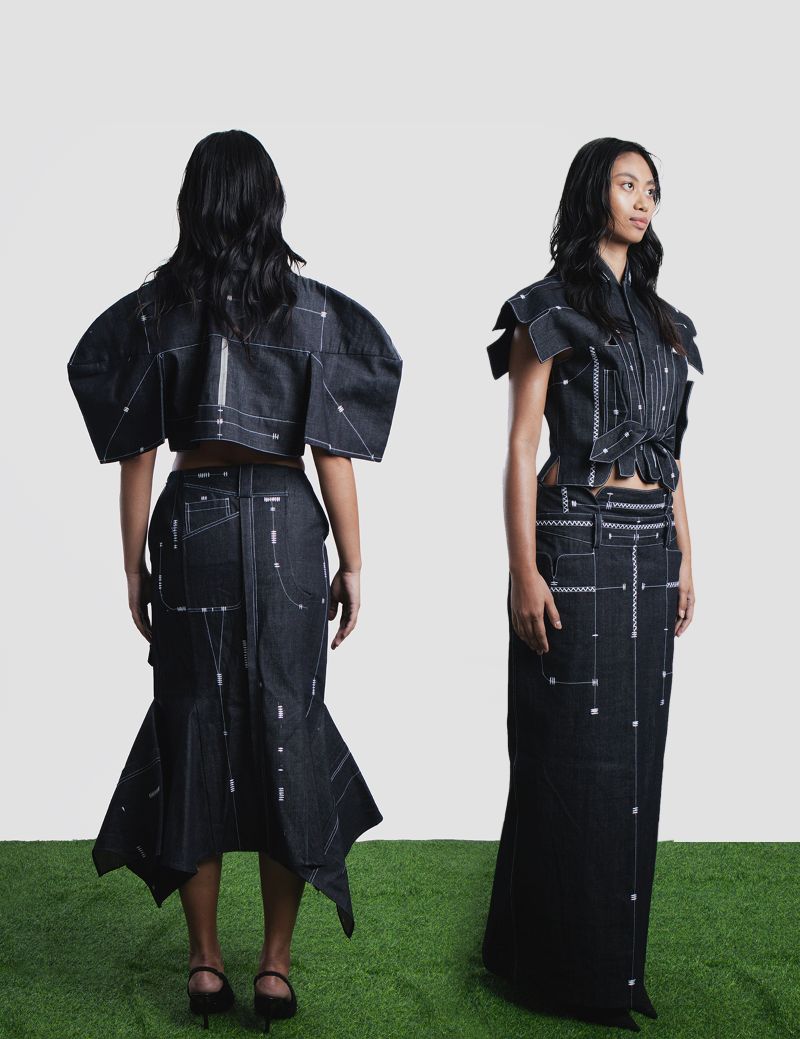
Utilitarian fashion inspired by the ‘camisa’ (left)
The Renz Reyes brand isn’t solely about complex dressmaking. “I aim to produce clothing efficiently without compromising artistic integrity. The designs may appear utilitarian, but details such as embroidery and cutouts add a touch of romance and prevent rigidity,” he explains.
Reyes discovered a market for deconstructive fashion during a pop-up at Comme Ci at Greenbelt. “The demographic is diverse. Initially, career women were the primary customers. Now, their daughters are also interested in the brand. Even straight men are embracing fashion risks, a trend sometimes referred to as ‘peacocking,’” Reyes observes.


