
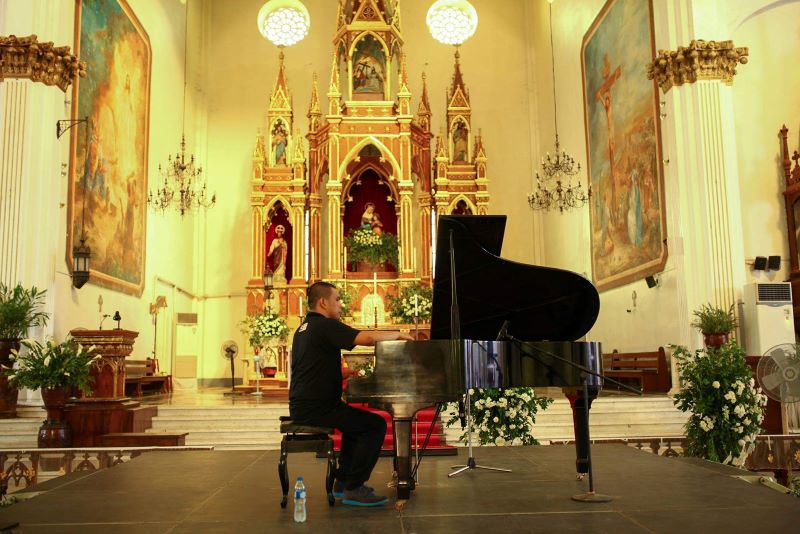
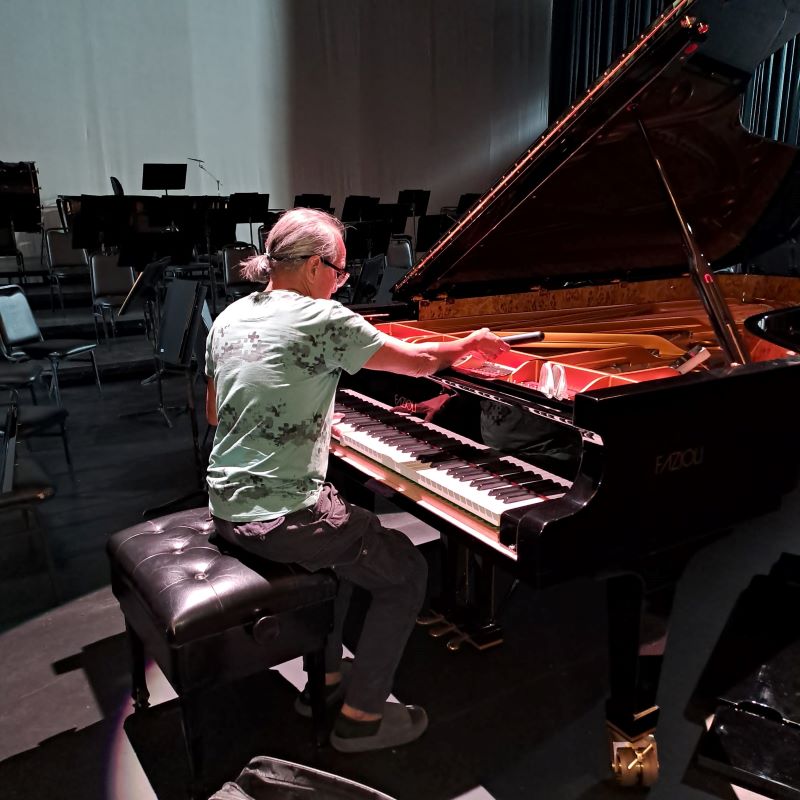
Danny Lumabi tuning the Fazioli piano at Metropolitan Theater
“White. Like a clean piece of paper, like uncarved ivory, all is white when the story begins.”
-Daniel Mason, author, The Piano Tuner
When Cecile Licad arrived in Manila from New York Friday night (March 15), the first thing she did Saturday morning was to check the full grand piano at the Metropolitan Theater and confer with her piano tuner, Danny Lumabi, who has been tuning pianos for 50 years.
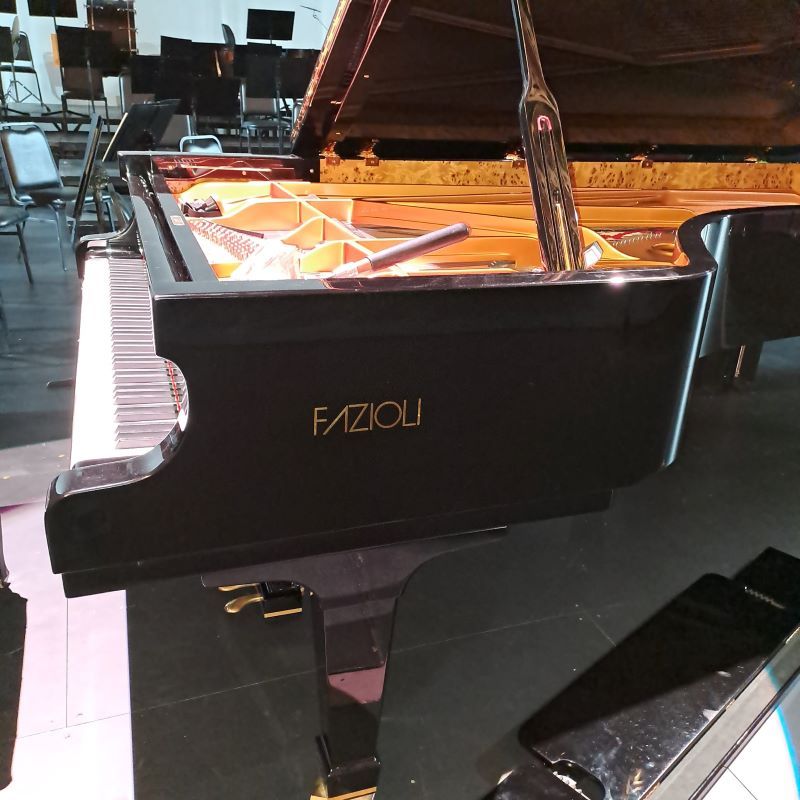
The Fazioli full grand piano at Metropolitan Theater
The full grand is a product of Fazioli Pianos, founded by the engineer and pianist Paolo Fazioli. Its brochure notes, “Passion for music, great artisanship, continuous technological research, and strict material selection.”
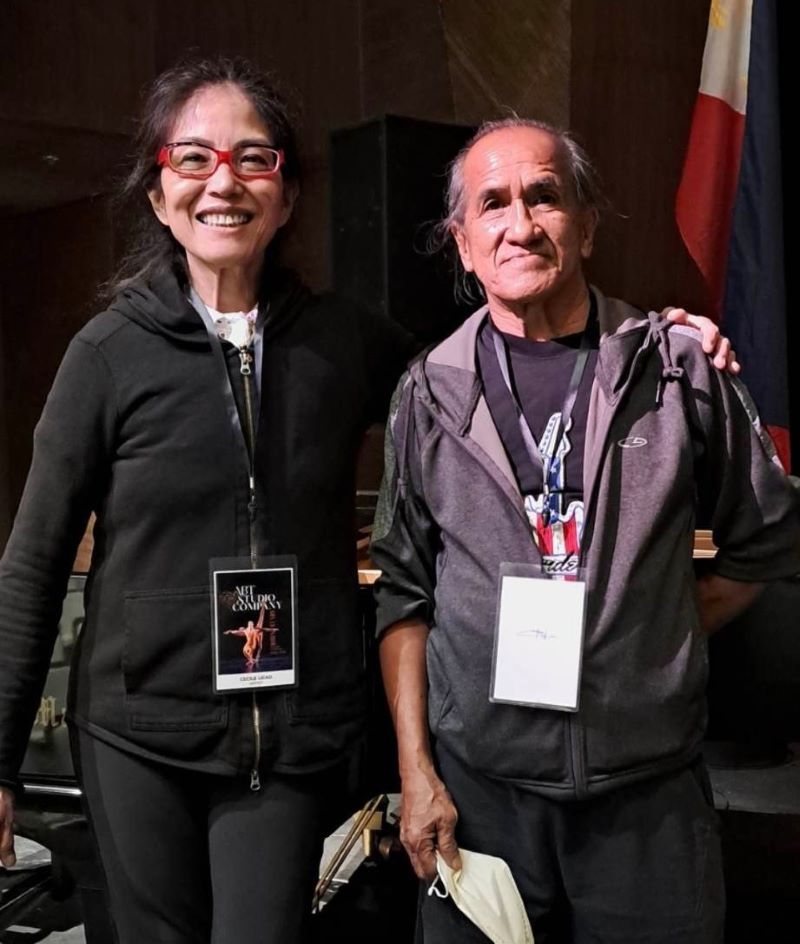
Danny Lumabi with Cecile Licad at the Metropolitan Theater
For now, its regular tuner is Danny Lumabi, who conferred with Licad at the Met.
In an interview with TheDiarist.ph, Lumabi said Licad likes the mellow, brilliant sound. “She is very particular not just with the sound but also the touch. The keys should be equally done underneath so that she can control the instrument even with closed eyes. The sound should be equal in the bass or treble parts. It involves constant adjustment of the hammerhead and a lot of revoicing.”
The tuner said the pianist would even request him to go around the hall to check the piano sound for himself. “She is very particular about how the sound bounces back to the audience. She is very smart and very frank.”
Lumabi was with Licad when she performed at the historic Paoay Church in Ilocos Norte in 2006, and a day later at the Currimao seaside Sitio Remedios resort of leading neurologist and Pinto Museum and Gallery founder Dr. Joven Cuanang.
In the Currimao outreach concert, Lumabi dove underneath the Steinway grand when its pedal gave way in the middle of a Mozart sonata. He quickly fixed it, to the amazement of the audience.
In the 2018 All-Chopin Recital Tour in Iloilo, Science City of Muñoz, Nueva Ecija, Baguio City and Roxas City, the piano tuner was Alexander Comoda, whose late father Romy Comoda also tuned the piano at the Pundaquit Festival Hall in San Antonio, Zambales, in 1995 during the performance of Licad with cellist Antonio Meneses.
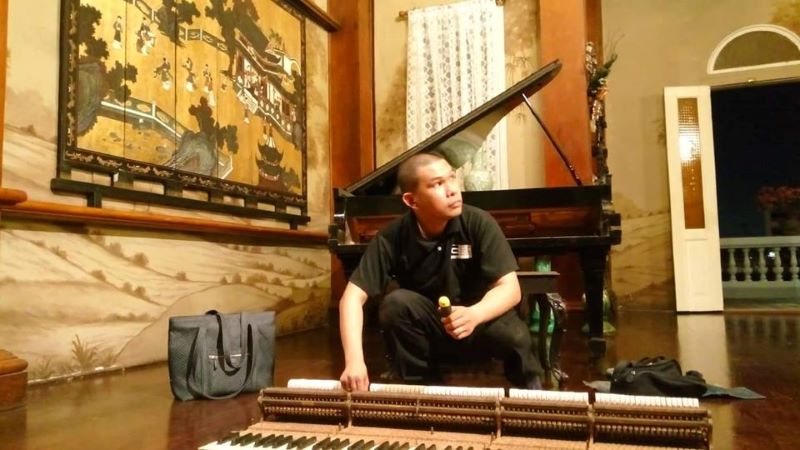
Alex Comoda tuning the baby grand at Nelly garden in Iloilo City
Comoda is now based in Dubai, United Arab Emirates as a full-time concert piano tuner. He recalled fixing the 1929 New York Steinway grand at the Nelly Garden in Iloilo City a day before the concert. “Her name alone speaks volumes, and that made me very nervous. Matinding pawis at kaba ang inabot ko (I was sweating and nervous) on the first day. She is very straight to the point when making suggestions especially in terms of the touch, the regulations, and the state of the piano pedals.”
The younger Comoda, who learned how to tune from his late father, Romy, started tuning pianos in 2003 and went full time in 2010, interestingly after earning a bachelor of science degree in nursing.
Said he: “Piano tuning allows you to meet music-loving families whose pianos have a rich history from one generation to another. Some wanted their old pianos restored because of the memories those pianos keep. Of course, I went full time into piano tuning to preserve the little legacy my father left.”
No one knows exactly when the first piano tuners arrived in the country. But to be sure, they came before or after the turn of the last century, when a German Benedictine nun named Sr. Baptista Battig introduced the first formal piano lessons in the Philippines.
When Manila was still known as “the Milan of the Orient,” the city already had its share of singers who were educated in Italy and an equally good share of pianists who made a career here and abroad.
Nena del Rosario Villanueva is considered the country’s first piano prodigy who studied at Curtis Institute of Music in Philadelphia. In her league is a sterling generation of pianists that included Benjamin Tupaz, Jose Contreras, Reynaldo Reyes, Ernesto Lejano, and Maria Luisa Vito.
Surely, all these excellent pianists couldn’t have done it without a good piano tuner.
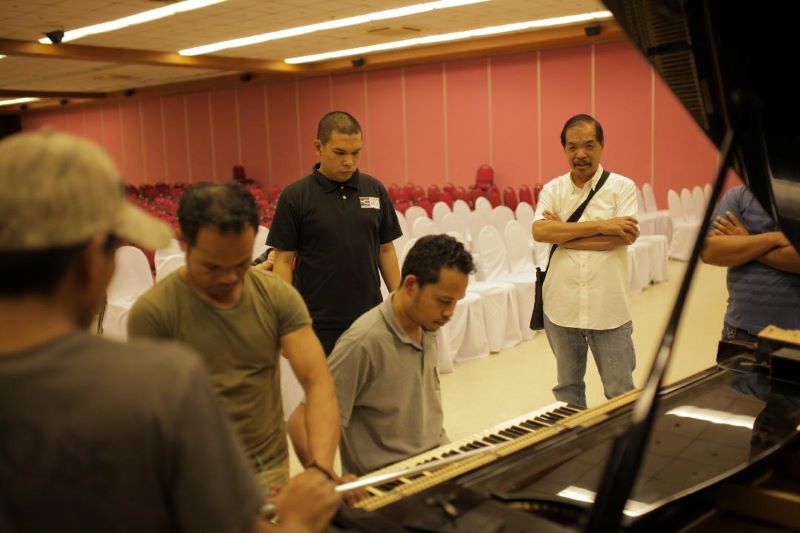
Three piano tuners in Baguio City inspect a piano to be used in 2018 outreach concert.
The piano tuner of Rowena Arrieta, the first Filipino Tchaikovsky Laureate in Moscow, during her Baguio City outreach concert, was the late Jun Jacela. With his death, his nephew, Michael Jacela, took over the servicing of pianos of music teachers. (He, too, has passed away.)
The piano concert odyssey of Cecile Licad has been far more definitive and spectacular than the rest of her colleagues, young and old.
Like Villanueva, Licad also studied at Curtis and became the school’s star pupil—like China’s Lang Lang and Yuja Wang.
With good pianists came the demand for good pianos—and good piano tuners. In Licad’s case, she expects shades and nuances of sound. She looks for the sound perfect for her Chopin and Schumann, and another for Rachmaninoff and Tchaikovsky, then another unique sound for her Brahms. Or in yet another variation, she will look for a sound ideal for Bartok and Shostakovich.
All these sound requirements can be met only by a good piano tuner.
When Licad performed at Santuario de San Antonio Church in Forbes, Makati, one Friday night in October 2016, she brought a 9-ft Hamburg Steinway rarely seen in Manila’s piano stores and which came all the way from New York—with a piano tuner named Ricard de la Rosa, president of the New York-based Pro Piano.
When the pianist borrowed the Steinway grand of presidential daughter Irene M. Araneta (the piano was a gift to her by the eminent pianist Van Cliburn), the piano was tuned by Raymond Lim, who is in the league of another much sought-after tuner, Iggy Tuazon, who services affluent piano owners.
There was also Pablo Umali (father of Arnel Umali), who tuned upright pianos when I opened the 1992 summer music festival in Catanduanes.
The late Romy Comoda, father of Alex, tuned upright pianos in the Cagayan Valley Music Festival which I opened in Ilagan, Isabela, in 2001. He also tuned the piano used by Licad at St. Paul University in Tuguegarao City in Cagayan in 2002 and 2003.
When the Licad-Meneses duo performed in Bacolod in the mid-‘90s, tuning was done by Ricardo Garcia, the tuner of leading concert pianist and former Cultural Center of the Philippines president Raul Sunico.
Today the Manila Pianos, the leading piano dealer in Manila and a venue of concerts, keeps a stable of piano tuners.
Ray Sison of ROS Music Center used to keep a stable of piano tuners, some of whom trained in Germany when he became distributor of Bosendorfer pianos in Manila.
Sison’s stable of piano technicians went beyond tuning. One of them, Arnel Umali, is a certified piano tuner and technician who trained in the Bosendorfer factory in Vienna, Austria. He said: “Good tuning lasts longer through careful repetition and special technique. We also offer good regulation, which restores factory settings of all moving parts of the piano. This results in a piano that responds easily with bigger sound and can give pianists more enjoyable performance.”
A piano dealer’s brochure describes piano tuning as “the act of making minute adjustments to the tensions of the strings of a piano to properly align the intervals between their tones so that the instrument is in tune. The meaning of the term in tune in the context of piano tuning is not simply a particular fixed set of pitches.”
Among others, the brochure says, “Piano tuning requires an assessment of the interaction among notes, which is different for every piano, thus in practice requiring slightly different pitches from any theoretical standard. Pianos are usually tuned to a modified version of the system called equal temperament. In all systems of tuning, every pitch may be derived from its relationship to a chosen fixed pitch usually pegged at A440.”
Associated with the world’s greatest pianists, Pro Piano’s de la Rosa has been a trusted name in the business of piano supply and tuning for the last 45 years.

In 1981, Cecile Licad (shown here with Pablo Tariman) plays her first reconditioned Steinway, a gift from her father, Dr. Jesus V. Licad. (From Pablo Tariman files)
His Hamburg Steinway—which he tuned himself in CCP concerts of Licad in 2016 and 2017—attests to the high degree of professionalism in the piano business.
Music specialists note that over the years, piano tuners have acquired a rare capability to absorb a specialized form of listening.
As music appreciation improves, the better an instrument should sound.
Before great music begins, the elements—upon which the harmonies are built—must be aligned. Indeed, it is unthinkable to have a good piano performance without a good piano tuner.
You will note this when Cecile Licad performs with the Philippine Philharmonic Orchestra under Maestro Grzegorz Nowak at the Manila Metropolitan Theater on March 19, the Women’s Month Invitational Concert spearheaded by Sen. Loren Legarda in cooperation with the National Commission for Culture and the Arts (NCCA), the CCP, and the Philippine Philharmonic Society, Inc. now headed by former CCP President Margie Moran Floirendo.


