
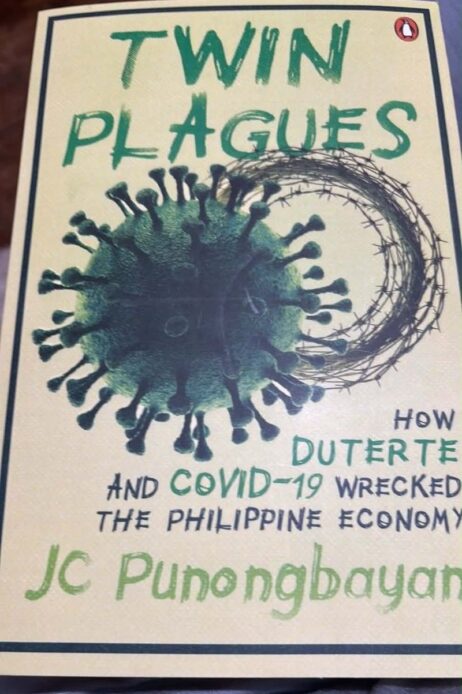
Like most Filipinos, economist JC Punongbayan is still reeling from the trauma of Rodrigo Duterte’s presidency and the long COVID-19 lockdown. Punongbayan processed the agony by writing (a form of self-therapy) Twin Plagues, his new 400-page book published by Penguin Random House, where he recalls and explains how Duterte upended the economy and had Filipinos grappling with death in more ways than one.
The explanations are detailed and insightful and done with scholarly tact and diplomacy, in contrast to Duterte’s governance, which Punongbayan describes as arbitrary and anti-science. He foregoes the jargon of an economist so as not to alienate readers. He doesn’t shoot from the hip and is like a forearmed trial lawyer who, with grounded emotions, supports his assertions, with credible data, on what went wrong under Duterte’s presidency.
Twin Plagues is divided into Part 1: B.C. (Before COVID-19) and Part 2: C.E. (COVID-19 Era).
Punongbayan discusses the transition from Benigno Aquino III’s administration to Duterte’s before the pandemic (2016–2019) in Part 1, then the horrific pandemic period (2020–2022) in Part 2. He does this while disproving what he says is the prevalent, dangerous narrative of the Duterte regime as “orderly, peaceful, and prosperous.”
The author uses the virus as metaphor for how Duterte infected the Philippines. “Duterte can be thought of as another potent virus whose essence he replicated in many corners of the Philippine government and ultimately had a deleterious impact on the fabric of Filipino life from 2016 onward,” says Punongbayan, an associate professor at the University of the Philippines Diliman’s School of Economics.
He says that Duterte, like a “virus attaching itself to a host cell’s receptor molecules,” latched onto the Filipinos’ psyche and consciousness, charming them with his populist rhetoric and strongman image. He writes: “Duterte infiltrated the government institutions, dismantled the checks and balances, and institutionalized his bad governance style.”
Punongbayan is judicious. Duterte’s regime isn’t alone in behaving dishonorably, he says, and cites the corruption controversies under Joseph Estrada; the “Hello, Garci” and fertilizer fund scandals under Gloria Macapagal Arroyo; and the pork barrel scam under Benigno Aquino III.
However, he argues that there’s a fundamental difference between the ignominy of the past administrations and Duterte’s: “…Our democracy’s immune system worked in the previous instances and was able to resist past viruses over and over. Estrada was toppled in Edsa 2, while Arroyo…stepped down in 2010 after a huge drop in her popularity.”
Punongbayan states that Duterte wasn’t interested in the economy: Then Finance Secretary Sonny Dominguez was all but a mini president, overseeing the government’s socioeconomic agenda while Duterte focused on his “pet project,” the war on drugs, which, asserts Punongbayan, was premised on Duterte’s false figures of the number of users, i.e., 3 to 4 million against the 1.8 million from the Dangerous Drugs Board.
He goes on to say that hearing about the drug war’s supposed incentive system was not surprising, because the Office of the President spent as much as ₱6.75 million for cash awards for police officials (₱200,000 or ₱250,000 per official, depending on the rank) in 2016.
Against the gains of uniformed personnel, Punongbayan juxtaposes the losses—from psychological to financial—of the general public. It meant 13.5 people killed per day. Orphaned children, the number of whom reached 18,000, were forced to work, thus missing school and health checkups—important criteria in receiving the monetary benefits of the 4Ps (Pantawid Pamilyang Pilipino Program), one of Duterte’s key anti-poverty programs. Financial aid was also withheld as the death toll rose, i.e., the US$434 million from Millennium Challenge Corporation, which helps countries fund development programs.
Against the gains of uniformed personnel, Punongbayan juxtaposes the losses—from psychological to financial—of the general public. It meant 13.5 people killed per day
Punongbayan says Duterte’s “pet project” was paralleled by his flagship economic program Build, Build, Build (which envisioned Metro Manila with a seamless transportation system), and bolstered by Jobs, Jobs, Jobs. Punongbayan doesn’t begrudge the two programs’ soundness, but cites the former’s egregious flaw: It didn’t address the long-standing constraints of the previous administrations’ infrastructure spending.
Jobs, Jobs, Jobs failed to create 1.1 million jobs annually, Punongbayan says, adding that Duterte’s dictatorial impulses started showing, particularly with the closure of ABS-CBN over his unaired political ads, resulting in a loss of 11,000 jobs.
Punongbayan says Duterte going after water concessionaires Manila Water (an Ayala Corp. subsidiary at that time) and Maynilad (under Manny Pangilinan’s Metro Pacific Investments Corp.), during the water shortage of 2019 “sent a very strong signal to the world that he’s god in this country, and no investment is safe from his whim and wrath.”
The sudden shutdown of Boracay that caught business owners off guard was another example of Duterte’s capriciousness and arbitrariness, writes Punongbayan. Was Duterte concerned about Boracay’s environmental welfare? The author disabuses readers of that notion, saying Boracay’s rehabilitation was paving “the way for new hotels and casinos to be built on the island by (Duterte’s) Chinese friends.”
Duterte’s fickleness extended to environmental policies, causing him to renege on his promises, writes Punongbayan, who cites the signed executive order lifting a moratorium on raw mining operations in April 2021 and ban on open-pit mining in December. Another was allowing OceanaGold Corp.’s operations in the gold copper mine in Nueva Vizcaya despite findings on the “degradation of water and access to potable water of nearby communities.”
Punongbayan remains cogent in his analyses as he explains Duterte’s mishandling of COVID-19, the other virus infecting the country. He says the lethal missteps began with the belated acknowledgement of the virus’ presence in the country (compared to Vietnam), and Duterte insisting that “everything (was) well…and that the virus (would) die a natural death.”
Data (Figure 11.1 in the book) showing Vietnam with only 381 cases, while the Philippines had 161 times as many, was proof that then Health Secretary Francisco Duque III was “delusional” (Punongbayan’s word) in his pronouncement that the country had flattened the curve.
COVID-19 was treated as national security emergency, not as health crisis, Punongbayan asserts. He cites the military personnel in the National Action Plan (NAP) committee (Delfin Lorenzana, who implemented NAP, is former commander of the Army Special Operations Command; Eduardo Año, Inter-Agency Task Force vice chair, is former chief of staff of the Armed Forces of the Philippines).
The exclusion of scientists, epidemiologists, health experts, and data scientists from pandemic policy-making underscored the administration’s staunch anti-science stance, stresses Punongbayan. With that, Filipinos faced inane policies, such as no mass testing (a critical element in a pandemic response) and—“the stupidest of policies,” he declares—the mandatory plastic face shield (cloth or surgical masks were safer) and plastic barriers (that caused wind drag and lift, endangering motorcycle riders).
The exclusion of scientists, epidemiologists, health experts, and data scientists from pandemic policy-making underscored the administration’s staunch anti-science stance, stresses Punongbayan
He also cites the Dolomite Beach project, which, he says, also ignored the laws of science (threatened Manila Bay’s ecosystem) and medicine (affected the human respiratory system).
Punongbayan’s frustration is palpable as he writes of officials aggravating the situation with their touting of insane COVID-19 cures: eating bananas (from then presidential spokesperson Salvador Panelo), doing steam inhalation, or tuob in Cebuano (from then Cebu governor Gwen Garcia); and sanitizing used face masks with ga-as for reuse (from Duterte himself).
Significantly, Punongbayan highlights the administration’s callousness in favoring Pharmally, “a tiny corporation” importing personal protective equipment from China, over those manufactured by local seasoned and experienced producers. Pharmally’s huge government contracts enabled the company “with just ₱625,000 capital” to profit ₱265 million in 2020 and earn 42,344 percent return on investment, he says.
The author lists the other sore spots in Duterte’s COVID-19 management: public reluctance to be vaccinated (caused by the Dengvaxia experience, along with unaddressed disinformation), vaccine procurement (centralized distribution wasn’t going well), and insufficient fund allotment in the 2021 budget. He says vaccination was deprioritized while cold storage facilities and logistics for vaccine distribution weren’t given a significant budget. The budget was prioritized for the National Task Force to End Local Communist Armed Conflict (NTF-Elcac), which received ₱16.4 billion, he says.
Readers at this point would be sufficiently enraged at reading of the government’s attitude vis-à-vis the pandemic crisis. The indignation would rise further with Punongbayan’s information that the budget for the confidential and intelligence funds for government officials and agencies increased astronomically from ₱1.58 billion in 2016 to ₱9.3 billion in 2022.
Punongbayan has thoroughly explained the Duterte regime, yet most would understandably want to forget the unpleasantness, to put it mildly. But is forgetting a prudent move?
Twin Plagues is Punongbayan’s subtle kick to the Filipino’s backside: to not let what transpired in those six years fade into oblivion. As he has intimated between the lines, Filipinos shouldn’t forget because “the last thing we want is false nostalgia bringing about yet another catastrophic, disastrous, and incompetent presidency.”
Instead, as the rock star Chikoy Pura sings the poet’s immortal lines, Filipinos should “not go gently into the night, let’s rage against the dying of the light.”
According to JC Punongbayan’s X account (@jcpunongbayan), ‘Twin Plagues’ will be launched Aug. 14, 2026 at the University of the Philippines Diliman’s School of Economics.


