

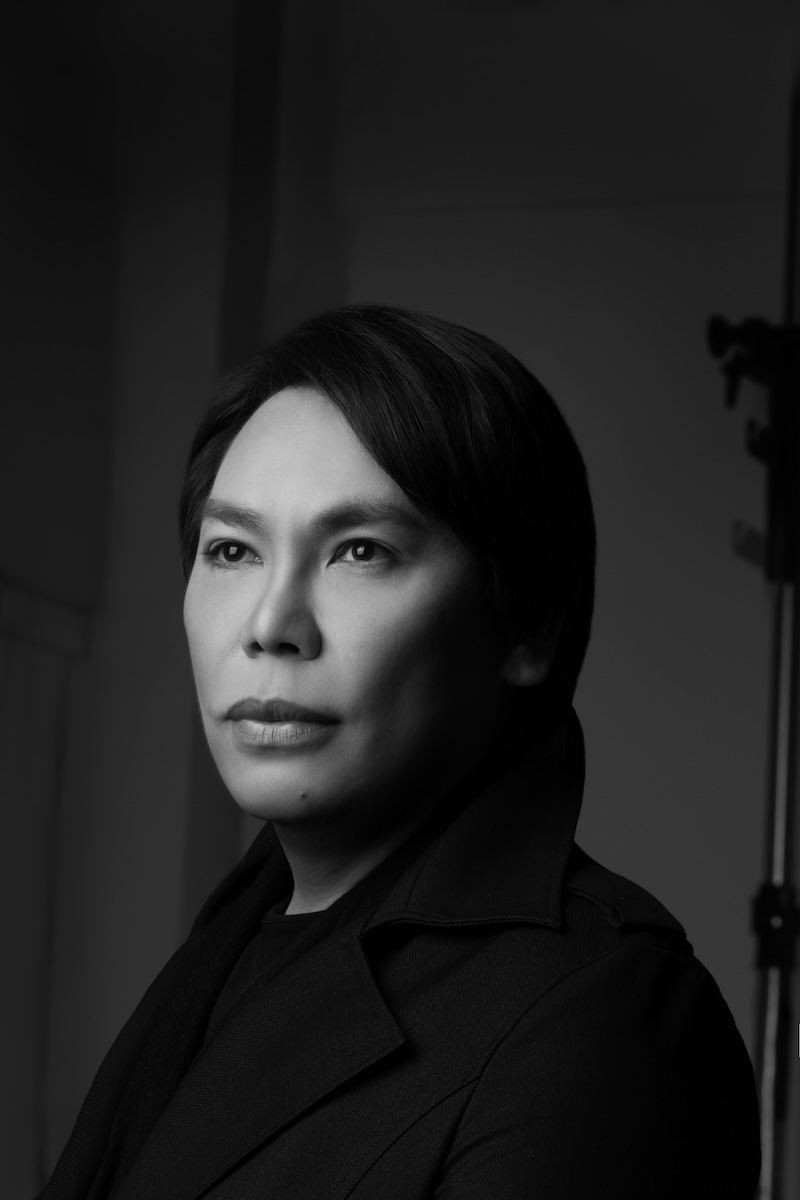
Cary Santiago: An invitation to join Metrowear became his turning point.
Cary Santiago stages his couture gala on Sept. 11, 2025 at Shangri-La at the Fort.
When war broke out in Lebanon in 2006, Cebuano designer Cary Santiago left Beirut and returned to Cebu, unsure of what was to come. He worked remotely for his Lebanese employer, but the setup felt temporary and unsatisfying. Then came an invitation from veteran lifestyle journalist Thelma San Juan—one he credits with opening the door to his career in Manila.
Fashion director Jackie Aquino invited Santiago to meet San Juan, then general manager and editorial director of ABS-CBN Publishing which included Metro magazine. Metro had been producing the trailblazing Metrowear fashion show series. San Juan asked Santiago to join Metrowear in December 2007 at Rockwell Tent.
Santiago now considers that invitation the turning point of his career.
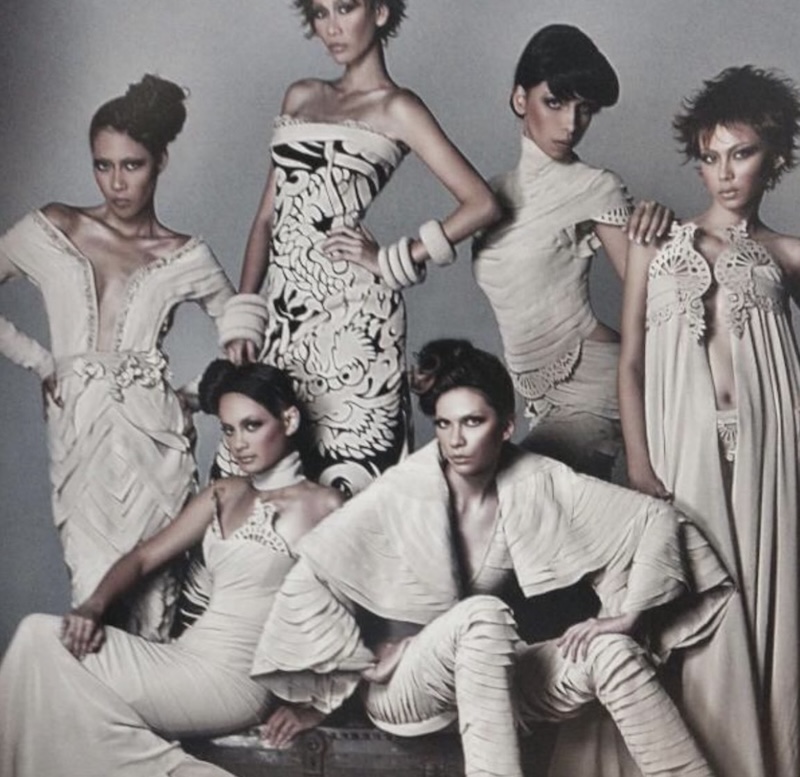
Dragon Dance collection for Metrowear 2007
For his Manila debut, he presented a collection inspired by the mythical dragon. During rehearsals, he overheard some designers saying it would be awkward if he was not given the coveted finale slot. He paid little attention, focusing only on his gowns. Aquino later told him the finale would be his, chosen for the drama of a collection that featured soldered cutouts resembling dragon scales and strips of fabric pieced together into gowns and pants—treatments never before seen on the Philippine runway.
The Dragon Dance collection consisted of nude-colored gowns that showcased Santiago’s command of technique. In one piece, nude fabric was carved into the shape of a dragon’s head and layered over black cloth, creating the illusion of a printed textile. Other gowns featured intricate patterns, each cut and sealed by hand with a hot knife to prevent fraying, a painstaking process that gave the effect of laser precision.
Santiago likened these details to dragon scales; the “scales” shifted with each movement of the model.
He also stitched together narrow strips of fabric to create a weave, then shaped the fabricated textile to hug the body.
At the time, such fabric manipulation was rarely seen in Philippine fashion
At the time, such fabric manipulation was rarely seen in Philippine fashion, which still leaned toward conventional techniques and embellishments.
Santiago was indeed ahead of his time; two decades later, designers would explore similar fabric treatments. That night, as Metrowear ended, the audience rose in ovation, among them Bea Zobel Jr., Charo Santos, Tessa Prieto, Katrina Ponce Enrile and Lucy Torres-Gomez, who placed orders on the spot.
It was at that moment that Santiago realized that he could build a future in the Philippines. “Cary was still relatively unknown in Manila when he suddenly rose to national prominence,” recalls Jackie Aquino.
The late couturier/columnist Christian Espiritu praised the collection for its pioneering fabric work, and described Santiago as a “master of the laser cut.” Santiago is quick to clarify that the scales were not made by machine. Each was cut by hand and sealed with heat, a process he had mastered long before computer-aided lasers became common.
From that debut, the designer’s reputation grew. He was invited to return for later editions of Metrowear, Metro Weddings, Metro 100 and a solo show for Metro Society. When San Juan later moved to Philippine Daily Inquirer as its Lifestyle editor, Santiago became part of her signature fashion series, Face-Off, where designers staged friendly competitions, and its subsequent iterations, Fashion and Fitness, bridal and “OOTD” shows.
He had once imagined returning to the Middle East, but San Juan’s faith in his talent convinced him to stay
Looking back, Santiago gives credit to San Juan (now the founding editor of TheDiarist.ph) for making the Philippines the anchor of his career. He had once imagined returning to the Middle East, but San Juan’s faith in his talent convinced him to stay.
Indeed Cary Santiago has come a long way.
In most interviews, Santiago gives credit to his mother, Crispula, now 95, a neighborhood seamstress who once asked him to help in her sewing just to keep him out of trouble. In Cebu of the 1970s, then still a backwater, most of the orders were for weddings or graduations. His father, Amado, a military official, accepted his son’s effeminate ways.
In Cebu City, Santiago worked for a local designer before moving to the Middle East, where he found jobs in ateliers in Dubai and Abu Dhabi. Between contracts, he returned home and joined the Philippine Fashion Design Competition 2004, organized by the Fashion Design Council of the Philippines. His winning entry was a terno inspired by the Philippine eagle, decorated with chicken quills bought in Carbon market in Cebu. He fused two layers of jusi between the quill, spray-painted them to resemble feathers, and arranged them in graduated layers. “Unlike wire or stick, the quill is light and elastic yet it won’t bend. They looked like real feathers,” he recalls.
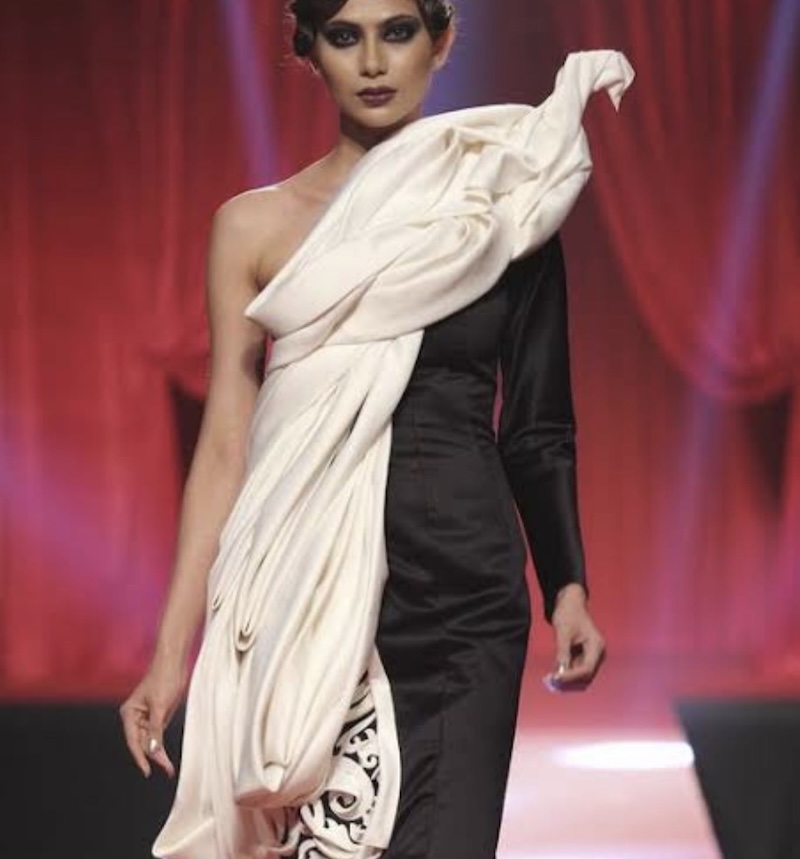
Bird sculpted on duchesse satin gown
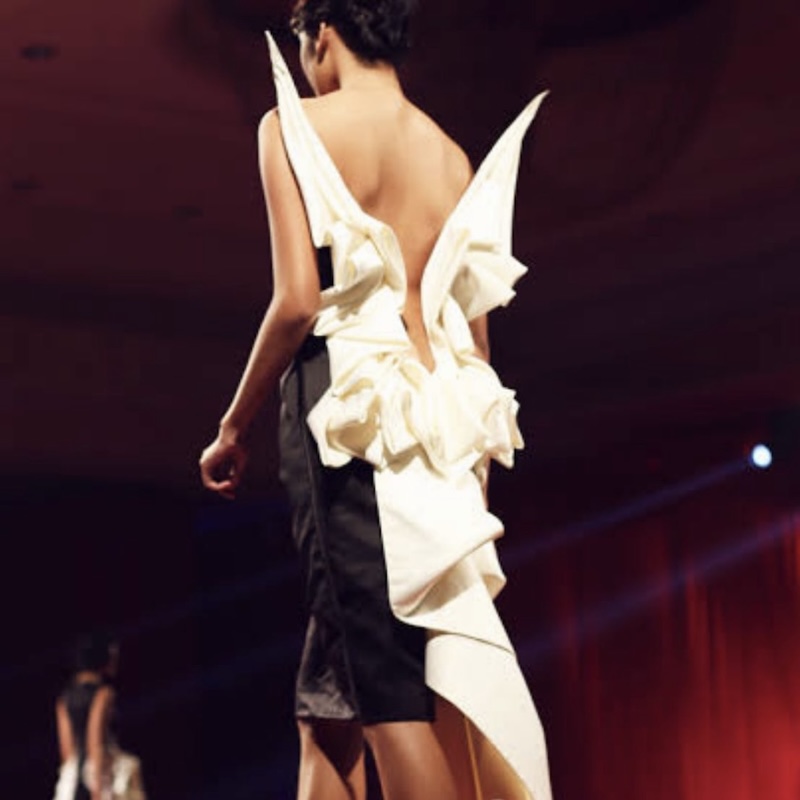
Duchesse satin draped to create wings.
This unconventional terno earned him a standing ovation.
“When you see the dress, you know it’s a Cary dress,” he says. “It’s hard to replicate.”
The prize of the 2004 competition took him to Paris, and afterward he worked in Beirut until the war broke out. “Cary was under the radar when we tapped him to participate in Metrowear,” recalls Aquino.
Today, there are many Manila clients who call him in Cebu, their personal mannequins kept in his atelier for basis of body measurements, his Manila-based staff, as needed, going to clients’ homes for fittings and deliveries.
These journeys—from Cebu to Dubai, from Paris to Beirut, and eventually Manila—shaped the style that would define his name. Santiago transforms fabric in unexpected ways, turning soft fabrics into sculptural forms. With precise pleating, embossing and fabric wrapping, Santiago builds three-dimension shapes that feel as much architectural as they are handcrafted.
His cutouts recall the sharp precision of laser work, though each piece is cut and sealed by hand. Embossing, by contrast, presses patterns into the cloth to create texture, adding depth. Fabric carving is another technique, in which he sculpts layers of cloth to form relief-like designs—different from simply cutting out shapes.
Instead of relying on flat patterns, he often uses moulage—draping and pinning fabric directly on the mannequin—to let the material dictate its form.
These methods, refined without machines or computers, became the foundation of his style. His fascination with soft sculpture—the use of pliable materials to create shapes that shift with the body—gives his couture a sense of movement and life.
At the heart of his process is the discipline of turning imagination into form through sheer patience and skill.
On Sept. 11, 2025 at Shangri-La at the Fort, Santiago will stage a couture gala for Cebu-based jeweler Diagold.
His relationship with the brand goes back years, beginning when Jennifer Ty, its CEO, became a client. She later introduced her family and friends, and a partnership grew. Each time Diagold released a new line of jewelry, Santiago created a collection to match
Diagold has become a fixture in his shows. “These gowns need to be accessorized with jewelry,” Santiago says.
Over the years, he has also produced fashion shows in Cebu, promoting local designers, or inviting Manila names to the city, with Diagold as consistent partner. Of Ms. Ty, he adds, “She’s a dream producer, easy to talk to and respectful of designers.”
The upcoming collection takes Artemis, the goddess of wildlife, as its muse. Santiago turns to embossing to suggest reptile skins, while other pieces borrow from the textures and patterns of the animal kingdom. The palette remains true to his signature—black, white, gray, gold and silver.
He is also revisiting one of his earlier innovations: fabric tiles. This technique involves cutting fabric into small, uniform pieces, then assembling them to look like mosaic tiles to create new surfaces. Santiago introduced the method years ago, and though it is now copied by other designers, he continues to refine it to achieve greater fluidity and strength.
A team of 30 artisans worked for seven months, often 12 hours a day, to complete 50 clothes. Santiago insists on overseeing every detail himself. “I don’t want anyone to know my trade secrets,” he says. “I am the only creative here. The rest are tailors and artisans.”
He allows one concession: on Saturdays, work stops at 5 pm instead of 10.
Away from the atelier, Santiago prefers a quieter routine. He bakes bread and cakes, cooks tinolang manok and binignit for his keto diet, and retreats to the mountains or beaches near his base in Talisay. “I love this place because of nature,” he says.
He enjoys long drives through the municipalities, stopping for home-cooked kare-kare, bistek Tagalog or roadside barbecue. “That’s happiness for me,” he says.
Sometimes he stays overnight at Ravenala Beach Resort, his favorite getaway, and returns to work on Monday morning. What matters most, he says, is the company. “You can talk about anything without filters. My car becomes a living room, only it’s moving.”
In the atelier, he creates gowns that move like living sculptures. On the road, Santiago finds joy in simple meals, the sea air, and unhurried drives. Both, he says, are part of the same pursuit: shaping a life with balance and care.


