
Text and photos by Elizabeth Lolarga
‘The Geometry of Being’ runs until Aug. 31, 2026, The Podium Boutique, 2F lobby, outside Hoka Brew coffee shop. The hotel is at Kilometer 4/5, Palispis (formerly Marcos) Highway, Bakakeng Central, Baguio.
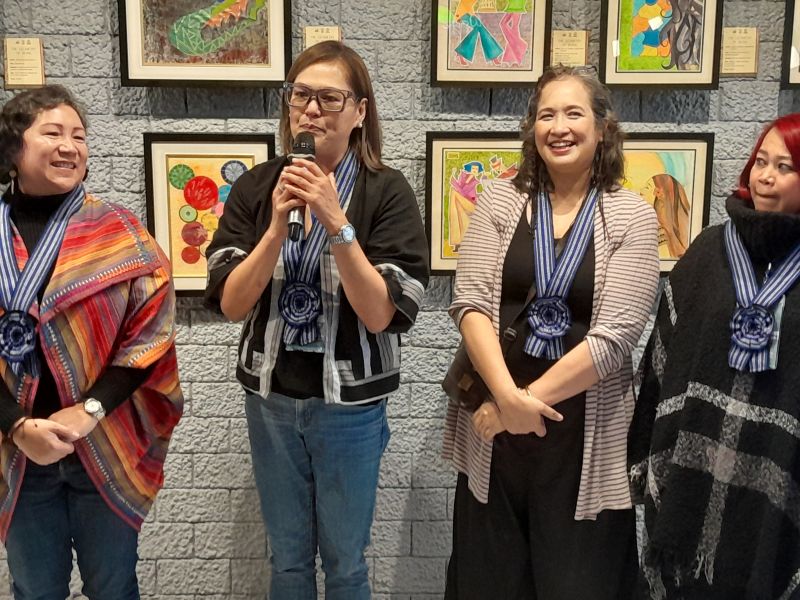
At the opening of the exhibition The Geometry of Being at The Podium Boutique Hotel in Baguio City, the four exhibiting artists, all women, were seeing and meeting each other for the first time. Earlier, they had communicated through an online group chat, encouraging one another to finish their drawings and paintings. Trust was established right away by these perfect strangers brought together by organizer and exhibiting artist Jingle “Melan” Ku Marquez. Not even the monsoon, whose rains seeped through the shuttered windows and doors, could discourage guests from coming.
Four is an ideal number for a group exhibition. Sometimes these shows have a way of turning into crowded rave parties, that the individual works can scarcely be appreciated. Not for this quartet made up of Charity Paltican Dannang, Jennifer Leung Francisco, Amparo Moldero Magallanes, and Jingle.
The four are largely self-taught artists, except for the occasional summer workshop or YouTube tutorial. Amparo, however, had the privilege of growing up with artist-parents in Malate in the ’70s and ’80s at the happening Syquia Apartments, where she was allowed to paint on their unit’s walls. Once she was finished, her work would be painted over.
She said, “I’ve been sketching all my life and through all my professions, when I’m bored, when I’m in a meeting, etc. It was handy in school for anatomy drawings. I also won some art awards in high school.”
Artmaking was encouraged by her mother, while her father taught her business. But both went for any form of creativity. “I never left art. I just did not pursue it full-time. Life happened, but art never got left behind. It would manifest in my school work and my leadership style. We sold mini art over roses for campus week and outsold all flower stalls. We used painted test tubes and slides, a fusion of science and art. In my career, it manifested in the presentations I made for my special teaching assignments. In my business, it became part of my special packaging and in some bags I made.”
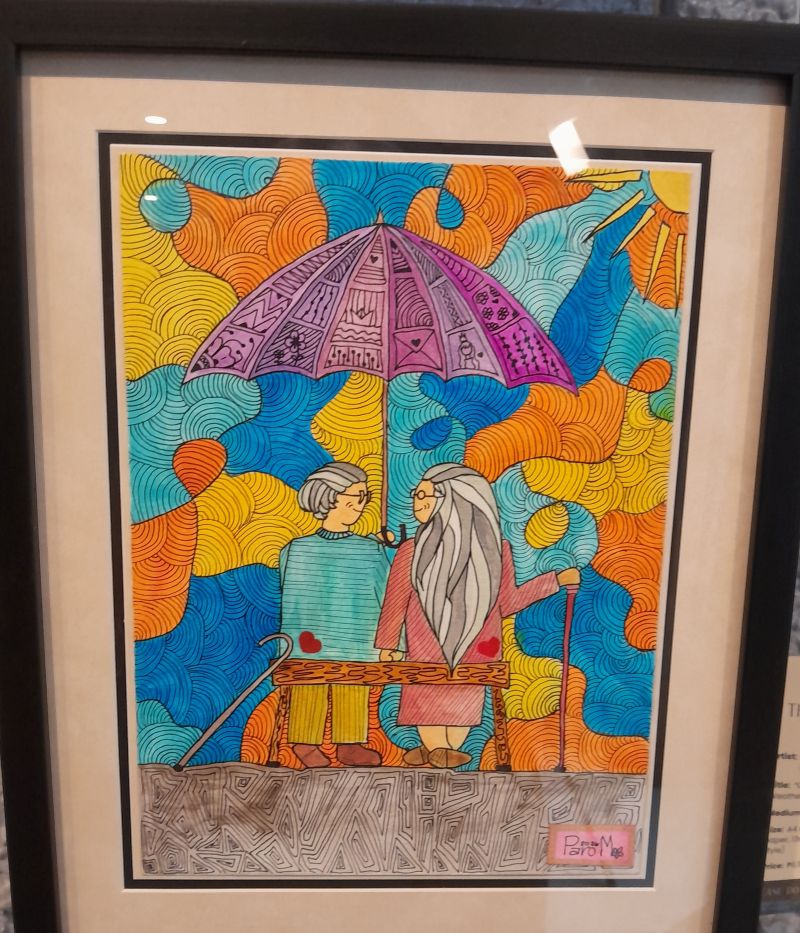
“Of Warm Hearts and Weathered Hands,” ink and watercolor by Amparo M. Magallanes
This woman behind the bestselling body products of Amparo’s Apothecary explained, “Despite art being part of my life, it never had a place in the front where I could present it by itself. It was always defined as an artistic part of me, not the artist in me. There were always reasons inside my head as to why I should not launch my artworks: not good enough, not ready, not trained. I am my worst critic. When I turned 50 last year, I decided that life was too short to gaslight myself. I prayed and asked the Lord for courage to finally share my works with others.”
Amparo considers herself lucky that her father studied fine arts in Madrid and taught her structure, shadows, rules, and limits, and “how discipline equates to practice equates to attention to detail equates to a polished finished product. My mother taught me that limits only exist in your head, and that art rules are just there as guidelines, that you can break them if you wish. I asked her if I could paint the face that I drew blue, the face I was crying over because it had uneven eyes and I called it ‘ugly.’ She said it wasn’t ugly, just different, and that there are people out there who have asymmetrical faces. So to the man out there with uneven eyes, you are beautiful. My mom taught me so.”
Asked who are the artists she admires and why, she naturally veered towards her parents “because they were the first artists I have met, and they will always be cool people to me. Of the greats, Gustav Klimt is on top of my list, but I appreciate the modern artists who do whimsical houses, both stacked and not.” She added, “If I had money and had to choose only one painting, I would choose any work of Klimt. His colors fascinate me.”
She believes in the healing properties of art, saying, “Jesus healed my broken life, and art is another way of His doing so. Everything that I have to give creatively comes from Him. He is my source. Even my sales come from Him. Realistically, if you compare my work to others in the current market, you would know that my work is not unique nor does it show training, and yet I have a good number of clients. This, too, I attribute to my Source. Art helps me continue to find pieces of my lost self, it has helped me manage the grief over the loss of my parents. I honor them through my art, which carries both their styles—lines from my dad, color and whimsy from my mom.”
‘My mother taught me that limits only exist in your head, and that art rules are just there as guidelines, that you can break them if you wish’
Jennifer Leung Francisco, a teacher and the Lower School Head at Brent International School Baguio, has been interested in art since elementary years. “I just didn’t think I was good enough. I always got a grade of 1/10 in my art projects. I specifically remember my color wheel and gradient project. I loved doing those projects. I loved playing with water and color, but I would use too much water and the paper would warp. It would turn out really ugly and dirty when it dried up in the morning, and it would be too late for me to redo my work.”
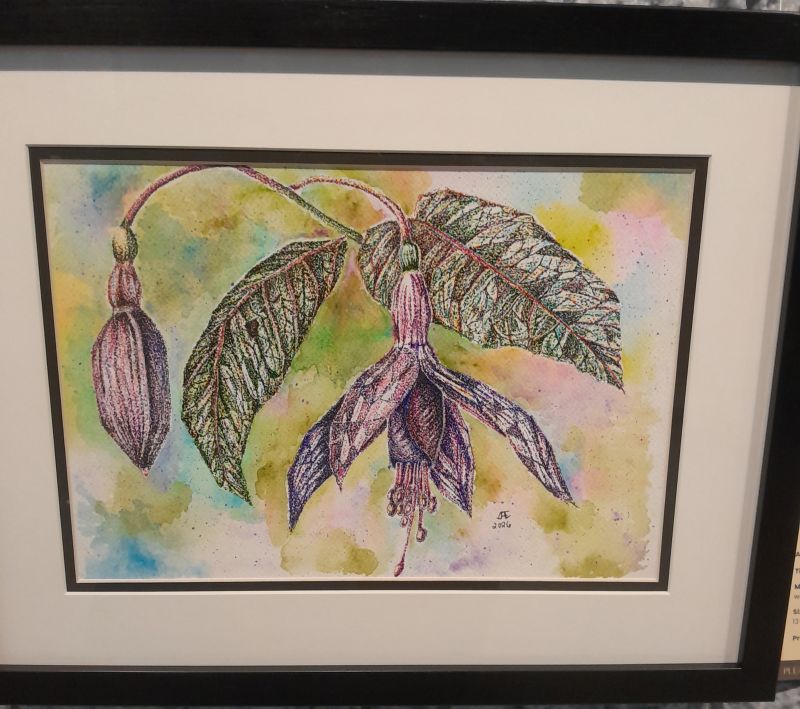
“Hummingbird Fuchsia,” mixed media on watercolor paper by Jennifer Leung Francisco
She recalled that her art teacher would always frown at her and ask her to redo the work and resubmit. Jennifer said, “Since then, no matter what I did in art, I always knew I was going to get a 1/10. Sometimes I thought it was because I wasn’t the favorite student. The favored students were the classmates who were in the top 10. I was in the bottom five back then. Looking back, I’m proud of that because I eventually came to understand that I was not meant to be in a traditional school. In high school, I moved to a school in Manila. It was a progressive school. It was child-centered and espoused learning by doing. If I remember correctly, that school was my first taste of multiple intelligences. They did not just focus on IQ; they also honed other talents, and creativity was one of them.”
One of her electives was drafting, where she rediscovered her love of drawing and learned the basics of sketching body parts, shading, and projected views or projections. She exclaimed, “What struck me most was my skill at sketching an entire face. I didn’t know I could do that!”
One of those who encouraged her artmaking was her aunt, who saw her drafting portfolio and suggested that the young woman take up architecture, which, Jennifer said, “just went in one ear and out the other. I had no plans of enrolling in architecture because I knew it required a lot of math and I did not like math at all. However, my aunt’s suggestion did spark something in me—that my art wasn’t actually a 1/10, and could turn into a career someday.”
In college, she continued to draw, doodle, and keep a sketchpad. She said she shelved her art because she thought that society had made it seem like being an artist was not a career. “I had dreams of having a career in the corporate world, or whatever job there was that brought in the big bucks. I ended up becoming a teacher, a wife, and a mom. That’s when I had to truly park everything. Not because of the life I had, but because my attention was drawn toward my career and my different roles as a woman: a teacher, a mom, a wife, and an entrepreneur of sorts and the balancing act that came with all of it. Life happened to me, and I totally forgot about art.”
In May 2013, she participated in an art workshop at Brent by Anja Diel, an experience that gave Jennifer another opportunity to reconnect with art. She also recalled a high school classmate, the class artist, whose style was pointillism. “I fell in love with pointillism because there’s something really meditative about it. It has taken me to different places in my mind that are quite soothing.”
She continued, “Art has, and will always be, a part of my healing. Finding my art, or what I love to call ‘finding my true colors,’ feels like circling back to who I truly am. For years, I had evaded my art. I was even ashamed of it because I grew up in an era where art was not a career. Somewhere along the way, I allowed myself to believe that perhaps art was not for me. As in, never! Complete with allergic reactions. Finding my art again, and embracing my true colors once and for all, has been both healing and liberating. It feels like breaking free from the version of myself that I had painted based on how others saw me, what others expected of me and what I thought I was supposed to be. What I thought I was supposed to be was the most destructive of all. I was so harsh with myself. Finding my true colors is breaking free from my own painted norm and giving myself permission to simply be who I am.”
‘When I am in the zone, the voices are having a siesta’
She said her pointillist style has “brought peace inside my head. I used to say that I had a lot of mind chatter, where different voices were talking all at the same time. The loudest voices were the ones that brought doubt about myself. They made me second-guess myself, talked me down, and told me I wasn’t good enough. Embracing my art has somehow quieted those voices. When I am in the zone, the voices are having a siesta. They’re suddenly quiet, lulled to sleep. They are at their most peaceful state. Perhaps that is what healing has meant for me: coming back to myself, embracing the colors that were always there and finally giving myself permission to let them show.
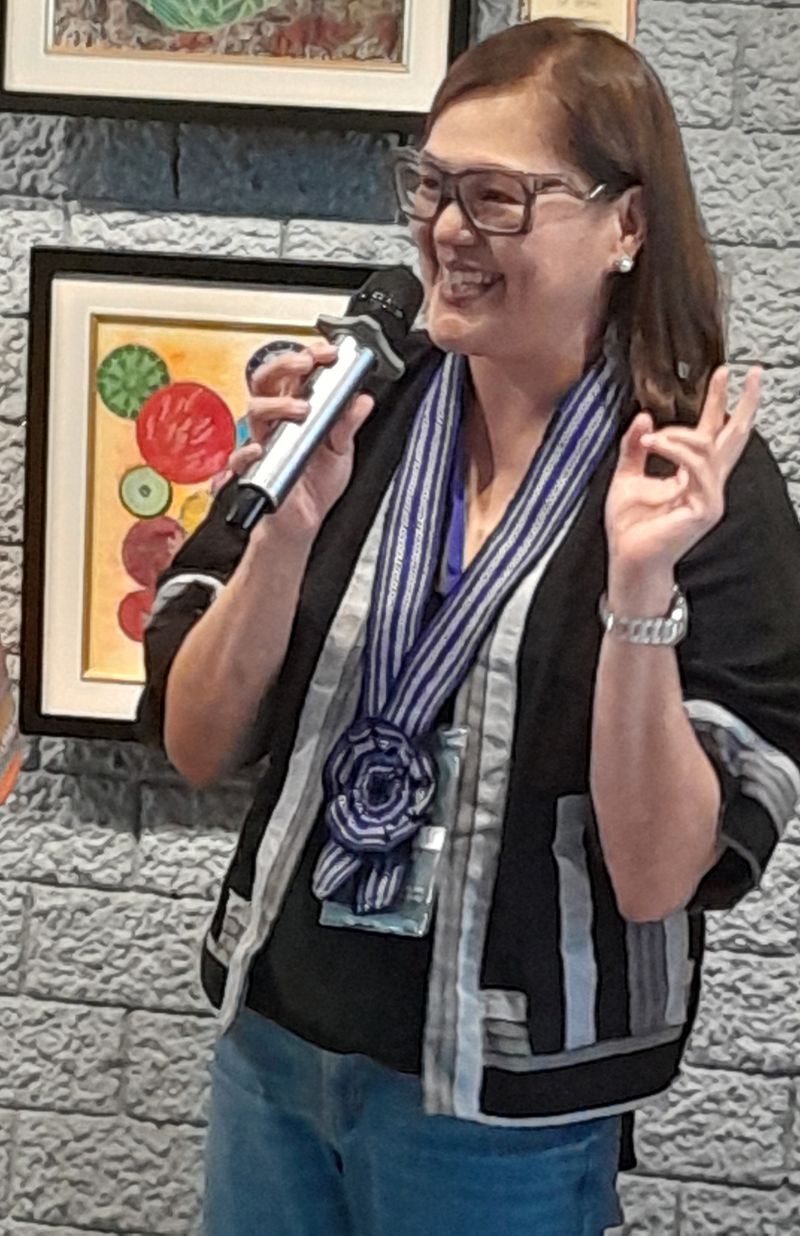
Jingle “Melan” Ku Marquez, exhibit organizer, painter, author and founder of Art Heals Inc.
To Jingle, author of the newly launched creativity workbook Mindful Lines, Mindful Lives: Drawing Your Way Out of Stress for Mental Clarity, art has always been there. “I have always been drawn to creativity—colors, lines, patterns, and the simple act of making something with my hands. What eventually became more meaningful to me was discovering how lines and shapes could express things that were sometimes difficult to put into words. I became particularly interested in neurographica during the pandemic that led me to creating mindful lines. It wasn’t one particular artwork that struck me, but the realization that something as simple as a line on paper could reflect an emotion, a thought, or even a part of one’s life story. That something unpleasant can be aesthetically pleasing when you make the right choices.”
‘It wasn’t one particular artwork that struck me, but the realization that something as simple as a line on paper could reflect an emotion, a thought, or even a part of one’s life story’
She realized from fellow artists and creatives that “creativity isn’t reserved only for people who have had formal art training.”
Since 2017, her family’s Podium hotel has been hosting exhibits, with “each one leaving a lasting impression on me—not so much because of the intricacies of the artworks, but because of the stories behind each piece. Being exposed to different artists and art groups inspired me to start doodling and sketching in my drawing journal. It was never meant for public viewing; it was simply something I did for my own enjoyment. In 2019, the Pasakalye Group of Artists gifted me a 2×3 feet canvas and a set of acrylic paints. Interestingly, they remained unopened for quite some time until I found myself being gently ‘forced’ out of my comfort zone to join a group exhibit of the Salonpas Group of Artists, headed by Fredi Agunoy. I was invited as their guest female artist, something the group traditionally does in their exhibits. That experience became one of the beginnings of my own journey into artmaking, particularly when I sold my one and only entry to someone whom I didn’t even know. There was something incredibly affirming about knowing that a stranger connected with my work enough to want to take it home. The thought that something I created could resonate with another person was simply wonderful—and it encouraged me to keep creating.”
She continued to doodle and sketch in her art journal. “Creativity was always there; it just quietly stayed with me in the background. Life simply became busy. There were many roles to fulfill—family, work, business, and community involvement—and creativity sometimes took a back seat. When I returned to art, I came back to it differently. I wasn’t trying to prove that I could paint or draw well. I was looking for a way to slow down, reflect and reconnect with myself. That eventually became part of the journey behind Mindful Lines, Mindful Lives. Art became less about creating something beautiful and more about being present in the process.”
Jingle did not have extensive formal art training. Much of it has been through exploration, observation, practice, workshops, YouTube, and observing other artists. She said, “One of the biggest things I learned is that technique is important, but it isn’t everything. Art also requires curiosity, courage, patience, and the willingness to make mistakes. I am still learning—and I actually like saying that because it keeps me open to trying new media and learning from artists who have generously shared their knowledge with me.”
Among Baguio’s established artists, she is inspired by the “authenticity and generosity of Roland Bay-an. He made me believe in myself by encouraging me to simply draw and paint without worrying too much about the outcome or what other people would say about my output. He taught me to create for the joy of it, to do something simply because it makes me happy. I admire artists who aren’t afraid to experiment, who continue creating regardless of age or circumstance and who use their art to connect with others.
“Being around fellow creatives has taught me that there isn’t just one definition of a ‘real artist.’ We each have our own language, process and story. Lately, I’ve found myself reading more about Picasso, his works and his journey as an artist. One quote of his particularly resonated with me: ‘I paint objects as I think them, not as I see them.’ Not that I’m using Picasso as an excuse for my still developing skills in realism! But his words beautifully align with my own evolving philosophy about art: that you don’t always have to reproduce exactly what your eyes see. Sometimes, you allow your thoughts, emotions, imagination and mindfulness to guide what eventually finds its way onto the canvas.”
As for art’s role in healing her, she said, “In many ways, art has taught me to slow down and become more mindful. When I draw or paint, my attention shifts to the line, the movement of my hand, the colors and what is happening in that moment. It quiets some of the noise in my head and helps me process thoughts and emotions differently. I experience mental clarity that helps me make better decisions.
“Believe it or not, I somehow credit art as having played a part in healing my sciatica. I don’t think of art as something that magically removes physical pain or life’s difficulties. Healing through art is more about creating space—to breathe, to reflect, to accept, and sometimes simply to be. That belief eventually became part of why I founded Art Heals Inc. I wanted other people to experience creativity not only as something you have to be ‘good at,’ but as something accessible—a tool for mindfulness, expression, connection and healing. Perhaps art hasn’t healed everything in me. But it has taught me how to sit with things, draw through them and sometimes see them differently.”
‘Healing through art is more about creating space—to breathe, to reflect, to accept, and sometimes simply to be’
Charity is also a book author (7 Days of Creative Healing: A Spiritual Journey Through Art) who grew up with a brother who was the artist in the family, able to draw without references. She recalled, “I was particularly struck by his handcrafted works—intricate and detailed pieces he created with such a young imagination. He filled our home and surroundings with beauty. His ability to make something lovely from nothing left a lasting impression on me. Watching my brother create with such skill and heart made me believe I could do the same.”
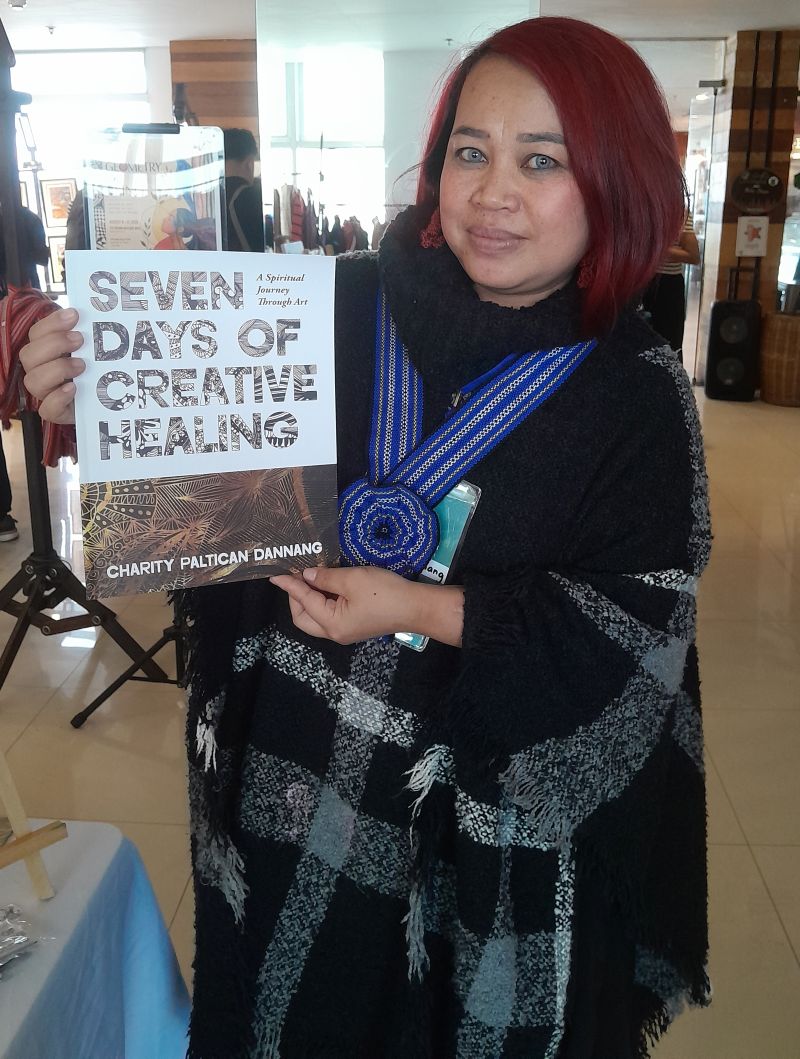
Charity Paltican Dannang, author and artist
Her family and community encouraged her until she found herself teaching and making art in Cambodia. Eventually, she said, “Work, responsibilities and the demands of daily life led me to set art aside for many years. I returned to it when my health became a challenge, and I began long-term treatment for my kidneys. Art became my quiet refuge, a way to process difficult days, find peace amid uncertainty, and turn struggle into something meaningful. It was no longer just a hobby—it became essential to my well-being.”
Although she has not taken formal art lessons, Charity learned “so much simply by watching others work, asking questions and sharing space with people who create from the heart. I also treated my time teaching art as an opportunity to learn alongside my students. The greatest lesson I took away is that perfection is not needed to create something beautiful; what matters most is intention, patience and honoring the traditions and stories that shape you.”
She is a great admirer of the indigenous and folk artists from the Cordilleras “many of whom remain unnamed, yet their work has been passed down through generations. They create not for fame or profit, but to preserve identity, teach values and bind their communities together. I also admire abstract artists because they create simply and freely, without the pressure to represent something exact. Their work shows me that art can be pure expression—just lines, colors and shapes coming together without rules or expectations, and that resonates deeply with my own creative spirit. Beyond them, I look up to contemporary creators who turn their own life challenges into art that heals and uplifts others. What resonates most across all these creators is their authenticity: they work from lived experience, making their creations not just visually beautiful but deeply human and purposeful.”
She said her lived experience became the foundation of her book, a reminder that art does not need to be difficult or impressive to be healing. “Sometimes,” she said, “all it takes is showing up, one small line at a time.”
‘The Geometry of Being’ runs until August 31. Exhibition is at the second-floor lobby, outside Hoka Brew coffee shop. The hotel is located at Kilometer 4/5, Palispis (formerly Marcos) Highway, Bakakeng Central, Baguio.


