
As passengers grow increasingly numb to standard safety demonstrations, airlines have turned to storytelling and spectacle to recapture attention. British Airways leaned on star power, Singapore Airlines highlighted destinations, and Air India translated safety instructions into the language of classical dance.
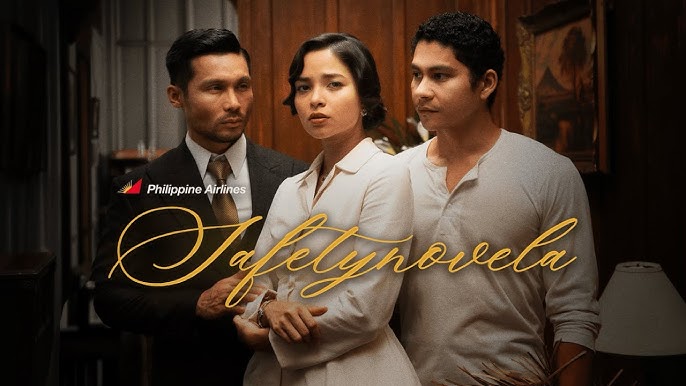
Philippine Airlines (PAL) has joined the conversation with the “Safetynovela,” a safety demo staged as full-blown melodrama—complete with a rich girl, a jilted groom, and a poor boy lover—interspersed with rules of inflight safety.
The experiment has divided viewers, landing somewhere between clever reinvention and unapologetic kitsch. Here are some opinions we gathered from Filipino creatives.
IMPY PILAPIL, sculptor: ‘It clearly resonates with the public’

Impy Pilapil amid her sculptures
Overall, it’s very amusing—some moments are genuinely funny and keep you quite engaged. That said, the pacing feels a bit slow in places. The long drive through the fields to the church, for example, could be trimmed or cut entirely. But that’s just me nitpicking to my taste in story-telling.
The pacing feels a bit slow in places
With now over 6.7 million views on YouTube already, it clearly resonates with the public. The creative team did an excellent job. The production quality is impressive, to say the least. As a piece of viral marketing for PAL and Philippine tourism, it is a true gem, but to be used as an actual in-flight safety video, I think it needs to be more snappy and concise. But again, that’s just my take.
MELVIN LEE, PETA president and assistant director for commercials: ‘The form ends up overpowering the content’
When I first saw it, my immediate question was: what is the whole point? Being non-traditional is fine—okay lang—and it is entertaining. If the goal was to present something out of the box, then they succeeded. It’s certainly not the usual straightforward presentation of safety precautions.
But my initial reaction was still: what are they actually trying to say? Why take the route of a teleserye, a full-blown teledrama? I wanted to understand what the campaign was really about—what PAL was trying to communicate, and why it chose such a popular genre to drive the message.
Being nontraditional is fine—okay lang—and it is entertaining. If the goal was to present something out of the box, they succeeded. It’s certainly not the usual straightforward presentation of safety precautions.
In the end, you’re absorbed by the drama, but the main purpose of the video—safety precautions—gets lost. The form ends up overpowering the content.
BART GUINGONA, actor-director: ‘As a Filipino, I get it—and I find it witty’

Bart Guingona
My first reaction was, “Well, this is kind of gimmicky.” That was my off-the-top-of-my-head response. But then I realized, oh, right—the objective is to keep eyeballs on the video, the same way teleseryes keep people glued to the screen. There’s a certain cleverness behind the concept.
After all, most of us don’t even watch airline safety demos anymore, even when they’re performed live in front of us. We’ve heard it so many times that we tune it out.
Another thing I noticed is how heavily it leans on familiar Pinoy soap opera tropes—the rich girl, the poor boy, the wealthy groom, the love triangle. That actually makes it more memorable, and there is a kind of cleverness to it. That said, I’m not exactly going gaga over it. It still relies a lot on clichés, and I kept thinking, “I wish it had a little more pop.” I mean, something closer to K-drama—more unpredictable, more surprising.
But then I reminded myself: This is a safety demo. You can’t really expect Emmy-level writing. And to be fair, the production values are quite good. Some of the shoehorning of safety procedures and equipment into soap opera situations is actually very funny. I laughed several times and caught myself thinking, “Grabe, talagang pinilit nila ’yan diyan (think wedding guests in Filipiniana with life vests)—but it works because it’s so forced.”
Take the instruction about wearing oxygen masks. Instead of dropping from the overhead compartment, the masks fall at the moment Anton, the protagonist, bursts into the church to stop the wedding—prompting the churchgoers to gasp. It’s funny precisely because of how hard it’s pushed. And I think that kind of creativity works. Once you’re already breaking the rules, you don’t have to follow them too rigidly.
‘As a Filipino, I get it—and I find it witty. But if I were a foreigner….’
The only real question I had was this: I’m looking at it as a Pinoy, but a lot of foreigners are going to see this, too. What kind of impression will they get of Filipinos and our culture? Will they even understand the references, or are they too specific? As a Filipino, I get it—and I find it witty. But if I were a foreigner, I might be asking, “What is this? What does it mean?”
Still, as we often say, you have to trust your audience. The structure of the safety video is so familiar that I was mostly curious about how they would handle the usual elements—the oxygen masks, the life vests—and in the end, they were covered.
KATSCH CATOY, lighting designer: ‘For first-time passengers, the video might be confusing’

Katsch Catoy
The airplane seats and equipment looked jarring inside a Filipino ancestral home. The only moment when the architecture really worked was the overhead shot of the church, where the aisles and side doors echoed the plane’s central aisle and exit doors. Otherwise, everything felt awkward—like storing carry-on luggage in an airplane overhead bin inside a heritage house.
I understand why they did it. Passengers barely pay attention to safety demos anymore, so airlines feel the need to make them entertaining. Still, I wish they had chosen a more modern setting, where airplane seats and equipment would feel more at home. For those of us with a theater background, the question is always, “Does it fit? Does it make sense?” In this case, it often didn’t.
That said, some elements were cleverly stitched together. The smoking scene, for instance—the bride’s father with a cigar and the betrothed groom about to vape on the veranda paired with a no-smoking sign overhead—worked well. The bride escapes with her true love; the jilted groom’s tears trigger the light on his life vest.
What was missing, though, was the bridal bouquet scene. That’s essential in any wedding narrative—everyone wants to know who the next bride will be. The flowers were tossed out and no one even caught them.
I also wished that the stewardess delivering the safety instructions had engaged more with the drama. Instead of turning her back on the narrative, she could have had a clearer relationship with the characters, creating a stronger link between the safety demo and the story.
For first-time passengers, the video might even be confusing. Where are you supposed to look—at the safety instructions or at the telenovela? The split focus makes it hard to know what deserves your attention.
CHERISH GARCIA, ballet educator: ‘Just like any telenovela, it’s only good for one watch’

Cherish Garcia
Safety videos are always a chore to watch, so when airlines get creative, it makes it compelling. The PAL video, done in telenovela form, is unique and entertaining to watch. (And also very Filipino!) Having said that, I’m not sure if I can watch it with full concentration after several flights with PAL. Just like any telenovela, it’s only good for one watch, so I don’t know if this is effective for frequent fliers.
BOBOY CONSUNJI, marketing consultant, Rockwell Land: ‘It was genuinely fresh and held my attention’

Boboy Consunji
I’ve seen too many gimmicky in-flight videos, so I expected PAL’s to be just another corny attempt. But it was genuinely fresh and held my attention. Even the transition into each safety demo was clever, not contrived. The acting and production were excellent. Yes, I’ll watch it when it plays.


