
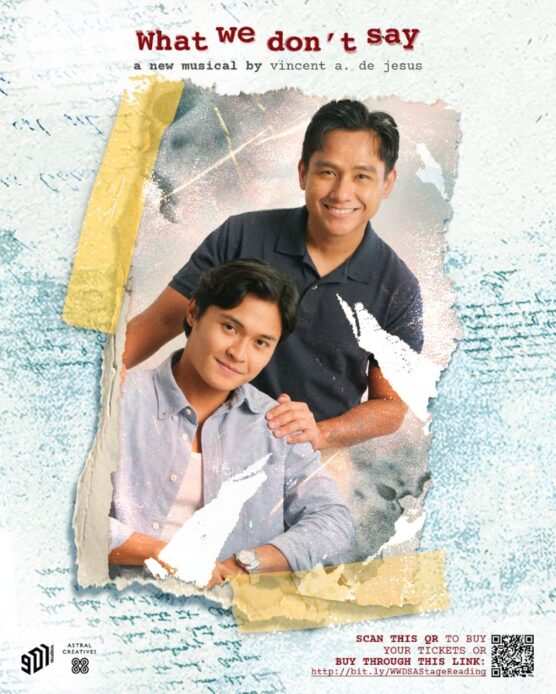
Filipino families are unlike any other. They aren’t always happy or uncomplicated; they can be many things at once. At their best, family serves as an anchor that keeps us grounded through difficult times. Yet that same anchor can become a weight that holds us back when we try to spread our wings.
It is this complicated relationship with family that Palanca Award-winning playwright and composer Vincent De Jesus explores in his newest musical, What We Don’t Say. In telling this story, De Jesus hopes to create a cathartic space for people who have lived through similar experiences and give them room to acknowledge the pressure they have learned to bear in silence.

Playwright and composer Vincent De Jesus
De Jesus, who composed the music for notable local films such as Ang Babae sa Septic Tank (2011), Changing Partners (2017), and Isang Himala (2024), now turns his attention to the expectations that often come with being part of a Filipino family.
“One of the things I find problematic about Filipino family culture is how we assign responsibilities based on someone’s place in the family. The eldest son is expected to be the provider. The unmarried daughter is expected to be the caregiver. The gay sibling is expected to be the dependable one, the one who has no family of his own to worry about and therefore has more than enough time and money to spare and to take care of everyone else,” he explained. And in a culture that places great importance on giving back, partly on utang na loob to the family that has provided food and shelter, these expectations can be difficult to resist. As De Jesus puts it, “These expectations become obligations. And obligations become a lifetime sentence.”
The difficulty lies not only in the responsibilities themselves but also in the guilt that comes with wanting to step away from them. Choosing to pursue a life of your own can feel like a betrayal of the family that raised and supported you, while admitting that your family has become a hindrance to your ambitions can make you feel ungrateful. In a society that places such weight on family loyalty, even wanting something different for yourself can be difficult to reconcile with the role you are expected to play. In What We Don’t Say, developed in close collaboration with director Rem Zamora, this conflict unfolds through the story of an eldest son whose rare opportunity to advance his writing career is threatened by his familial responsibilities. His predicament raises a difficult question: How much of your own life must you put on hold to fulfill the obligations you have to your family?
“We romanticize family sacrifice so much that we sometimes forget that the people who are expected to make the biggest sacrifices have lives of their own, dreams of their own, responsibilities of their own, and limits of their own,” De Jesus emphasizes. His observation points to a deeper tension in how family relationships are structured: the expectations placed on each member are not always shared equally, and the ability to set those expectations often rests with those who hold greater authority. For De Jesus, these imbalances are part of a broader interest in the power dynamics that exist in these very personal spaces.
“Just like in Ateng, Skin Deep, and Changing Partners, I’ve always been drawn to writing stories about the politics of relationships, the different ways power, influence, expectations, loyalty, control, and negotiation operate between people in any relationship,” he says.
The musical grew out of the Scriptwriting Workshop led by National Artist Ricky Lee, which De Jesus attended from 2025 to early this year. He wanted to bring the same complexity of family life to the stage, allowing humor and heartbreak to coexist without making either feel out of place. “As a writer, I love jumping from comedy to drama and back again in a snap. Because that’s how life actually works. One minute you’re laughing, the next you’re drowning in tears,” he says.
De Jesus wanted to bring the same complexity of family life to the stage, allowing humor and heartbreak to coexist without making either feel out of place
This tonal shift also allows the musical to capture the contradictions that shape family interactions, where affection can exist alongside frustration and difficult feelings often go unaddressed. De Jesus notes, “Sa totoong buhay, we spend probably 90 percent of our time pretending we’re okay, saying we’re fine when we’re not, laughing when we want to cry, and changing the topic when conversations get too personal.”
These moments of avoidance lend the story much of its dramatic weight, while the characters’ attempts to maintain a sense of normalcy can make their circumstances both painfully funny and deeply moving. As he puts it, “There’s something terribly funny, and truly heartbreaking, about watching people try to keep it together when everything in their world is falling apart.”
The emotions that the characters struggle to put into words also find an outlet in the musical’s sound. De Jesus hopes the music will make the experience just as cathartic and give shape to the frustrations and anxieties that the lead character cannot easily express.
With this, he takes inspiration from bands such as Temple of the Dog, Alice in Chains, and Pearl Jam. “I’ve always enjoyed listening to the gritty, raw, almost careless sound of ’90s Seattle grunge. There’s something wonderfully unpolished about it; the distortion, the angst, the vulnerability, complete emotional abandon,” he says. The choice of these vocalists also reflects the kind of emotional intensity De Jesus wants the lead character to convey. He explains, “Their voices sound angry, wounded, rebellious, and vulnerable all at once.”
For him, the music should offer an unrestrained release for these emotions, one that even the most carefully crafted melody cannot fully contain. “Sometimes singing is not enough—you just have to scream it out.”
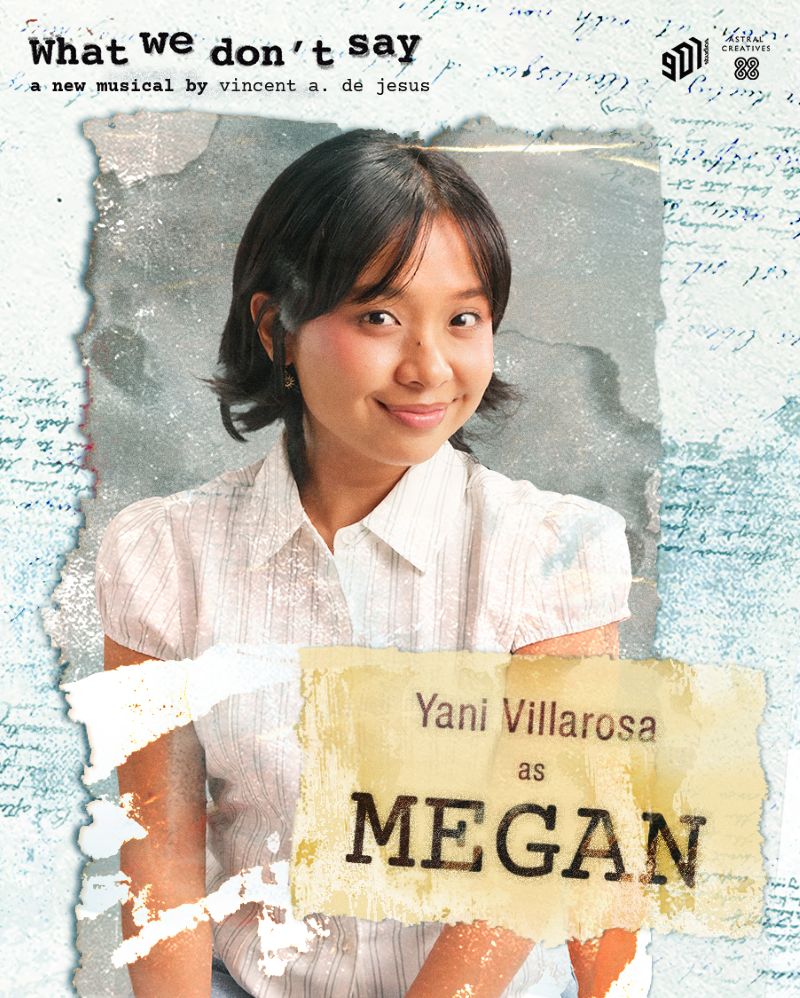
Yani Villarosa as Megan
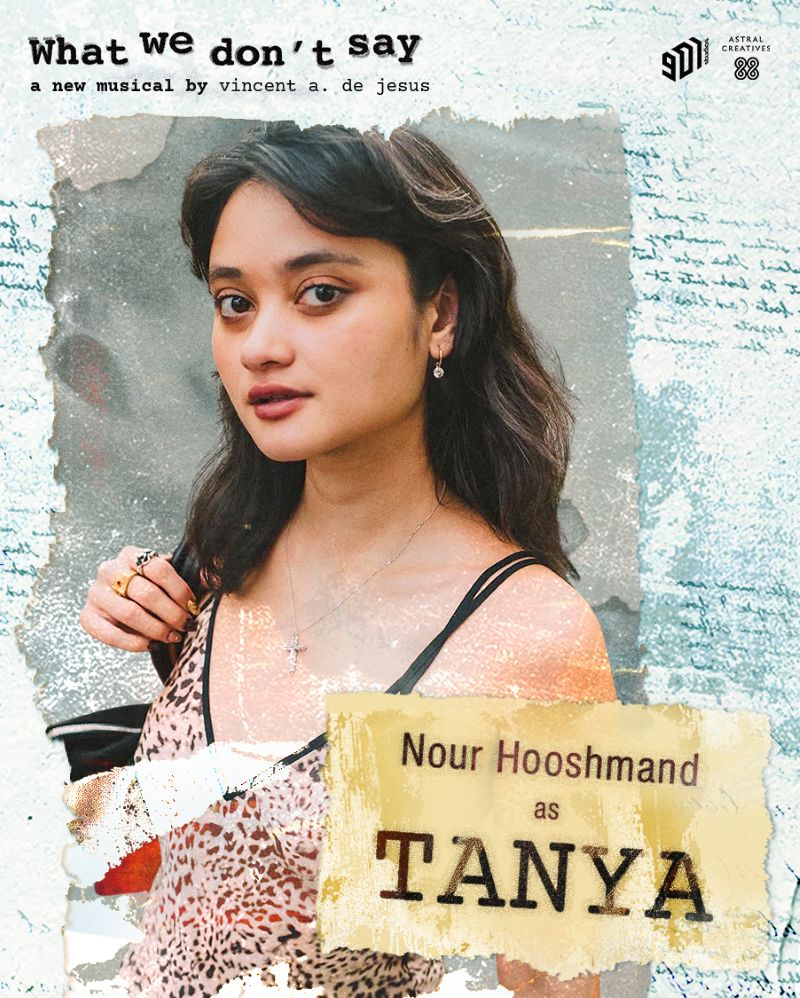
Noor Hooshmand as Tanya
What We Don’t Say has a clear creative direction, and De Jesus is confident that the people bringing it to the stage understand the story he wants to tell, especially since many of them have worked with him during the workshop. “Several people involved in this staged reading are also from Batch 30. Yani Villarosa and Nour Hooshmand are part of the cast, while Jon Galvez, together with 901 Studios PH, produced the reading.” And given the generational tensions at the heart of the story, the range of perspectives behind its staging takes on added significance. He says, “It’s good to see how people from different generations and levels of experience learn from each other, challenge each other, and bring something surprisingly different to the table.”
‘What We Don’t Say’ will have its staged reading on December 5 and 6, with performances at 3 pm and 7 pm at Sine Pop Cubao in Quezon City. Tickets are now available through http://bit.ly/WWDSAStageReading.


