
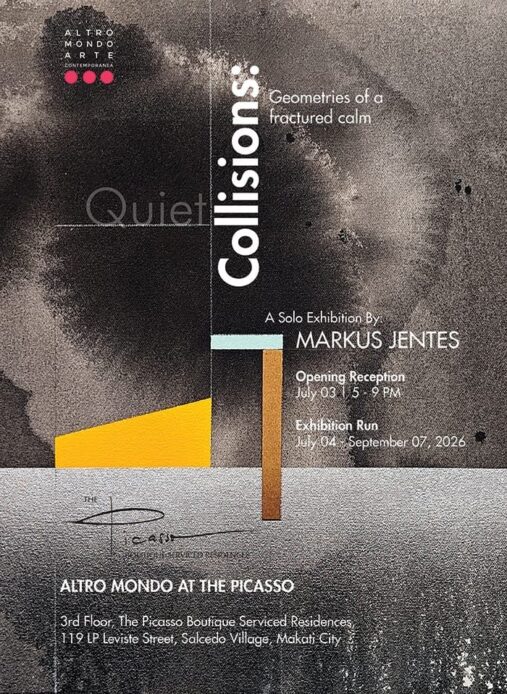
From geometric precision to expressive depth, Markus Jentes navigates the dualities of abstract art. His solo exhibit Quiet Collisions: Geometries of a Fractured Calm opens on July 3 at Altro Mondo Gallery, Picasso Hotel, Makati.
Markus Jentes is a Manila-based contemporary abstract artist recognized for his dynamic interplay of expressionism and geometry. His work explores contrasts and opposites, balancing raw emotion with structured form. Markus earned his Bachelor’s degree in Fine Arts from Pepperdine University in 1999, where he trained under esteemed professors Joseph Piasentin, Avery Faulkner, Bob Privitt, Sonia Sorell, and Leonard Skuro. While much of his career was dedicated to running his own advertising firm, he later channeled his extensive creative experience into the world of fine art. His early work, marked by hard-edged geometric compositions, gained recognition with his 2019 solo exhibition, MIAMI.
In recent years, Markus has undergone a profound artistic shift, embracing a more expressive and introspective approach. His latest collection delves into personal experiences of frustration and transformation, with the horizon line serving as a central visual metaphor for duality, choice, and resolution. This body of work reflects his evolving perspective—balancing structure and spontaneity, geometry and fluidity, order and chaos. Alongside this shift, he has expanded his use of mixed media, layering acrylics, spray paint, and other tactile materials to create depth and texture, further enriching the complexity of his themes.
Through exhibitions, commissions, and ongoing artistic exploration, Markus continues to push the boundaries of his creativity, using abstraction as both a form of expression and a tool for introspection. His work invites viewers to engage with contrasts, tension and harmony—ultimately finding meaning within the layered complexities of his canvases. In his own words:
How would you describe the evolution of your artistic style from your early geometric compositions (from 2013) to your more recent expressive works in 2021 onwards?
The evolution of my artistic style has been both a gradual journey and an enlightening process. While my early work focused on precise geometric compositions, recent years have seen a shift toward a more expressionist approach. This transition has allowed me to channel my experiences and emotions more freely into my art, creating a more natural and authentic feel. I’ve come to realize that expressionism and geometry can coexist within a piece, offering the potential to either soothe or provoke tension. It’s a balance that I find deeply moving, and it’s this interplay that defines my current work.
Can you elaborate on how personal experiences and introspection have shaped your latest collection?
Life’s challenges and triumphs are powerful forces that inevitably shape us, and for me, they are the core reason I create art. Since 2024, a significant personal and family situation has heavily influenced my work, infusing it with tension and intensity. This period of experimentation led to unexpected outcomes—art that was raw, emotional, and darker than my previous work. It marked a moment where my art became a direct reflection of my entire being, not just my artistic skill. While some pieces are quite raw, the collection also explores themes of nature, offering a contrast to the darker elements. My latest works hint at what’s to come—an evolution that continues to embrace both personal reflection and broader themes.
Your recent work prominently features the horizon line as a metaphor. What drew you to this symbol, and how does it reflect the themes of duality and transformation in your work?
The horizon is a powerful symbol of division and definition, creating boundaries that suggest either support or resistance. It can be soft and blurry or hard and defined, much like how nature organizes elements into their rightful places. In my art, the horizon serves a similar function, visually defining areas of contrast such as color versus flatness, or soothing versus textured spaces. My favorite contrast to explore is rawness versus minimalism. The horizon line intensifies these contrasts, often serving as a focal point in my pieces. Interestingly, some of my artworks feature more than one horizon, adding further complexity and depth to the composition.
‘My favorite contrast to explore is rawness versus minimalism. The horizon line intensifies these contrasts, often serving as a focal point in my pieces’
How do you approach the use of mixed media in your art, and what materials are you currently experimenting with?
When incorporating mixed media into my art, I typically plan which materials will be included, ensuring they work together not only visually but also chemically. I’m intrigued by the potential of Epoxy resin to add a new dimension and tactile experience to my work. Additionally, I’m considering the incorporation of metal, which could bring a unique texture and reflectivity. Right now, my focus is on experimenting and discovering which combinations of materials harmonize effectively, both visually and materially.
Tell us about your artistic influences and how they impact your work.
Rothko and Zobel are masters at creating layers that seem simple and unassuming at first glance, yet reveal profound depth upon closer inspection. Their work carries an emotional weight that transcends the visual, and their techniques for layering color resonate deeply with me. Both artists also employ subtle geometry to segregate and interact with space, which is something I’ve integrated into my own work over many years. Additionally, learning from Frank Stella and Arturo Luz, particularly their use of hard-edge techniques and mixed media, has provided me with new perspectives and pathways for my art. While it may sound like a complex mix, these influences are propelling my work to new heights, pushing boundaries I hadn’t envisioned before.
How do you balance the influence of your advertising background with your fine art practice?
My background in advertising has taught me to approach painting in a more methodical way. It involves planning, sketching, and executing at the right moments to maintain a linear progression. This structured approach ensures that when it’s time to paint, there’s clarity and purpose, minimizing hesitation. While there are always unexpected elements that surface during the creative process, having a timeline and structured methodology allows the work to flow more smoothly. It also helps me step back and recognize when a piece is complete, preventing overworking it.
What can audiences expect from your upcoming solo exhibition at Altro Mondo Gallery in July 2026?
Audiences can look forward to witnessing a more cohesive and complete evolution of my work, a journey that began in 2024. The exhibition will showcase a transition from raw, emotional pieces to those offering a calmer and more collected visual experience. On a personal level, this body of work reflects my own transformation—a more focused and balanced self, having navigated significant challenges over the past two years. It’s been a lesson and an opportunity to step back, realign, and start anew with a fresh perspective.
You are involved in numerous group exhibitions. How do these collaborative environments influence your work?
Participating in group exhibitions offers a wonderful opportunity to observe what my peers are doing and what they’re currently creating. I’m always eager to witness the subtle—or sometimes significant—changes in their art. These events also open doors for potential collaborations in future projects or exhibitions. Additionally, when group exhibits have a specific theme, it challenges us artists to explore new ideas and step out of our comfort zones, allowing us to try something different and push our creative boundaries.
What are your thoughts on the current abstract art scene in the Philippines, and how do you see your work contributing to it?
The abstract art scene in the Philippines is definitely here to stay. While it’s not new to the local art landscape, it doesn’t yet have the prevalence of figurative art in its various forms. However, I see a blurring of lines between abstract and figurative styles, with both increasingly mixing. Abstract art isn’t for everyone, and it can be challenging to create. For artists, it either comes naturally or it doesn’t, and the same might be said for those who appreciate it. Despite its subjective nature, abstract art offers a rewarding experience for both creators and viewers, and I’m excited to contribute to its growth and evolution in the Philippines.
For inquiries and commissioned works, e-mail markusjentes.art@gmail.com. www.markusjentes.art; Instagram: @markusjentes.art


