
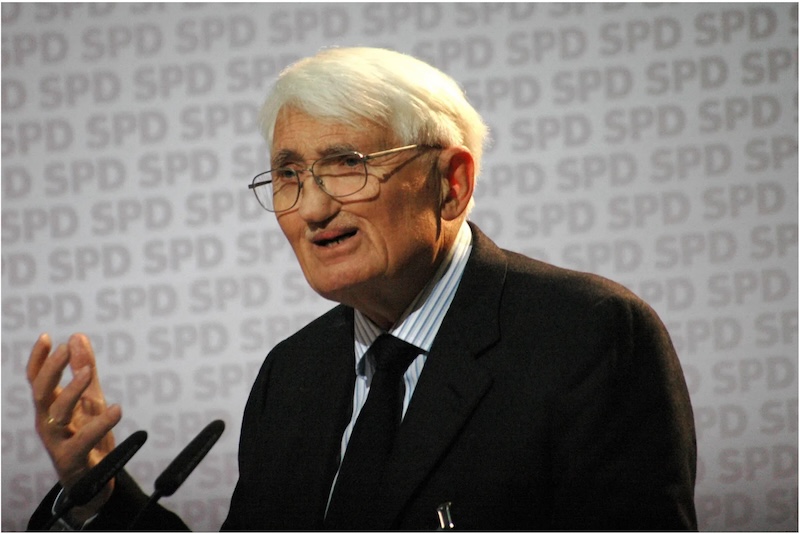
It’s been a month since the world-renowned philosopher, sociologist, and public intellectual Jürgen Habermas passed away. Over that period, more than 200 tributes and remembrances celebrating his life and legacy have appeared in legacy and digital media platforms.
Among the prominent personalities who have written about the impact of Habermas’s philosophy were United Nations Secretary-General Antonio Guterres and French President Emmanuel Macron.
Guterres “was particularly struck by his ideas on the distinguishing feature of a modern democracy as the permanent interflow of communication between political decision makers and civil societies. Today more than ever, we need this…”
For his part, Macron praised Habermas’s “existential drive to find political ways to liberate Germany, and indeed human society as a whole….”
Being a graduate student, however, I was drawn to the pieces written by former graduate students who had the privilege of having him as dissertation adviser.
The leading Habermasian Cristina Lafont, for example, swears by how Habermas truly believed in the “unforced force of the better argument.” She recalls that during a seminar in Frankfurt in which Habermas presented his interpretation of the philosopher Martin Heidegger’s magnum opus Being and Time, it was all she could do not to stand up to challenge Habermas’ interpretation. For fear of not being able to articulate her arguments in German, she decided to write to Habermas instead.
“To my complete surprise, Habermas arranged a meeting with me, in which, in addition to the discussion of Heidegger, he offered me to become his doctoral student in Frankfurt.”
Lafont would go on to complete her dissertation under the guidance of Habermas.
Alexander Karp was not as fortunate. Although he was able to convince Habermas to take him in as an advisee, he was eventually let go. Apparently, Habermas did not agree with his approach to the literature on the sociologist Talcott Parsons. Writes Karp who eventually completed his dissertation albeit under another adviser: “His decision came as an utter shock and was wounding. The sting would linger for years.”
What I would give to be in the shoes of Lafont or even Karp. Not being as fortunate, I suppose I would have to content myself with a long distance encounter with Habermas in 2021.
The year 2021 happened to be the 35th anniversary of the Historikerstreit or Historians’ Debate—a controversy that Habermas provoked when he castigated four historians for attempting to revise the uniqueness of the Holocaust. I had just visited the Topography of Terror, a historical museum, in Berlin with my wife. There, I found an anthology in English of the essays related to the debate. Having defended my thesis on his participation in that debate, I decided to write him to ask if he had plans to write anything new to add to his stance 35 years ago. Given his stature as an academic and a public intellectual, I did not expect him to reply.
You could imagine my disbelief when I received a two-page signed reply from Habermas! Who knew?
When he passed away last March 14, I remembered why his reply has been a source of inspiration to me over the years.
For one thing, even if I did not include any honorific in my return address, he addressed me as Dr. Katindoy. Did he infer I was a doctor of philosophy? Or was he perhaps encouraging me to forge ahead with my doctoral journey? I will never know. But coming from a world-famous philosopher, I will always take it as a good omen that I will one day complete the longest marathon of my life.
For another, he could have reprimanded me for wasting his time. Was I not aware of the various search engines that graduate students regularly use for research? Instead, he very kindly pointed me to several books and essays that were recently published in English. Hindi lang pala henyo si Habermas, mabait na tao din siya (Not only was he a genius, he was also a good man).
Most importantly, his valediction read: “with best wishes on your further work, signed Jürgen Habermas.” You could say he was just being polite. To me, however, it is a gentle reminder to persevere despite the long and winding road of graduate work. If he were Filipino, I suspect he would have closed with “Padayon”—the Visayan word that is just as encouraging in spite of its brevity.
Now that he is gone at a time that both reason and the public sphere are under constant attack by fascists and demagogues, his best wishes could probably be extended to all humans everywhere who believe as Habermas did—that the fight for human emancipation from all forms of domination continues because “things needed to get better.”


