
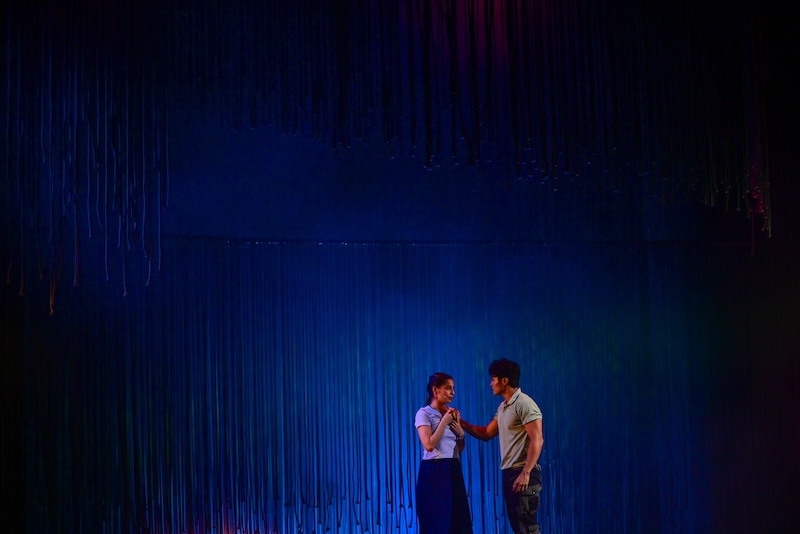
Endo runs until May 10 at the PETA Phinma Theater.
“Dance is the oldest form of prayer,” National Artist for Literature Alejandro “Anding” Roces wrote in tribute of National Artist for Dance Leonor Orosa Goquingco. “For her, every dance was a prayer.”
We are reminded of this after experiencing At Nagkatawang-tao ang Verbo (And the Word Was Made Flesh) by the theater group Tanghalang Bagong Sibol, performed for two weekends, April 10 to 19, at PETA (Philippine Educational Theater Association) Phinma theater as part of Control + Shift, Changing Narratives, PETA’s annual festival of one-act plays.
The story by playwright Mikaela Regis is about the residents of a small fishing community along Tullahan River who constantly deal with pollution and the threat of eviction.
Tullahan River is one of Metro Manila’s ecological buffer zones and a natural flood control-drainage system starting from La Mesa Dam, snaking its way through the cities of Caloocan, Malabon, Navotas and Valenzuela, also known as CaMaNaVa area, ending in Manila Bay. Like the Pasig River, its perennial problem is pollution.
Unlike a traditional play, Verbo combined body movement, dance, and pantomime under the direction and choreography of Anthony Cruz, the artistic director of Tanghalang Sibol.
Verbo was inspired by the senakulo, the Catholic Church’s Lenten street reenactment of Christ’s crucifixion.
Religious images and symbols, as the play’s title suggests, became the nameless characters played by Tanghalang Sibol members Ernest Gillacanao, Ghillian Chavez, Jasmine Lulu, Jenelyn Malunes, John Solcruz, Johnmer Ursula, Nelson Cabuhat Jr., and Wilman Tolda.
Days after seeing its final performance on Sunday, April 19, we were still haunted by this reminder of how industrialization continues to dehumanize people, who, in a literal sense, are living on the edge.
Despite its limited two-week run, we can say there has never been a play as timely and spot-on as Verbo. It was initially staged in last year’s Control + Shift, and the issues on environmental degradation, urban decay, and displacement along Tullahan River have gone from bad to worse.
As I write this, government agencies warn against the “very unhealthy” poor air quality in Metro Manila. Those who venture outdoors are strongly advised to wear facemasks.
As I write this, government agencies warn against the ‘very unhealthy’ poor air quality in Metro Manila
GMA News Online reported about the “tiny solid particles and liquid droplets in the air measuring 2.5 micrometers or smaller in diameter, which can penetrate deep into the lungs,” in the cities of Caloocan, Malabon, Marikina CEMO, and Quezon City.
The air quality also worsened after the fire in the Navotas City sanitary landfill, reported the Inquirer.
Control + Shift started in 2024 in the intimate PETA Studio Theater which can accommodate around 80 to 100. On its third year, there are four plays grouped into Set A, titled When Power Falls Into Our Hands, and Set B, When Care Becomes Survival.
The comparison of dance or choreographed movement to prayer by Anding Roces, who was one of the founding board members of PETA from 1967 until the early 1970s, also aptly describes Baga ng Gumuguhong Langit (Embers of a Falling Sky), the play paired with Verbo in Set B.
Written by playwright and current PETA executive director Anj Heruela and directed by Ian Segarra, the play is about three orphaned children trapped in the war zone, which reminds us of the ongoing conflicts in the Middle East, Gaza, Israel and Ukraine.
The three children are played by Rona Manio, Rei Millete, and Wade Dizon, essaying in choreographed body movements the anxiety, relentless hunger, and sleepless nights of these innocent casualties of war.
On one end of the stage sits PETA artist-teacher Ada Tayao, the musical director and sound designer, providing live music accompaniment using ukulele, guitalele, apple box with metal sheet, singing bowl and stick, T’boli bells, tongue drum with mallets, clave, small rain stick, djembes, glass bottles, a can with marbles, and believe it or not, a frying pan.
How each instrument matches the emotions, interpreted through pantomime and terpsichorean movements, is pure genius. Hers is a performance in itself. Tayao could have used an acoustic guitar or violin, but that would have been trivial and trite. This is the kind of PETA production that bravely pushes artistic boundaries.
During a “debriefing,” facilitated by Tayao, after curtain call, some audience members opened up and some even cried while sharing their thoughts over the plights of affected communities along Tullahan River, and the innocent children caught in the crossfire of these ongoing senseless wars.
Set A: When Power Falls into our Hands has two straight plays under PETA’s “StudioLab.” It’s where new works are tested to a live audience.
Originally staged last year, Monit-Oh! Monit-Ah! by playwright Herlyn Alegre, under the direction of Norbs Portales, tackles how corruption thrives in workplaces, be they factory or fast-food. “It’s who you know, not what you know,” the saying goes.
The play is a forum theater piece “that follows Jaylord, a rookie waiter hoping to win his boss’ favor through a Christmas monito-monita gift,” but along the way, he discovers a web of lies that could either break or make him.
It is paired with Cleaners, a play by Jhudiel Clare Sosa, directed by Julio Garcia, about a group of high-school students punished by their teacher to clean rooms after classes. Their graduation depends on their work. Everything looks okay until they discover a classmate’s dead body. This farce is a fast-paced, comic whodunnit, but behind the physical comedy and funny dialogues, audience members realize it’s about extra-judicial killings and impunity.
Control + Shift ran from April 10 to April 19, but for those who missed it, there’s another production worth the trip to PETA Theater Center.
Interpretative dance and well-choreographed body movements are also used in PETA Plus’ ongoing stage adaptation of Endo, the award-winning 2007 Cinemalaya Independent Film Festival romantic hit movie topbilled by Jason Abalos and Ina Feleo, directed by Jade Castro and co-written by Castro, Michiko Yamamoto, and Moira Lee. The past two weekends, theater lovers scheduled their viewing of Control + Shift and Endo in one day. From the Studio Theater, they could just go downstairs to the PETA Phinma Theater to theater-hop.
PETA Plus is staging Endo in partnership with Ticket2Me. Darwin Mariano of Ticket2Me told The Diarist.ph that they own the rights to adapt the film. They decided to do a stage adaptation because the story remains relevant, nearly two decades since the film was made.
The adaptation was written by Liza Magtoto (Rak of Aegis, Care Divas, A Game of Trolls) and directed by Melvin Lee, PETA president and creative director of PETA Plus, with assistant direction and dramaturgy by Eric V. dela Cruz.
In an interview after the play, filmmaker Jade Castro said audiences need not watch his film to appreciate the PETA Plus stage version. When he learned that Lee and Magtoto were doing the adaptation, he was very happy and excited because he has looked up to the two as storytellers. “They’re my idols,” Castro said. (See Marge Enriquez in the advancer article for TheDiarist.ph.)
Endo, short for “end of contract,” is about the struggles of casual workers in the gig economy. Unlike the freelancers in the creative industry, who are sustained by projects they choose, the endo workers have no choice but to jump from one company to another before they reach the mandatory government-imposed regularization.
‘Endo,’ short for ‘end of contract,’ is about the struggles of casual workers in what we now call the gig economy
It’s been 19 years since Endo opened, so Magtoto updated the setting to the age of social media, delivery and ride-hailing apps, Zoom conferences, and online tutorial classes.
The unfair labor practices in Endo continue today among sales people in the malls and department stores, service crew in fast food chains, construction and factory workers and the like. Nowadays, they are prevalent even in media companies whose workers are bound by three-month contracts.
Like in the movie, there are three main characters, Leo, Tanya and Candy, all trying to survive the harsh realities of going from one temporary workplace to another.
Leo (alternately played by Royce Cabrera and Esteban Mara) is the breadwinner in a family composed of his father (played by Carlon Matobato) and younger brother (Denmark Brinces). The father remains a broken man since his wife left him for another man. He refuses to work, not even in menial jobs. The younger brother, still in college, could have gotten part-time jobs and function as working student, but he is easy-go-lucky. He and his father depend on Leo.
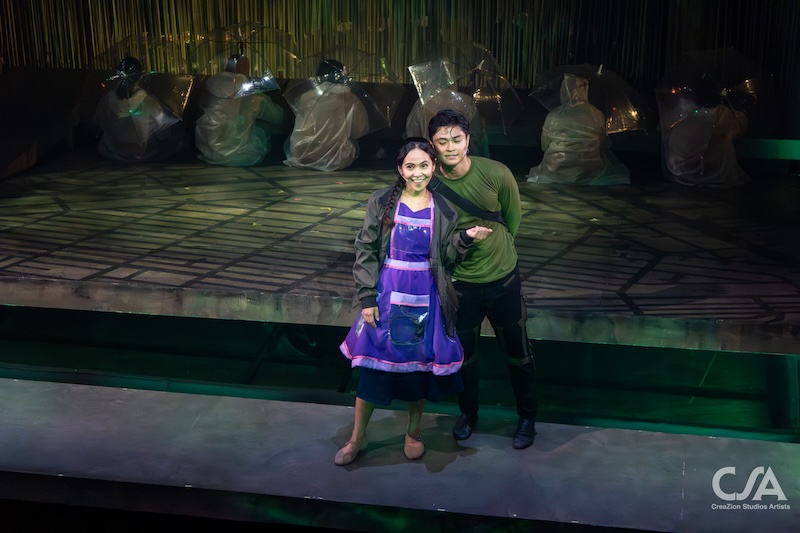
Rissy Reyes-Robinson, paired with Esteban Mara, owns the character with depth and conviction. She’s not just an alternate. (Photo by Enzo Guinto for PETA)
There’s Tanya (played in alternate by Jasmine Curtis-Smith and Rissey Reyes-Robinson), a board-passer nurse who refuses to work in a hospital. “Besides the long hours and punishing work, you have to pay the hospital for the work that you do for them,” she says, out of frustration, and that’s actually the reality. Medical workers like nurses and laboratory personnel pay hospitals to gain work experience. Instead, Tanya works multiple jobs. She does online selling, works in a call center on weekdays, and teaches English to Korean students.
There’s Candy (Kate Alejandrino-Juan, Iana Bernardez), a former “endo” worker who finds a new career as social media influencer with a “secret” side hustle that pays a lot.
Leo and Candy were once lovers, but had to part ways out of necessity because of the endo setup. Leo meets the ambitious Tanya, who tries to help him get out of the economic quagmire.
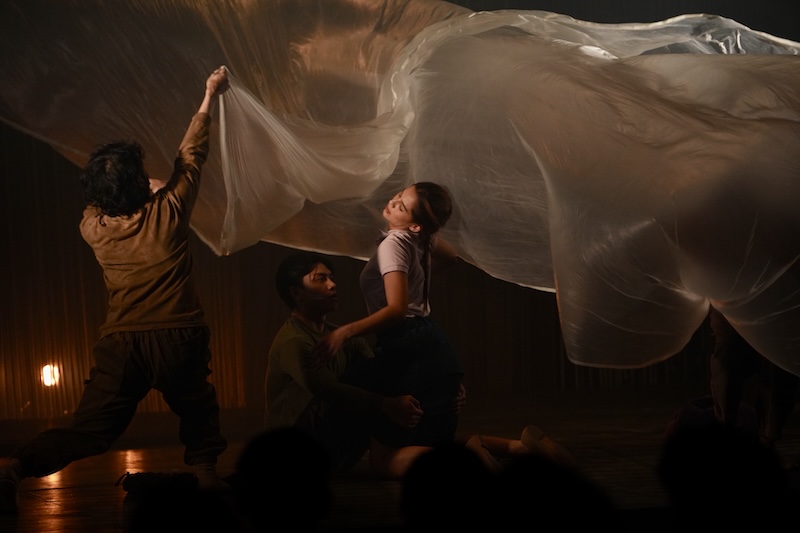
Choreography by Christine Crame enhances the storytelling in Endo. (Photo by Jamin Lim for PETA)
There are scenes, like the lovemaking of Leo and Tanya, performed through well-choreographed dance-like body movements. Choreography was done excellently by Christine Crame, a former principal dancer of Ballet Philippines when it was under the helm of founder and National Artist Alice Reyes.
The first two weekends, I managed to watch both versions with different female lead characters. Initially, the play is promoted on the draw of Curtis-Smith, some reviews pointing out “the celebrity factor.” Unfortunately such slipshod observations easily dismissed Curtis-Smith’s theater performance. She has proved she could do live theater with credibility, the same way she does films and television.
RELATED STORY:
What a year for Jasmine Curtis-Smith
Vincen Gregory Yu praised Curtis-Smith and her co-actors Paolo O’Hara and Cris Pasturan, comparing their performances with the previous cast. “The first time I saw 3 Upuan at the Ateneo de Manila University was in February, with Jojit Lorenzo, JC Santos, and Martha Comia all returning from the 2024 premiere—the play, in their hands, an exercise in intellectualizing raw emotion. In October, I saw the new cast—Paolo O’Hara, Cris Pasturan, and Jasmine Curtis-Smith—their emotions collectively bigger and more in-your-face. Two different versions, each no less potent than the other: theater as spiritual reckoning. I can’t wait for the third, and fourth, and fifth iterations.”
RELATED STORY:
Why I still longed for Filipino theatricality in 2025
Curtis-Smith’s Tanya, despite that “celebrity aura,” is believable in a sense that she shows strength and vulnerability without being conscious of having to look good before the audience. She is intense, and has restraint. And she speaks Filipino well.
We initially knew Reyes-Robinson as the wife of the famous musical theater actor-heartthrob Vic Robinson, who we admire a lot. Vic, a product of the Ateneo theater community, started acting in professional theater in PETA before he was propelled into theater stardom.
But after seeing Reyes-Robinson play lead in last year’s Cinemalaya movie, Ang Paglilitis, which is about a female worker harassed by her sleazy boss and who rises from trauma to seek justice, I became an instant fan.
Reyes-Robinson has been doing theater for years, in English and Filipino plays and musicals. Tanya was our first time to see her in a lead role in a Filipino play in Filipino, and like in Ang Paglilitis, she showed equal depth and conviction.
As “brawn and brooding” Leo, Cabrera has come a long way as a theater artist since his beginning in 2017 in the titular role in Dulaang UP’s Bagong Cristo.
Alejandrino’s Candy is outright cunning and wicked, while Bernardez’s is deceptively charming.
The laudable PETA team has Teetin Villanueva, Carlon Matobato, Raphne Catorce, Raflesia Bravo, Denmark Brinces, Kirby Dunnzell, Ekiz Gimenez, Jacinta Pascual, Noelle Polack, and Nikki Soriano.
The production design of D. Cortezano, executed by Julio Garcia, is a ground shaking with tremors, evoking danger and caution, where everyone could trip and fall.
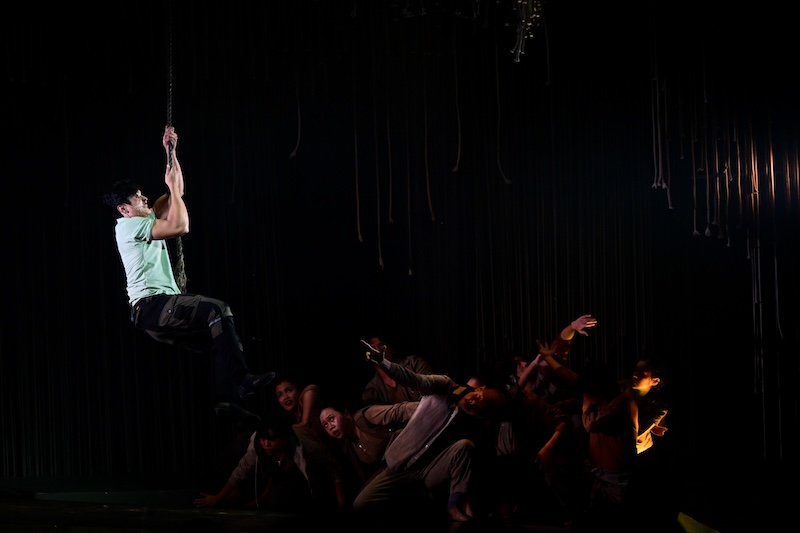
Esteban Mara as Leo tries to climb his way up from the dire situation he’s in. (Photo by Kyle Venturrilo for PETA)
There are curtain ropes dangling on the stage. Leo tries to climb using one, yet he pulls himself down doing it—symbolic of how, no matter how hard he works doing multiple jobs or how Tanya tries to lift him to a more secure future, he is tied down to his family situation.
Leo is today’s Juan dela Cruz? We pray not.
Endo runs until May 10 at the PETA Phinma Theater. For tickets, priced from ₱1,600 to ₱2,700, log on ticket2me.net.


