
The following text is taken from León Gallery’s ‘The Magnificent September Auction 2026,’ which takes place September 12, 2026.
Kit Ongpin-Roxas had an excellent eye. No one had a better, more exacting knowledge and feel for antique Oriental ceramics, an expertise honed while working alongside her mother, Fe Ongpin, the original Oriental ceramics expert. Through decades of experience and handling the finest of objects, Kit could tell a lot about Oriental ceramics with just one glance: its glaze, its kiln of origin, possibly even its excavation site, and know more just by running her hands through it and then gently tapping it, knowing if it’s pristine or repaired/restored, quickly assessing its current market value.
She also had an unerring eye for quality, and was known for selling blue-chip Filipino artists Fabian de la Rosa, Fernando Amorsolo, Vicente Manansala, Victorio Edades, H R Ocampo, Jose Joya, Fernando Zobel de Ayala Montojo, BenCab, et al. She often engaged with leading art critics and collectors. The true Indiana Jones of the Philippine antiques trade, Kit traveled locally and internationally to discover hidden gems. Her background in architecture and civil engineering informed her expertise in antique Filipino and Chinese furniture. She knew the various Philippine hardwoods, had a feel for old wood, understood classical furniture construction, thoroughly researched repairs and restorations, and kept herself up to date on materials, finishes, and techniques.
She had a distinct aesthetic that left its mark in many finely furnished distinguished collector’s homes today. As for the decorative arts, Kit had visited the most beautiful houses in Manila for decades, and through her, appreciation of them grew. Her quiet elegance drew people to her and forged deep friendships that helped build the finest collections. She understood intuitively how her world lived, what they desired and required. Her Tawalisi store inventory reflected that discernment: upscale paintings, excavated Oriental ceramics, Oriental jars, Manila kamagong aparadors, Batangas hardwood mesas altares, Bulacan bone–inlaid mesas altares, long narra dining tables, elegant chairs, antique sofas and lounging chairs, tester beds, antique chandeliers, hanging lamps, church silver, antique glass. It was everything that defined a truly upper-class Filipino home. At least, until mass-market, senseless modernism crept in, yet again.
Kit had taste. Kit had style. She was pretty, slim, and chic. Effortlessly. She dressed with understated elegance; she always looked good. She remained so to the end. Her clients were the same: attractive, intelligent, fascinating, stylish, rich people. Very rich people. After all, one had to be very rich to buy from Kit’s Tawalisi and Boy Villegas’ Katutubo.
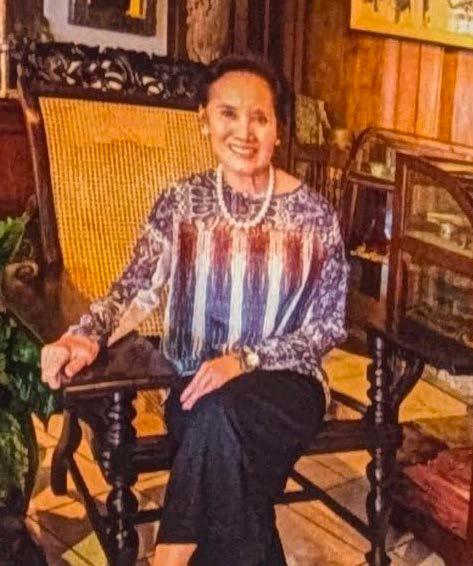
Kit featured in ‘Mabuhay Magazine’ in her shop at LaO Center in 2017 (Photo from the Kit Ongpin Roxas archives)
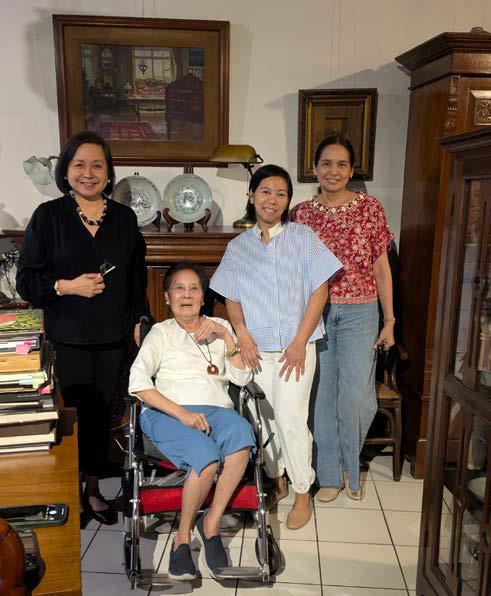
Kit with her daughter Ginger, fiber artist and art dealer, and her two nieces from two sides of her family: Gina Consing McAdam, author of ‘Houses that Sugar Built,’ and Lisa Ongpin Periquet, co-founder of Art Fair Philippines. All are in the field of
fine arts and antiques. (Photo from the Kit Ongpin Roxas archives)
The hobby of collecting art and antiques is a very expensive pastime, once reserved only for royalty and aristocracy. Kit (Maria Cristina Consing Ongpin) was born to Magin Tempongco Ongpin, an engineer, and Fe Calo Consing, an architect, on 3 June 1942, during the early years of World War II. Kit was named after her paternal grandmother Doña Cristina Tempongco y Calixto (Lola Tinay), wife of Ramon Bartolome Ongpin y Domingo. Don Ramon was a son of the famous Chinese–Filipino community leader Don Roman Ongpin y Tanbensiang and his wife Doña Pascuala Domingo y Encarnacion, a descendant of the pioneer Filipino painter Damian Domingo. Don Ramon was the father of Magin Ongpin, Kit’s father.
Kit spent her formative years in Cebu and attended Saint Theresa’s High School. Even at a young age, Kit was developing a taste for fine art and upscale antiques, which wasn’t surprising, considering she was a grandniece of Don Alfonso Tiburcio Ongpin y Domingo (Lolo Poncho), her grandfather Don Ramon’s younger brother, the pioneer and foremost art scholar, aesthete, connoisseur, and dealer in Manila during the first half of the 20th century. Art was a traditional Ongpin involvement. College was in Manila. She took care of her younger siblings. Her architect mother Fe was widowed early and occupied herself with commercial construction projects in Cebu and Iloilo.
It was during excavations for Shell gasoline stations that Fe first encountered the antique Oriental ceramics that would be her second career, and later on, Kit’s. Those early ceramic finds are now exhibited in London and elsewhere in Europe, taken there by the expatriate executives who funded those construction projects. Fe Calo Consing, Mrs. Magin Tempongco Ongpin, was a daughter of Don Rafael Consing y Soriano (Lolo Pael) and Doña Emilia Calo of Butuan, Agusan del Norte. Don Rafael married three times, the second to Doña Porfiria Quintana, and the third to Doña Remedios Pagkatipunan. Don Rafael Consing y Soriano was a cousin to prewar Iloilo Governor Don Timoteo Consing y Yusay. Fe’s half–brother, the World War II hero Horacio Quintana Consing, was killed in Fort Santiago for refusing allegiance to Japan. The famous young banker Rafael Jose Consing Jr. (Joel) is descended from Don Rafael and Doña Remedios. It was from the Consing and Soriano lines that Fe and Kit were related to all of Old Iloilo—Lopez, Ledesma, Jalandoni, Yulo, Montinola, Sanson, Villanueva, Araneta, Lacson, Yusay, Locsin, et al. It was from the Calo line that Fe and Kit were related to all of Butuan, Agusan del Norte. That was Fe’s and Kit’s social network, to which Ongpin–Binondo and Roxas–Capiz were added later by marriage.
As a young student, Kit was always a whiz at numbers. She was the first female architecture and civil engineering graduate of the Mapua Institute of Technology along with her sister Leni (Elena Consing Ongpin–Haag). Bert finished architecture at Mapua, and became president of the Roxas family business, RECCI Roxas Electric & Construction Company.
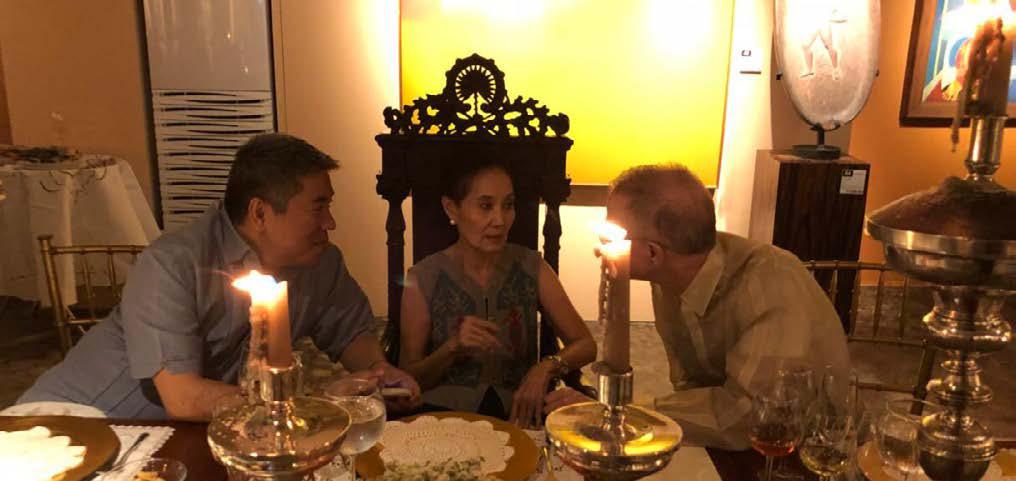
Ongpin Roxas engagement dinner at Paco Church, with Kit at center with
husband Bert Roxas. To his left is childhood friend, the late Mrs. Willie Soong. (Photo from the Kit Ongpin Roxas archives)
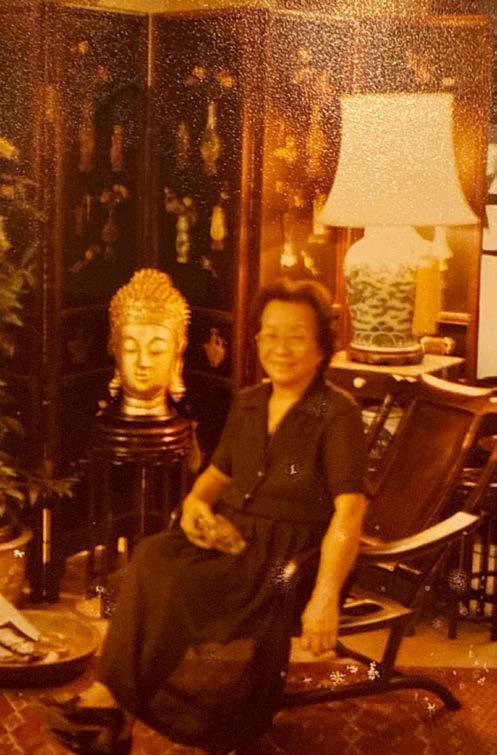
Fe Ongpin
Kit and Bert (Roberto Berja Roxas) married on 19 December 1965 at the Mary the Queen church in Greenhills. They had four children: Bamm (Jose Maria Ongpin Roxas), Pebbles (Maria Teresa Ongpin Roxas–Lichauco), Ginger (Anna Maria Ongpin Roxas–Arzt), and Pepper (Maria Isabel Ongpin Roxas-Houhoulis). During the 1960s, Fe Consing–Ongpin maintained an informal antique shop in the garage of her home at 1191 San Marcelino Street, Manila. It was there that the young Imelda Romualdez–Marcos and the “Blue Ladies” (Marcos Sr–affiliated society matrons) would sit on the floor and study the excavated genuine Oriental ceramics which were all the rage for collectibles at that time in Manila high society. Kit’s kids Bamm, Pebbles, Ginger, and Pepper remember all sorts of curious and strange objects at Lola Fe’s home, like ancient celadon plates and barnacles immersed in buckets of fresh water to separate them and old burial jars that would rattle at night. Fe’s antiques business grew organically to a second location at Padre Faura street in Ermita.
It was a very good time, a burgeoning time, for the antiques business, so Kit and Bert bankrolled the 1191 Art & Antiques shop of her mother Fe at the new and fashionable Quad Theater and Shopping Arcade at the Makati Commercial Center (MCC) because they wanted to establish the business in a better, busier place than Fe’s home at 1191 San Marcelino Street and the second shop at Padre Faura Street, Manila. Opening Fe’s antiques business at the MCC improved access to the most affluent clientele. Kit followed her footsteps to become the principal doyenne of the Manila art and antiques world, following the 2002 demise of the senior Viring de Asis, who dominated that realm during the late Marcos Sr. era (1980–1986) and beyond.
A highly experienced Kit finally came into her own when she established Tawalisi Art and Antiques in the early 1980s on Burgos Street, Makati. She was a cerebral and exceptionally well–read lady, and the unusual name Tawalisi was not a random choice from nowhere; it was an esoteric one. Kit had always admired the national hero Dr. Jose P Rizal. She recalled that Rizal had read with great interest about ancient and medieval accounts of what seemed to be Las Islas Filipinas. Claudius Ptolemy, a Greco–Roman mathematician, astronomer, and geographer from second-century Alexandria, discussed the emergent science of cartography and the known Greco–Roman world, including China (and by extension, Filipinas); Ibn Battuta, a Moroccan traveler from the 14th century, had visited Tawalisi in Southeast Asia and encountered its warrior princess Urduja. And so, Tawalisi it was.
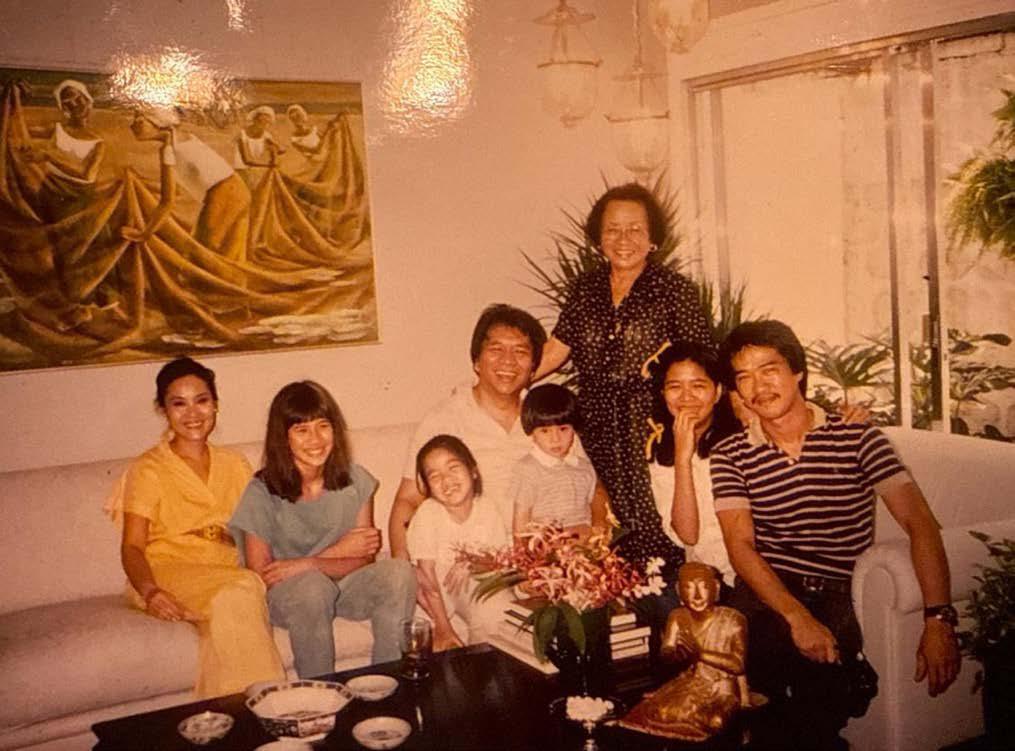
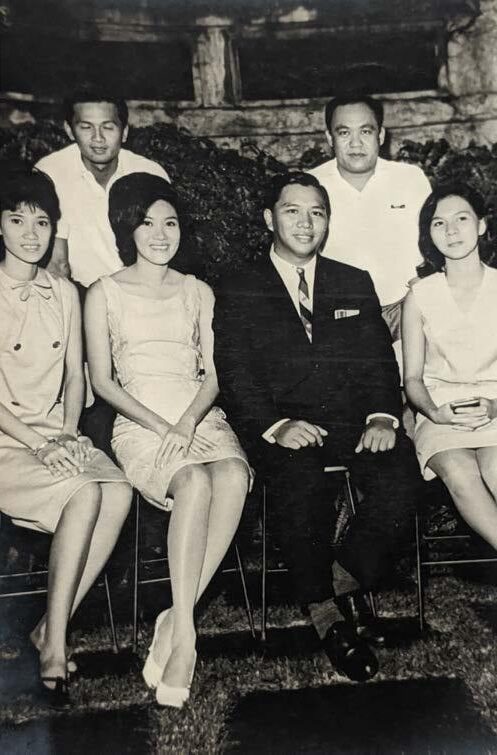
Kit Ongpin Roxas, Patricia Ongpin Haag, Pepper Ongpin Roxas, Bert Roxas, Marlo Ongpin, Pebbles Roxas Lichauco, Mario Ongpin, and Fe Ongpin (standing)
The Tawalisi Art and Antiques store on Burgos Street became a de facto hangout for the city’s affluent culturati, who admired, desired, and acquired Kit’s constantly replenished stock of Filipino and international fine art, antique classical Filipino furniture, and Filipino and European decorative items.
After some years at Burgos street, Kit transferred Tawalisi to a prime and spacious location on the ground floor of the new LaO Center Building along Pasay Road. When Boy Villegas’ Katutubo Arts & Crafts and Omeng Esguerra’s Osmundo Gallery opened shop as well, LaO Center became the best destination for the finest art and antiques in Manila, bar none. Kit was an Ongpin of Binondo (a patrician Chinese–Filipino clan steeped in big business and the fine arts), a Consing of Iloilo (a respected sugar planter and political clan), and a Mrs. Roxas of Capiz province to boot (a prominent landed and political family, relatives of President Manuel Acuña Roxas and famous soprano Jovita Flores Fuentes, who were closely related by blood, according to family. That guaranteed unquestioned entrée to privileged Manila circles.
When Kit passed away on 17 January 2026, it was the end of a memorable golden era of art and antiques in Manila.
A museum Piece by Don Mariano Asuncion
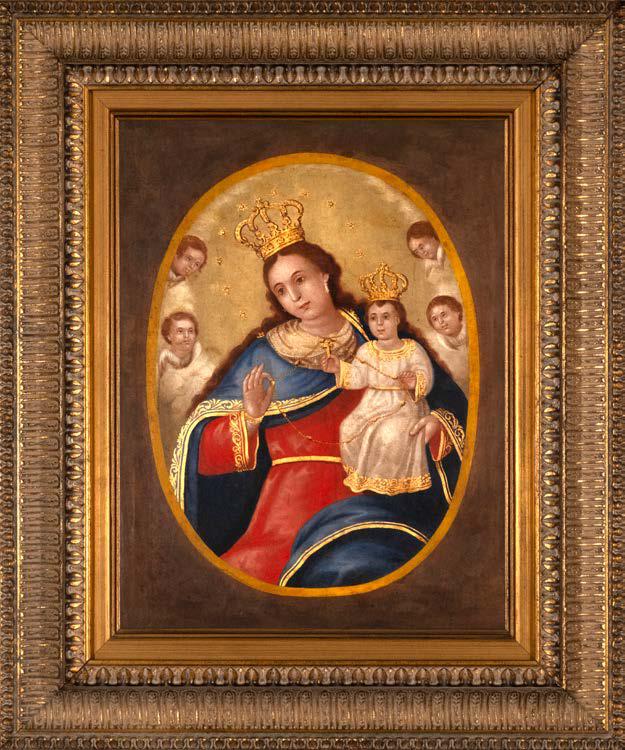
Mariano Asuncion (1802–1885), ‘Nuestra Señora del Rosario,’ 19th-century oil on board, 18″ x 13 1/2″ (46 cm x 34 cm), from Santa Cruz, Manila, private collection of Maria Cristina Consing Ongpin–Roxas
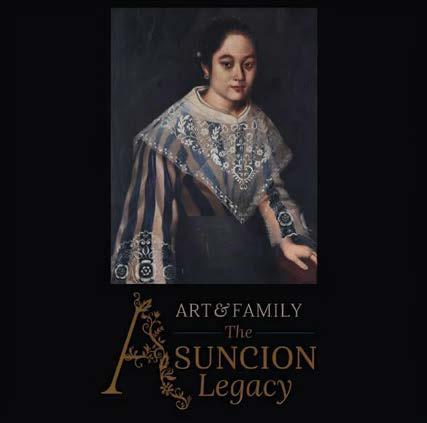
The catalogue cover of the Ayala Museum exhibition ‘Art and Family: The
Asuncion Legacy, ‘published by the Ayala Museum in 2018. The book features the Mariano Asuncion painting ‘Nuestra Señora del Rosario,’ owned by Kit Ongpin-Roxas.
This painting depicts Nuestra Senora del Rosario/Our Lady of the Rosary. The Virgen Maria holds the Niño Jesus on her left hand while he holds the rosario which hangs from her neck in the fashion of the day, which she also holds with her right hand. The Virgen Maria is dressed in a red tunic edged with gold embroidery, a gold cincture around her waist, and a blue cape also edged with gold embroidery; she also wears an embroidered pina/nipis balabal scarf on her neck. The Niño Jesus is dressed in a white tunic (perhaps pina/nipis?) edged with gold embroidery. The Virgen and the Niño both have gold crowns and are surrounded by two cherubs on either side. All the faces are singular and individual, none are academic. The careful and palpable rendition of the Virgen’s and Niño’s dresses take inspiration from 17th-century Spanish painter Francisco de Zurbaran. The work is attributed to the 19th century Filipino master of religious painting, Don Mariano Asuncion y Molo (circa 1802–1888). The devotion to Nuestra Señora del Rosario and to the Rosario was propagated by the Dominicans (OP Ordo Praedicatorum/La Orden de Predicadores), who arrived in Manila in 1581 and set up their first church and convent of bamboo and thatch in Intramuros, beside the Rio Pasig.
The attribution to Don Mariano Asuncion y Molo by Maria Cristina Consing Ongpin–Roxas, Ramon N. Villegas, and Santiago Albano Pilar is strong and defensible. Stylistic comparisons, magnification work, laboratory/chemistry work, pigments analysis, canvas/board stabilization, historical context, provenance, and repair/restoration were all utilized by Ongpin-Roxas, Villegas, and Pilar to study the work. The results were all affirmative. Overall, this Nuestra Senora del Rosario compares favorably with the signed works of Mariano Asuncion y Molo. There is a rare, signed Santa Regina, virgen y martir, and its attributed pendant Santa Isabel de Ungria, reina in the Dr. Antonio Perez–Canon Manahan and Josefina Acebedo Pedrosa Collection. An attributed, lovely La Asuncion de la Virgen is in the Eleuterio Montano Pascual Collection. There is an attributed, stirring El Transito de San Jose in the Renato Luna Santos and Asuncion Soriano Lopez Collection. An attributed, elegant Nuestra Señora del Rosario is in the Bangko Sentral ng Pilipinas Collection. Another attributed Nuestra Señora del Rosario is in the Museo de Intramuros of the Intramuros Administration. There is a rare, signed Nuestra Señora del Rosario in the Lamberto Raymundo Ocampo (Ambeth Ocampo) Collection; the signature was found at the rim of the canvas, obscured by the frame. There is an attributed, luminous La Coronacion de la Virgen in the Paulino Que and Hetty Kho Collection. And there are many more waiting to be discovered.
There are two religious paintings, Nuestra Señora del Rosario and La Coronacion de la Virgen, in the Atty Jose Maria Perez–Barcelo Trenas Collection attributed by Ramon N Villegas, Maria Cristina Consing Ongpin–Roxas, and Santiago Albano Pilar to Don Justiniano Asuncion y Molo (1816– 1901), Don Mariano’s younger brother. They are important to the study of Mariano Asuncion’s works because they are certainly different in style, and show the progression of Filipino religious art through the decades.
Very few religious paintings from the 19th and 18th century are signed. The pioneering names Faustino Quiotan (18th century), Damian Domingo y Gabor (1796-1834), Juan Arceo, Jose Dans y Luciano (active 1850s), Antonio Francisco Malantic y Arceo, Mariano Asuncion y Molo (1802-1888), Justiniano Asuncion y Molo (1816-1901), Simon Flores y de la Rosa (1839-1904), and Juan Senson (1846–1927) rarely appear, if ever at all. There are many unrecognized masterpieces by 19th century blue–chip artists floating around, unwanted and unappreciated.
The anonymity is in accordance with a prevalent tradition in those extremely pious and unreasonably scrupulous days: God is the creator, not Man. Humility of Man before God is paramount. In short: Divine Origin is the order of the day. God made the Art. Period. That explains why so many popular, venerated religious paintings/icons and images have romanticized origins: They were “mysteriously” and “miraculously” found floating on the sea or river, in a fishing net, rose from the waves, among the rocks, in an abandoned house, in a burning house, in a cave, atop a tree, in a rice field, descended from the sky, brought by lightning, carved by angels, and other highly unusual circumstances. They were never made by Man.
Don Jose the painter, Don Mariano the painter, Don Leoncio the sculptor (1813-1888), and Don Justiniano Asuncion y Molo (1816-1901) the portrait painter were among the artistic sons and daughters of Don Mariano Cagalitan Asuncion (born around 1770) and Dona Maria de la Paz Molo of Santa Cruz, Manila. Dona Maria de la Paz Molo was a sister of Don Paterno Molo de San Agustin, forebear of the extremely affluent and distinguished Molo Agustin Paterno clan; Maria de la Paz and Paterno were children of the Molo ancestor Ming Mong Lo, the migrant apothecary from China who was probably a descendant of the Ming dynasts, according to Chinese genealogists. The famous Capitan Maximo Molo Agustin Paterno y Yamson (Capitan Memo) and his sister Capitana Martina Molo Agustin Paterno y Yamson (Capitana Tinang), wife of Mariano Zamora, were the first cousins of Jose, Mariano, Leoncio, and Justiniano Asuncion y Molo. The very rich siblings Capitan Maximo Paterno and Capitana Martina de Zamora commissioned many works, indeed masterpieces, from their talented, paternal Asuncion first cousins—paintings, portraits (bust and life–sized), sculpture, religious statuary. However, so much was destroyed during the Liberation of Manila in February 1945. Sic transit gloria mundi—thus passes the glory of the world.
An intact 19th-century masterwork from the Kit Roxas Personal Collection
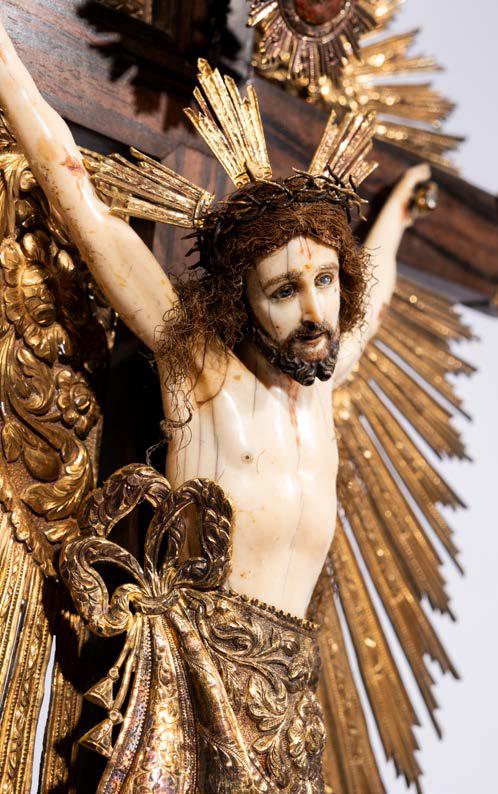
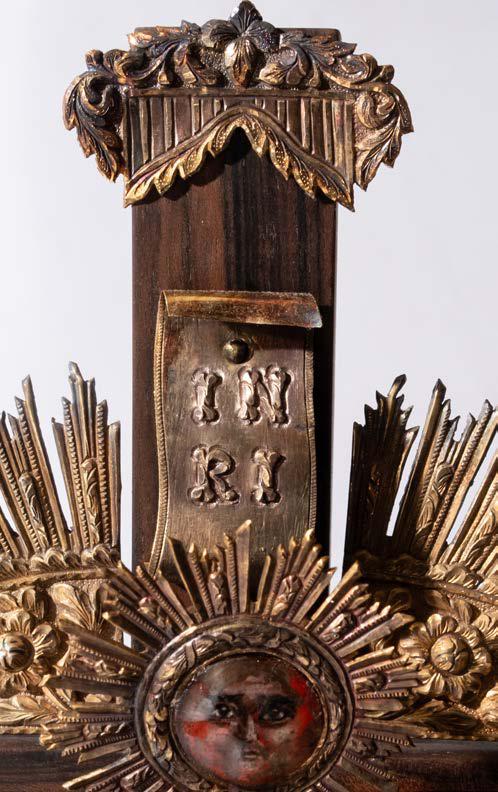
Details of the majestic gold embellishments
This Calvario (Calvary) tableau depicts the passing of Jesus Christ on the Cross, accompanied by his mother the Blessed Virgin Mary, his best friend the apostle Saint John the Evangelist, and his great friend and ardent supporter Saint Mary Magdalene. It is a popular subject in Christian-Roman Catholic art. The Cristo Expirante (Dying Christ, as opposed to Cristo Moribundo, or Dead Christ) corpus of Jesus Christ is entirely in ivory, his tapis/perizoneum/loincloth made of gold, the cross of kamagong wood (Diospyros discolor/Diospyros blancoi), the rayos cross rays of gold, the INRI sign of gold, and the polychromed silver leaf base of baticuling wood (Litsea leytensis). The three figures of Mary, John, and Mary Magdalene are dressed in velvet, silk, and satin richly embroidered with silvergilt threads. Mary’s vestments were originally a blue cape and gold tunic (traditionally a dark blue cape and white tunic, or a black cape and white tunic, or all–dark blue or all–black), John’s a gold cape and red tunic (traditionally a green cape and red tunic), and Mary Magdalene’s a red cape and gold tunic (traditionally a yellow/gold cape and red/purple tunic). Mary’s rostrillo (rays of light) as well as John’s and Mary Magdalene’s paraguas (halos) are solid gold. There are the traditional sun and skull symbols. This Calvario tableau was most likely ordered at a famous taller/workshop in Binondo or Santa Cruz, Manila. And it was certainly expensive.
In extremely pious and overly scrupulous 19th century Filipinas, however theologically erroneous, the mere possession of a religious image/icon was already a sure step towards Catholic salvation in the afterlife. The more religious images/icons acquired, the higher the tier of Catholic salvation. That is what the indios/Filipinos believed. Comical, but true. Religious images were domestic must-haves in Roman Catholic, Spanish Filipinas. Every household had to have an image of the Crucifixion and the Blessed Virgin Mary on a simple mesa altar or altar table in the one–room bahay kubo. Prayers were recited kneeling before these images three times a day: 6 am, 12 pm, and 6 pm (El Angelus).
Modest households had folk images of softwood crafted by the barrio carpenters, carvers, santeros. Richer households had small images of hardwood by the santeros, like those in the churches, as well as tabletop and processional devestir ivory santos on elegant mesas altares in the caida or entrance hall, in the cuartos or bedrooms, and in the capilla/oratorio or private chapels. There are very few documented, extant, antique Filipino Calvario ivory tableaux with 14K or even 18K solid gold accessories. One is with the Escudero-Adap family at Villa Escudero in San Pablo City, Laguna, an heirloom from their landed Marasigan y Javier ancestors, originally in the capilla/oratorio of the Escudero y Marasigan casa senorial in the poblacion of San Pablo, burned during World War II, and in the private collection of the late Conrado Adap (Ado) Escudero. A magnificent one is with the Syquia-Angco family in Vigan, Ilocos Sur, originally in the capilla/oratorio of their Mansion Syquia, dakkel a balay ancestral house before the estate partitions. Another one is with the Donato-Crisologo family in Vigan, Ilocos Sur, originally in the capilla/oratorio of their dakkel a balay ancestral house before the estate partitions. There is one with the Rosario-Villanueva family in Vigan, Ilocos Sur, originally in the capilla/oratorio of their dakkel a balay ancestral house before the estate partitions.
An interesting one from the early 19th century/early 1800s with polychromed de tallado (wholly carved) figures and extremely fine 18K sala–salamin (faux mirrorwork) goldwork was sold off from an old family on Calle San Sebastian (R. Hidalgo street), Quiapo in the mid–1990s. It could only have come from one of the Old Calle San Sebastian clans: Paterno, Zamora, Ocampo, Tuason, Legarda, Prieto, Valdes, Genato, Zaragoza, Roxas, Araneta, Velez y Infante, Preysler, Resurreccion–Hidalgo y Padilla, Bautista y Lintingco, or Nakpil, then sold to a very private collection in Jaro, Iloilo.
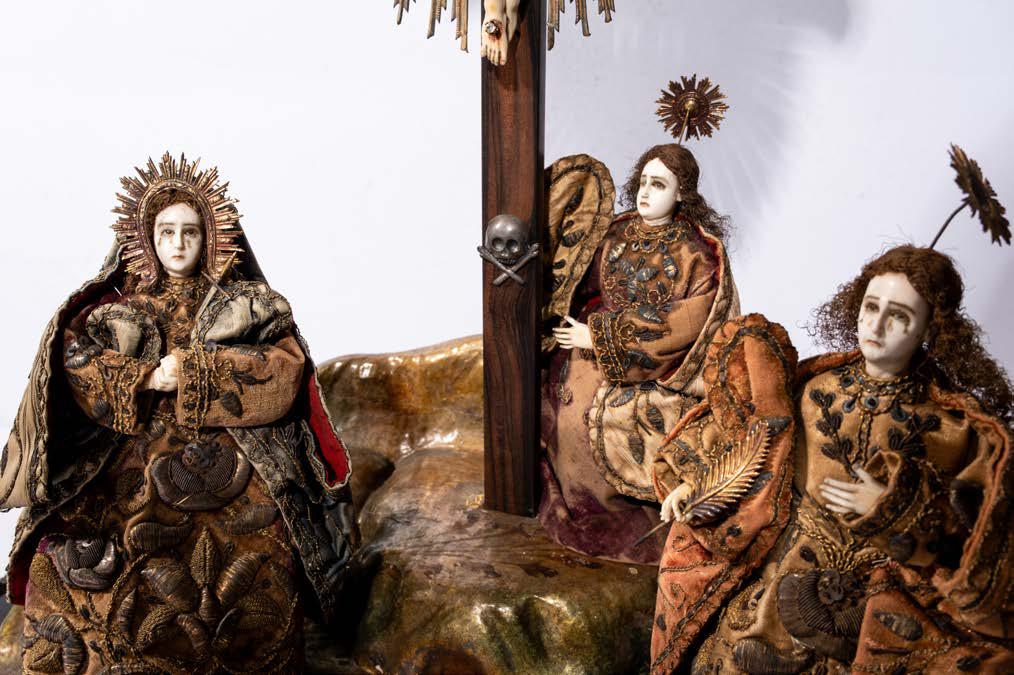
The Roxas ‘Calvario,’ last quarter of the 19th century (1875–1900), Crucifixion scene with Jesus Christ, the Blessed Virgin Mary, Saint John the Evangelist, and Saint Mary Magdalene, ivory, ‘kamagong’ wood (‘Diospyros discolor’/’Diospyros blancoi’), 14 K gold (or higher); with ‘viriña’: H: 28″ (71 cm) L: 19 1/2″ (50 cm) W: 12″ (30 cm); without ‘viriña’: H: 26 1/4″ (67 cm) L: 19 1/2″ (50 cm) W: 12″ (30 cm) corpus: H: 8 3/4″ (22 cm) L: 5″ (13 cm) W: 1 1/4″ (3 cm). Binondo, Manila, private collection of Kit Ongpin–Roxas; it was kept in Mrs Roxas’ bedroom, and acquired directly from an old Baliuag, Bulacan family.
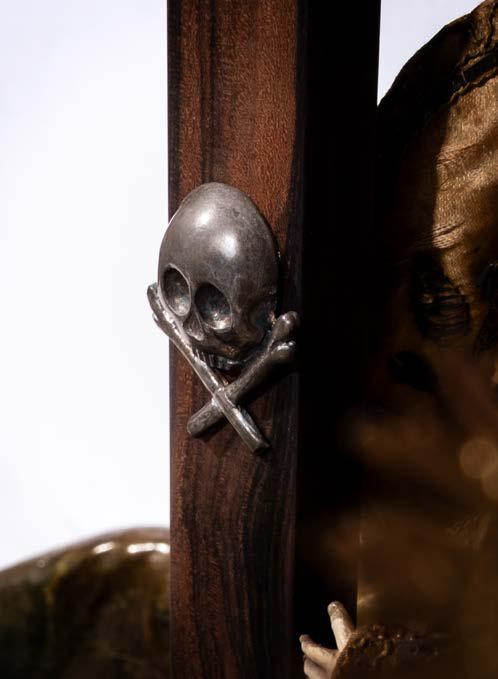
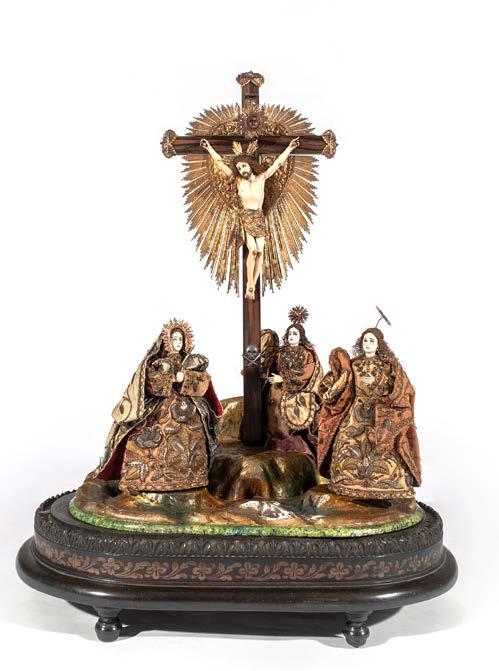
This one of Kit Ongpin–Roxas was purchased directly from an old Baliuag, Bulacan family (it could only have come from one of the Old Baliuag clans: Rustia, Ponce, Gonzalez, Vergel de Dios, Cruz, Fores) is only the sixth one known to Manila art and antique circles. The capilla/oratorio in the 1840s Rustia ancestral house was famous, apart from its ancient image of the Santo Entierro de Baliuag, for its many beautiful ivory santos in viriñas (glass cloches), several of which were placed on brackets attached to the pillars in the room, up to the estate partitions; the Rustia house also had several pieces of outstanding antique bone, lanite, and kamagong–inlaid Baliuag furniture up to the estate partitions. Doubtless there are more Calvario tableaux with solid gold accessories in private collections, but they are not known nor documented.
The Roxas ‘dulang’ colonial low table for a ‘gobernadorcillo’
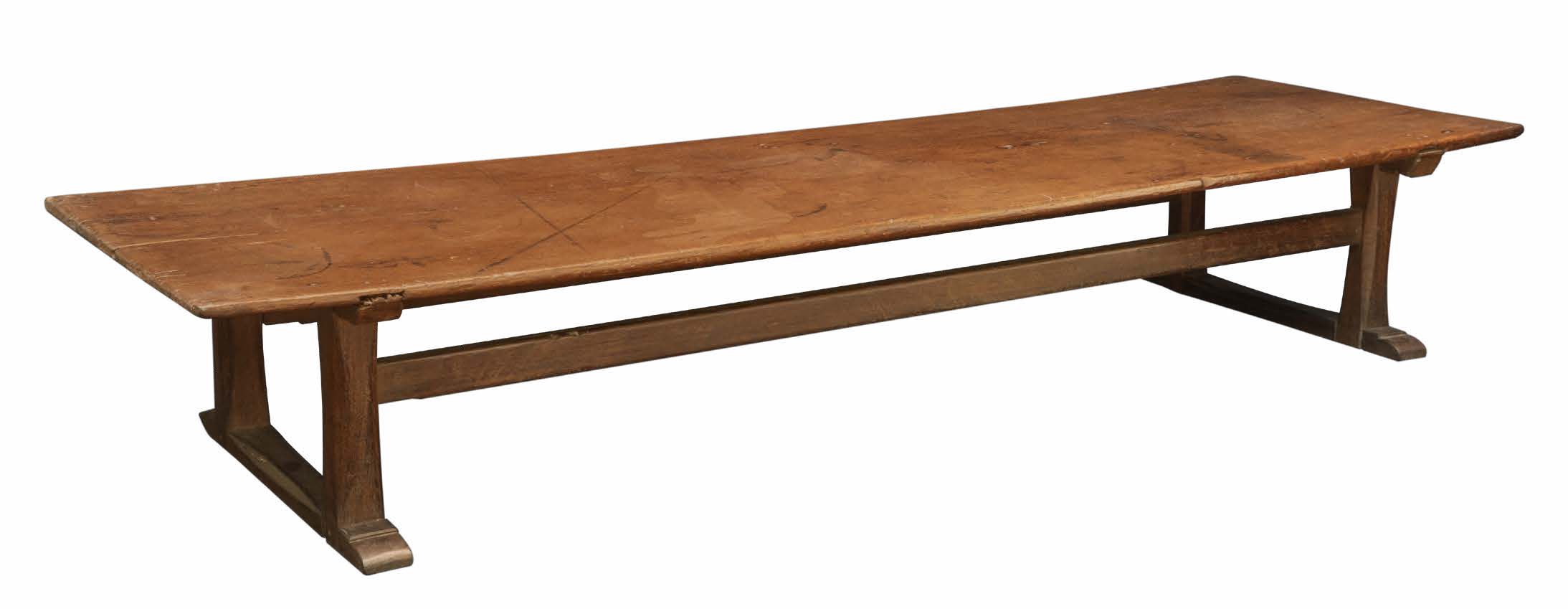
‘Dulang, precolonial style low table, 19th century or earlier, ‘balayong’ wood (‘Afzelia rhomboidea’), H: 12″ (30 cm), L: 74 1/2″ (189 cm), W: 22 1/2″ (57 cm), Batangas province, from the collection of Maria Cristina Consing Ongpin-Roxas
A dulang is a traditional low table, its form a rare survivor of the precolonial era, before 1565. It was already widely–used by the islanders along with an occasional bangko, a low stool, when the Spanish colonialists arrived. The conventional form is actually low trestle table: a long board supported on each end by a pair of posts on plinths. This outstanding dulang has an exceptionally long and beautifully burled tabletop of balayong wood (Afzelia rhomboidea).
Dulang and bangko were the basic furnishings of a bahay kubo, the local thatched hut. These gradually found their way to the cocinas of the large bahay-na-bato, where the dulang remained the same but where the small bangko morphed to a conventional long bench, still called bangko (as in the churches and convents). In the cocinas, the dulang was relegated to the use of the staff and the children, whether the owners’ or the staff’s. The staff ate on it and also used it for preparing foodstuff, like the rice–based kakanin, with lots of antibacterial, antifungal, and antiviral banana leaves lining the tabletop for hygiene. Many children during the Spanish and American eras remembered having their daily meals at the dulang, sitting cross-legged or squatting, and quarreling among themselves and their yayas.
Another piece that found itself relegated to the cocina was the sturdy papag daybed or actual bed, which had hardwood slats for a cushion. The papag was extremely practical as it allowed anybody, employers or staff or children, to lie down, stretch, and have a restorative afternoon siesta. It was Ramon “Boy” N. Villegas, a a proud Batangueño, fervent nationalist, and vehement Filipino, who first rediscovered the artistic merits of the antique dulang and the antique papag, specially those from Batangas. He presented his initial finds to his tight circle of clients, friends, and mentees (practically everyone who mattered). Boy, being who he was, a de facto Oracle of Delphi in the Manila art and antiques world, consulted constantly by top art and antiques collectors and connoisseurs, sold out his finds within the day. All of a sudden, having an antique dulang for a coffee table in the living room and an antique papag in the lanai, as well as a bangko or two thrown in for good measure, were the absolute must–haves in au courante high society circles.
The fashion left the Old Guard befuddled, as they considered dulangs, bangkos, papags, and the like to be kitchen furniture, furniture for the staff, or worse, furniture for the poor. That was the dictatorial albeit soft power of Ramon N Villegas: He could make or unmake anything and anyone. At will.
A happy memory associated with this exceptionally long dulang of balayong wood is that the Batangueño antique scout accompanied Kit Roxas to the family who owned this rare and important antique furniture in a remote town in Batangas. It was the day of the town fiesta, and the all–important lechon or roast pig was laid out on this very dulang. Kit was promptly invited to the feasting and merrymaking and enjoyed herself. Afterwards, when all the food and the lechon had been consumed by the family and their guests, Kit paid well for the important antique dulang, her assistants Johnny T & Co packed it well, and they all headed back home to Makati city. Mission accomplished!
Exquisite 12th to 13th century wares
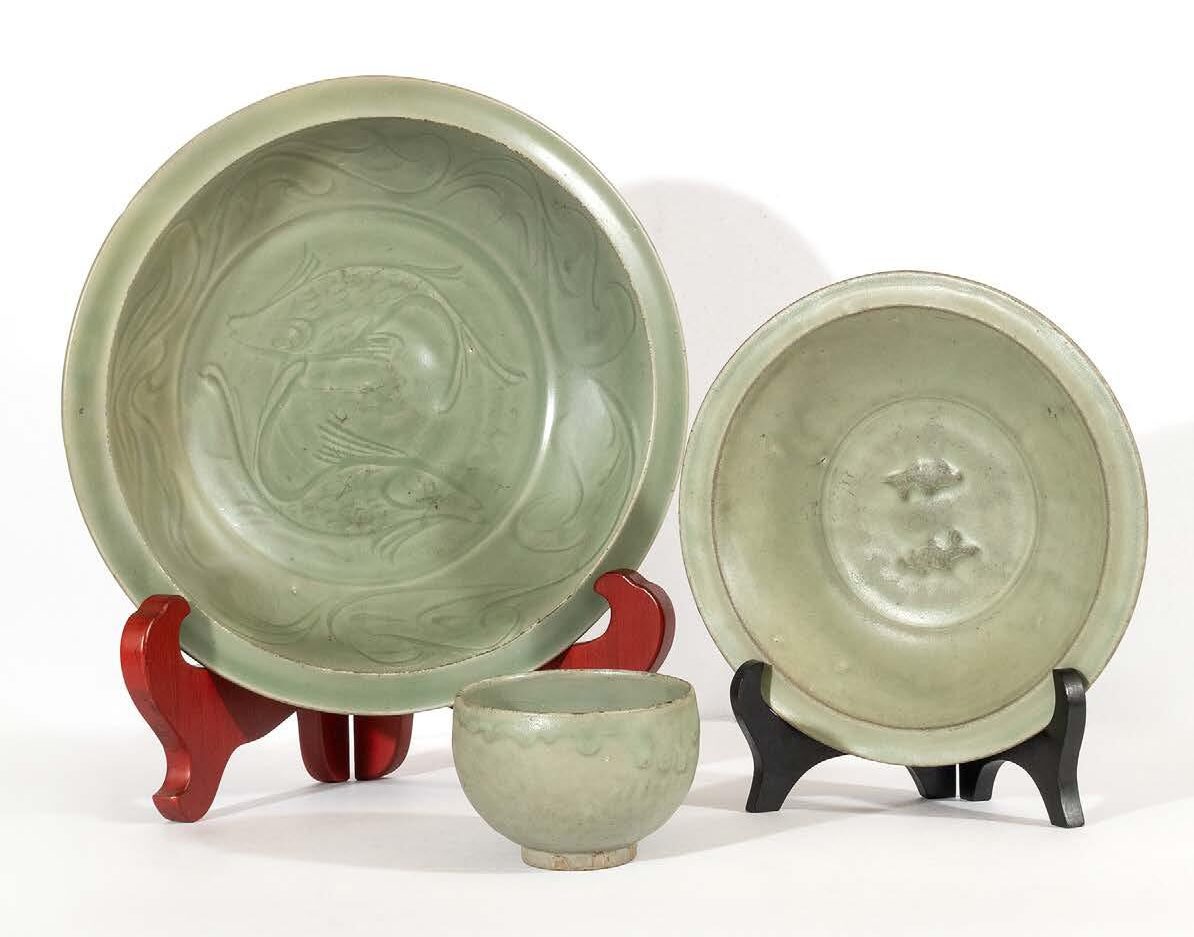
Three pieces of Longquan celadon ware, Southern Song dynasty, 1127–1279: a) large celadon plate, diameter: 14″ (36 cm); b) small celadon plate, diameter: 10 1/4″ (26 cm); c) celadon bowl, diameter: 5″ (13 cm); Longquan kilns, southwestern Zhejiang Province, China; stoneware with celadon glaze
A harmonious trio of Longquan celadon ware pieces are from the personal collection of Kit Roxas. The grouping consists of a large dish decorated with two fish in pursuit, a smaller dish with paired fish, and a small bowl.
The pieces are covered in the characteristic Longquan celadon glaze: a dense, unctuous, jade-like surface ranging from soft green to bluish green. The glaze is the result of a carefully controlled reduction firing and a local ceramic tradition that drew on porcelain stone, clay, quartz, and plant ash. Their resonant ring when lightly tapped is consistent with the high-fired, densely vitrified bodies associated with Longquan production. Fish are enduring symbols of abundance, marital felicity, and domestic harmony in Chinese decorative arts. On the large dish, the circling fish evoke concord and continuity within the family; the paired fish on the smaller dish are especially auspicious, traditionally signifying conjugal union, prosperity, and good fortune.
The Longquan kilns reached particular artistic and commercial prominence during the Southern Song period, when their celadons circulated widely within China and across the maritime trade networks linking East and Southeast Asia. Longquan wares were among the most admired Chinese ceramics to reach the Philippine archipelago during the centuries of regional maritime exchange, prized for their refined forms and luminous sheen. This trio offers an excellent introduction for the collector wishing to pursue Oriental ceramics, bringing together the refined glaze, auspicious symbolism, historical importance, and enduring appeal that make Longquan celadons a cornerstone of Chinese ceramic collecting found in the Philippines.


