
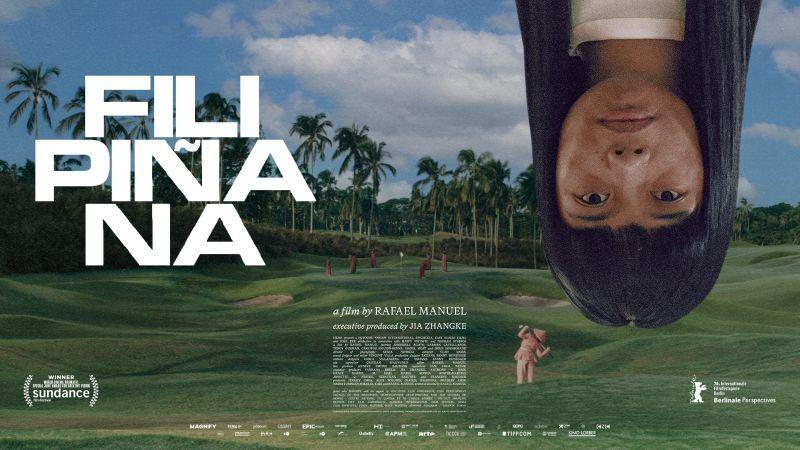
In almost a century of Academy Awards ceremonies, a Filipino film has yet to be nominated for an Oscar. Not that Philippine cinema’s own rich history and persevering industry need validation from an American awards show, but it’s still exciting to have the annual opportunity to submit one movie for consideration to the Oscars’ Best International Feature category.
For the 99th Academy Awards set next March, the Film Academy of the Philippines has selected Rafael Manuel’s Filipiñana—which recently had a limited theatrical run at SM Cinemas—from a shortlist of eight potential representatives.
This absurdist story of a “tee-girl” who works in the golf course of a garish Filipino country club has already proven to have international appeal, playing at Sundance and the Berlin International Film Festival, to strong reviews. It isn’t difficult to see why it’s attracted a global arthouse crowd: the film is an undeniable visual feast, its lush images haunted by an undercurrent of violence.
However, when viewed in the very country where this violence occurs, its greater ideas eventually become clouded by its own artistic vision.
Filipiñana speaks through imagery of excessive wealth and wastefulness, captured by cinematographer Xenia Patricia. The rolling hills of the golf course stretch all the way to the horizon; trees, lakes, and mountains in the background making the country club feel like the surface of an alien planet. This comes into stark contrast with the club’s hollow interiors and the even emptier expressions of both staff and guests. Whoever finds themselves here either stays obediently rooted in place or moves in coordinated fashion like an automaton. There is no true individuality, as emphasized by the matching, color-coded uniforms of the tee-girls and the caddies—making them easily recognizable (and easier to surveil) even in an extreme wide shot.
It is, in a word, Imeldific. What gradually comes through in the movie’s deliberately languid pacing is not the beauty of its location but the pointlessness of its existence. Manuel and Patricia’s framing renders the setting’s structures oppressive, be it in how the tee-girls are suggestively positioned between the legs of the male golfers, or in how the film’s final, eight-minute shot doubles down on the world’s indifference.
The club’s monotonous ambient noise is only occasionally interrupted by the festive instruments of a rondalla and the startling metallic thuds of golf balls in the driving range. It’s a place that seems to be afflicted with nostalgia for days of peace and quiet, but only the kind that the wealthy can afford to enjoy.
Manuel (who also serves as screenwriter) succeeds in expanding upon the themes in the original 24-minute short film version of Filipiñana released in 2020. This feature-length movie is now a clearer, albeit broad-strokes, critique of how the Philippine ruling class still serves its colonial masters, turning the country into a Marcos-era caricature of a “developed” nation.
At the same time, the film also gets to a point where it just stops saying anything specific. With a feature-length runtime to fill, the movie isn’t able to develop its commentary beyond depictions of hypocrisy and injustice. The more that it keeps deferring to its images, the more it seems like greater importance is being placed on simply sustaining its aesthetic.
This eventually comes to affect its characters as well. The cast is clearly making careful, subtle choices—especially Carlitos Siguion-Reyna’s jovial callousness, and lead actress Jorrybell Agoto’s blank expressions just barely revealing her unease.
But it feels like a frustrating missed opportunity that these actors are limited to complying with the established aesthetic at the cost of any stronger purpose. A subplot involving Filipino-American visitor Clara (played by Carmen Castellenos) becomes little more than a second pair of eyes through which to view the club’s excesses. And Agoto’s Isabel becomes so opaque but not in a way that seems particularly tragic. The decision she makes at the culmination of her journey doesn’t feel guided by a specific logic or philosophy.
Manuel’s vision for this world and this story is still well worth admiring; as director, he’s obviously capable of curating an evocative experience of slow cinema, with a whole range of tones allowed to inhabit individual shots. It’s an added plus that the highly tactile nature of the film’s production design becomes its own little rebellion against the increased proliferation of AI-generated slop in filmmaking.
But as a narrative, it does leave a lot to be desired. One can acknowledge Manuel’s craftsmanship, while still feeling that the movie’s perception of the Philippines, its societal ills, and the ordinary working people who are just trying to make ends meet, doesn’t meaningfully reflect the reality we experience here today.
A common point of criticism against Filipiñana is Manuel’s decision to edit it in such a slow pace. But like in many other films of this style, slowness isn’t the issue—if anything, here, it helps emphasize the hollowness of the external and internal worlds presented. Where the movie stumbles is in how its editing and storytelling don’t necessarily deepen or complicate our understanding of this dystopia. The sensory experience that is offered is undeniably impressive, but as the images and situations repeat themselves, the more cynical the film begins to feel. But maybe even dystopian fiction needs to resist surrendering to outright defeatism.


