
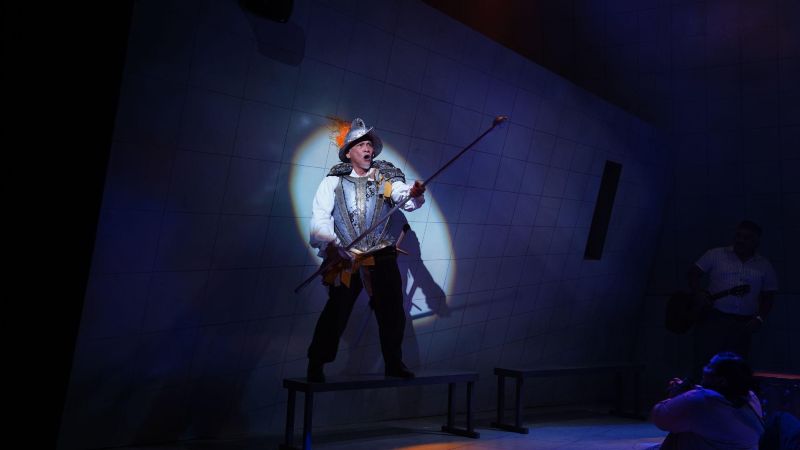
‘Man of La Mancha’ runs until June 28, 2026 at Eastwood Repertory Theater in Eastwood, Quezon City.
The story of Don Quixote, the Man of La Mancha is one that has gone through three life stages.
From the 17th century novel by Miguel de Cervantes Saavedra, it morphed into a straight play, and from there, a musical. Both the play and the musical were written by Dale Wasserman.
It was on June 28, 1965 when The Man of La Mancha, the musical, was first mounted at Goodspeed Opera House in Connecticut, and later, in November of the same year, moved to Broadway. With each iteration, the public acceptance was a critical success, even in de Cervantes’ lifetime.
It was a landmark shift in format from the usual straight play to an innovative play-within-a-play, something unheard of, unique, and amusing, earning the title of the first modern play ever to be staged. Aside from its format, the theme—at once a comedic genre, but upon further digging, was found to have layers of philosophical viewpoints—explored the contrasts between idealism and harsh reality, a situation that can easily be adaptable to current times.
Given these adaptations, this year’s mounting of the play by Repertory Philippine for the third time receives yet more layering in the hands of its brilliant director, Nelsito Gomez.
This time, the reconfiguration is represented in the visual set-up by Julio Garcia, and the audial interpretation of musical director Farley Asuncion. Garcia’s stark, Art Deco-ish angular shapes, scalene and obtuse, big, airborne triangles, occasionally being moved up or down, mimic walls. A singular rectangle, hanging mid-air at the center, makes up for a ceiling. This setting, while stark and minimalist, nonetheless give an air of exclusivity to the cast, with a modern vibe.
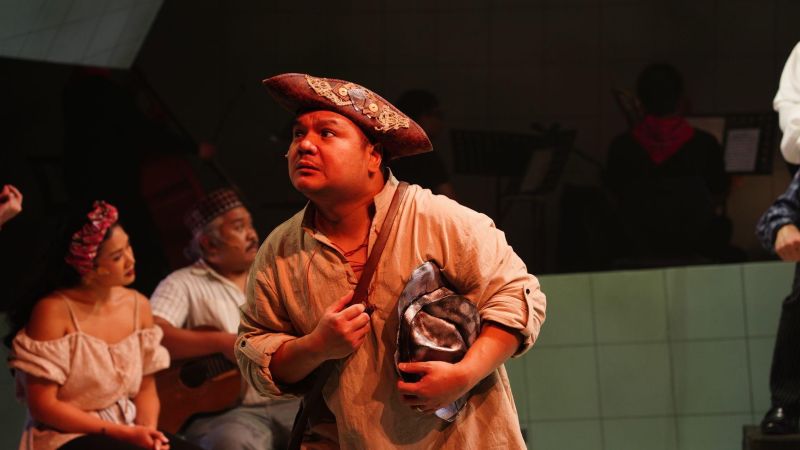
Gawad Buhay winner Marvin Ong plays Don Quixote’s faithful squire, Sancho Panza.
The curtain rises to a chain link floor-to-ceiling fence, caging in some characters to be tried by the Spanish Inquisition. Among them is the author Miguel de Cervantes, with his manservant Sancho Panza, jailed for financial mismanagement and theft of public funds while Cervantes worked as tax collector. It was during this period of his life that he started writing his novel, Don Quixote.
After some coaxing, the inmates decide, in defense of Cervantes, to take on the roles of the musical’s characters, with Cervantes playing an eccentric nobleman, naming himself Don Quixote, who envisions himself to be a knight. With Sancho, he sets out to right wrong, literally as a knight in shining armor.
The cast is superbly chosen, each with voices resonating roundly, executing a robust delivery of lines and mannerisms specific of the era.
With a trail of theater successes, and after a lengthy absence from the theater, Nonie Buencamino as Quixote is convincing as a dignified yet deranged nobleman. Perhaps quivering in his notes at times to personify an aging man, Buencamino nonetheless hits the “high Cs” with nary a flat nor sharp. Right at the start is Buencamino’s show-stopping I, Don Quixote, where he sings as the disillusioned knight, his delusions making him perceive a rundown inn as some royal castle where the town prostitute and barmaid, Aldonza, whom he has renamed Dulcinea, works. He treats her like a royal lady, professing his adoration for her as she insists on who she really is.
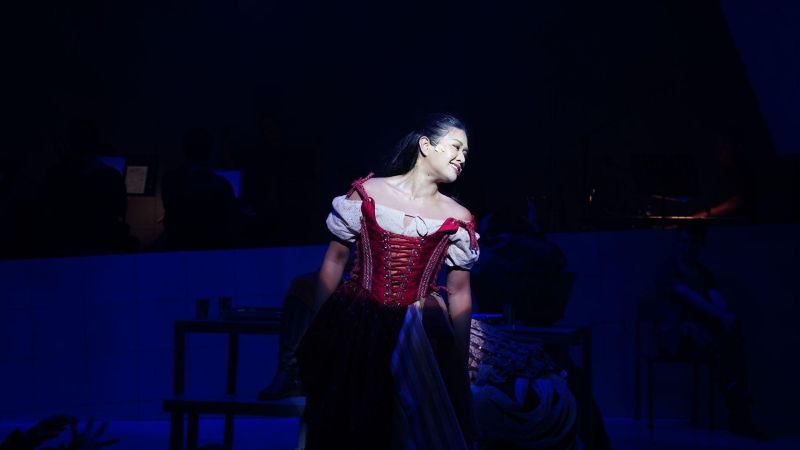
Classical singer and actress Katrine Sunga takes on the role of Don Quixote’s muse, Aldonza.
Katrine Sunga’s acting prowess as Aldonza/Dulcinea is matched by seamless vocal delivery. Particularly touching is What Does He Want of Me?, a poignant sung soliloquy, as she is puzzled by Quixote’s respectful and tender treatment of her, a bar girl and a whore to boot. This contrasts with her irate and indignant words as she rejects Quixote’s advances: “Look at me! Look at the kitchen slut! I am no lady!” countered by Don Quixote’s sweet and loving romantic tribute to her, Dulcinea.
Right there and then, it is clear that the cast is out to mesmerize, successfully merging character, stellar vocals, and dramatic aptitude. Not one of the cast members displays a tentative vocal range or iffy dramatic characterization.
The music score, rearranged by Farley Asuncion, was updated, adding percussive beats and distinct bass undertones, sometimes to the count of a flamenco compás, almost purposely distinguished from the usual Broadway music vibe of thematic reprises or leitmotifs.
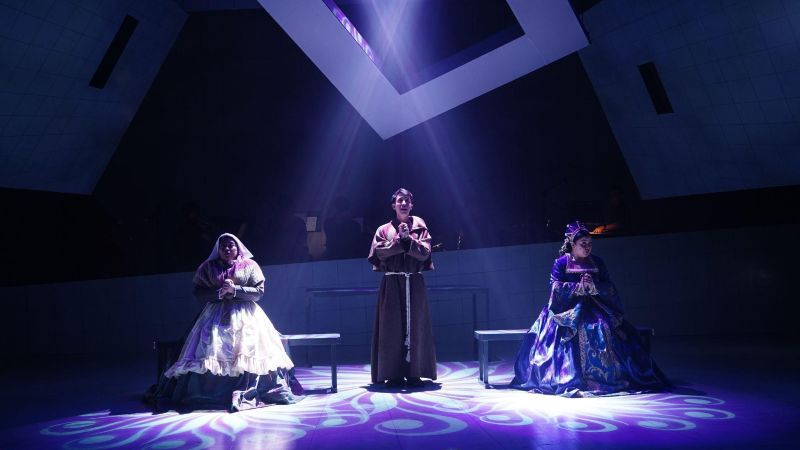
Sarah Facuri as Housekeeper, Steven Hotchkiss as Padre, and Mikkie Bradshaw-Volante as Quijano’s niece Antonia share their worry for the old gentleman’s mental state in ‘I’m Only Thinking of Him.’
What was attractive was Asuncion’s inclusion, nearing the end, of a Filipino lullaby, Lucio San Pedro’s Sa Ugoy ng Duyan, strummed by a singular guitar, its choice and musical arrangement posed as a denouement of sorts, as Don Quixote reverts to his real self. The lyrics could very well have carried the message of nostalgic homecoming, as Don Quixote regains his sanity and his identity as Alonso Quijano, peacefully welcoming his death after apologizing for the chaos he caused.
As the cast reunites by his deathbed, including Aldonza and his squire Sancho, one notices some characters in costumes of Quixote’s reverie, and some in current clothes of the time, including Don Quixote himself, leaving the audience in sniffles.
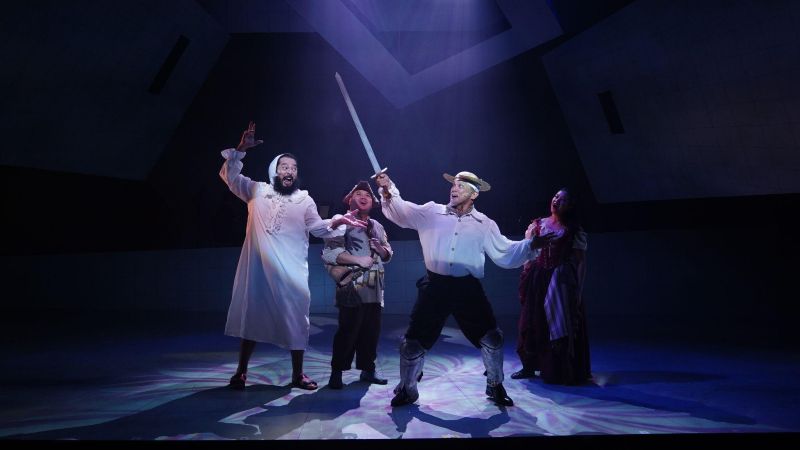
Tarek El Tayech (leftmost) portrays Governor and Innkeeper.
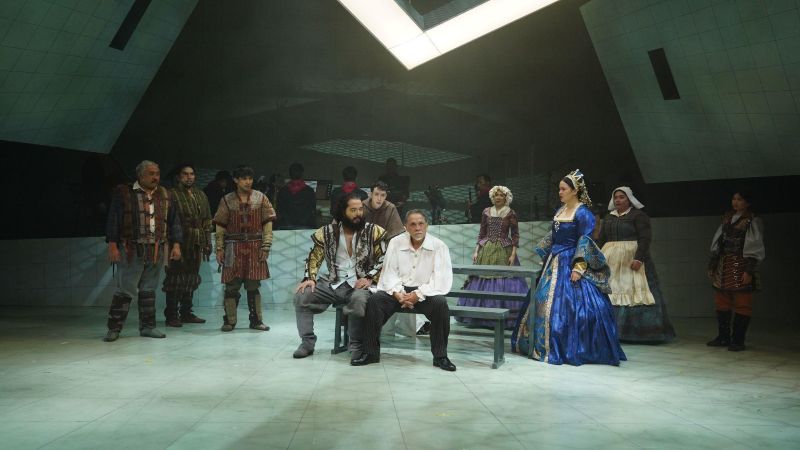
Reimagined restaging of the musical begins in detention camp.
If previous versions of this musical were crowned with success, this current iteration deserves one just as well, received by the audience with extended standing ovation and a plan to watch the masterpiece once more.
‘Man of La Mancha’ runs until June 28 at Eastwood Repertory Theater in Eastwood, Quezon City.


