
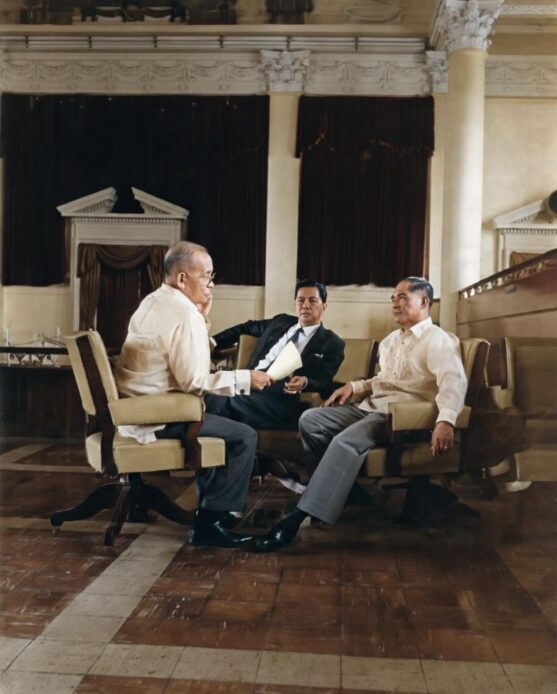
You may no longer know their names, except perhaps as streets, but this image of senators Cipriano Primicias, Gil Puyat, and Arturo Tolentino, speaks of our collective image of the Senate of yesteryears: a place inhabited by thoughtful statesmen. The reality, of course, may have been just that from time to time—senators, until very recently, took immense pains and took great pride in doing their homework and sounding intelligent—but politics has always had its fair share of ruthlessness and scandal.
Human nature remains consistent: There are people motivated by idealism just as there are people motivated by greed; there are responsible and irresponsible leaders and followers. What should be a cause for reflection is, were there times when both institutions and the people tasked with making them work, seemed to function, and were there times of dysfunction: when institutions proved impotent or broken, and people seemed motivated mostly by self-interest with little or no consideration for the public or the future? Because identifying such times is a guide to determining if an era, a way of life, a system, has reached the end of the road—bound to be replaced by something else.
The past can provide a useful shock of recognition to discover these times. Take the recent weeks.
A kind of collective nerdgasm took place on the part of historians, political scientists, and lawyers (and maybe even a sociolgist or two) when the current Senate circus provoked the dusting off of old political tales and Supreme Court cases because they proved directly relevant to what’s been happening.
You know what happened. Vicente Sotto III was toppled from the Senate presidency and replaced by Alan Peter Cayetano, whose majority began to shrink after Bato dela Rosa went back into hiding and Jinggoy Estrada ended up behind bars awaiting trial. Right before this happened, Cayetano had tried to push through a change in Senate rules to allow senators to vote remotely, and the minority walked out rather than dignify the proceedings—denying Cayetano a quorum necessary to do business. Cayetano retaliated by denying the minority a chance to hold sessions for two days, until the minority, up to that point 11, became 12 with the sudden switching sides of Chiz Escudero, at which point, a Supreme Court decision from 1949 was invoked: Avelino v. Cuenco.
What happened was this. In what was clearly an intramural fight within the Liberal Party, Avelino was accused in open session of illegally profiting from the sale of war surplus goods. As one press account put it, “Insults and jeers began to fly like shrapnel, with the crowded gallery joining in, and before order was restored the presiding officer had broken two gavels. But Avelino won a 10-to-7 vote of confidence.”
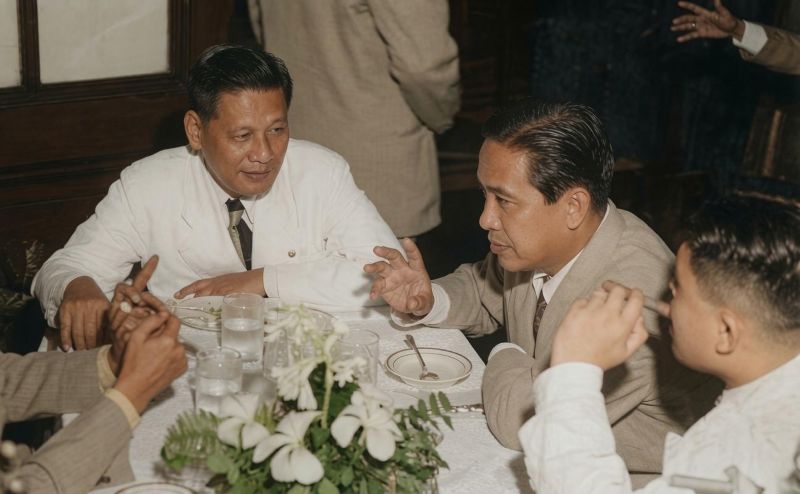
National Library photo of Jose Avelino and Lorenzo Tañada
Then, Sen. Lorenzo Tañada announced he would deliver a privilege speech denouncing Senate President Jose Avelino for corruption (half a million pesos in illegal contributions, according to one report). On February 21, 1949, “the most turbulent (Senate session) in Philippine history” took place.
The same press account said, “Two fist fights broke out on the floor. The galleries roared. And someone fired a pistol in the corridor, Finally, Avelino announced adjournment and stalked out of the chamber, followed by nine Senators. But 12 members stuck to their seats, claimed the session was still in order, declared the Senate presidency vacated and forthwith elected Mariano Cuenco to the office. President Quirino, notified of the action, promptly recognized Cuenco.” Avelino ran to the Supreme Court, saying the session was illegal because it lacked a quorum (based on needing 13 representing a majority of 24 members).
Avelino v. Cuenco was promulgated on March 4, 1949. It dates from an era when the Supreme Court was more respectful of the separation of powers and conscious of the fact that there are some more properly political questions best left to other institutions and not the courts. As reported by Jairo Bollero, what the Supreme Court actual did was to step back from resolving the issue, saying it wasn’t for the Supreme Court to determine the Senate’s leadership. Upon a motion for reconsideration, the justices relented and issued a ruling: It said 12 senators constituted a quorum because while normally it should be 13, the absence of two senators who couldn’t have been compelled to attend sessions (one was in hospital, the other abroad) meant a quorum should be a majority of available senators. It has become, by being cited so often, a defining legal principle. One lawyer summarized the cases its been cited in: “SC decisions that acknowledged Avelino doctrine on quorum: Tañada v. Cuenco, 103 Phil. 1051 (1957), Gonzales v. COMELEC, 129 Phil. 7 (1967), Defensor Santiago v. Guingona, 359 Phil. 276 (1998), Zamora v. Caballero, 464 Phil. 474 (2004), and Tinio v. Duterte, 934 Phil. 212 (2023).” For most non-lawyers, it was most recently cited as the basis for the Senate deciding, in 2015, to base the number required for a quorum on available senators—excluding Enrile, Revilla, and Estrada, who were behind bars facing trial for plunder. Some in the Senate today were also members of that Senate.
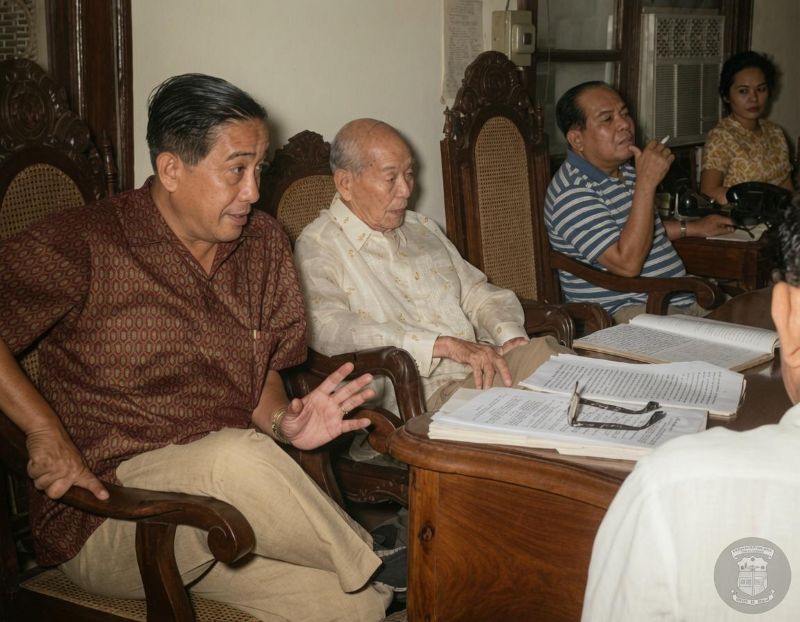
National Library photo of Lorenzo Tañada and Mariano Jesus Cuenco in the early 1960s, long after 1949, when Tañada himself filed a case against Cuenco that was resolved on the basis of Avelino v. Cuenco
Quite a few people remarked, in surprise, that it seems senators today aren’t too different from the senators of yesterday, though there were descendants of former senators who took exception to this. What I think is being overlooked is that extreme cases of legislators behaving extremely badly is usually a manifestation of something else being deeply wrong with the system. Because it’s only in times of great stress that our institutions crack.
What, then, was going on, to provoke the walkout of Jose Avelino, and by his so doing, marking the end of his political career, which ended up as a sad footnote in a song by his granddaughter?
It began not in 1949, but 1946. It involved three crises. The first was the Parity Amendment, an amendment to the 1935 Constitution to give American equal economic rights as a condition for American war damage and other funds. The second was war surplus scandals, as a destitute country squabbled and schemed over mountains of valuable US military surplus left with the Philippine government. The third was Elpidio Quirino’s presidential ambition provoking senatorial insubordination on the part of Jose Avelino.
Suffice it to say that before World War II, the Philippines was unique in our region for being poised to achieve independence with remarkably little disruption or even risk, but the situation was reversed after World War II, which devastated the country: Its infrastructure was wrecked, its economy comatose, its society divided. America was supreme in the world, but since all politics is local, Americans were sick of paying for war, sick of being generous with friends, and was demanding hard choices from its allies who suffered the most: Britain and the Philippines faced incredibly harsh demands from the United States as the price for continuing to support its allies’ economies.
In our case, it was a demand for our constitution to be amended to give Americans the same economic rights as Filipinos, otherwise the USA wouldn’t pay to repair war damage or help rehabilitate our economy. But the new Roxas administration lacked the votes in Congress to pass the amendment, so congressmen and senators who were hardcore opponents of the Parity Amendment were removed from office on the basis of “electoral fraud.” Having passed the amendment, success was achieved in the plebiscite.
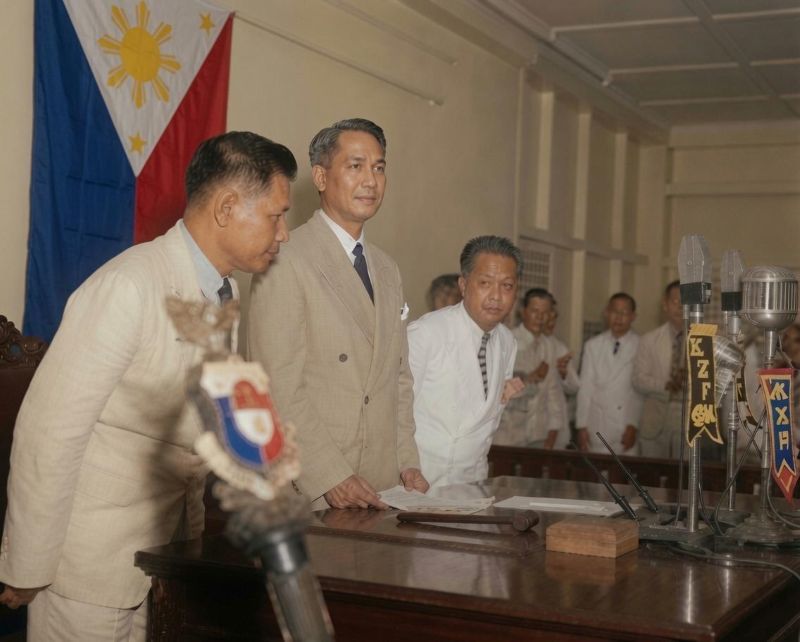
National Library (1946) photo of Senate President Jose Avelino, President Manuel Roxas, Speaker Eugenio Perez
Roxas’ going-for-broke had three incalculable effects. First, it transformed the House of Representatives into a purely conservative institution, since any radical representation was closed off. It thus turned the Senate, formerly meant to be the conservative institution, into the place where more modernizing ideas could take hold.
Second, it made what had been the temporary division of the pre-war Nacionalista Party into a permanent two-party system, turning the Philippines into an outlier among former colonies, all of which had achieved independence under monolithic parties that preserved their dominance well into the second generation of independence.
Third, it marked the end of the positive identification of Filipinos with their democracy as being a process of constant improvement, and the start of the adoption of an inward-looking, self-loathing victim’s mentality grandly calling itself “nationalism.”
For our purposes, it means the late 1940s was an era of Communist rebellion in Central Luzon and continued political division, a poisonous political atmosphere on its own. But then, one has to add to this, the other continuing obsession of the public in this era: the repeated examples of corruption involving war surplus.
The justification for invading the Philippines in 1944 wasn’t just to liberate; it was to turn the Philippines into the staging area—which would be enormous—for the massive, planned invasion of Japan that was due to begin in 1946. By the time the atomic bombing of Hiroshima and Nagasaki ended the war, a mind-boggling amount of US military equipment had been stockpiled in the Philippines. With the war over, it made little economic sense for the Americans to pack it all up and ship it out; instead, its assessed value was computed and the goods turned over to the Philippine government as a form of war relief and reconstruction aid.
And so the war surplus scandals began as officials took care of their friends, and everyone was out for a quick buck
What the Filipino governing and middle classes —the classes of the leaders and the bureaucrats who had endured the Japanese Occupation and stayed in their jobs, not knowing or being capable of doing anything else, but thereby earning, in many cases, the hatred of the people—had in common was that the destruction of Manila and the country’s other urban centers left them penniless and homeless. It was inevitable, therefore, that they would look after themselves by trying to find ways to profit from all the material left behind by the Americans. And so the war surplus scandals began as officials took care of their friends, and everyone was out for a quick buck. The effect of all this on public respect for formerly highly respected and respectable people—officials, professionals—was catastrophic.
The Liberals won the presidency in 1946 denouncing what they said was Nacionalista war surplus corruption in 1945; by 1949, however, continuing scandals meant the Nacionalistas were regularly denouncing the Liberals for doing worse.
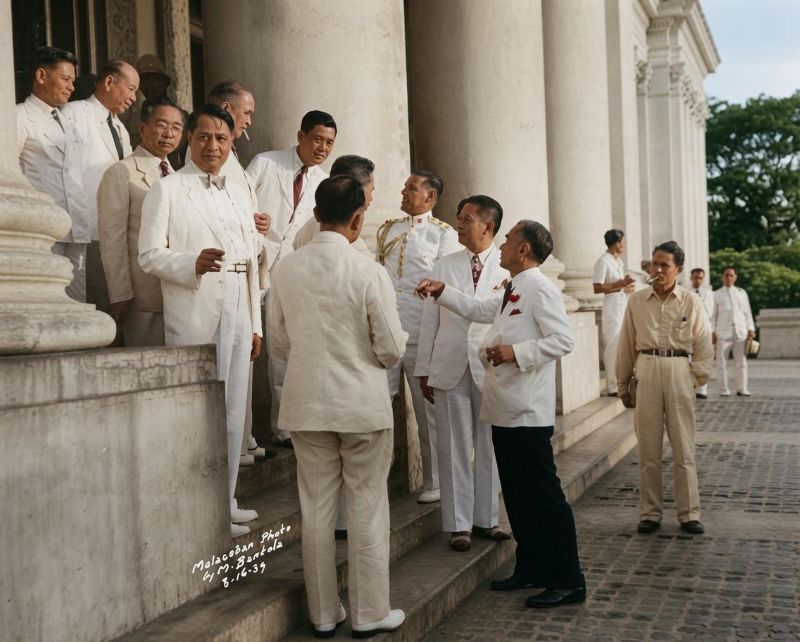
Aug. 16, 1939—President Quezon with his Cabinet on the front steps of the Legislative Building. In the back are Jose Avelino (Secretary of Labor) and Mariano Jesus Cuenco (Secretary of Public Works); in front of them, Jorge Bocobo (with glasses, Secretary of Public Instruction), Manuel Roxas (in bowtie, Secretary of Finance), Rafael Alunan (with cigaret, Presidential Legislative Liaison), unidentified, Jose Abad Santos (Secretary of Justice), aide-de-camp Manuel Nieto, Benigno S. Aquino Sr. (Secretary of Agriculture and Natural Resources), and Quezon. With his back to the camera is Executive Secretary Jorge Vargas.
Now comes Jose Avelino as the central character in our story. He was a remarkable politician who had everything going for him except for one fatal flaw: He never knew when to stop.
Before World War II, he had been not only a senator, but Senate President Pro Tempore—the last, before the Senate was abolished in 1935. He held two portfolios in the Quezon administration: Secretary of Labor from 1937 to 1939, when he unified all unions (a remarkable feat), and then Secretary of Public Works from 1939 to 1940.
Here was where his fatal flaw first showed itself. He got into a fight with the President over who had authority to approve expenses in his department. One of his subordinates, following new budget rules, submitted a request for authorization to the President, who approved it; Avelino publicly complained and criticized his subordinate, who then asked for a ruling from the Auditor-General (today’s Commission on Audit), which decided in favor of the subordinate. When this, in turn, was brought to the attention of the President, he supported the Auditor-General, and Avelino resigned in a huff and lost his opportunity to be an official candidate for the Senate.
He clawed his way back to power after World War II, helping to build the Liberal Party, winning election in 1946, became Senate President under Roxas, and was very popular with his party because he ensured every candidate got funding for their campaigns. But by 1949, Avelino’s ambition and popularity with his partymates put him on a collision course with President Elpidio Quirino (who’d succeeded to the presidency in 1948 when Roxas suddenly died in office).
Avelino and Quirino weren’t close like Avelino and Roxas had been; what’s more, by 1949, Quirino was up for reelection as President, but far from popular enough to make his partymates comfortable. Even worse, he was making his partymates uncomfortable by trying to placate public opinion with investigations into allegations of official wrongdoing. (After Quirino’s fall from power, Manuel Manahan, tasked by President Ramon Magsaysay with investigating his precedessor’s administration, came to the conclusion that Quirino himself hadn’t engaged in corruption, but that he’d antagonized his fellow Liberals by approving too many investigations or worse, actually trying to stop some of the more spectacular instances of corruption within his administration’s ranks).
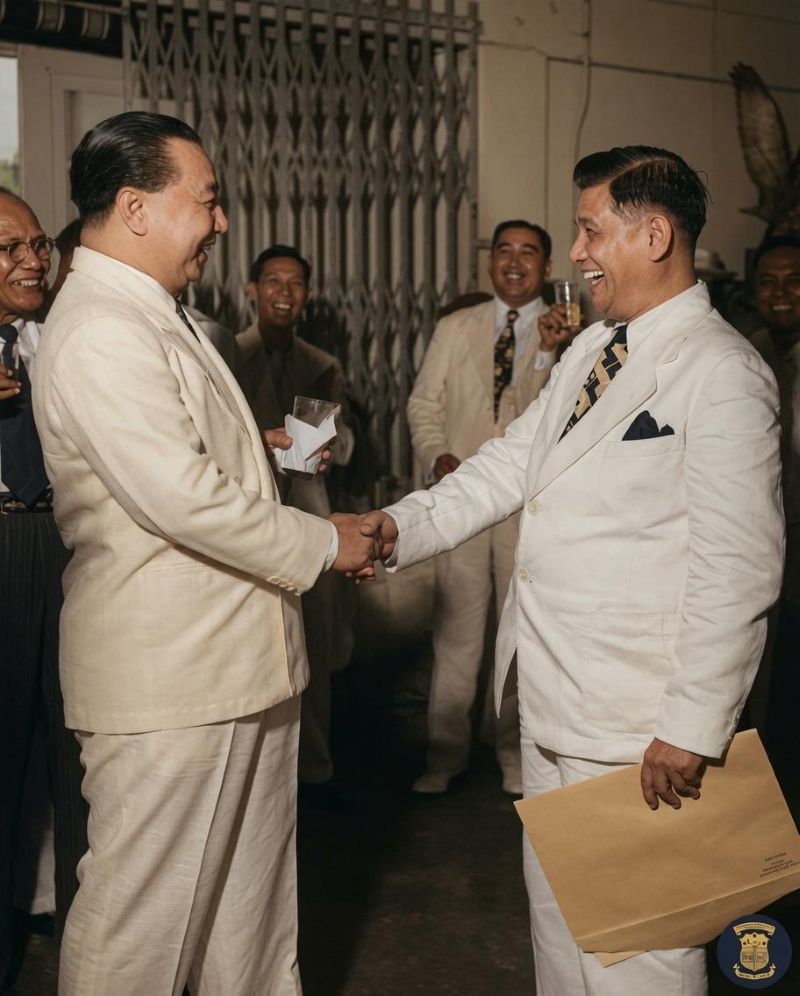
National Library photo of Quirino and Avelino being political
By all accounts Avelino began to think that if the Liberals were to stay in power, they would need a better presidential candidate, and no one was a more perfect presidential candidate than himself. Quirino was an even older pro than Avelino and wasn’t about to take this sitting down, and so began the sniping that began to irritate Avelino.
A reporter named Celso Cabrera said he crawled underneath it and overheard Avelino raging at Quirino….
This is the background to one of the most famous confrontations in our political history, which gave birth to one of the most lasting quotes. In a (secret) meeting in the Nipa Hut in the garden of Malacañan Palace, a reporter named Celso Cabrera said he crawled underneath it and overheard Avelino raging at Quirino, because Quirino had maneuvered to confront Avelino with a signed party resolution asking Avelino to run as Quirino’s vice-presidential candidate (apparently offensive, considering Avelino’s ambitions; he preferred a showdown in a party convention he was convinced he’d handily win).
Cabrera reported that Avelino went into a rage for two hours, complaining of investigations, with the immortal line, “What are we in power for?”
The die was cast; there would be no reconciling the two, and so a little over a month later, in February, 1949, Avelino was ousted from the senate presidency. Avelino went down fighting. In May 1949, he formally split the Liberal Party; he ran against Quirino in the November election (and lost), and by 1951 he was out of office and permanently out of power, only making a cameo in the 1970s in one of his granddaughter’s songs.
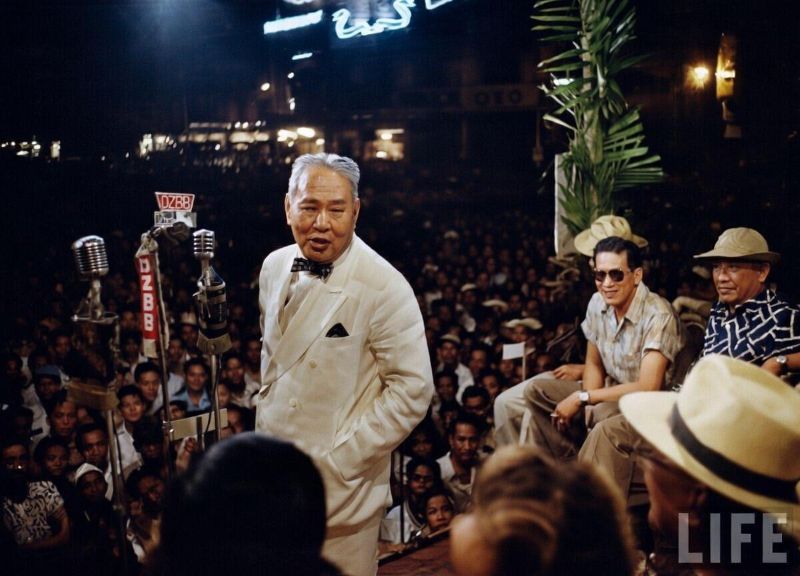
LIFE photo of two generations of politicians opposed to Marcos: Amang Rodriguez in prewar-style suit, and Arsenio Lacson in post-war Hawaiian shirt and shades
Another story that was dug up concerned the rise of Ferdinand E. Marcos to the Senate presidency, and it’s quite a dramatic story, too.
For years, two men, an old pre-war-era veteran politician, Eulogio “Amang” Rodriguez, and the face of the new populist politics, Arsenio Lacson, had used their power and popularity to block Marcos’s rise to power. In the Senate, Rodriguez had become the second-longest serving senate president and seemed unremovable. But Marcos launched a bid to topple Rodriguez, who clung on, holding on to his majority; at one point, Sen. Roseller Lim engaged in a filibuster—the use of Senate rules to speak without interruption, so long as you could stand on the floor—to hold the line while Rodriguez’s coalition waited for one of Rodriguez’s partymates, Alejandro Almendras of Davao, to return from a trip to America.
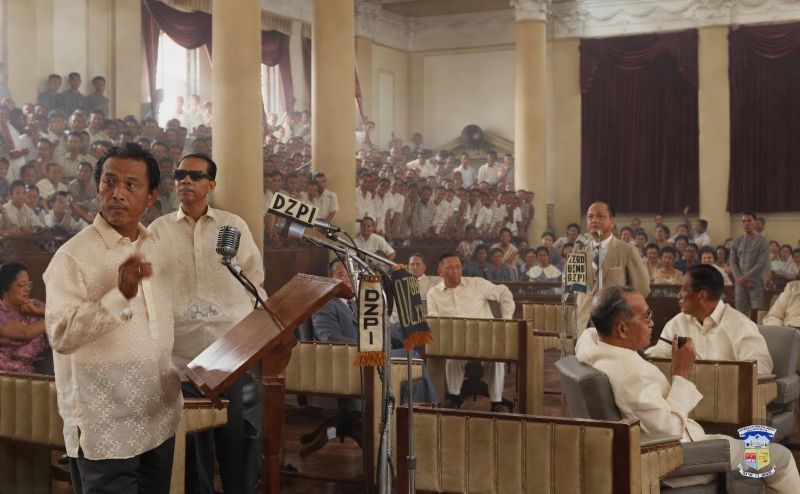
National Library photo of Roseller Lim in the Senate; in the back, Fernando Lopez (seated, center), staring into the distance
Lim’s filibuster lasted 18 hours; then, on April 5, 1963, Almendras dramatically arrived—and stabbed Amang Rodriguez in the back. He voted for the Liberal candidate, Ferdinand E. Marcos, ending Rodriguez’s presidency. Almendras would then become a close Marcos ally all the way to 1986, and kingpin of Davao. Amang Rodriguez would live until 1964, but on that day, his political power and ability to impede Marcos, ended. By April 15, 1963, Arsenio Lacson was dead (of a heart attack).
In 1964, Marcos would leave the Liberals and lead the Nacionalistas to power by 1965.
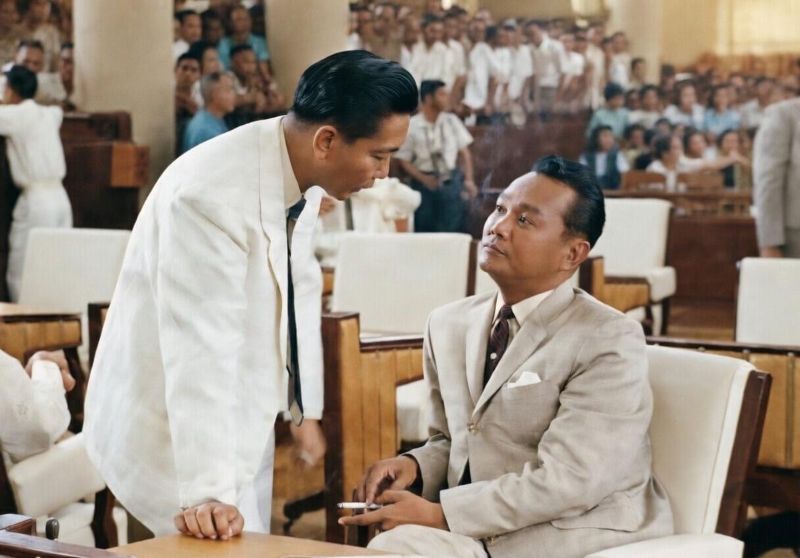
Kingmaker: National Library photo of Ferdinand Marcos and Alejandro Almendras, the one who made him Senate president
Equally dramatic was how Marcos later kept his senate presidency. Nick Joaquin famously wrote a brilliantly witty account of it in Thirteen o’Clock, which revolved around a strange legislative practice: of literally stopping the clock to prevent a scheduled deadline from arriving. You have to read a bit of Nick Joaquin’s reportage to understand how Marcos’ gambits not only got everyone’s goat, but left everyone speechless. Wrote Joaquin, in June, 1963 (when Amang and others were still trying to regain the Senate presidency):
“The pretense is that the minute before midnight just goes on and on, without ever reaching the hour, until the assembly so decrees. Otherwise, the rump of the meet would protrude outside the limits set by law and would have to be chopped off as illegal. So, everybody pretends the clock hasn’t struck 12.
“This long, stopped midnight of the politicians has stiffened into ritual. The Legislature of the Commonwealth, in its sine die sessions, used to put the clock back an hour or so, before it could strike midnight; and the regained hour usually sufficed to complete the business at hand.
‘The Congress of the Republic has a simpler rite in this day of electrically-run clocks; the clocks are unplugged…’
“The Congress of the Republic has a simpler rite in this day of electrically-run clocks; the clocks are unplugged, a few minutes before midnight, and their stopped hands keep pointing to a ghostly time between yesterday and today—the ghostly hour of 13 o’clock—until the solons’ labors are finished, which is usually at dawn. Sine die sessions have been ending later and later with the years, and the rites this sloth has produced are perversely charming: The solons’ wives attend the session, to keep vigil with their husbands, and are invited at dawn to a merry breakfast by, usually, the Speaker of the House.
“The rite of the stopped clock has a formula. A solon rises to advise the presiding officer that, according to his, the solon’s, watch, it’s already, say, five minutes past midnight, and past the time set by the Constitution to adjourn the session. The presiding officer glances at the clock in the hall, which has been stopped, and announces that, according to that clock, it’s only say, five minutes to twelve, and that the time indicated by the official clock of the chamber shall be accepted as the official time by everybody in that chamber. So, the session continues, for the official clock’s hands never move to midnight.”
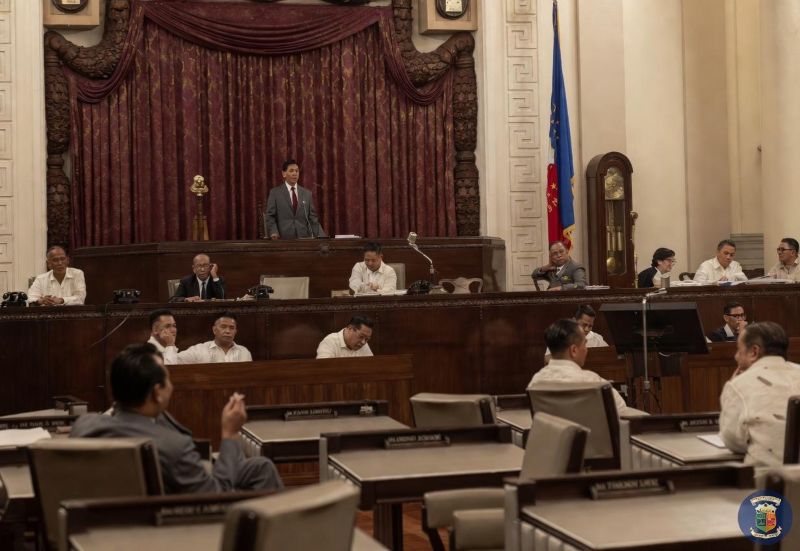
National Library photo of Marcos presiding over the Senate, with the clock on the side that Nick Joaquin wrote about in 1963
Marcos did something that would foreshadow his later political tactics
Marcos did something that would foreshadow his later political tactics: use technicalities in a manner no one thought of, because it was previously thought either impossible or dishonorable. In this instance, as his enemies circled in for the kill, the stopped clock of the Senate suddenly starting working again and, with an eye on the clock, Marcos stood up, said the time was up, banged the gavel, closed the session, and walked out—saving his Senate presidency.
Aside from Marcos’ ambition—to achieve the Senate presidency and remove a veteran politician opposed to those ambitions—what else was going on during the turbulent two-month period from the Marcos coup in April and his maneuver in June?
A war had been going on between President Diosdado Macapagal and the Sugar Bloc in Congress. Macapagal had won the presidency in 1961, but both chambers of Congress remained in the opposition’s hands: only in June, 1962, six months into his presidency, did Daniel Romualdez get removed from the Speakership and replaced by Cornelio Villarael, but the Senate remained in Nacionalista hands and, according to the invaluable chronicler of party politics in the era, Dapen Liang, Macapagal’s biggest fear was that Fernando Lopez, brother of the industrialist Eugenio Lopez, Sr. of Meralco and ABS-CBN fame, would become Senate president.
To prevent that, he’d have to take down Rodriguez first, and put in a partymate and keep him in the Senate presidency. Done and done in April and June, and, so far, your standard engulf-and-devour politics. Then, as in 1949, the Liberals began to feed on themselves.
It began with an American businessman, Harry Stonehill, and an exposé: that Stonehill, one of the richest men in the Philippines by that time, who, among other things, came up with the idea of reclaiming land in Manila Bay for profit, had many politicians on his payroll, including some of the biggest names. It was July 1963, with everyone gearing up for the midterm elections in November, 1963. That election would, of course, help determine if Diosdado Macapagal would have a chance to run for reelection in 1965.
Macapagal had fired his Secretary of Justice, Jose W. Diokno, when his investigation of Stonehill began to hit too close to home. To put an end to the whole messy affair, Macapagal ordered Stonehill deported.
Diokno quit and joined the opposition as one of its senatorial candidates. In July, he made a televised address implicating Macapagal, Marcos, and Villareal (President, Senate President, and Speaker, all from the LP) of having once been on the take from Stonehill. Macapagal retaliated by having his new Secretary of Justice, Salvador Marino, deliver a speech implicating Vice-President Emmanuel Pelaez and Senate President Marcos in the Stonehill files.
Vice-President Pelaez was furious; so was Marcos. The Executive Secretary weakly replied that their names were in the files as a dirty trick of Stonehill or the opposition, in the same manner Macapagal’s name had been faked.
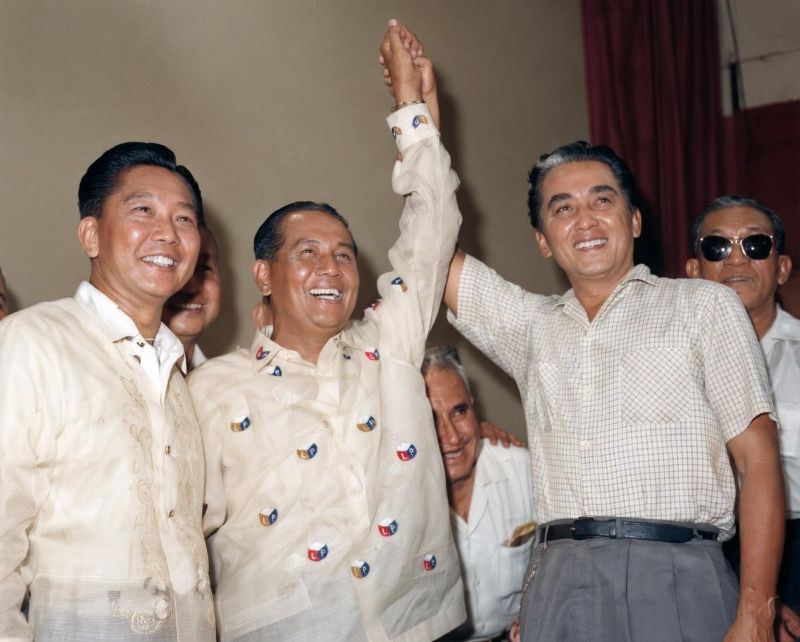
National Library (1961) photo of Marcos and Macapagal, with Rogelio dela Rosa and Arsenio Lacson (in dark glasses)
The result was that Pelaez parted ways with Macapagal and joined the opposition; by 1964, Marcos had done the same. Both argued there was no longer space in their old party because of Macapagal’s ambition (he’d promised Marcos he’d be a one-term president, but was obviously preparing to seek reelection). So Marcos followed Pelaez to the Nacionalista Party. There, the two became candidates of the Nacionalista Party in the 1965 presidential elections.
Here we see three parts of a pattern similar to 1949: an incumbent president wants to take down potential opponents in his reelection campaign; the result is a ruling party, already tarnished by controversies implicating its leadership, divided and cannibalizing itself. This in turn leads to frustrated rivals leaving the party and being adopted by the rival party, which is unable to come up with viable candidates for itself.
The result is deepening cynicism: among politicians, who see little value in party loyalty, and among voters, who see little value in parties and who prefer to pin their hopes on individual candidates. This leads to even noisier, more ruthless, more irresponsible campaigns to use drama to disguise the deeper problems in a decaying system.
There’s one more area where today looks like yesterday. Just as the Senate circus came to town, the House was going through its own funny business. It decided to expel one of its members., Cavite 4th district Rep. Kiko Barzaga, on June 2. He’d been suspended twice from his House duties, for “inflammatory and misleading social media posts.” The third time around, the House Ethic Committee decided to recommend his expulsion for his pattern of disorderly behavior, conduct unbecoming a member of the House, and unauthorized social media posts from the plenary floor. The House approved the recommendation.
In a chamber that’s always had its fair share of oddballs, Barzaga has proven to be perhaps the kookiest in the history of the House
In a chamber that’s always had its fair share of oddballs and cranks, Barzaga has proven to be perhaps the kookiest in the history of the House. But until Barzaga, only two representatives had ever been expelled: Dominador Gomez in 1908, for his threats against a fellow assemblyman, and Arnulfo Teves Jr. in 2023, after he fled to escape arrest after being implicated in the assassination of the governor of Negros Oriental. Others have been removed on the basis of conviction or suspended, however.
During the Macapagal era, in early 1963, Bohol Rep. Bartolome Cabangbang, considered “President Garcia’s most fanatical supporter,” was accused by Ilocos Sur’s Floro Crisologo of disorderly conduct, complicity in the death of President Magsaysay, and for being part of an assassination plot against President Macapagal. Cabangbang was suspended for 60 days. Only the eccentricity of the charges separates Cabangbang’s fate from other congressmen before who were also suspended, but it was only since 2023 that the House has resumed actually expelling its own members, something last attempted in 1908, and not since, until recently.
Former representatives like Walden Bello criticized the move as a denial of free speech, while others insist only the electorate should be able to decide if a representative is hired or fired. But the way Barzaga, despite his obvious weirdness, managed to get under the skin of his peers, is instructive. It has something to do with that watershed year, 1963, when it could be said the party system on both sides fell apart for good. Writing about the midterm campaign, Nick Joaquin reported:
“The following night, at the NP miting de avance, there was again no doubt that the crowd responded most fraternally to another Southerner, Senator Roseller Lim of Zamboanga—and this on the testimony of a Pampango-Manileño, Senator Puyat. A forecaster could indeed have read in the size and temper of that multitude on Plaza Miranda the great swing of the South to the Opposition that the next day’s polls would reveal. If the politicos want a new rule on Manila, here’s a possible one: As Manila goes, the South goes. Because Manila is now the biggest Southern city in the Philippines.
“Puyat says he felt rather scared when the atmosphere became so charged with passion the miting turned into a mighty dialogue between speaker on stage and the crowd below.
“SPEAKER: Ano ang gagawin kay Macapagal?
“CROWD: Palakolin!
“SPEAKER: Ano ang gagawin kay Macapagal?
“CROWD: Martilyuhin!
“’I felt,’ says Puyat, ‘that if the speaker had shouted “On to Malacañang!” that mob would have followed—and I fear to think what would have happened there. We politicians carry a big responsibility.’
“As one listened to Puyat’s account, one had the creepy feeling, too, that our political campaigns have gotten out of hand and are becoming sick.”
Worse, of course, was to come: the chaos and anarchy of the early 1970s which Marcos used to convince terrified parents that martial law was needed to control sex-and-drugs-crazed hippie kids. You often see, in online comments, a similar concern: that the political temperature has become so heated, because comments have become so infuriating, there is little room and even less opportunity for any civil conversation.
In the end, it’s easy to see the past seemingly repeating, when what is repeating is not so much the past, but something consistent about power and the human condition; it is in the nature of the powerful to start blurring the distinction between the public good and private benefit. Power doesn’t just corrupt, it emboldens. This boldness leads to going a racket too far, a theft too obvious; it leads to a backlash, and then—a change. Which lasts so long, as those given power still feel accountable to those who gave that power.
If we are seeing the past as a familiar place now, then it is a sign that what is to come is what followed next, after those once-familiar and now rediscovered things, happened.


