
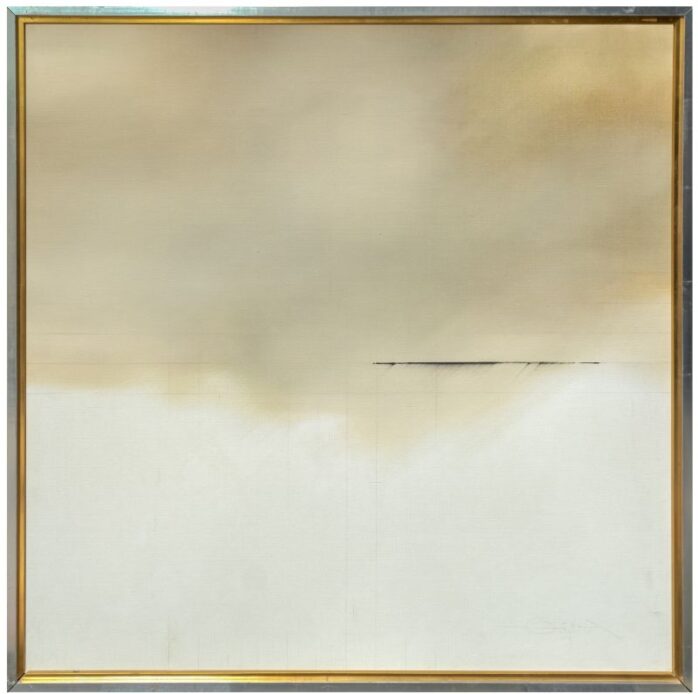
Fernando Zóbel’s La Raya, which once belonged in the collection of Ralph Graves, the last managing editor of the famous Life Magazine and the artist’s dear friend during his Harvard years in the late 1940s, is a highlight of León Gallery’s year-end sale, The Kingly Treasures Auction, happening on 28 November 2026 at 2 pm. When Graves died, the painting was passed onto his wife, Eleanor MacKenzie Graves, then to her son from her first marriage, Alexander Parish, a New York art dealer who, together with his friend and colleague Robert B. Simon, famously purchased Leonardo da Vinci’s iconic long-lost painting, the Salvator Mundi, at a 2005 New Orleans estate sale for a bargain price of $1,500.
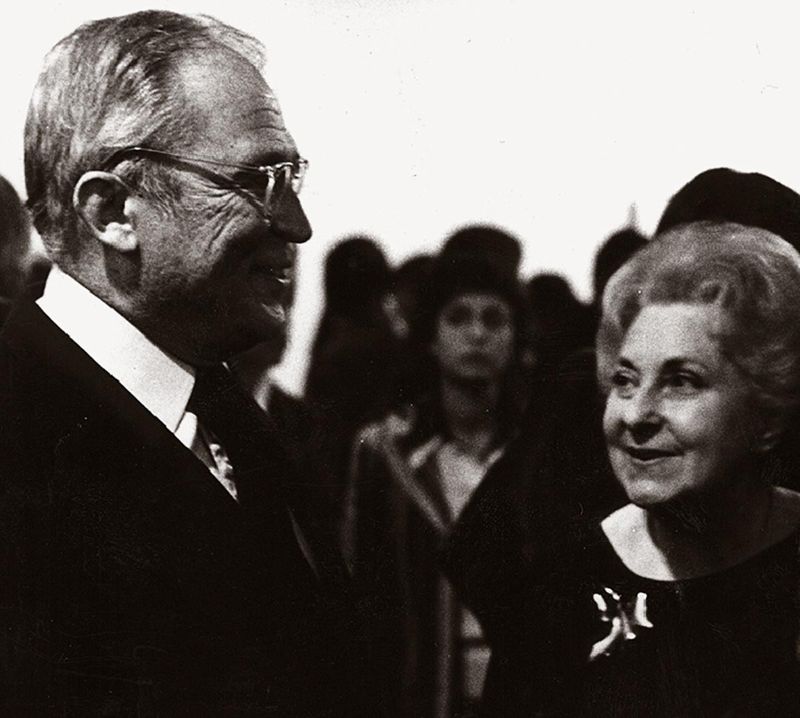
Fernando Zóbel with Juana Mordó at the exhibition opening of his ‘La Vista’ Series, held in 1974 at the Galeria Juana Mordó in Madrid (Photo from fernandozobel.es)
This Zóbel possesses a sterling provenance. It originated at the Galería Juana Mordó, a vanguard of Spanish abstraction during the second half of the 20th century. It was founded by Juana Mordó, a Greek-born gallerist who would go on to foster the careers of Spanish abstractionists, including the El Paso group, who were the champions of Informalismo, the Spanish artists’ answer to French art informel and American abstract expressionism.
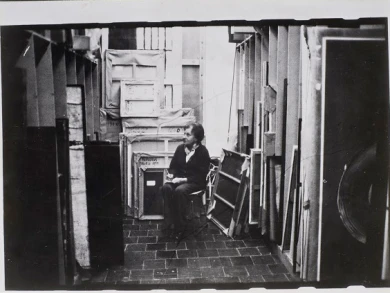
Juana Mordó inside her gallery in 1976 (Photo from the Juana Mordó Gallery Archive, Library and Documentation Centre of the Reina Sofía Museum, Madrid)
The Galería Juana Mordó, through its founder, inherited the avant-garde legacy of the Galería Fernando Fe in Puerta del Sol, Madrid, which once became ground zero for the informalistas and future members of El Paso—Antonio Saura, Rafael Canogar, Guillermo Delgado, Luis Feito, Antonio Lorenzo, Antoni Tàpies, and Eduardo Chillida. It was also at the Fernando Fe where Zóbel serendipitously discovered Spanish abstraction in 1955, during a modest exhibit by these artists titled Exhibition on Spanish Abstraction; Zóbel also purchased a painting by Delgado, drawn by its “uncompromisingly abstract” quality.
Mordó’s rise to the directorship of the influential Galería Biosca (founded by the Catalan painter Aurelio Biosca, considered the true pioneer of Madrid galleries) in 1958 became one of the most crucial turning points in her career. In 1959, Mordó helped organize Zóbel’s debut solo exhibition on Spanish soil, featuring works from his Saetas and Serie Negra, and it was the first time that the gallery mounted an exhibition of purely abstract works. Through this landmark exhibition, Mordó became Zóbel’s first gallerist in Spain, where he would eventually settle permanently in 1961 after torturous years of existential dilemma: whether to pursue painting as a lifeblood, or continue his corporate responsibilities as an heir to the Zóbel de Ayala family business.
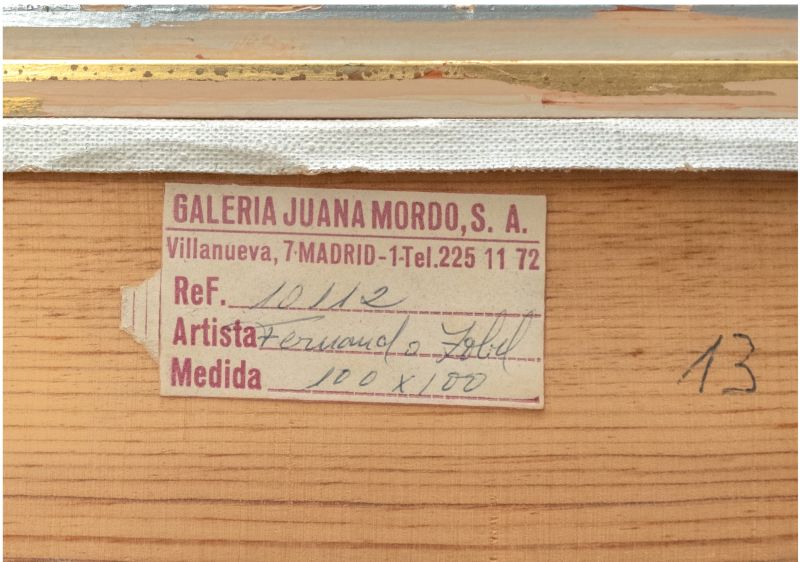
Sticker from the Galeria Juana Mordo attached to the back of the painting
In 1964, Mordó established her own art space, the Galería Juana Mordó, due to growing tensions and differences with Biosca. Mordo opened her gallery at Calle Villanueva 7 in Madrid. Works of El Paso were showcased and promoted in her gallery: Canogar and Saura’s violent action painting; Feito’s monochromatic oil impastos and the tension achieved by mixing sand and gravel; the “free and anguished protest” of Millares’ gashed burlap stained with black, white, and red; and the distraught rigidity of Rivera’s wire mesh. Mordó exhibited works by the Cuenca Group, Zóbel’s inner circle of artist-friends, two of whom were instrumental in the establishment of his Museo de Arte Abstracto Español in Cuenca—Gustavo Torner and Gerardo Rueda. Mordó also brought in Spain’s leading young realists, Carmen Laffon and Antonio López García, effectively christening the Galería Juana Mordó a melting pot of Spanish contemporary art at the time.
The Galería Juana Mordó also became Zóbel’s artistic turf. He participated in its inaugural exhibition, held from March to May 1964, and held another show at the gallery toward the end of the year. In particular, La Raya was showcased in a traveling exhibition sponsored and organized by Galería Juana Mordó that visited the cities of Pretoria, Johannesburg, and Cape Town in South Africa from September 1971 to January 1972.
The Galería Juana Mordó became Zóbel’s artistic turf. He participated in its inaugural exhibition, held from March to May 1964
After years of its whereabouts being undocumented, La Raya would wind up at an auction by Stair Gallery in New York, where it was purchased by a man named Ralph Augustus Graves, coincidentally a close friend of Zóbel during his Harvard days in the late 1940s. Graves was a writer and reporter for Life Magazine from 1948 to 1958, and served as the magazine’s last managing editor until its final weekly issue on December 29, 1972.
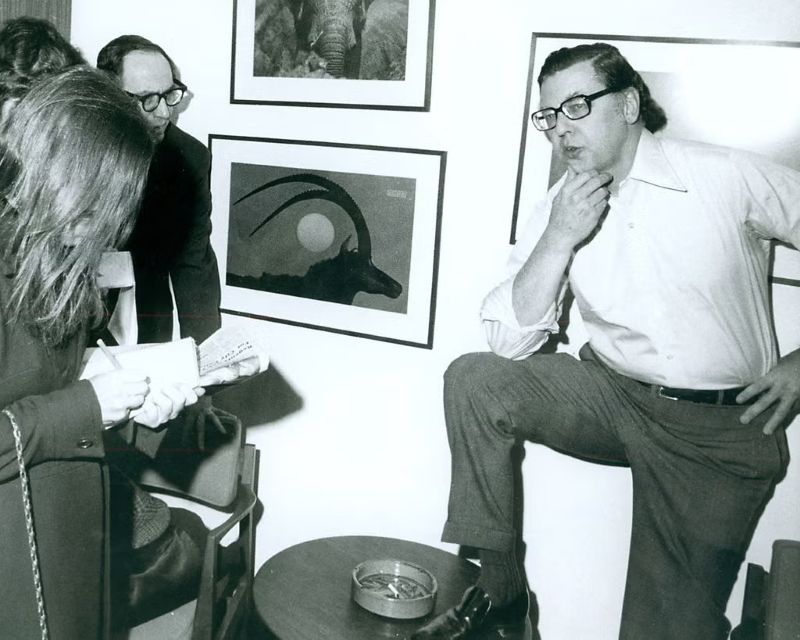
Ralph Graves, then managing editor of ‘Life,’ in 1972, after the weekly magazine announced it would cease publication (Photo courtesy of United Press International, reproduced in The ‘New York Times,’ 15 June 2013)
Graves’ father and namesake, Ralph Graves Sr., was an editor for National Geographic and died when Ralph Jr. was still a child. Ralph’s mother, Elizabeth, remarried in 1937 to Francis Bowes Sayre Sr., former son-in-law of United States (US) President Woodrow Wilson by virtue of his marriage to the presidential daughter Jessie (who died in 1933). Sayre Sr. became US High Commissioner to the Philippines in 1939, and Elizabeth and the then-15-year-old Ralph moved to the Philippines and lived in the US Embassy until the outbreak of the Pacific War in December 1941, when they escaped to Australia by submarine in early 1942.
Immediately after he graduated from Harvard in 1948, Graves began working for Time Inc., which published Life, as a researcher. He also worked as a reporter in the Time-Life news bureau in San Francisco, as bureau chief for Life Chicago, and as a senior editor for all of Time Inc.’s magazines. In 1969, Graves was promoted to managing editor of Life. Barely a week after his promotion, Life published one of its most controversial and startling issues—the June 27, 1969 issue featuring the article headlined “The Faces of the American Dead in Vietnam: One Week’s Toll,” which graphically showed photographs of 242 American soldiers killed in the Vietnam War. The article sparked widespread public debate about what the US really gained from its participation in the war. Also in 1969, Graves supervised Life’s coverage of the historic moon landing and the landmark Woodstock music festival. The following year, at the height of the Cold War, Life published former Soviet Union premier Nikita Khrushchev’s unauthorized memoirs, which earned the ire of America’s rival superpower.
Graves sustained Life until its final years, when specialty publications and television broadcasting became the dominant medium for entertainment and information. When Life ceased weekly publication in December 1972, Graves became editorial director of Time Inc., a post he held until his retirement.
Zóbel and Graves became good friends, with the latter introducing the former to the elite circles of New York high society. The two first met at Harvard sometime in 1946; Zóbel arrived at the university that year, taking up Humanities courses and advanced writing classes in English, and Graves was most likely in his second year of college. Harvard Magazine recounted an instance that showed their camaraderie. Zóbel, fondly called “Ferdie” by his Harvard acquaintances and friends, once showed Graves an album with small drawings and prints by master artists. When Graves commented on an image of a man’s anatomical study of his shoulder and arm, Zóbel, in his signature deadpan humor, wryly replied, “There wasn’t much left to collect, so all I got were the armpits.”
Zóbel and Graves likely shared a bond over reading classic literary works by García Lorca, Juan Ramón Jiménez, Marcel Proust, and other titans of Western literature. Graves indulged in writing his own pieces of literature in college, publishing his first full novel right after graduation, Thanks for the Ride (1949), a fictional account of his experiences and recollections as a post-war college student.
In his article “Art in the Philippines Today,” published in Liturgical Arts (Vol. 21, No. 4, August 1953), Zóbel wrote that during one of Graves’ visits to the Philippines, he asked a certain Filipino artist what the basis for modernism in the Philippines was. The artist answered: “Very simple: Life magazine.” Life magazine’s color photographs became a primary source of inspiration for the modernist movement in the Philippines, especially when access and exposure to artistic trends overseas were limited; its issues were a ubiquitous sight on Manila’s sidewalks, where street-side magazine stands paraded multi-tiered displays of local and foreign periodicals. Coincidentally, Graves was also working for Life at the time.
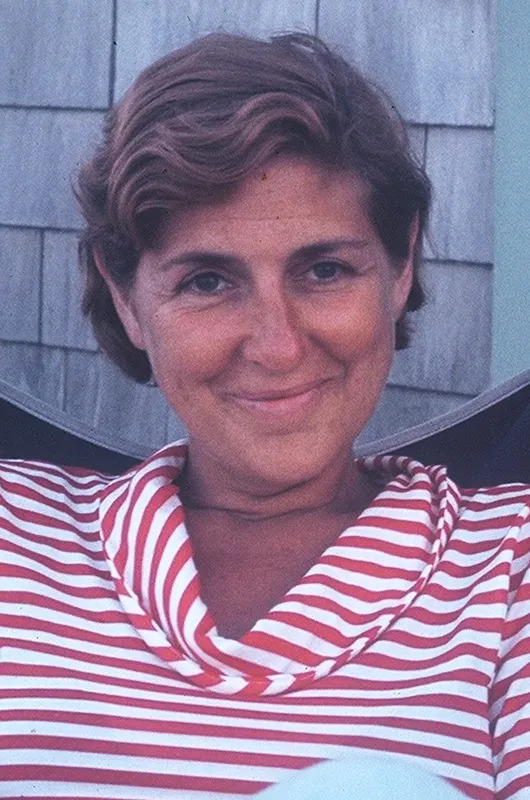
Eleanor MacKenzie Graves, wife of Ralph Graves (Photo from the ‘Vineyard Gazette’)
When Graves died, La Raya would be passed on to his wife, Eleanor MacKenzie Graves, who also worked for Life and retired as the magazine’s executive editor. Eleanor is best remembered as the author of the classic American vintage cookbook titled Great Dinners from Life, published by Time-Life Books in 1969.
Ralph married Eleanor in 1958, who became his second wife after he divorced Patricia Monser, whom he married in 1950. The couple maintained three homes: one each in New York City, Sarasota, Florida, and Martha’s Vineyard in Chilmark, Massachusetts. From their Vineyard home on Middle Road, Eleanor was an art dealer who ran Tiasquam Gallery, which specialized in 19th- and early 20th-century American art. All three of the couple’s homes were graced by paintings by artists from their beloved home island.
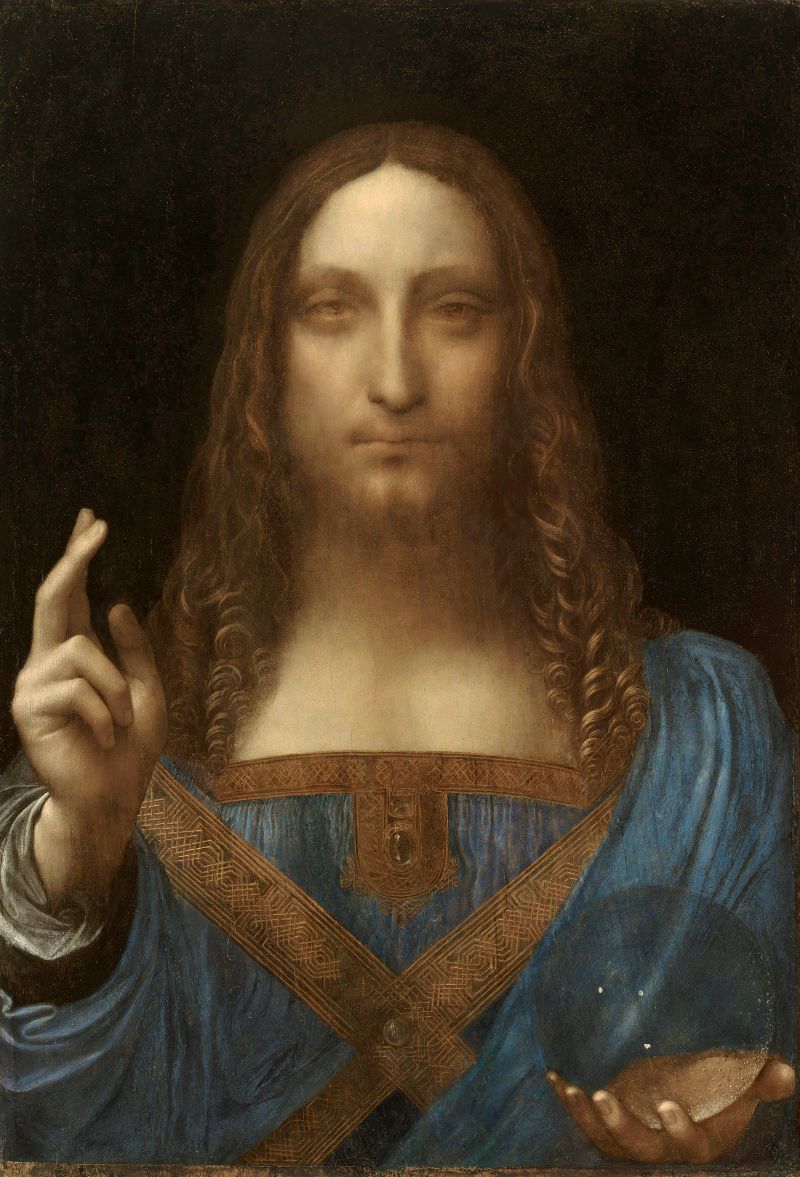
Leonardo da Vinci’s ‘Salvator Mundi’
Eleanor died in July 2022 at the age of 95, leaving La Raya in the care of Alexander Parish, her son from her first marriage. Parish and his friend Robert B. Simon, an art historian, dealer, and specialist in Old Master paintings, had bought Salvator Mundi for $1,500 at a St. Charles Gallery auction in New Orleans in 2005. Then titled After Leonardo da Vinci: Christ Salvator Mundi, the painting was part of the estate sale of Basil Clovis Hendry Sr., who ran a sheet-metal company in Baton Rouge, Louisiana. Parish and Simon believed that the 500-year-old painting was something greater than it was marketed in the auction, bringing it to conservator Dianne Modestini, who undertook its examination and restoration. Modestini was among the first to be convinced the work was an authentic Da Vinci because of a subtle detail on Jesus’ lips that is also present in the Mona Lisa.
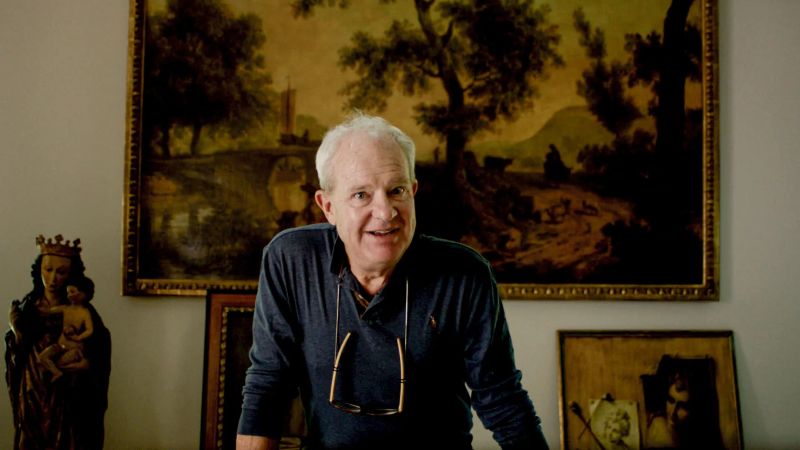
Alexander Parish, son of Eleanor Graves from her first husband and Ralph Graves’ stepson, who discovered ‘Salvator Mundi’ and bought it for just $1,500. (Photo is a film still from the documentary film ‘The Lost Leonardo,’ released in 2021 by Sony Pictures Classics.)
Conservator Dianne Modestini was convinced that ‘Salvator Mundi’ was an authentic Da Vinci because of a subtle detail on Jesus’ lips that is also present in the ‘Mona Lisa’
The extremely controversial painting has raised numerous questions about its authenticity (there are fewer than 20 paintings by Da Vinci that are either universally or widely attributed to him), and whether it is a work by one of his students. It currently holds the record for the most expensive painting ever sold at any auction, selling for more than $450 million at Christie’s Post-War and Contemporary Art Evening Sale on November 15, 2017, in New York. The painting was bought by Bader bin Farhan Al Saud, currently the incumbent and inaugural Minister of Culture of Saudi Arabia, but allegedly as an intermediary for the real buyer: the Crown Prince of Saudi Arabia, Mohammed bin Salman.
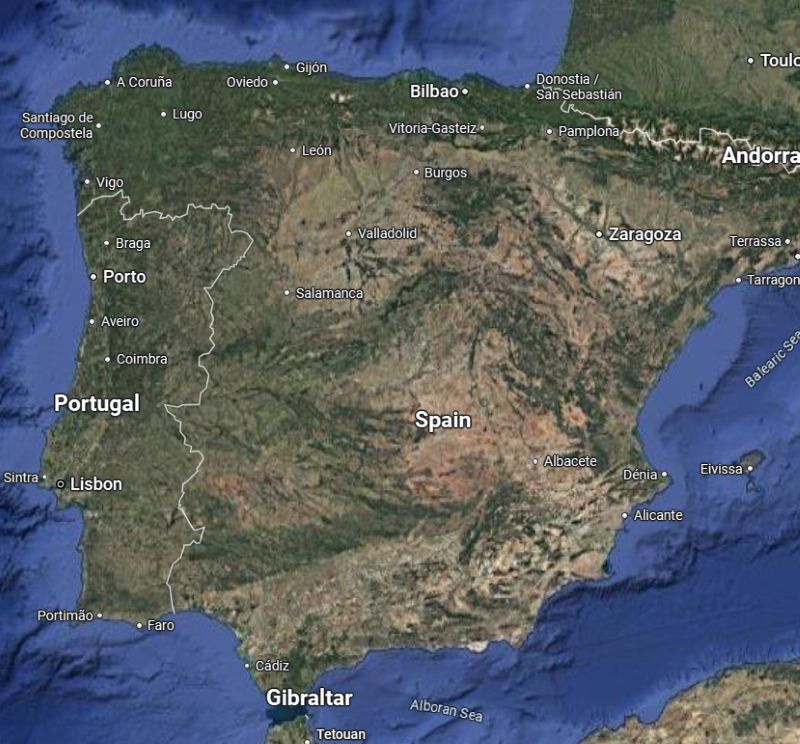
The border between Spain and Portugal, known as La Raya (A Raia in Portuguese), inspired Zóbel’s painting. The border between the two Iberian nations is seen in white. (Photo from Google Maps)
La Raya, which means The Stripe, refers both to the border between Spain and Portugal—”the line” where the two Iberian countries meet—and the regions and their respective provinces situated within and near the border. In Portugal, La Raya is called A Raia.
La Raya is Europe’s longest continuous international border (1,234 km) and one of the world’s oldest. The autonomous community (comunidad autónoma) of Extremadura in Spain and the regions of Alto Alentejo and Central Portugal are traditionally and historically associated with the boundary. The region is defined by centuries of shared heritage and culture, set against a backdrop of Roman Empire and Medieval Era fortresses and architecture and dramatic landscapes: rolling grasslands dotted with forest green oaks and olive trees with silvery-green foliage, gigantic prehistoric granite boulders, and the sweeping Spanish tablelands that extend from Extremadura to Alto Alentejo.
Zóbel’s La Raya possesses irregular swathes of color in the center that evoke the natural configuration of Spain and Portugal’s shared borders, especially as seen from above. La Raya belongs to the Second Period of Zóbel’s landscapes (1970 to 1975), which his friend and right-hand man since the late 1960s, Rafael Perez-Madero, described in his landmark monograph Zóbel: La Serie Blanca, as studies “of the structure of real landscapes, but the color becomes abstract and conceptual.” This contrasts with his First Period (1963 to 1970), in which his landscapes were “abstract and imaginary; use of color observed in nature.”
Zóbel’s clear use of grids points to a preliminary, detailed study of the actual border between Spain and Portugal, resulting in a work grounded in a systematic framework that characterized the artist’s landscapes of the time. It is also important to note that by this time, Zóbel had been utilizing photographs as a point of reference for the development of his paintings—intellectual rather than instinctive.
In La Raya, the two varying shades of color that divide the work into two segments are utilized as demarcations representing Spain and Portugal, and are not used as identifying elements of the natural geography or topography of the two nations. Maybe Zóbel made the upper part of the work representative of his beloved Spain, as it is, geographically, the larger of the two countries. Overall, the composition is shrouded in ambiguity, leaving a vast expanse for imaginative play.
León Gallery’s ‘The Kingly Treasures Auction 2026’ will be held on Saturday, 28 November 2026, at 2 pm. The preview exhibit will run from 21 November to 27 November, from 9 AM to 7 PM, at G/F Eurovilla 1, Rufino corner Legazpi Streets, Legazpi Village, Makati City.
To browse the online catalog, visit https://leon-gallery.com/. For further inquiries, email info@leon-gallery.com or contact 8856 2781. Follow León Gallery on their social media pages for timely updates: Facebook: www.facebook.com/leongallerymakati and Instagram: @leongallerymakati.


