

During a birthday party in his gallery, Avellana wearing his favorite color, with Pandy Aviado, Gus Albor, Edwin Evangelista
It was an ordinary Thursday afternoon in his atelier in Pasay when fashion designer Jojie Lloren exchanged pleasant banter with his neighbor and gallerist Albert Avellana over uraro cookies and coffee.
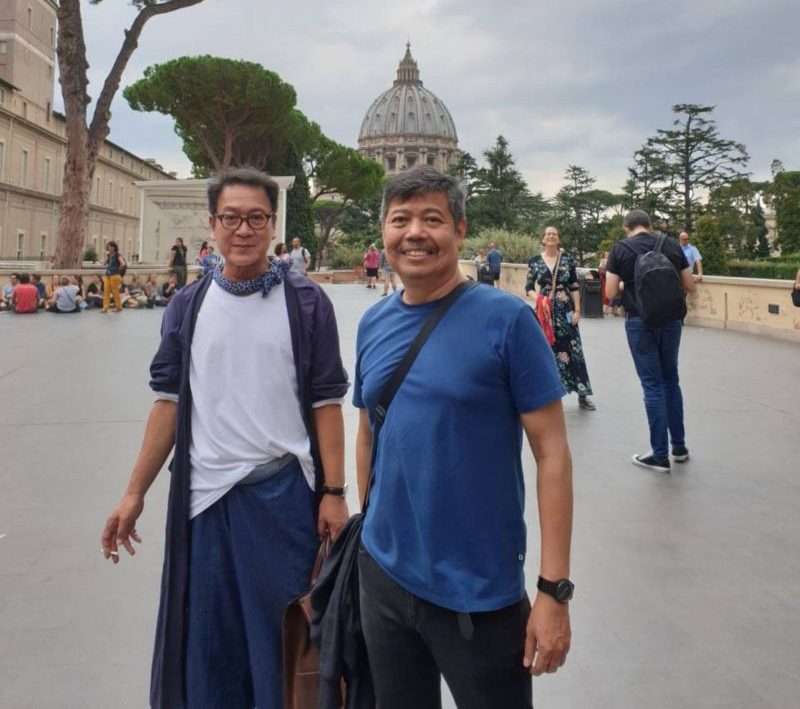
In Rome 2019, Avellana with his BFF Jojie Lloren
“We laughed so hard,” recalls Jojie. The designer was stepping out on errands and Albert, whose gallery was beside the atelier, asked him to buy siopao. The following day, he dropped off the siopao in the gallery, unaware of what had occurred.
Albert was supposed to have a morning meeting at the Avellana Art Gallery in Pasay City on Friday, Sept. 16. He told his staff to prepare breakfast for 7:30 am. He didn’t show up.
“They found it strange because he would normally call or text. They became worried,” says Jojie. The wife of Albert’s staff, who cleaned his Makati home, was called to check on him. She and Albert’s niece and nephew went to the bedroom and found his lifeless body. According to the medical report, he died of a longtime ailment, congestive heart disease. He was 59.
Beyond being a gallerist and arbiter of taste, Albert was a creative genius who pushed boundaries. To me, he was like Karl Lagerfeld, the polymath.
“He was always 10 steps ahead of everybody,” says leading artist Ivi Avellana-Cosio. When National Artist Arturo Luz closed down his namesake gallery in the ’90s, he gave his blessing to Albert, saying, “You will be my successor.”
“Albert’s vision ran along the same lines as Arturo’s,” says Ivi. He eschewed social realism and representational art.
Way before other galleries took to the post-modern style of exhibits which encompassed non-traditional genres, Albert was already merging the different media
Way before other galleries took to the post-modern style of exhibits which encompassed non-traditional genres, Albert was already merging the different media in his shows.

Allan Cosio retrospective at Avellana Art Gallery in 2021 showing Avellana’s distinct way of displaying art
Albert came from a family of creatives. His father, Angel, was a sound engineer and a six-time Famas awardee. His uncle was the late Lamberto Avellana; Lamberto and his wife Daisy are National Artists for Theater and Film. He curated the works of his second cousin Ivi and her late husband, painter Allan Cosio.
When Albert was a fine arts student at Philippine Women’s University, the school director and leading printmaker Virgilio “Pandy” Aviado noted already that Albert was a charismatic leader, and that he showed an unerring eye for original composition and styling.
After college, he performed in the Cultural Center of the Philippines’ (CCP) Magsimula Ka and Fiddler on the Roof, although I have never heard him sing.
‘Albert grouped artworks differently,’ says Deanna Ongpin. ‘He was such a sensitive soul’
Albert had such a flair for selecting and displaying art that he helped set up galleries and exhibits. He assisted the cultural affairs section of the then newly-established Instituto de Cervantes. Deanna Ongpin, then president of Alliance Française, tapped Albert to curate exhibits, one of which was Aviado’s Passe Partout in 2011. The sell-out show featured hand-colored, one-of-a-kind intaglio prints, displayed in eye-catching clusters instead of a straight line.
“Albert grouped artworks differently,” says Recto. “He was such a sensitive soul.”
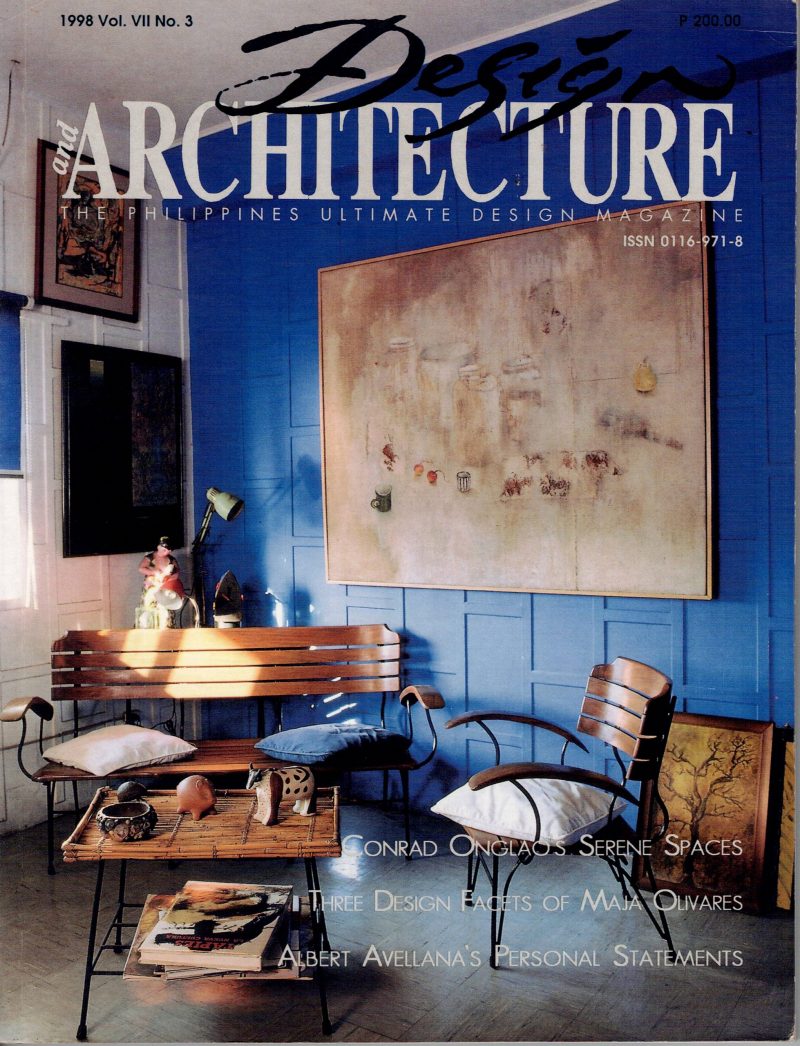
Avellana’s house in San Juan Apartments was cover story in 1998
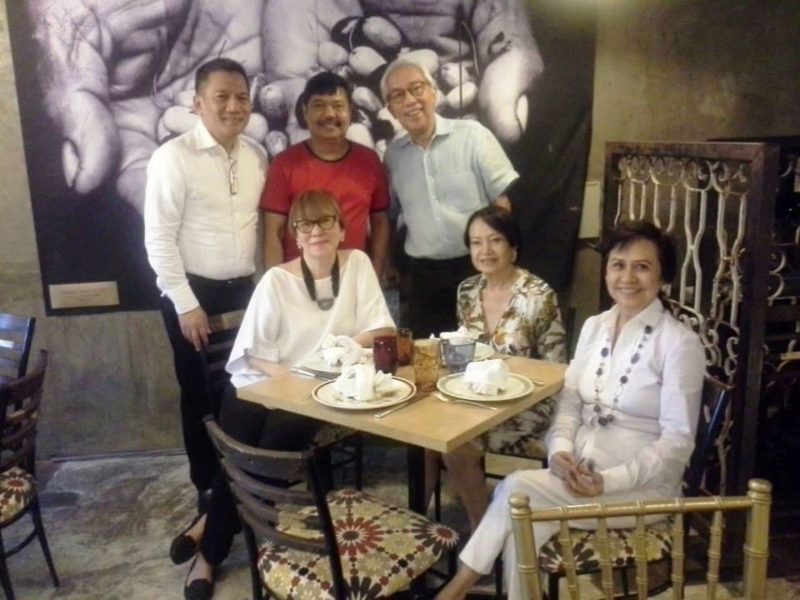
During his Design and Architecture days, Avellana (in red) with Toots Tolentino (standing, far left), architect Toti Villalon (standing, far right), Villalon’s wife Darla (seated, far left), Opat Hermano (seated, middle) and Sylvia Montilla
In the ‘90s, Albert became the art director of Josephine “Opat” Hermano’s groundbreaking Design and Architecture magazine. He opened his namesake gallery in the San Juan Apartments in 1997 and in 2003 moved to the compound in Pasay City known for its ‘50s architecture homes and which would soon attract other designers to set shop in.
While other galleries maintained a conventional display of art, Avellana transformed the gallery space without going over the top. The innovative touch could be as simple as painting a wall red to make Ivi Cosio’s works pop out, or extending the exhibit to the garden, out in the open air. His was a simple idea that evoked drama.
“Albert was protective of me, as if he were my kuya,” says Ivi. “Regardless of the gallery where I exhibited, he was my curator because we were both on the same wavelength. Once I was going to make a scroll with dimensions of 5 ft by 8 ft. He told me to exaggerate it by running the length of 12 ft for more impact.”
During his five-year term as president of the Museum Foundation of the Philippines Inc. (MFPI), Albert worked hard on fund-raising projects.
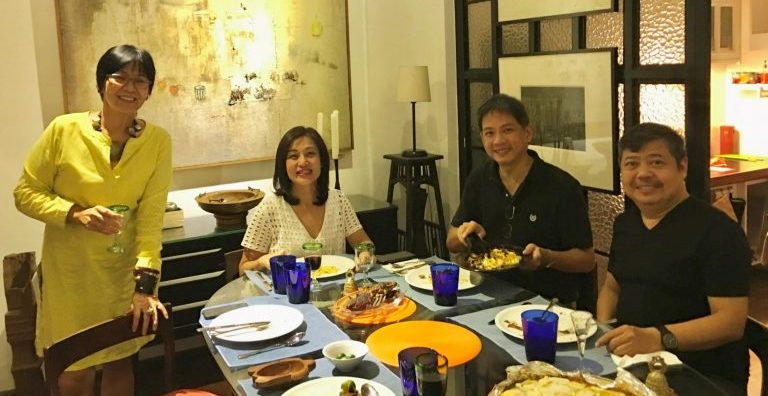
Avellana (far right) at lunch with foodie friends in his house Tina Bonoan (far left), Malu Gamboa and Mon Lindo
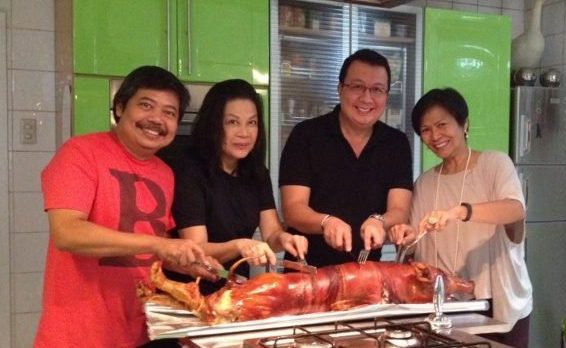
Avellana’s another art/foodie group of sculptor Impy Pilapil (second from left), Philip Escudero and Tina Bonoan
Last June, photographs of Albert taken during his annual birthday parties through the years kept popping up in my FB Memories. The last FB throwback showed a slimmed-down Albert—Albert, a foodie who enjoyed drinking, had to go on a diet. The artful display of empty wine bottles at the gallery entrance was a memento of the good life with friends.
Every June 12, he would celebrate his birthday with an exhibit opening in the gallery, attended by friends in the creative industries. When he turned 50 in 2013, he asked each of his 50 friends to host a birthday meal for specific cliques. I joined the intimate dinner hosted by Elena “Morita” Roces, the publishing and real estate heiress who was one of the country’s most interesting creatives.
For decades, he had done so much for me that I wanted to give back by writing about his gallery. I was surprised when Albert said he had no plans for a birthday party nor an exhibit this year.
Why so quiet? We were told that he was busy decorating homes and selecting artworks for a prominent client, and he had other big projects.
I first met Albert a few days before the failed coup d’etat attempt in December 1989 in the home of interior designer Opat Hermano. Handling the Arts and Leisure section of BusinessWorld then, I had the tough job of changing the readers’ perception that BW was just a business/economics publication. Since I didn’t know anything about architectural photographs, Opat requested Albert to direct the shoot. That started mine and photographer Teddy Pelaez’s collaboration with Albert, which would span years.
He would show Teddy the best angles and would define spaces where the lighting was soft. He hardly moved the furniture for the camera, to respect the owner’s arrangement. When our then managing editor, Leticia Locsin, saw the full-page layout, she was impressed with the dramatic black-and-white photos that showed contrast of tones and depth of space. Since then, we had worked with him in “guerrilla” set-ups sans professional light equipment and assistants in the era of black-and-white analog photos.
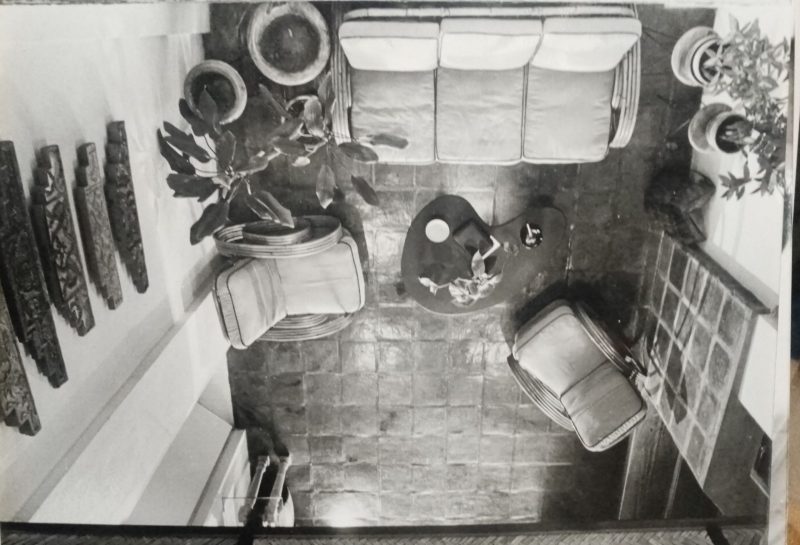
Outtake from Teddy Pelaez’s shoot of architect Toti Villalon’s house in Greenhills for BusinessWorld
From 1990 to 1992 until the time I left BW, Albert helped us in our photo shoots gratis, including the home of architect Augusto “Toti” Villalon who was on the forefront of conservation architecture.
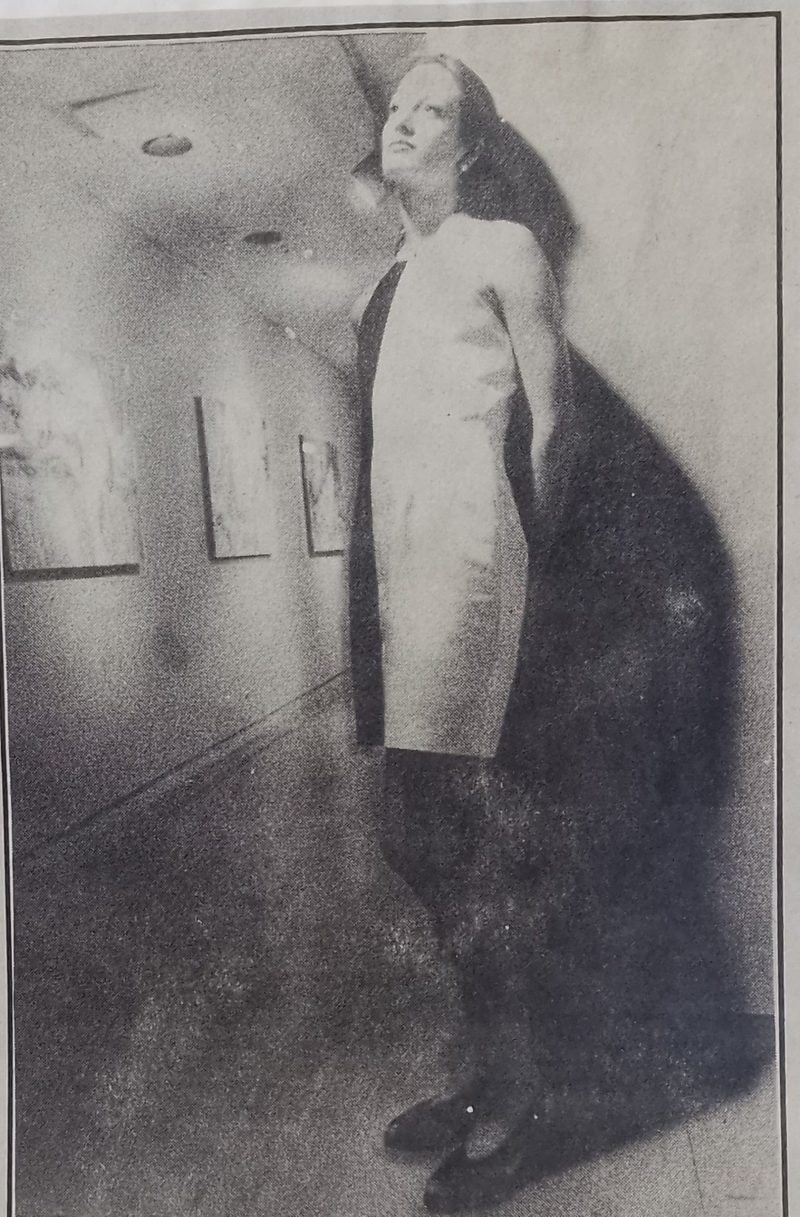
Portrait of ballerina Julie Kent in 1991 at CCP, directed by Avellana and photographed by Teddy Pelaez for BusinessWorld
In 1991, the stars of American Ballet Theater (ABT) came to perform with Ballet Philippines at CCP. With only 30 minutes to photograph and interview ABT soloist Julie Kent at the CCP gallery, Albert knew exactly where to place her using the available lights.
At the turn of the millennium, he helped me again when I was tasked to run the home and fashion pages of the Philippine Daily Inquirer’s Lifestyle section.
He advised me to hold a fashion show inside the carriages of the new Metrostar Express
People always tapped Albert for his imaginative ideas. He advised me to hold a fashion show inside the carriages of the new Metrostar Express. With the help of the Metro Rail Transit Corporation, the show was held on the night before then President Estrada inaugurated the MRT Line 3 in December 1999. We sought producer Albert Almendralejo for help. He tapped Joey Espino to direct it and create the line-up of designers—Frederick Peralta, Barge Ramos, Rusty Lopez (who had semi-retired from fashion), Rajo Laurel, Joe Salazar, and Auggie Cordero.
The fashion route was from the stations in North Avenue in Quezon City to Shaw Boulevard in Mandaluyong. Each designer was assigned a station where their models boarded. With Auggie’s collection as pre-finale, the show ended at the MRT Station in Shaw Boulevard, featuring Bench’s mini-fashion show on the concourse; Ben Chan supported the project. The show was very successful, thanks to a professional team, even as Albert and I thumbed down the chest-thumping.
Albert helped us in other “guerrilla” shoots, many of them with photographer Chito Vecina. He skillfully combined fashion with architectural elements. For instance, ethereal gowns of Joe Salazar were set against Ruby Roa’s sprawling Balinese-inspired estate in Alfonso, Cavite. Albert also suggested vintage designer clothes to complement the architecture of the landmark PhilamLife building in Manila. My favorite was this photo of the model wearing a peplum-waist suit by Azzedine Alaïa, its curves echoeing the curvilinear brises soleil on the driveway.
I introduced him to the quirky tita Morita Roces, who designs coffins and urns embellished with semi-precious stones
I introduced him to the quirky tita Morita Roces, who designs coffins and urns embellished with semi-precious stones, bold patterns, and carved wood. While most galleries shunned the idea of displaying funereal art, Avellana Art Gallery didn’t and instead juxtaposed the urns with tita Morita’s elaborate religious installations and triptychs. She woud invite Albert always to her place for the paella she was known for, the family’s centuries-old recipe.
When I moved to Elán, Inquirer’s high-end lifestyle section, Albert suggested that the “E” should be exaggerated in the logo. By then, it became harder to ask Albert to assist in our pictorials, as he was always busy with projects. Yet he made time to display the tarpaulins of my dance concert sponsors as if they were artworks at the theater lobby.
We never spoke face to face during the pandemic. Our exchanges were mostly through SMS. He was like my directory when I needed to contact a certain creative.
Cheesy as it sounds, Albert will always live in our hearts. As of this writing, his immediate family is in talks about succession. Albert wanted to bequeath his gallery to his nephews and nieces. The sole proprietorship will be turned into a corporation with a board of directors that will include Ivi, Jojie, and MFPI president Danny Jacinto, all of whom will continue his vision.
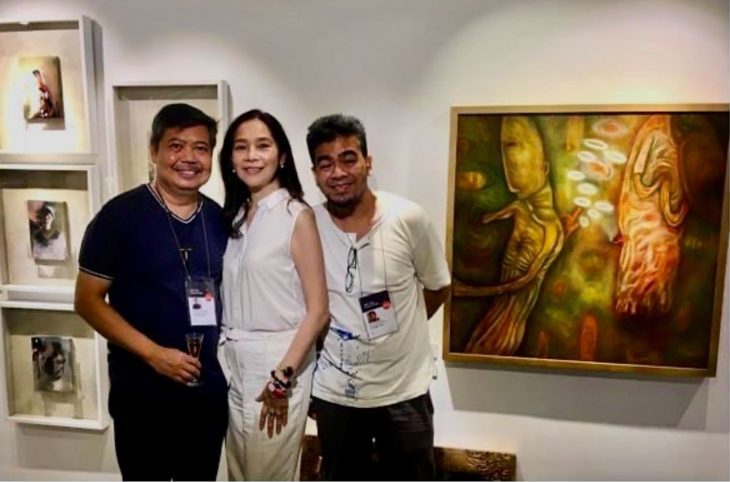
In Art Fair 2020, Avellana (far left) with writer/artist Marivic Rufino and Joey Cobcobo
It would take a book to write about Albert and show the gamut of his work. In the meantime, his friends speak:
Jojie Lloren, designer and president, F.A.B. Creatives Manila
He advised me on everything, from small details such as our food delivery in 2020 to my fashion exhibit at CCP in 2015.
As part owner of the school F.A.B. Creatives, Albert was responsible for promotions. He didn’t mentor, yet every day, he shared his ideas about art and professionalism. He was a workshop on the fringe, talking about the real world. If a student was slow in design, he would pull that student and offer tips. The students loved him.
When I moved the shop to the Pasay compound, I acquired artworks from his gallery. I wouldn’t want to buy anywhere else. He guided me, yet he also respected people’s preferences. He advised that you don’t buy art for investment, but what resonates with you.
Deanna Ongpin, strong culture advocate, former culture official
Albert thought of things that nobody would think about. It was his idea to bring the Maarte Fair to Peninsula Manila in 2017. The exhibitors had their rooms, different from the usual set-up in a ballroom or building. Maarte brought a lot of people to the Pen. It took us an hour to get a seat at The Lobby.
Pandy Aviado, printmaker
Albert was never a loner. He was always part of a group, and he energized people to produce a synergy. He curated my show at Ateneo Art Gallery in 1995 and my 50th anniversary exhibit at the Ayala Museum. He didn’t follow the grid layout like conventional galleries.
In Balay ni Tana Dicang gallery in Negros Occidental, my concept was that the bottles were quantum spaces with prints inside. That was the message. It took some art to set it up. Like any product, they needed to be displayed to draw attention. Albert hung the bottles from the ceiling and arranged the rest on the floor.
Albert’s layout style is different. It’s more compositional. He explores spaces. When he was late to register his gallery at the Art Fair, he made use of the stairwell at the venue. Since everybody passed there, they saw our works and bought. He arranged the empty wine bottles from his events at the gate. His idea was like alchemy, turning basura into gold.
Mariano Garchitorena, director of public relations, Peninsula Manila
We owe him a debt of gratitude for styling Peninsula Moments (bespoke experiences for guests) and the Peninsula Academy Program (introduction to local culture).
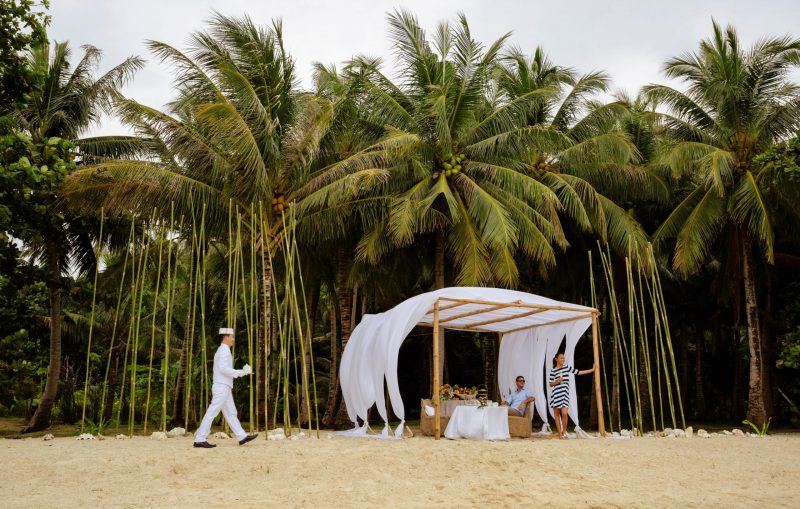
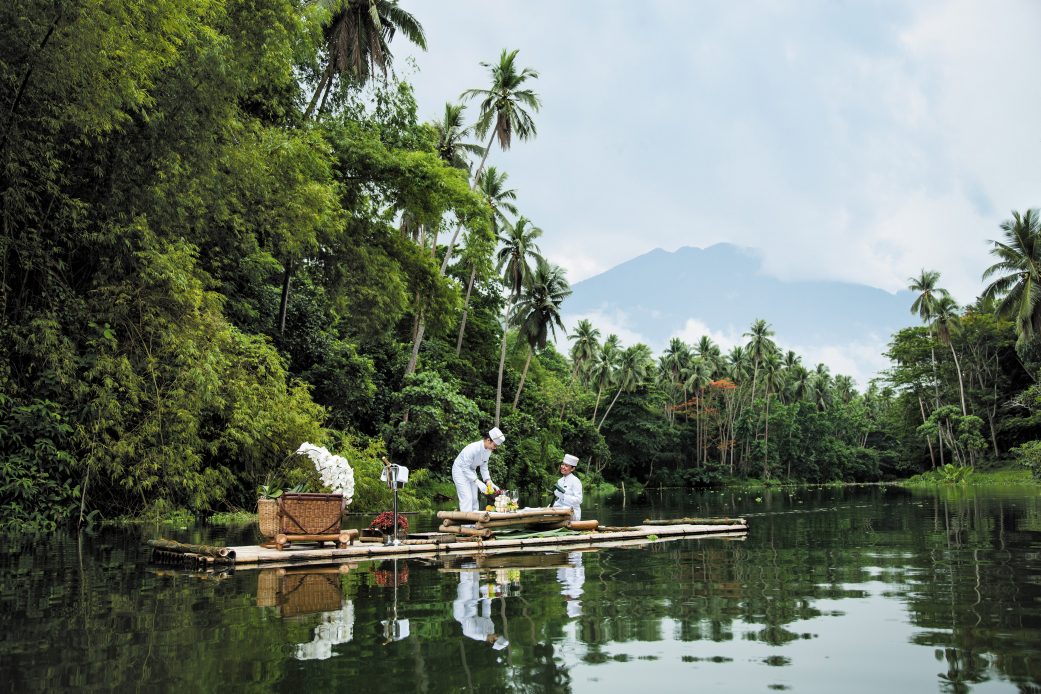
Bamboo installation in situ in Mindanao for Peninsula Academy photo shoot: Avellana made art out of available materials. (Photo by Paco Guerrero)
When we did the shoot for Pen Moments, we went in the dead of night to Villa Escudero. Albert thought of covering the bamboo barge with the golden side of kaimito leaves. We showed flaming torches, fireworks, and bits of gold from sky to water.
Albert found beauty in the most mundane things. Giant taro leaves harvested from a plant along Taal’s Pansipit river were used as mantel for the fruit bowl at Villa Tortuga. In the Batungbacal Farms, Zambales, he helped us style the picnic table. He paired the Peninsula Brut with the magnificent Batungbacal manggang hilaw and bagoong.
When we needed a tent, he created one using yards and yards of white cotton sheets that we’d used to swaddle the china, silverware, crystal, champagne, and comestibles we’d flown in from Manila. And finding a pile of bamboo poles, he created an in situ “installation.” He also found shells from Jewelmer’s Flower Farm to tie down the cloth and add more drama
Danny Jacinto, MFPI president
Albert and I frequented Divisoria, thrift shops, second-hand and surplus stores. He loved ambassador chairs. He painted a vintage ambassador chair in black. It turned out to be so sophisticated that an affluent client bought it.
Credit: Virgilio Aviado


