
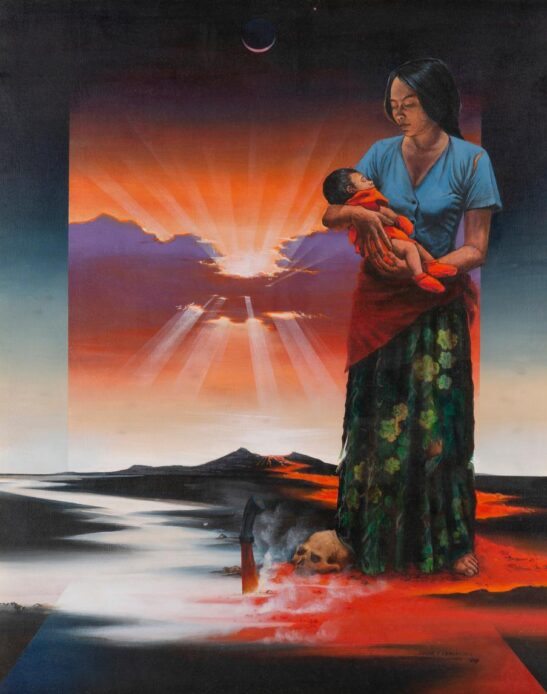
In a significant move bound to benefit not only art lovers but also the public, the Bangko Sentral ng Pilipinas (BSP) is lending more than 30 important works from its contemporary art collection to the National Museum of Fine Arts, to be put on exhibit starting late August.
The BSP has among the most comprehensive, if priceless, collections of Philippine art and antiquities in the country, which was started in the late ’70s and ’80s. The Philippine art collection, which spanned from the Spanish colonial era to contemporary times, was believed worth PhP2 billion 10 years ago, an estimate said to have been made by book author, writer and an authority in Philippine art and antiquities, the late Ramon Villegas.
The forthcoming exhibit at the National Museum is a rare opportunity for the public, particularly the students, to see these major works. “This collaboration (with the National Museum) allows us to share our collection with the public in a space that celebrates Philippine heritage and creativity,” BSP deputy governor Bernadette Romulo Puyat told TheDiarist.ph in an online chat.
“Art should be displayed, appreciated, and experienced, not kept out of sight,” she added. “This partnership with the National Museum allows us to do just that.”
Puyat explained the back story of the forthcoming event titled Kultura. Kapital. Kasalukuyan. Contemporary art from the Bangko Sentral ng Pilipinas Collection: “The BSP has an amazing art collection, but with no dedicated museum yet. Much of it is kept in storage or displayed only in offices and hallways. Many people ask if they can view the collection. We usually bring them to our meeting rooms where some pieces are displayed. Wanting to make the collection more accessible, I reached out to Andoni Aboitiz, chair of the National Museum, to explore the possibility of exhibiting select works. We met shortly and the National Museum generously offered us an entire floor for the display.”

‘Sacada’ by Renato Habulan (1980, oil on canvas)
The exhibit on the third floor galleries of the National Museum in Padre Faura Manila will have about 36 works from the ’70s by major contemporary Filipino artists: Antonio Austria, Pablo Baens Santos, Santiago Bose, Roberto Chabet, Charlie Co, Danilo Dalena, Antipas Delotavo, Brenda Fajardo, Edgar Talusan Fernandez, Ofelia Gelvezon Tequi, Renato Habulan, Junyee, Onib Olmedo, Mario Parial, Maria Victoria Abaño, Leonard Agoncillo, Gus Albor, Nunelucio Alvarado, BenCab, Imelda Cajipe Endaya, Emmanuel Garibay, Marina Cruz, Maria Isabel Cruz, Joey Cobcobo, Melvin Culaba, Patricia Perez Eustaquio, Emmanuel Garibay, Riel Hilario, Geraldine Javier, Elaine Navas, Demetrio Padua, Jr., Dan Raralio, Brave Singh, Cesare A.X. Syjuco, and Gerardo Tan.
BSP, through this event, manifests its recognition of Filipino ‘artists as creative capital’
What is noteworthy in this era that now acknowledges soft power is that the BSP, through this event, manifests its recognition of Filipino “artists as creative capital”—stated in the exhibit catalogue that TheDiarist.ph was able to get hold of before the press preview. The collection captures “the dynamic intersection of culture, artists as creative capital and the surrounding issues of the time.”

‘Terminus 94’ by Gus Albor (1981, acrylic)
The works on exhibit carry themes such as economic resilience, labor, national growth—“the exhibit frames art as living response to contemporary realities.”
The BSP collects, “preserves works that embody the Filipino’s evolving ideals and collective spirit for today and generations to come.”
The BSP collection of significant Philippine art didn’t happen overnight. It began in the early ’80s under the stewardship of Dr. Jaime Laya as governor of the Central Bank (the forerunner of BSP), the youngest to hold that position, an academician and technocrat, who was then already known for his love of art history books and art. On weekends when he was free from his task as dean of the University of the Philippines (UP) College of Business Administration, he’d scour the galleries and antique shops for finds—a habit he had even as a professor—and later donated two paintings to the college. The first painting he owned, he recalled for us, was an Amorsolo painting of the sunset, a gift to him.

‘As Fragrant in Rivers in Autumn’ by Riel Hilario (2013, carved wood and polychromed fruitwood)
In an informal talk with TheDiarist.ph after the BSP exhibit was announced, Dr. Laya recalled how as early as the term of his predecessor, Central Bank Gov. Gregorio Licaros, the latter was already purchasing Philippine artworks to display in the newly built Central Bank building along Roxas Blvd., the massive sprawl that remains as the BSP headquarters.
“Artworks were needed for the Monetary Board room, for the Governor’s office, for the Executive Lounge, for the lobby, and he asked the senior officers to pick paintings for their rooms,” Laya recalled.
Licaros decided to buy the Amorsolo himself, using his own money. The price of the object of the Senate’s ire? PhP30,000
Governor Licaros had the good mind to acquire an Amorsolo for the Central Bank. However, then senator Ernesto Maceda denounced such acquisition on the Senate floor, and blew it up into a controversy. In anger and frustration, Licaros decided to buy the Amorsolo himself, using his own money. The price of that Amorsolo masterpiece, the object of the Senate’s ire? PhP30,000.
That episode showed how art acquisition by a government body, in the early ’70s and ’80s, could draw a lot of political flak, and that it took strong will, a stronger sense of history and heritage, and of course, a sustained interest in Philippine art, to build a collection for a government body.
Then Governor Laya picked up that challenge like a matter of course. “My thinking then was that none of the culture agencies (like the National Museum) had money for acquisition,” he told us. “I believe (these acquisitions) could be consolidated into a national collection.”
The governor gained the support of the Monetary Board.
Otherwise there was always the likelihood of major art works, owned by private collectors, being brought out of the Philippines. The then Central Bank found itself in a position to minimize this practice. Fast forward to today, government institutions such as the Government Service Insurance System (GSIS) and private institutions such as banks have followed suit, and now have their own significant art collections.
‘My thinking then was that none of the culture agencies had money for acquisition. I believe (these acquisitions) could be consolidated into a national collection’
Dr. Laya started the BSP collection with Spanish colonial art. He recalled for TheDiarist.ph: “Adding to the Central Bank of the Philippines (as it was named then) art collection was, of course, incidental to my main job as governor and chairman of the Monetary Board. Except for a handful of pieces, I didn’t go out of my way to look for something. I passed the word around that the Central Bank was adding to its art collection, and offers started coming in.
“I had wanted to organize a committee to recommend the additions to the collection, but no one admitted to an interest in art. Dr. Benito Legarda was the officer most interested in art, but by the time I was appointed governor, he had left Central Bank for the International Monetary Fund (IMF).
“Under the circumstances, I ended up making decisions by myself. I decided to focus on early works. Except for Luna and Hidalgo at the National Museum and Malacañang, there were no Spanish Period works in public collections. Lindy Locsin (National Artist Leandro Locsin-Ed.) and a few others were the ones getting what was available, and there was the possibility that foreigners—including wealthy Filipinos abroad—would bring them abroad. Also, it was easier to get later works than colonial works.
“Owners were also careless about inherited works, and damage or destruction was a danger. Anyway, that was why I decided to emphasize older works, and spread the word around.”
The Central Bank didn’t lack for offers to acquire art works. Dr. Laya was appointed governor of Central Bank in 1981. “Jack Pilar (book author and authority on Juan Luna-Ed.) was one of the first who offered works, and soon other people began doing so,” Dr. Laya described the start.
“The restorer Jun Gonzales was also active in searching for old works. Viring de Asis (the popular antiques dealer-Ed.) was dealing mostly in furniture, and added paintings to her shopping list when checking out old houses. Manoling Morato (art collector-Ed.) was from Quezon and, therefore, came across works produced in Laguna and Quezon and/or inherited by families from there. Bambi Harper (newspaper columnist from an old Manila family-Ed.) also dealt in art and offered works now and then.”
In 1981, the Dewey Dee crisis proved fortuitous. “Bancom Development Corporation (Sixto Roxas’ finance company-Ed.) got into trouble in the aftermath of the Dewey Dee crisis and had to sell its government securities and other assets to meet demands for withdrawals from creditors. He sold some works to the Central Bank,” Dr. Laya recalled.
Dr. Laya’s knowledge was limited to art history books, “and stock knowledge,” Laya said, “and I, of course, relied on my own taste in deciding what was worthy of a national collection or not. I also had to decide on what a reasonable price was, and I ended up turning down pieces that eventually ended up with Locsin, PCIBank (the Philippine Commercial and Industrial Bank–Ed.), UCPB (United Coconut Planters Bank-Ed.) and maybe others.”
‘The big treasure of Ayala Museum, the long gold band, was offered to me for an impossible PhP4 million’
Dr. Laya added a footnote that museum denizens might deem important: “The big treasure of Ayala Museum, the long gold band, was offered to me for an impossible PhP4 million, so I turned it down, after which it was offered to Locsin for PhP2 million, and now it’s in Ayala. Ditto for a religious work now with BDO (Banco de Oro) and a Botong (Francisco-Ed.) that UCPB bought and that was recently foreclosed by PDIC (the Philippine Deposit Insurance Corporation-Ed.) and turned over to BSP, where it now is.”
Dr. Laya recounted that if there were art works he went out of his way to acquire, it would be the Simon Flores portrait. “One of the paintings that I went out of my way to get is the Simon Flores portrait of the Quiason family. It appeared in a Manila Chronicle Sunday article in the 1950s or 1960s, and I never forgot it. I asked Serafin (Quiason, Jr., historian and former director of the National Library-Ed.) if he knew where it was, and he discovered the owners, relatives of his. We went to their house behind Sto. Domingo church and got it for PhP600,000. It was owned by the owner of a bakery shop known for sans rival located in front of Sto. Domingo Church.”
Dr. Laya put the act of acquisition in context: “The National Museum had no acquisition funds and in my mind, works in the public sector, including the Central Bank and later, GSIS under Jun Cruz—they can always be brought together in one comprehensive national collection, whether permanently or on temporary loans. This has begun to happen.”
Dr. Laya has always been straightforward: “On conflict of interest, I was always conscious of this and deliberately allowed the Central Bank to get works that I came across and could afford. I could afford the beautiful Luna of a woman playing a guitar, the Paz Paterno landscapes, etc., but gave them up to the Central Bank. I do have nice works, as you know, but I acquired them all either before or after my term in the Central Bank, or was chasing them even before I became governor.”
After more than two decades, Dr. Laya can now look back on the building up of the BSP art collection: “The offers were unpredictable, and I, or for that matter, no one, had any idea what were in private homes’ walls, attics, and bodega. Pieces on offer came out one by one, and decisions had to be made also one at a time. I simply had to exercise my judgment on quality, rarity, and price each time, and the result speaks for itself. No one has ever even hinted that I made any money on anything, and no sector is more gossipy than the culture and arts community. The value of the Central Bank collection has multiplied. I’m not aware that any fake made it to the collection.
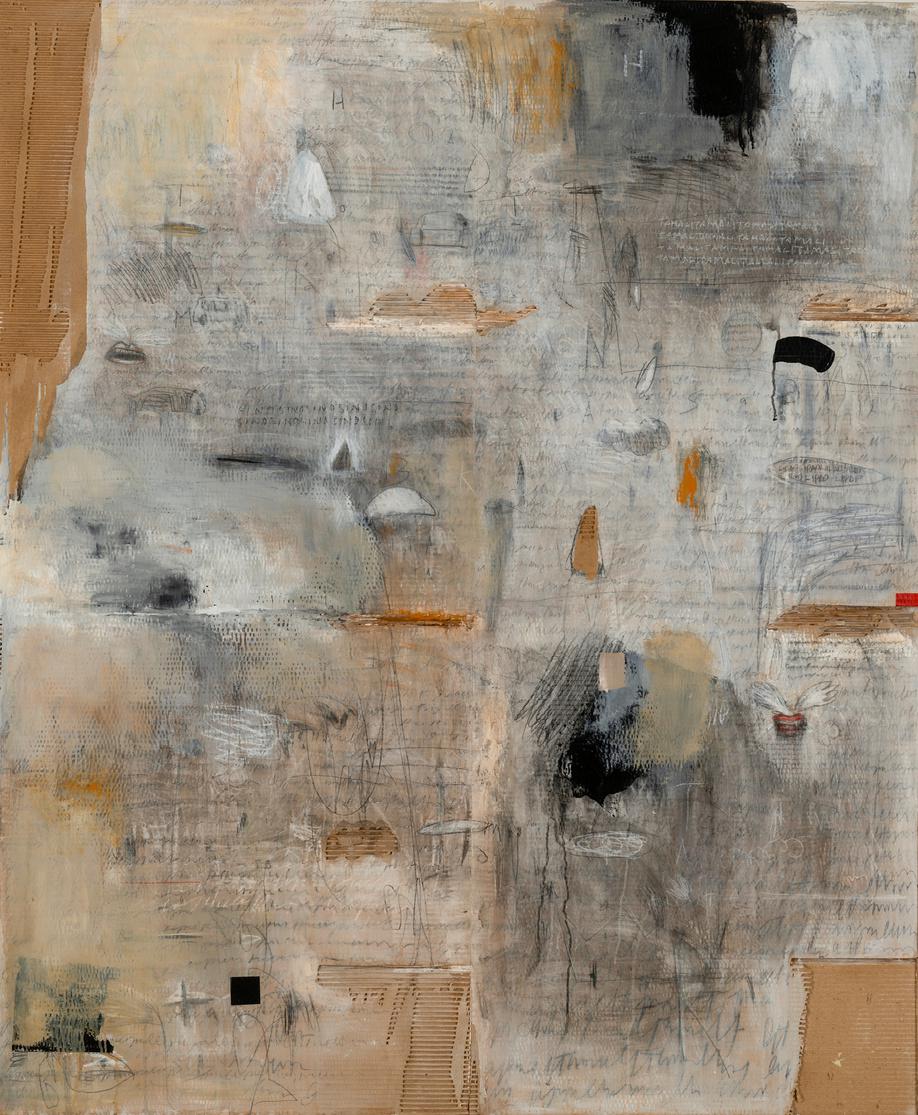
‘Hearsay’ by Demetrio Padua Jr. (2012, mixed media)
“The National Museum has borrowed, I understand, close to 200 works.”
The making of the BSP art collection continued to the term of BSP Gov. Amando Tetangco, Jr. The BSP Cultural Properties Acquisition Advisory Committee, chaired by Dr. Laya, is in charge of the collection.


