
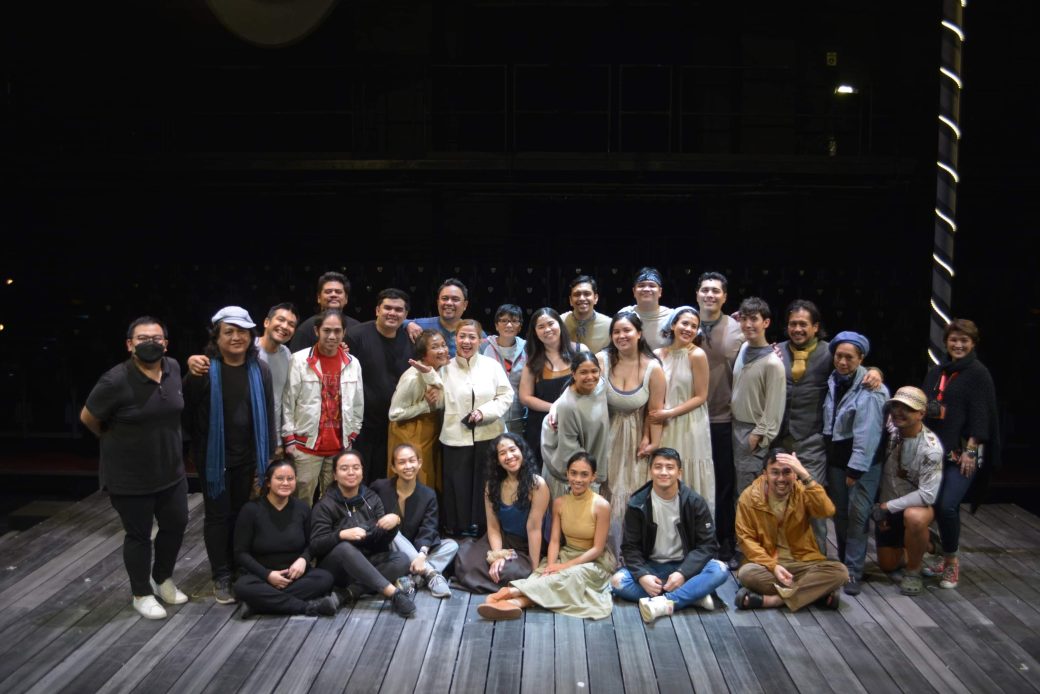
For those of us who grew up watching Repertory Philippines’ productions, Zenaida “Bibot” Amador and Baby Barredo will always be synonymous with Broadway. They co-founded Repertory and produced, directed, and starred in countless productions authored by everyone from Lillian Hellman to Lerner and Loewe. The two phenomenal divas aren’t with us anymore but this didn’t spell the end for Repertory. It’s still kicking with its current production of Rodgers & Hammerstein’s Carousel.
Carousel doesn’t merely mark the return of Repertory after a two-year hiatus brought about by the pandemic. It also heralds a return to the classic musicals. Repertory’s artistic director Liesl Batucan-Del Rosario chose to stage Carousel for its 20th season because “it had the deepest personal significance” to Amador and Barredo.
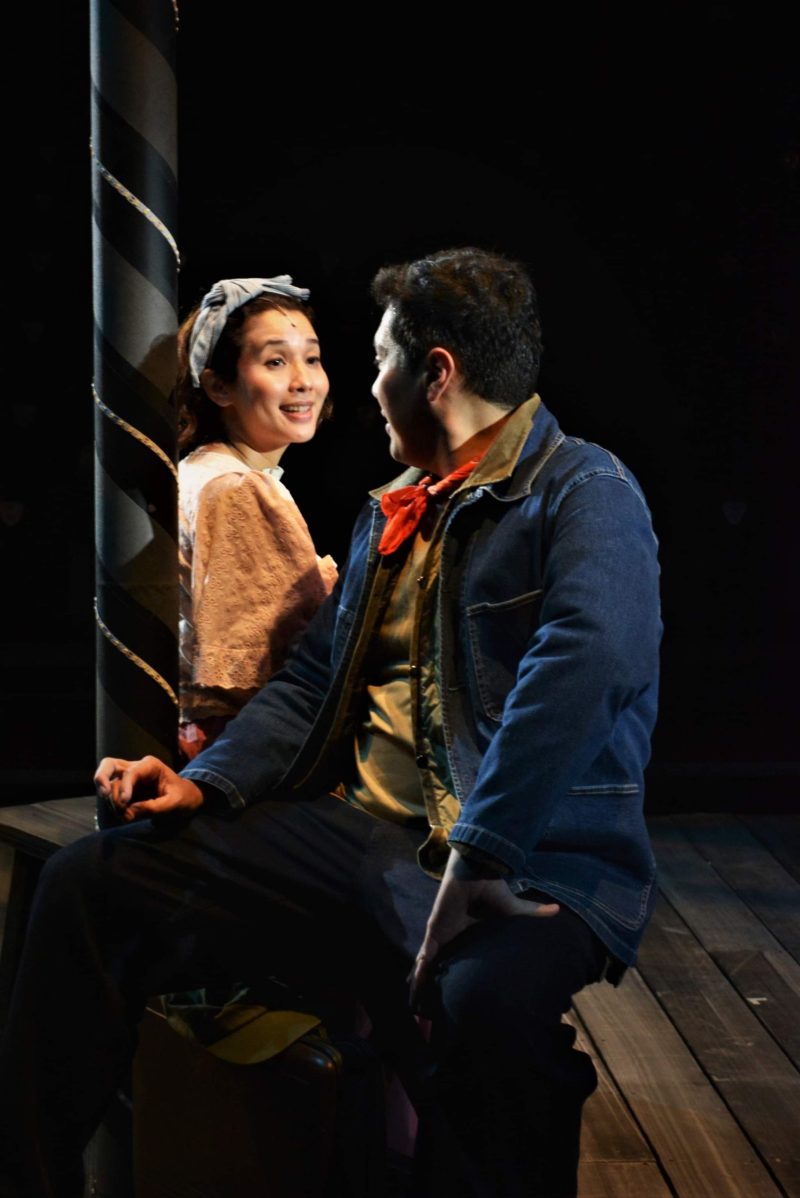
Karylle Tatlonghari and Gian Magdangal: ‘I’ve come to enjoy their depth, profundity, and gravitas’—de Venecia
But as with most revivals, a few nips and tucks have been made to Repertory’s Carousel. At the 2010 Tony Awards, presenter Raquel Welch explained it all when she said that a revival is not necessarily a reproduction. “But the end result is a new experience that has a power to excite a new generation of theater goers.”
Repertory has done exactly that. No major rewrites were made. What they did was underscore the show’s darker moments through choreography and characterization. They’ve also made this grand scale musical fit in a more intimate venue, the newly opened CCP Black Box Theater.

Karylle Tatlonghari with Mia Bolanos and Gia Gequinto
This production imparts an edgy and youthful vibe that makes Carousel look even fresher. The cast is fairly young. Ditto with the director, Christopher “Toff” de Venecia. He’s only 36. That makes him a newborn in the year Joy Virata and Baby Barredo were alternating in the role of Eva Peron in the first Philippine production of Evita (which Repertory staged just months after the 1986 People Power revolution). Who could have imagined that almost four decades later Repertory would still be around working with a director who was born in that historic year!
The acting bug bit De Venecia at an early age. He became a fairly popular child actor and appeared regularly on stage and screen. Today, his day job is serving the people as Representative from Pangasinan’s Fourth District. He’s following in the footsteps of his father, the former Speaker of the House of Representatives Jose de Venecia Jr.
It can be said that he’s also following in the footsteps of his mother, Gina de Venecia, when he’s “moonlighting” in the theater. Mrs. De Venecia’s family was a pioneer in film and entertainment. The younger De Venecia has appeared in numerous shows produced by various theater companies, including Repertory. He eventually established his own theater group, The Sandbox Collection. So there he was at the lobby of the Black Box Theater, dressed casually in black and mingling with friends before the start of the show.
Black box theaters are like miniature arenas. So at first it was hard to picture Carousel in such a small venue. A 2013 concert version at Lincoln Center in New York had an orchestra so large the musicians alone would have filled the Black Box’s bleachers. Likewise, the energetic dancers of the 2018 Broadway revival would have tripped over the front row audience. Anyone who’s seen the 1956 film version will remember the male dancers leaping from rooftops, or how most of the ballet was filmed on an actual beach in Maine. We wondered then how De Venecia would stage his show.
Well, as the director himself described his version of Carousel in the show’s Playbill, the production doesn’t feature the usual “bells and whistles” that came with the film and previous incarnations. “It’s just people telling stories and “sharing their heart and soul onstage.”
Sans the frills, audiences get to be intimate with the cast. There’s no big orchestra to compete with their singing, just a piano accompanist. The stage is bare much of the time. There’s just a single, colorfully adorned post that audiences can imagine as the carousel in the story. In that tiny theater, emotional scenes are magnified. The audience gets truly involved in the plot and we get to really understand the context of the songs. When male lead Gian Magdangal stands three feet away from you and performs Billy Bigelow’s’s Soliloquy facing you, you’re immersed in the character’s thrill over the prospect of having a baby boy. (It helps that Magdangal brings the house down with that performance.)
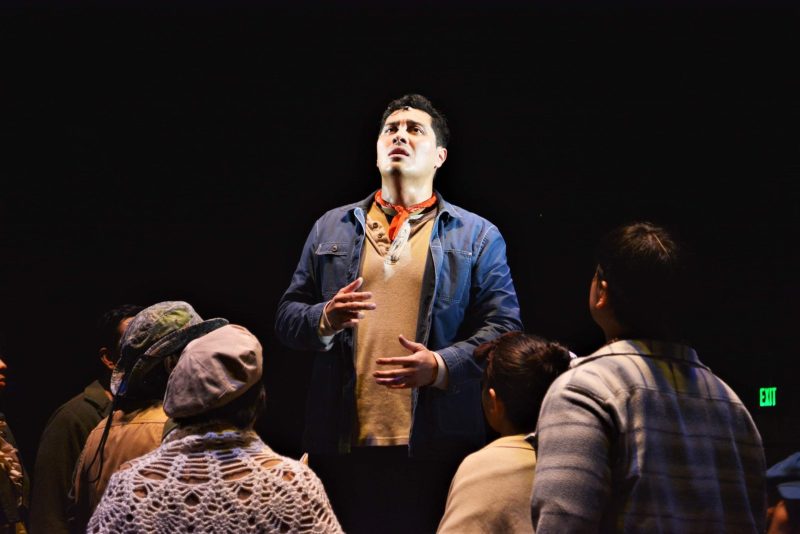
Gian Magdangal brings the house down.
In mounting the show, fitting Carousel into the confines of a black box venue was just one of the many challenges De Venecia faced. First and foremost, he says he didn’t even care for traditional musicals, which he described in Playbill as “The Establishment.” He was surprised when Liesl Batucan-Del Rosario offered him the job in 2019. As he wrote in Playbill, he had several reasons he was averse to directing the show.
With its dark theme and less than happy ending, Carousel wasn’t as popular as the later shows of Rogers & Hammerstein, such as South Pacific, The King and I, and The Sound of Music. But he admits it does contain some of the finest songs in musical theater history. He adds that Carousel has the most operatic songs ever written by the duo and he was humbled and flattered to be asked to direct it. But he considers Carousel as “definitive establishment.”
“I’m a modernist,” he wrote. “I’m known for directing contemporary, fringe-type work—not proscenium spectacles. I’m very much a millennial in age and mindset, and my works have always catered to my generation. Carousel caters to my parents.”
But he stopped to think and he pondered. He said there was something in Liesl’s heart that propelled her to bring him “and this 20th century” text together. “We’re both believers in energy. Or perhaps it’s to see ‘if the greatest musical of the 20th century’ as dubbed by TIME Magazine could hold space in this century.”
In doing his research on Carousel, the director said he was “galvanized” by the musical’s source material and its darkness. Carousel is based on a Hungarian play called Liliom, and De Venecia came to realize how the musical was forged with Liliom’s spirit. “Violence, misogyny, domestic abuse, generational trauma, catcalling, abandonment, social injustice, the value of artists in society. We cast a definitive spotlight and wondered if R&H’s Carousel could, despite the romanticism and music’s largesse, could be taken into account and be relevant in the age of MeToo,” he said.
De Venecia notes that a controversial line in the show that appears to condone violence in favor of filial or emotional commitment, which he describes as entrapment. “This and many other aspects of the show are seemingly remnants of MeToo that sadly still exists today,” he said.
He explains that in his previous works, he’s always gravitated toward the political. He blames it on his Political Science background and political upbringing, or that he’s actually involved in politics. Thus his vision of Carousel is less romantic and far from rosy. He explains that there is “a lot of darkness, prurience, and mordancy” in his reimagination. He says his version is closer to a revival that was produced in the 1990s than the film or the concert and the 2018 Broadway revival.
“But there’s a lot of playfulness too since it is postmodern. It’s self-aware. It draws inspiration from a lot of sources – from our collective Covid experience, the Great Depression, which sees to estimate what we went through with COVID,” he said.
Indeed, our doubts suddenly vanished when the pianist started playing the Carousel Waltz at the start of the show. The beautiful, lilting music got us in the mood and in a snap we were prepared to come under the spell of Christopher de Venecia’s version of Carousel.
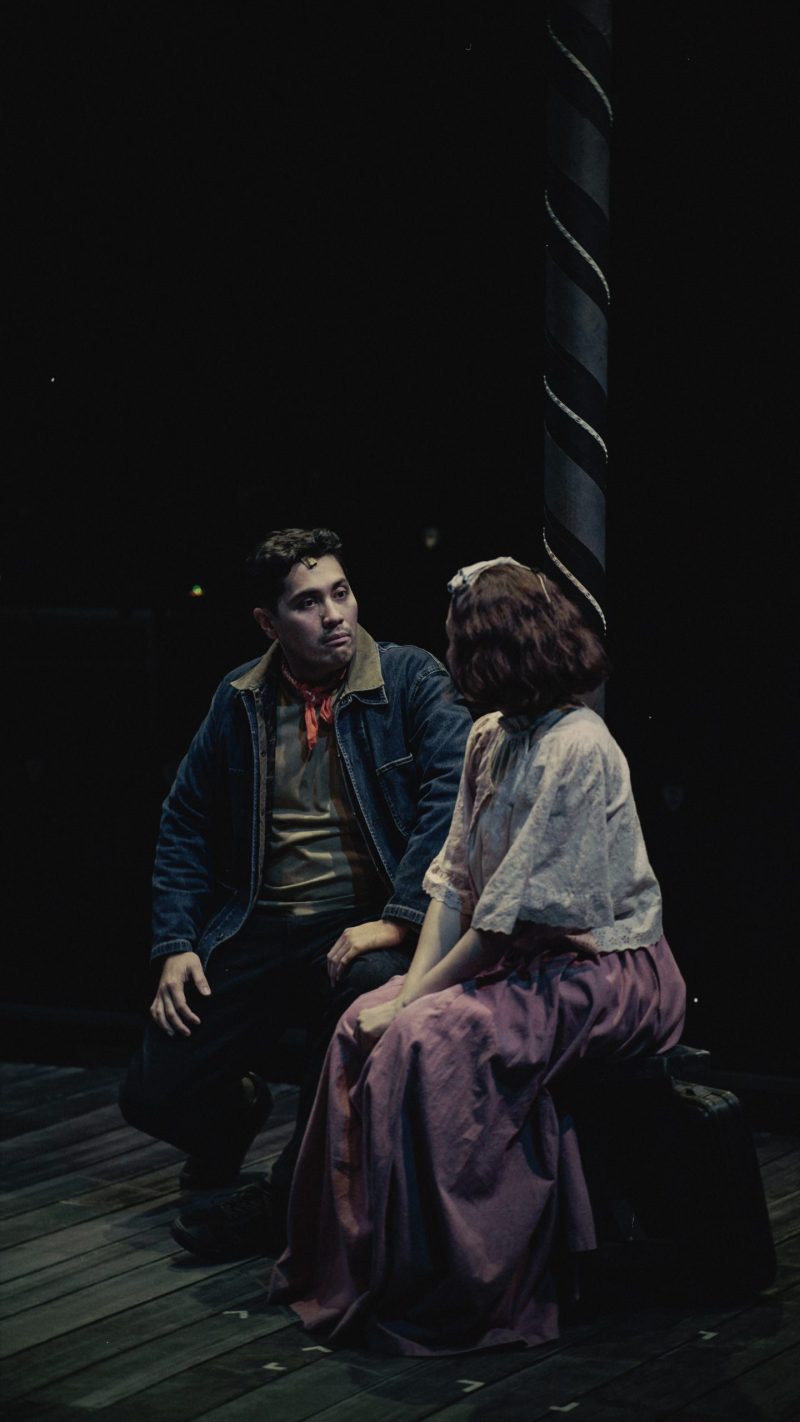
TheDiarist.ph’s Q/A Toff de Venecia:
When and how were you bitten by the acting and theater bug?
It was after I joined my first workshop with Repertory Philippines in 2005. We did a production of Guys and Dolls, directed by Arnel Carrion and Cara Barredo. I played Nathan Detroit. Shortly after, I was hooked.
Who were the people in the world of theater who influenced you?
Tita Baby Barredo and Tita Joy Virata were among my first mentors in theater. The directors I am inspired by the most are John Doyle whose work I first encountered in an actor-musician production of Sweeney Todd on Broadway, Robert Icke who directed memorable productions of George Orwell’s 1984 and Oresteia in the West End, and theater philosopher Anne Bogart who co-founded viewpoints (a rehearsal technique I use in building stage images and unleashing the creativity of the ensemble). I am also very much inspired by the work of Dexter Santos.
Why did you decide to be a director?
I enjoy working behind-the-scenes and executing a vision with the team. The page-to-stage journey is so rewarding.
Much of your previous stage production stint as actor and director had more contemporary themes and subject matters. What got you interested in a traditional musical like Carousel?
I had a very contemporary reading of this classical piece and thought it would be both interesting and important to explore it from this lens.
Have you seen previous productions of Carousel (here or abroad) and the film version? How did you react to the musical and which production did you find the best?
Yes, I saw it both on Broadway a few years back and at the English National Opera. I saw excerpts of the show on my DVD copy of the Cameron Mackintosh Hey Mr. Producer concert when I was much younger. And as part of the research for this production, I watched the film. I saw a video recording of the Nicholas Hytner staging at the Lincoln Center in the ’90s via the Lincoln Center Archives and was most intrigued by that version. I liked its darkness. It was prurient and that the compositions emphasized the drudgery and social inequality.
What was your reaction when Repertory offered it to you?
I was surprised since I’m known mostly for staging and producing contemporary theater, almost fringe-type work —not lavish proscenium spectacles. And my work caters to millennials. I thought that Carousel catered to my parents who are both boomers.
Composer Richard Rodgers reportedly said Carousel was his favorite work. Would you agree with him? Do you think it’s the best work of Rodgers and Hammerstein?
It’s certainly the most operatic. The songs are among the most memorable and iconic from the musical theater canon. But I have a bias towards The Sound of Music since I grew up watching that.
Certain people who are described as “woke” have said Carousel sort of sanctions spousal abuse. What’s your take on this?
This production definitely condemns it rather than romanticizes it. The material is quite dated and we felt passionate about making a firm stance on VAWC, that it is not to be condoned in any shape or form. We might have missed out on this opportunity if we went with a traditional, straightforward romantic version.
Whose idea was it to present the musical in a smaller venue like the Black Box Theater?
The CCP grant was broached by Liesl and I immediately jumped at the opportunity.
Was it a major challenge for you to mount what has always been considered a grand scale musical in such a small venue?
I was always more interested in black box venues than proscenium stages. I like the intimacy of it. It also stretches your creativity.
Which part of the musical was hardest to fit into the smaller stage? Having seen the movie with its outdoor location shoot, would it have been the hardest to stage the ballet or the musical number June is Bustin’ Out All Over?
The decision to do it in a Black Box shaped our ideas for this particular staging. We didn’t encounter hardship in ideas, but perhaps what was most challenging was shaping the show in a thrust with audiences on two sides, and another audience on a third.
But would you think Carousel is better suited to a smaller, more intimate venue?
Perhaps it’s a path forward towards a more sustainable theater.
How much input did you put into the dancing? Did you work closely with the choreographer?
Yes, it was a collaboration with Stephen Viñas through and through. Our assistant director Kyla Rivera also provided a lot of insight and ideas into staging. Apart from the deconstruction of most of the musical numbers in the show, we were excited about the prospects of reimagining the ballet. So from narrative, it became a commentary on the themes of the show: generational trauma, violence, toxic masculinity, misogyny, and violence against women. I was very much inspired by the Daniel Fish staging of Oklahoma! which also reimagined the dream ballet of Agnes de Mille.
Most theater revivals often put some changes in the libretto and sometimes even in the songs, so what were the changes that you made yourself? Were some of the other changes based on the changes that were made in the revivals?
We didn’t alter anything in the text because of limitations from the rights holders. What we did was alter the intentionality of how the text is approached. Some numbers traditionally performed as showstoppers became avenues to comment on themes or to convey a message we felt strongly about – from consent to catcalling. We wanted to present a Carousel that was more attuned to the times. Most if not all Carousels leaned into romanticism and nostalgia. We wanted to lean into the darkness—closer actually to the source material of this R&H musical, the Hungarian play Liliom.
What are the qualities that Karylle Tatlonghari and Gian Magdangal have that led you to casting them in the leads?
They are both amazing actors with astounding voices. But in the process, I’ve come to enjoy their depth, profundity, and gravitas. They are brimming with ideas and it’s been an absolute joy collaborating with them both.
Did you encourage them (and the rest of the cast) to see the other productions (which may be available on YouTube) or the movie? Or did you prefer to do their own take on the role they play?
I didn’t want them to latch on to any version other than what we set off to do from the beginning. After all, this is their Julie and Billy. I gave them “handouts,” as Karylle likes to refer to them, and made them watch films like Grapes of Wrath that estimate the spirit of the times in which the musical is set.
What are your favorite moments in Carousel?
It’s hard to choose. I would say the ballet. It makes sense of Billy’s torment and tumultuous journey through the eyes of his daughter Louise. It also emphasizes the cyclicality and nature of abuse unless we actively break the cycle. I also love the Starkeeper scene which we reimagined with a Greek chorus instead of a singular male figure. It was our attempt to make this wife-beater come face to face with voices that represent #MeToo.
What would you consider the darkest or most disturbing moments?
The ballet. It’s an expressionist explosion that is so poignant but also rife with pain and postmillennial rage.
As a member of the audience, I think the depiction of Louise was the most disturbing. It was as if she had been a child who had been found in the wilds (as seen in the ballet) or an inmate who had escaped a mental institution, and was constantly taunted. Was this done intentionally to make the play look edgier or to emphasize Louise being an outcast?
The latter. She is a product of a broken family and a broken system with the spectre of her father, literally and figuratively looming over her. While Carousel has been notoriously known as the wife-beater musical, we wanted to lean into the idea of generational trauma. Louise is also omnipresent throughout the show in various inceptions and intentionalities—she is a spectator, she is a summoner, she is a shifter, she is a seer, she is a memory, she is a spirit, she is a feeling, she is a reflection and a refraction.
How would you rate Carousel as a classic musical? Would you think it’s above the more contemporary works of Sondheim and other current musical composers?
It’s not for me to rate Carousel. There are admittedly a lot of thematic landmines viewing the show from a contemporary lens. It is very much a product of its time – written in 1940s America after WW2. But it’s material that’s very meaty and challenging.
Would you direct another Rodgers and Hammerstein musical? If so, which one and why?
What changes would you make?
If anything, this postmodern deconstruction of R&H’s Carousel gave me creative permission to revisit classics and refract intentionalities. If not other R&H titles, perhaps classics from the Golden Age. It’s exhilarating to make something old new again.


