
How often we’ve been told, drummed into our heads since childhood, that recalling the past is needed to get us where we want to go!
But what if a review shows that we’re stuck, still immersed in the tribalism that leads us always into toxic dichotomy—into classifying ourselves today either as Dilawan or DDS; elite or prom di; Inglisero or Bisdak; pa-intellectual or pa-kalyeserye?
Perhaps we need another perspective. A new and fresh one.
Perhaps we’ve looked enough at our situation through lenses that refract reality into too many separate colors so that we lose track of that one single beam called Light into which all colors naturally and ultimately coalesce.
Case in point:
Budots (from the Bisdak slang for “tambay”) is a popular maskipaps-dance, invented in Bgy Camus of Davao City.
It supposedly derives from Badjao celebratory dancing. The dance’s movements—the squatting position when danced, and the rowing/flailing/swimming arm movements, look as if the dancers are on a boat as befits the seaborne Badjao. The dance is accompanied by pop-techno music, very percussive, and called by locals “Bistik” (Bisayan-techno).
Many Facebookers showed a clear bias against the dance. They disparagingly assigned it to be danced by the reviled though victorious senatorial candidates in the past mid-term elections.
But to mock Budots is to miss an important point—that culture is created as much from “below” as from “above.”
To appreciate this is to engender a unity among us that’s encompassingly human, one much more than being merely political.

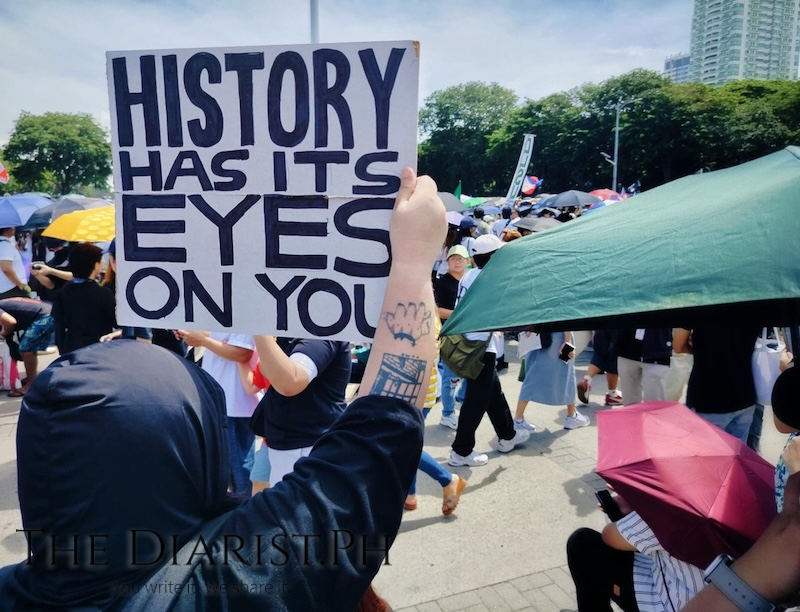
Baha sa Luneta rally (Photo by Medel Sablaya)
Though they may be viewed as victims of history, those we call the Masa, far from being simply victims, are, and have been, active agents of revolution.
Highly motivated, and usually with mystical underpinning, purely Masa revolutionary movements (such as the turn-of-the-century Colorums; the Santa Iglesia in Central Luzon) fought oppressors to the death.
In 1967, the Lapiang Malaya with its founder, Valentin de los Santos, armed with bolos and anting-anting, fought Marcos’ troops and were massacred.
Much if not all of the tragedy behind this is that revolutionary movements from above and those from below tended to proceed on separate tracks. Like the Katipunan, they split into factions (Magdiwang and Magdalo) never combining into one, complete, successful whole.

A question from Baha sa Luneta rally (Photo by Medel Sablaya)
Our challenge today is to try to discover why this has been so, and hopefully prevent history from repeating itself.
The sense of unity that has eluded us begins with understanding that our reality can no longer be divided into one “above” and another “below,” but should be a single inclusive reality—one united by common ground—by issues which address the good of all.
Perhaps too we must read in between the lines of history, in what’s known as “conventional wisdom,” go beyond the biases that have grown due to western-oriented education—towards knowing the Masa, who together with the Katutubo among us, establish the base line of our culture on which we—elite, Masa and Katutubo, together, with neither condescension nor breast-beating—must build upon to reach that wholistic cultural experience called Nationhood.


