
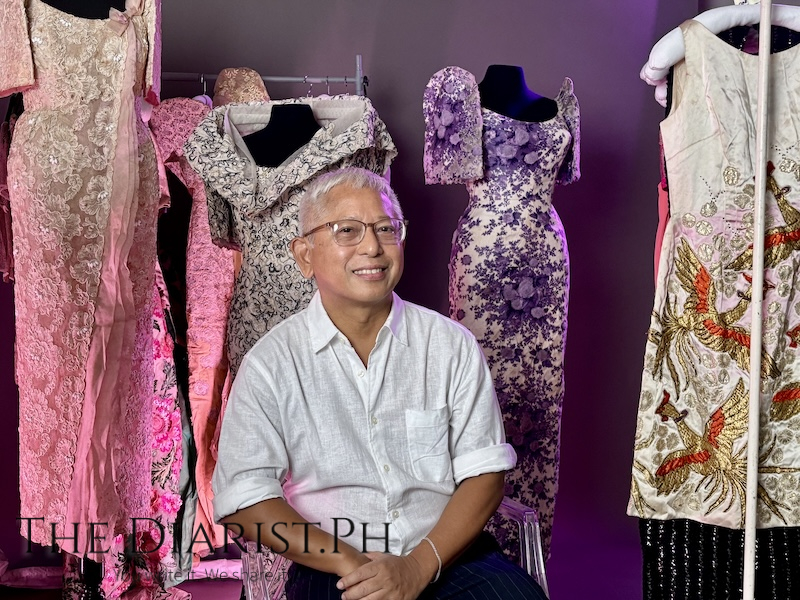
The exhibit, ‘Magsaysay as Muse: Luz Banzon Magsaysay and the Terno as Cultural Identity,’ is ongoing until March 27, 2026 at Ramon Magsaysay Center (Magsaysay Laureate Library and Museum), Roxas Blvd., Manila.
Finally, it is happening. The Philippines is having its first fashion museum that will collect, conserve and showcase the works of the Filipino fashion greats starting with the post-war era. The De La Salle-College of Saint Benilde (DLS-CSB) is setting up the Benilde Fashion Museum to house the select collections of the contemporary design masters.
Stepping inside this room at Benilde’s Design and Arts building in Manila, we feel how the reality of a Philippine fashion museum is indeed taking shape fast. This room serves as a tentative repository of the collections of the masters, which have been donated to Benilde through the efforts and under the stewardship of architect Gerry Torres, the college’s erstwhile head of Architecture until he headed the Center for Campus Arts. He was then given this task to set up the fashion museum.
Hanging on a few racks are the gowns, mostly ternos, of Ramon Valera, Ben Farrales, even Cesar Gaupo. These works and those hidden from view are undergoing preservation/conservation work, categorization, and when there are exhibits, curatorship. It’s a sum of tasks which, in the museum capitals of the world, such as London and New York, is handled by fully-manned institutions housed usually in landmark structures. At Benilde, it is only a room or two—for now.
The Benilde Fashion Museum (BFM) will be in what was known as the Instituto Cervantes de Manila (the old Mayflower building), a 1938 heritage building which is being restored and repurposed into a fashion museum. On Leon Guinto street, a stone’s throw away from the Benilde campus, it should be ready to open to the public late this year.
In the meantime, BFM continues to build its collections—the latest being those of Slim’s or of its founder, the National Artist Salvacion Lim-Higgins, turned over after the pioneering fashion design school was acquired by CSB last year. Last year BFM also acquired the latest collection of Cesar Gaupo which had been in the safe keeping of his close friend, SM designer Anthony Nocom. Both Gaupo and Nocom are deceased. In the works is the acquisition of the collections of the late Auggie Cordero, who, interestingly, didn’t discard any of his collections through his entire career.
While all this is under way, BFM continues to hold events to give the public even only a slight glimpse of its collections. More important, these events give informative talks about the terno and the other Filipiniana creations. Ongoing at the Ramon Magsaysay Center on Roxas Blvd., Manila, is the exhibit, Magsaysay as Muse: Luz Banzon Magsaysay and the Terno as Cultural Identity. It displays the ternos of former First Lady Luz Banzon Magsaysay, designed by Aureo Alonzo, and National Artist Ramon Valera, from the BFM collection.
Ongoing until March 27, 2026, it has lecture series. On March 26 is Ramon Valera: the Evolution of the Terno as Cultural Icon by leading fashion and theater designer Eric Pineda, a member of the BFM board of adviser.
In a talk with TheDiarist.ph, Torres recalls how the Magsaysay exhibit came to be: “I was doing another project at the Magsaysay Center and had a meeting in their library, the Magsaysay Laureate Library, and realized, from a curatorial point of view, that it was the perfect venue to show the gowns of Luz Magsaysay.”
He underscores the significance of the Magsaysay collection: “The Luz Magsaysay collection holds some of the earliest ternos in the BFM collection, designed in the 1950s by National Artist Ramon Valera. They demonstrate the versatility and skill of the renowned fashion designer—in design, construction, fabric manipulation, and embellishment.”
Torres is known for the endurance and tenacity he’s always shown doing spadework. This pioneer at DLS-CSB, a Bacolod-born architect, has been with CSB from its early years as it began to pave the path to innovations in learning, offering courses new to Philippine education: from production design to multi-media arts, music production, and later, photography, animation. He taught history of architecture and became the dean of Architecture, then head of the Center for Campus Arts which stages precedent-setting exhibits and events.
He now heads BFM. “I am a soldier. I go where I’m sent,” this soft-spoken Visayan tells us. Then he adds, “I follow my heart.”
Excerpts from TheDiarist.ph interview with architect Gerry Torres:
Would you tell us the reason behind Benilde’s decision to open the country’s first and only fashion museum?
The story of the Benilde Fashion Museum started in 2021 upon the death of Mang Ben Farrales.
The niece of Mang Ben works at DLSU, knows that we have a fashion design program, got in touch with Bro. Dodo (Edmundo) Fernandez, our president, and asked him if we’d be willing to accept the clothes of Mang Ben. To be honest, initially, I said no; I said, Brother, we do not have the facilities to house these garments, and I didn’t want to put ourselves in a position where we’d not be able to take care of the garments. But Brother insisted that we accept them. So we did, I said on one condition, Brother, just give me a room with 24/7 air conditioning. That’s the basic requirement for conservation.
So we’re here now in this room that was given to us in 2021 in the middle of the pandemic.
We were able to get the clothes of Mang Ben in 2021…. initially, we were given 41 clothes by the family, just a selection…. I created an exhibit of the 41 clothes. I included the students of the Fashion Design program so that they would know about Mang Ben. And we were the first exhibit to open at Benilde.
This was in 2022, still in the pandemic. People were wearing masks, the students had to register; it was that period.
Inquirer columnist Bambi Harper visited; she was the muse of Mang Ben. She was in a wheelchair. When she saw the clothes, she said, this is not complete. There are still so many of Ben’s…. So she took it upon herself to talk to the family of Mang Ben and I guess tell them, just give it to Benilde. They’re exhibiting it, they’re letting the students interact with the clothes and learn from them…. She was able to convince the family.
I remember she even went with me to a storage facility in Makati…. because she wanted to see how the clothes were being kept. Eventually, the family gave us the whole collection.
We have about 360 Farraleses in the collection. So…. the news sort of spread that Benilde was accepting clothes from known designers, and we would get messages from potential donors…. Bambi gave 12 of her Farrales, 12 ternos. Conchitina Sevilla-Bernardo gave some Pitoy (Moreno), Vicky Rodriguez from Bacolod gave her Valeras…. It was also because of Edu Jarque, head of our media relations and close to these families.
Eventually we also got an offer from the family of the late Tonichi Nocom for the clothes of Cesar Gaupo, to be donated through Jackie Aquino this time.
We now have about 550 clothes. At one point, Brother Dodo said let’s have a museum because he was probably thinking where are we going to put all these clothes….
Why invest in fashion, for De La Salle and Benilde?
To begin with, the Fashion Design program is one of the strongest at Benilde…. the fourth in terms of enrollment, so there’s really a lot of interest in fashion…. And Brother Dodo, an artist, when he saw the clothes, realized that these are works of art, worthy of being collected and conserved.
How were the students reacting to the exhibits of collections that were done way before their lifetime?
I did an exhibit on Ben Farrales in 2022. In 2024, I did another when we had more clothes. Another exhibit specifically on the ternos. We called it The Ternos of the Benilde Collection. But before that, in 2018, I already did an exhibit on Ramon Valera….
How did the students react? First, they don’t know who these designers are. With Mang Ben, we had 80 students participating in the exhibit because I asked them to do miniature interpretations of Mang Ben’s clothes. The first time I asked them, “Who among you know Ben Farrales?” Among 80 students, I think only three said yes. And they said, “Because of our grandmothers. We sort of heard about him from our grandmothers.”
So the young generations don’t know these great designers of the past…. It is different when they see the clothes in real life.
Most of them are amazed. Some cannot believe that Filipinos can do clothes like this. When they see the details, the craftsmanship, the construction, they’re amazed that, you know, 30 years ago, 50 years ago, Filipinos were able to do couture comparable to the ones that were done in Paris or in America.
This is a very huge undertaking. What is the vision of the museum, the priorities and emphasis you will need beyond having the room to store?
The museum has been in operation for a year already. We focus on four directions.
The first direction is conservation, which means eventually we will get into serious conservation, repair, rehabilitation of the clothes.
The second is collection, we hope to be able to collect and have a good cross-section of Philippine fashion history.
The third is exhibition, to be able to share the collection with the public and, of course, with the Benilde community.
And the fourth is education. The fashion museum will be intertwined with the fashion program of Benilde and also Slim’s School, which is now part of Benilde. So the Slim’s School, the fashion museum, and the fashion design program will be working closely together to enhance the education of the students under these programs.
We are doing the finalization of the plans of the heritage building at the corner of Estrada and Leon Guinto in front of St. Scholastica. The former Instituto Cervantes is a 1938 heritage building we are converting into the fashion museum. It’s four and a half floors, approximately 2,000 square meters of floor space…. It will be designed by Gerard Lico and me also, I’m helping Gerard to turn the MFC—formerly the Mayflower also, it has many names—into the Benilde Fashion Museum.
The museum as a museum, as an institution, is running, but the renovation of the MFC/Mayflower building started. We are looking at possibly September 2026 to open the museum to the public.
Do you have priorities in setting up the museum? You said conservation will be your priority.
These are equal priorities, but in terms of space, of course, the conservation area will take a big chunk of the building. Exhibition, of course, although the hierarchy now that I’m looking at, at how we are, how we are expanding, seems to be changing because I realize that we need a lot of space for the collection.
We will have, including the Slims collection, approximately about 900 clothes maybe by October (2025) …. in this room, we have about 550 pieces, it’s already filled to the rafters.
We are open to collecting pieces that are not necessarily Filipiniana because Philippine fashion is not, was not just Filipiniana
What are your criteria in accepting the collections? In terms of fashion, design, and history? It will not be all ternos, for example, like those of the golden era of Philippine fashion, of the ‘70s and ‘80s of Inno Sotto, Auggie Cordero, and Gang Gomez.
I think we hope to get representational pieces from each decade just to show the progression of Philippine fashion design through the years. And it’s not just ternos because after a while, you know, fashion changed, and fashion changes quite quickly. In fact, the collection of Cesar Gaupo, about 125 pieces, does not have ternos. So we are open to collecting pieces that are not necessarily Filipiniana because Philippine fashion is not, was not just Filipiniana. It was a range of designs, and we just want to emphasize the genius of our fashion designers and what they were able to do.
We also want to focus on clothes that are modern, contemporary, even major progressions like RTW. That will be part of the collection because that is part of the story of Philippine fashion.
Did it cross your mind to weigh artisanship, craftsmanship, and design? Given the many trade fairs, it’s been mostly artisanship or craftsmanship all the way from the Mindanao tribes. What will be the emphasis of the museum?
We don’t really want to give value judgments on these areas, craftsmanship and design. But when I saw the clothes up close and I saw the level of craftsmanship…. beading, embroidery, weaving, draping, it brought to mind the people behind the designs, the ones constructing the clothes, and the amount of time and skill they devoted…. because I’ve seen pieces that were amazingly constructed and embellished and detailed. My mind went to the people behind it…. the beaders, the embroiderers that were for me as important as the designers. I’m an architect, and I know that the design is just 50 percent. The execution of the design is another 50 percent. So I compared that to fashion. The design is only half of it. How it will be executed is the rest of the work.
So I salute and always tell our students, when you look at these clothes, also think of the people who did this, the Filipino craftsman. I will also give it emphasis, you know, the amount of work, skill and talent the Filipino craftsman behind the designs.
How are you building the infrastructure of this museum, starting with the technology of conserving the clothes, or maintaining the embellishment? Do you have access to this technology? Will you get foreign consultants?
We are the first fashion museum in the country, so we’re learning as we’re going along…. we’re learning how to preserve fabric and textile and also rehabilitate them. We are getting people from outside. Last December, we were able to get an expert from Japan, one of the foremost textile experts…. We had a two-day seminar under the auspices of the Japan Foundation.
We are going to continue reaching out to other countries, other museums who may have had more experience in conservation. We are going to need help in this project because we’re the first to do it. We learn as we go along. We may make mistakes, but if we learn from those mistakes, we’re willing to do that. We are aware that there have been museums ahead of us, even just starting in Southeast Asia or Japan. We have reached out to them, and we will continue reaching out to give us assistance.
For now, you are limiting it to clothes. There will be no fabric or textile collection.
Yes. We are focusing on clothing first. Women’s clothes first. There are also people asking me, do you want barongs from, you know, this designer? I said maybe we do women’s first. The framework of the museum is 20th century, from 1900 to the present. We decided not to include 19th century because there are museums already doing that. We need to limit our scope.
So it’s contemporary Philippine design
I’d like to call it modern because modernity in fashion started in the ‘20s and ‘30s, when people started to get away from the corsets of the 19th century…. with Chanel and Poiret, who started to have loose clothing. Maybe we can use modern fashion that will define what we will do at Benilde Fashion Museum.
Do you have a wish list, since this is a first, and there is no precedent for this kind of project and vision?
First, we hope to get the support of the Filipinos because this is an important part of our legacy as a nation, as a people. I believe fashion is a reflection of who we are as a people and also the history of the Philippines. So, we hope to get the support of people.
We hope to get donors and sponsors because the budget that’s been given to us is not really that big. You know, Benilde is a school and it has many needs.
Are you at liberty to disclose the budget?
Maybe not yet because we are not definite with even the estimated cost…. the biggest expense is the renovation of the building. And that’s probably going to run, of course, in the millions, maybe a hundred million, perhaps even more…. We were able to get one donor already, and I was very happy with Ernest and Josie Rufino, who gave an amount that will help in furnishing the main gallery for the exhibits, because we need to have the proper lights, the proper climatic systems for the galleries.
We also need to have special firefighting equipment, and these cost a lot of money. We need to do state-of-the-art if we can. So that’s why the support, I hope, can also be financial.
Most museums need the support because you can’t really earn from tickets or events. We really need funding from people who are going to decide to support a very important part of our legacy as a country and as a people.
So part of your wish list is the funding and the support.
The funding and the support. We will eventually invite people for naming rights of certain rooms and areas in the museum, like the archives, and the conservation room, libraries, and the galleries, like what other museums do…. if they want their names there, they will be connected to a museum that is also uniquely part of a school. So aside from being a repository of our fashion heritage, it will also be part of educating the next generation of designers.
It is through education that we secure the future
Are you already working in tandem with the fashion curriculum of Benilde? Do you already have a structure how the students can learn and access the existing collections?
Yes. We started in 2024. We had certain classes come over and look at the collection. We will eventually have a study collection. We will have select pieces they can look at. We had a meeting with Angelo Lacson, our vice chancellor for Academics, and also Ionica Lim, head of our Fashion Design program, Dean Harvey Vasquez, Dean of Fashion Design, and Christine Bennett, head of Slim’s Fashion. The five of us defined certain subjects that will have some weeks in the semester to be spent going through the collection, studying the collection. So it’s already in the curriculum of the Fashion Museum as well as in the upcoming Slim’s curriculum.
To recap, can you underscore again the significance of the establishment of this museum, not only in Philippine fashion design but also in education and for the future generation?
It has to be emphasized that it is a school that has decided to put a stake in the first fashion museum—Benilde. And because of that, it also makes it a unique partnership because this is a museum—the first fashion museum in the country—the first museum in fashion that is strongly connected to a school.
I am also a teacher, I’ve been with Benilde for the longest time, and at heart, I am really and still a teacher…. I find this very important because of the educational element. This is an investment in the future, through our students.
I’ve seen through my years here at Benilde how talented and creative the Filipinos are. And my proof? Every year, with freshmen coming in, I see them batch by batch…. and after three years I see the amount of creativity and output they produce through the years.
I’m excited about this fashion museum because it will be an intrinsic part of their education. If you study fashion at Benilde, whether through Slims or the Benilde fashion program, the fashion museum is a resource that will be available to students.
But not just to the Benildean students, because the BFM will be open to the public. We will welcome students from all over the country…. even researchers from all over the world…. because I really believe that it is through education that we secure the future.
So this museum will be a source of education for our next generation, not just in fashion, also for design. So this will be a center of design for the next generations of Filipinos and global citizens.


