
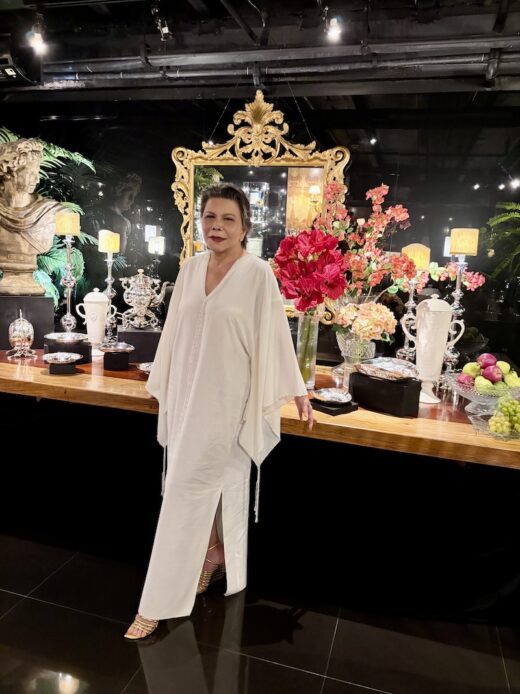
Nothing Fabulous will have a pop-up from March 25 to 29 at Mentxaka at DPC Place, G/F Unit 2, DPC Place Building, 2322 Chino Roces Avenue, Taguig.
Style maverick Lourdes Menchaca de Tuason, Doody to friends, has always been a seeker with a sharp eye and restless curiosity. She has scoured France and England for fine silver, immersed herself in goldsmiths’ workshops in Italy, and explored emerging metaphysical frontiers online.
These experiences now shape the aesthetic of Mentxaka, her boutique for European artisanal objects and select fashion pieces. The name comes from the Basque spelling of her ancestral surname. Mentxaka is best understood as Doody’s curated world of décor and design, an extension of her taste and devotion to exquisite craftsmanship.
Doody watches the seasonal shows the way others scan headlines, streaming the major houses on YouTube to stay fluent in what designers are thinking. It is not because she intends to wear any of it, but because she wants to see where taste is heading.
Right now, she finds the whole landscape flat. The departure of Maria Grazia Chiuri from Dior and the reshuffling at Celine suggest a reset, while Matthieu Blazy at Chanel may finally push things forward after what she considers a stalled stretch under Virginie Viard. Even John Galliano has been quiet after his departure from Martin Margiela, and Rick Owens, usually a provocateur, seems restrained.
For Doody, the lull reflects something larger. The mood is cautious. Consumers are holding back, waiting to see how global tensions and political volatility play out. Fashion is simply mirroring that collective hesitation.
That hesitation, she says, exposes a divide. The people still spending wildly, logos plastered everywhere, are often those who have not quite figured out who they are, easy targets for an industry built to keep them buying. Those drawn to quiet luxury tend to be more secure, less interested in proving status through constant novelty. That has always been Doody’s instinct. She shops for design, proportion, and workmanship, not labels, and sees no reason a well-made piece cannot be worn again and again without apology.
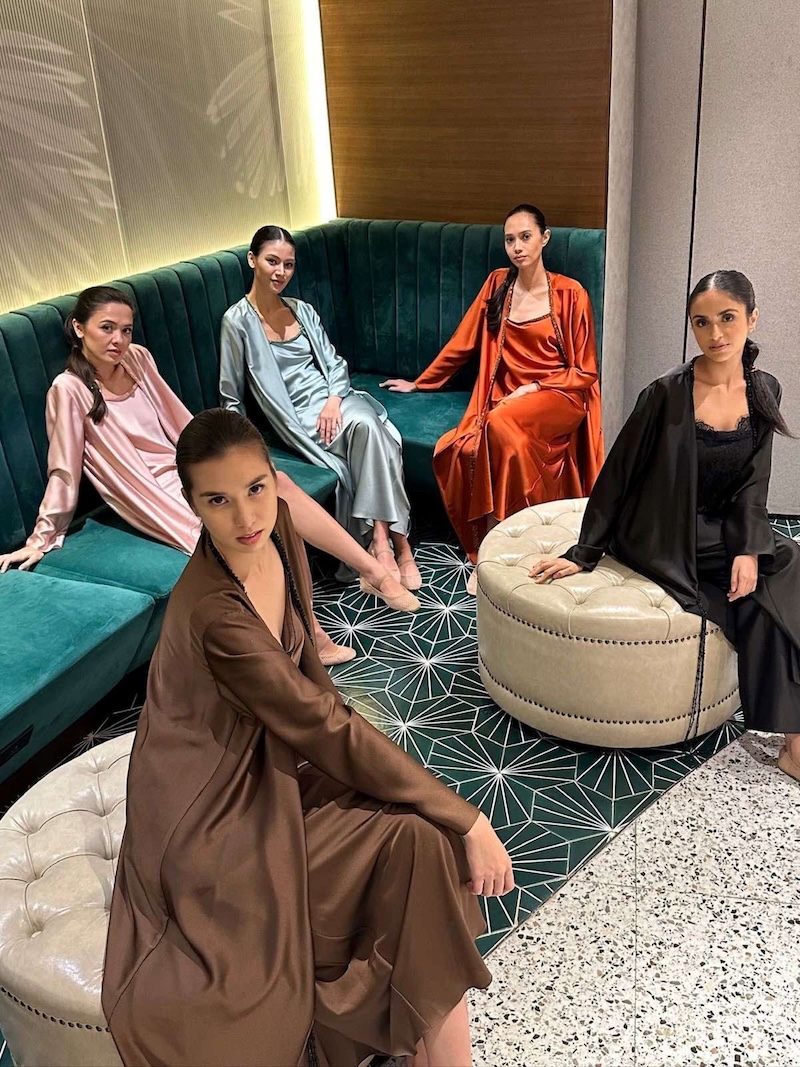
An array of long bias chemise satin dresses with matching night coats adorned with beaded neckline and tassels
That self-possession traces back to a stubborn, early rebellion. As teenager, Doody fought constantly with her parents, who wanted her properly dressed for dinners and parties. She clung to her repeatedly worn jeans, pressed but never washed, paired with battered Italian moccasins. In the 1970s she rotated between Fiorucci and Levi’s denim, tiny boys’ T-shirts that fit her slight frame, and peasant blouses sewn from her aunt’s saved flour sacks.
These choices baffled her family but aligned with the anti-establishment hippie look she was determined to project. Logos meant nothing then. It was all about silhouette and attitude, often finished with a fringed Davy Crockett crossbody bag, homemade pieces, and dramatic lashes layered in multiples.
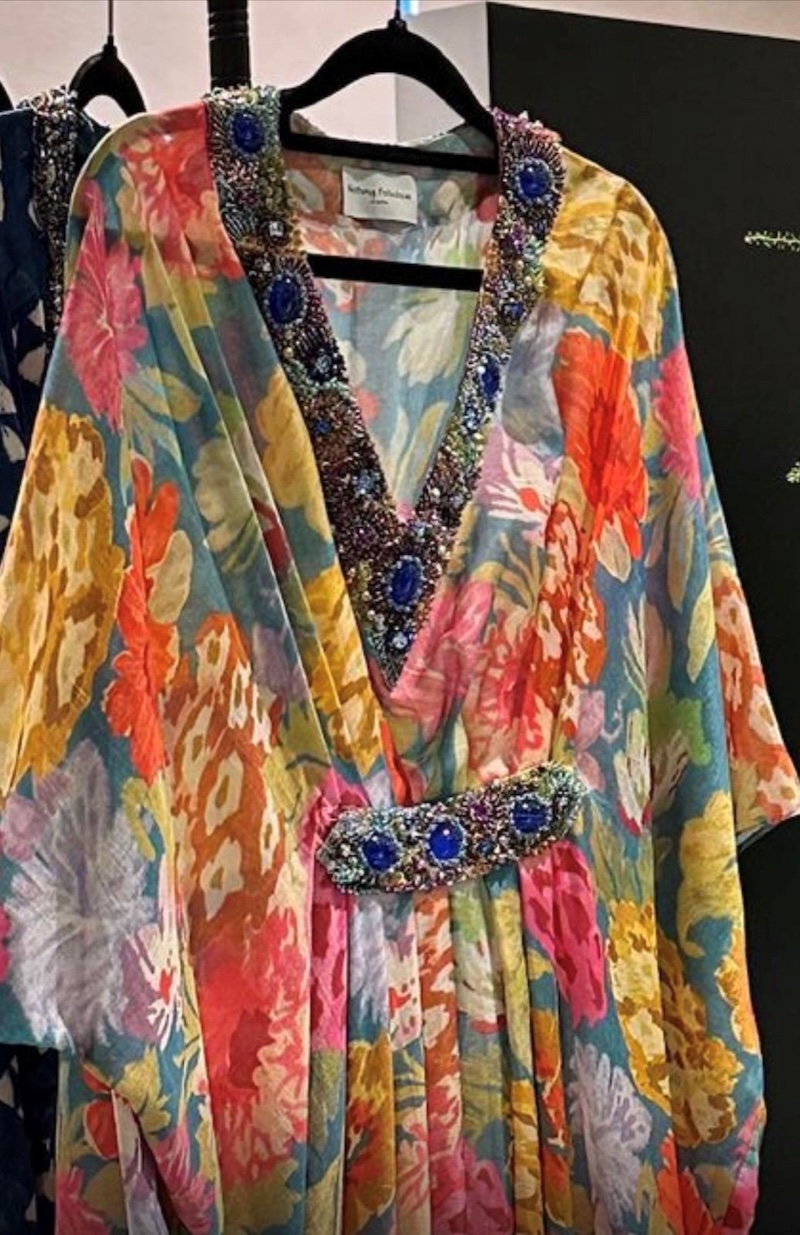
Printed silk kaftan with emphasis on beaded neckline and waist
Likewise, Doody treated style as improvisation. She threaded beads onto knitting needles to mimic Japanese kanzashi hair sticks, to secure her Afro hairstyle. Early influences were designer Helena Carratala of the label Azabache, whose refusal to follow convention resonated deeply, and the bohemian mystique of Stevie Nicks, lead singer of Fleetwood Mac.
Doody’s romantic, free-spirited aesthetic gradually sharpened when she began working with Auggie Cordero, whom her sister, Menchu Menchaca, had modeled for. He paid attention to what she actually wanted and pushed it slightly off-center, modern but still wearable.
She was also drawn to the theatricality of Ernest Santiago, though his unpredictability and lack of professionalism made him harder to rely on. This ultimately tipped her loyalty toward Cordero’s steadier hand.
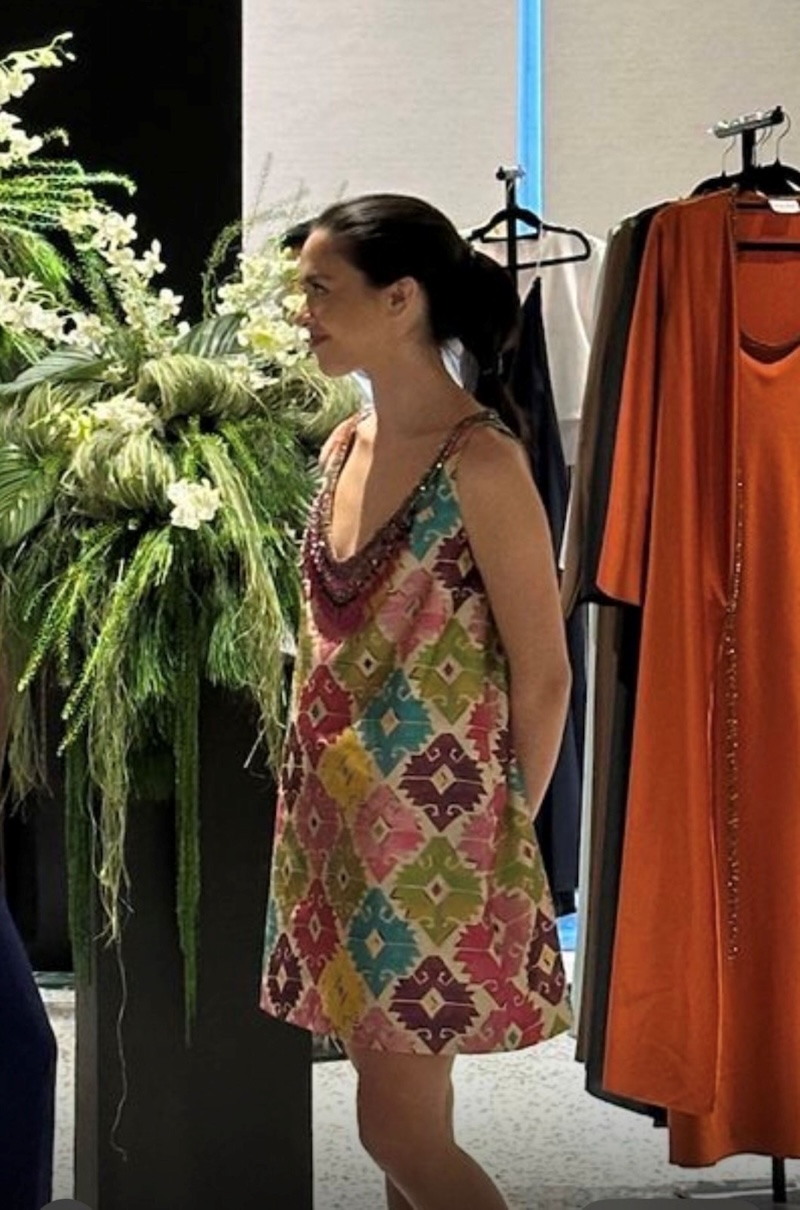
Printed silk tunic detailed with a beaded neckline, that can be worn over silk pants
Her wedding gown was not a debutante fantasy but something streamlined and assured. Cordero’s design featured a deep V neckline, a serpentine fit dusted with tiny rhinestones, and only a modest train, closer to 1920s restraint than 1980s excess.
That moment marked a turning point. Her taste kept refining toward what she now calls disciplined elegance: fewer elements, stronger impact. When there is too much happening, she says, the person disappears and the clothes take over.
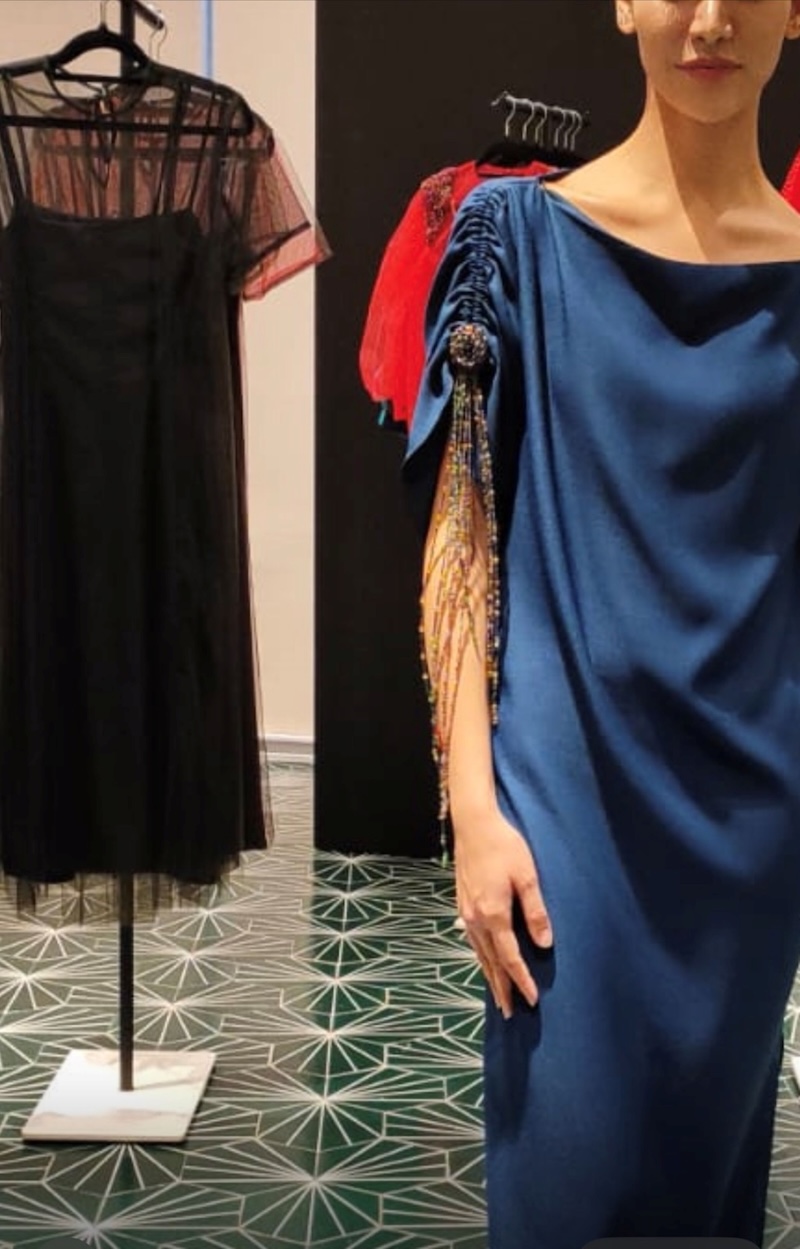
Linen easy dress with ruched beaded sleeves
Doody’s style resists categorization. It leans on fine materials and well-chosen accessories, but never on flash, which makes it hard to pin to any trend or label. For her, dressing has always been a visual shorthand for what she believes and how she feels. The rebellious streak that defined her youth still shows up, though age has edited the proportions. Until her 50s, she was gallivanting in hot pants and high heels, a freedom she now tempers with age-appropriate clothing. But the instinct remains the same. Wear what feels true and let the attitude carry the clothes.
Lately, Doody has been building a loungewear line, Nothing Fabulous, with designer Tina Romack Lirag, launched last year. The idea came after she grew frustrated with local designers—overpriced, sloppy, and unreliable. One designer she tried to help never delivered. Another, initially promising, once offered her a suit with misaligned pockets. Then there were clothes with puckered seams, and exposed stitching. “I’d rather wear my Armanis,” said Doody.
At a VIP event, he repeated the offense, leaving her and three other male personalities in matching fabric. “We looked like a performing quartet,” she recalled.
Her breakthrough came when she met a friend who was wearing organza slacks by Tina Romack Lirag, a third-generation designer from the 91-year-old New Yorker Gown Salon. Under Lirag’s helm, it has been renamed Romack Manila after the founder, her grandmother Pilar V. Romack.
Despite having no formal training in fashion, Tina grew up around the New Yorker Gown Salon, absorbing its standards by osmosis. Some artisans have now been with Romack Manila for more than two decades, and new hires are trained the Romack way. Each client has a dedicated mannequin so imperfections can be spotted and corrected before fittings. The atelier also maintains traditional techniques, including hand-beading directly onto tulle before the embellished panels are sewn into the garment.
“As a client, Doody loves fashion, but she doesn’t dress the way Filipinas usually do,” said Tina. She first noticed Tina’s workmanship through the aforementioned friend’s impeccably made slacks. The friend later gifted her a pair of sheer organza pants with visible stitching and no lining. They fit perfectly without Doody needing to be measured.
“At her age, to wear a pair of organza pants and carry it well, you know the clothes are well made,” Tina says. That encounter led to their collaboration.
Doody gravitates toward refined vintage silhouettes that suit her frame, observes Tina. One of their first pieces reinterpreted a 1950s Chanel suit using T’boli fabric, reshaped into a cropped jacket with three-quarter sleeves and a high-waisted pencil skirt. Dangling shell beads, inspired by traditional T’boli jackets, were added using vintage beads from Tina’s grandmother’s collection. The result referenced Filipiniana without being literal, something wearable abroad while still expressing the Philippines, said Tina.
For SONA 2025, she designed for Doody a modern Filipiniana with a structured bubble skirt in Indian silk, reminiscent of the alaskin silhouettes of the 1960s.
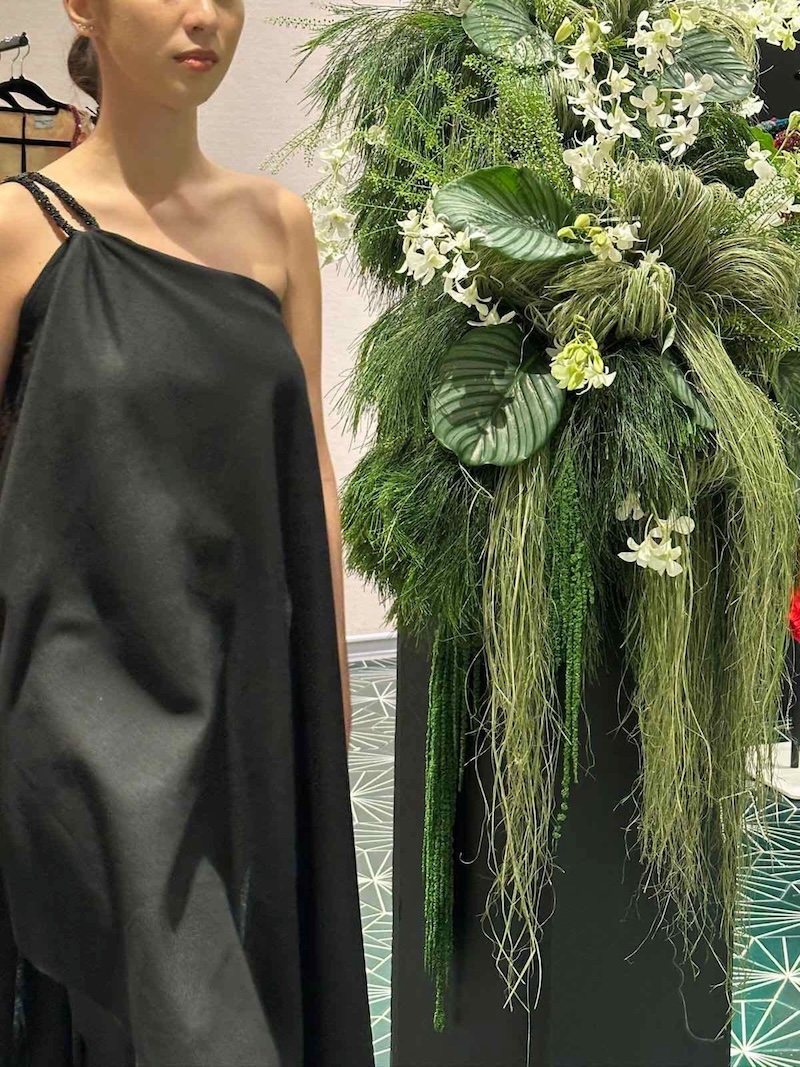
One-sided draped lounge dress in black linen with a beaded shoulder detail
Last year, Doody and Tina introduced Nothing Fabulous, a line of loungewear that was elegant and versatile. Unlike other kaftans that made women look like frumpy matrons heading to a mahjong game, the cuts were flattering, slightly tapered, armholes designed to drape cleanly without exposing the body like other kaftans. It also offered slip dresses and robes. Linen and silk were pre-washed and tested so the pieces could be washed, hung to dry, and worn straight from the hanger without needing to iron or dry-clean. Subtle beadwork added refinement without fuss. Doody calls it quiet luxury.
“Tina brings artistry and precision to every piece. She is a genius with cuts and proportions,” said Doody, who is exacting about finish. “Every garment has to feel right, move with the body, and become part of you. There is nothing worse than an outfit that constricts or makes you sit awkwardly. Tina is not interested in being commercial. For her, fashion is more like art.”
Nothing Fabulous operates like a pop-up. You see a piece now, you buy it, and it may not appear again. “It is a bit like Banksy, the street artist whose work shows up unexpectedly and only once. Each design is unique—one fabric, one print, so you will never run into anyone else wearing the same outfit,” said Doody.
Her aesthetic sense is guided by her spirituality. As you progress on a spiritual journey, Doody explained, you realize you do not need much. To highlight what matters, you have to remove unnecessary details. That principle applies to fashion in general, even in people. To truly appreciate someone, you strip away labels, boxes, and other people’s impressions. When you see the soul, unburdened by pretense or accumulation of traits and emotional baggage, you see the person’s real self, she said. Her approach to style works the same way. Less is more, and clarity reveals what is truly beautiful.
Doody has always been a seeker, exploring different philosophies. She has tried Ananda Marga, joined Siddha Yoga, read the Quran alongside the Bible, and studied the Upanishads and the Bhagavad Gita, the 700-verse dialogue between Prince Arjuna and Shiva on a battlefield in the Indian epic the Mahabharata that addresses duty, morality, and the nature of reality. At first, she did not fully understand it, but now she sees how it all connects. Conversations with her Jewish friends about Yahweh and the Old Testament helped her recognize a common thread. Humanity is connected through a single Source, God whom we can access anytime.
Meditation is central to her life. The day does not feel right without it. Sessions do not have to be long, though she reserves certain days for extended practice. Even brief daily meditation, she says, anchors her, bringing clarity and a sense of alignment that informs everything she does, including her approach to style and beauty.
Nothing Fabulous will have a pop-up from March 25 to 29 at Mentxaka at DPC Place, G/F Unit 2, DPC Place Building, 2322 Chino Roces Avenue, Taguig, tel. no. 8828-9748


