
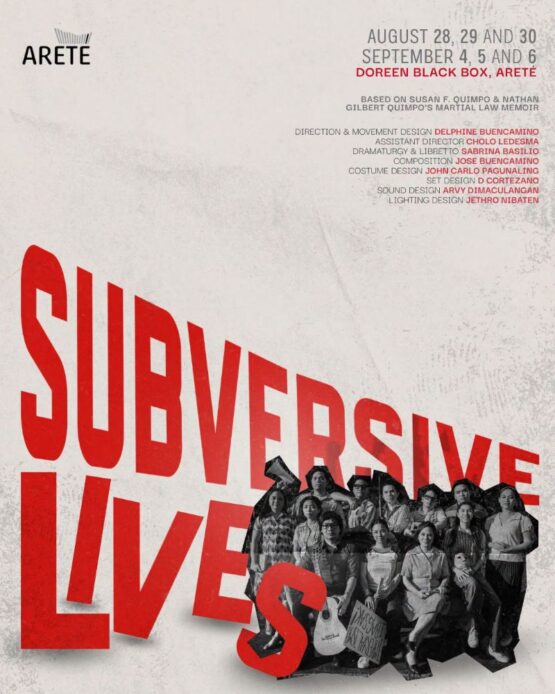
‘Subversive Lives’ runs on its last weekend (Sept. 4, 5, 6) at Doreen Black Box, Arete, Ateneo de Manila University Loyola Campus, Quezon City.
It was some dozen years ago that I got to read the memoir Subversive Lives, and it still ranks among my top Philippine works, whether of history or literature. Authored (if the term is appropriate) by siblings Susan and Nathan Quimpo, it stitches together with astonishing skill the narratives contributed separately by (if I recall right) eight siblings and an in-law, portraying their personal odysseys through the martial law years.
To my mind, it constitutes the most piercingly authentic portrayal of the horrors of that era, through a both intimate and panoramic lens of a single family. (I also made a brief acquaintance of Susan, through my late friend Rofel Brion, and came away with the memory of an engaging, generous personality.)
While the underground armed struggle of the CPP-NPA, which involved a majority of the family in varying guises, is central to the epic, it does not limit its perspective to this, but covers as well an alternative path of a religious community (the Opus Dei), and closes poignantly with virtually all siblings severing their respective involvements with the revolution or religion.
In this way, it served as a micrososm of the national dilemmas, but always as embodied by the family.
So much for a preface: This is not intended to be a book review, but a post about the play Subversive Lives running at the Arete’s Doreen Black Box, Ateneo de Manila University, Loyola Campus, Katipunan, Quezon City, based on the book and directed by Delphine Buencamino.
Inevitably my reactions to the play were refracted through my memories of the book. When I first heard of the projected Arete production, I was honestly skeptical of the viability of transposing the sprawling sweep of the book to a (presumably) two-hour play. I approached it with some trepidation, having had my share of plays or films failing to recapture their original material (or worse).
I had about speculated that it would likely limit its remit to specific dramas (but attempting to convey the spirit of the whole). I was determined that to enjoy it, I ought to prescind from what I remember from the book and appreciate a more limited narrative on its own terms.
As they say, oh ye of little faith! Buencamino’s creative crew and cast are clearly determined to do justice to the full scope and range of their material—and I was astonished at the extent of their success in achieving this.
Through the kaleidoscopic medium of juggling time frames and scenes with dizzying dexterity, the production manages to convey an entire family history reaching back to pre-martial law childhoods, even sketching portrayals of parental backgrounds, and moving forward to the open-ended present lives of the survivors.
Virtually everything I recall from the book is at least touched upon (if with sometimes uneven specificity or context). In the end I felt I had relived the days of absorbedly reading the original.
Inevitably, the capture is not perfect. How could it have been? As previously mentioned, some treatments feel uneven. The death and recovery of the body of Jun is extensively covered, but the disappearance of Jan feels mourned only at a glance. The progress and disillusionment of Emily with the Opus Dei received much more attention in the book.
And, to this viewer, the final portion of the narrative feels rushed, in some details (how did Ryan end up in Europe?), but more seriously in evoking the psychology behind the surviving siblings’ unmooring from their commitments. Such decisions on abridgements are, of course, unavoidable in compressing such rich material into a manageable runtime. And such qualms are likely a result of my overfamiliarity with the book.
But such reservations are really nitpicking when placed in the overarching sweep of the narrative and its insistence on portraying the very human details of the trajectory of its characters—down to the children’s games the siblings played in younger days, or the preoccupation with the Lantern Parade at the University of the Philippines, juxtaposed with rumors of deaths. These run alongside the horrifying torture scenes and the petty bureaucratic hoops for the retrieval of a loved one’s corpse.
Throughout the play’s evocation of national struggle against oppression and the unimaginable cost, the family remains the context; after all the physical pain, almost unnoticed is the collapse of Lillian’s marriage under the strain of resistance. This makes the reality of the struggle all the more relatable, for any generation.
Throughout the play’s evocation of national struggle against oppression and the unimaginable cost, the family remains the context
How this all comes alive is through an outstandingly imagined production. First, there is the audacious physical staging, a wraparound promenade of sorts where the action proceeds all around the audience, sometimes with scenes almost overlapping. I have seen this device a couple of times, notably in the Entablado original staging of Guelan Luarca’s Desaparesidos, and have always found it exhilarating.
This production, however, takes it one step further by seating the audience (or a majority) on swivel chairs, so that the viewers can turn around to follow the action. I am not sure if this is to every audience member’s taste—I’ve had more than one half-joking references to vertigo!— but it enables the staging to run at a breathless, if reckless, pace, with hardly a pause in segueing from the tense to the playful to the visceral.
In two hours and a half of the show, momentum hardly flags. (One has the option to sit more conventionally at the rear, where I was originally ushered, apparently under the notion that senior age may not take to all the swivelling.)
Then, there is the structuring of the narrative, which essentially toggles between three time frames: the present-day framing of Susan and Nathan (Sonny) hectoring their siblings for their manuscripts; the central narrative of the siblings being drawn toward and getting immersed in the revolutionary war; and flashbacks to the halcyon days of family and childhood. The transitions between these—not to mention the sometimes contemporaneous scenes of the activist era—are not always seamless, but their juxtaposition contributes to sense of a family in flux, sometimes violent, yet remaining somehow whole.
Director Buencamino’s orchestration of this often dizzying juggling is outstanding. The play is billed as “devised”: I am not entirely certain of what this entails, but assume it implies an imaginative collaboration of the whole crew and/or cast. In that case, kudos to everyone.
The cast of 10 is superb. Many play double or multiple roles. Aside from the siblings, parents, and spouses, there are sundry bit parts (military, UP orgmates, NPA, what-have-you) such that occasionally, even someone familiar with the book’s narrative can be thrown off. But every role is performed with aplomb.
Naturally the most intensely dramatic roles are of those most directly immersed in the revolutionary struggle, particularly in their portrayal of their transitions from activist to militant—the brothers Sonny (Jerome Canlas), Jun (Jerome Dawis), Ryan (Timothy Castillo), and Jan (Joshua Tayco), and a sister, Lillian (Liway Perez). Particularly grim kudos to Canlas for the horrific torture scene! Susan’s (Rigel Hechanova) role, while not on as visceral a level, serves as the narrative lynchpin, both overall and in particular scenes. The others—Gino Ramirez (as both Norman and Father), Noemi Gonzales (as both Lys and Mother), Teetin Villanueva (as Karen), and Chic San Agustin (as Emilie, the Opus Dei sister)—are a quieter but critical presence. It is, in all, a remarkable ensemble.
And beyond the production’s merits as pure theater, it stands (like the book) just as crucially as a memorial to a nation’s sense of its past and a caveat for its future. It may be a painful nostalgia trip for the boomer generation that lived through it, but its value lies more, in this age of virtual revisionism, in its being a potential source of identification for the younger generations who approximate the age of the play’s protagonists.
It was heartening to see students seated beside us, whose first theater this was, rush out at intermission to buy a copy of the book. I understand that the stack of copies at reception sold out.


