
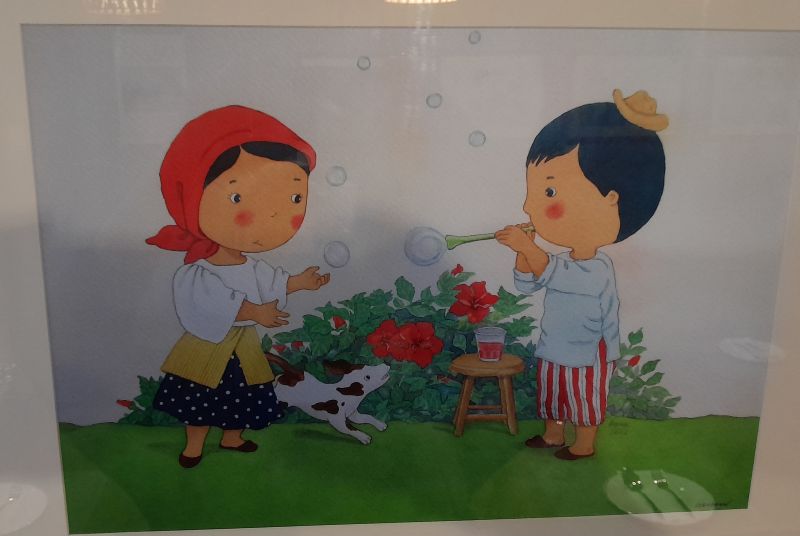
Text and photos by Elizabeth Lolarga
‘Lugod’ is on show until May 31, 2026, Gypsy Baguio by Chef Waya, No. 6 Road 2, Quezon Hill, Baguio City.
Visual artist/children’s book author Kora Dandan Albano is almost family. When my spouse, siblings and children need cheering up, we just gaze at her paintings or prints that hang on our walls, our hearts are eased, and we feel that somehow the world will be all right.
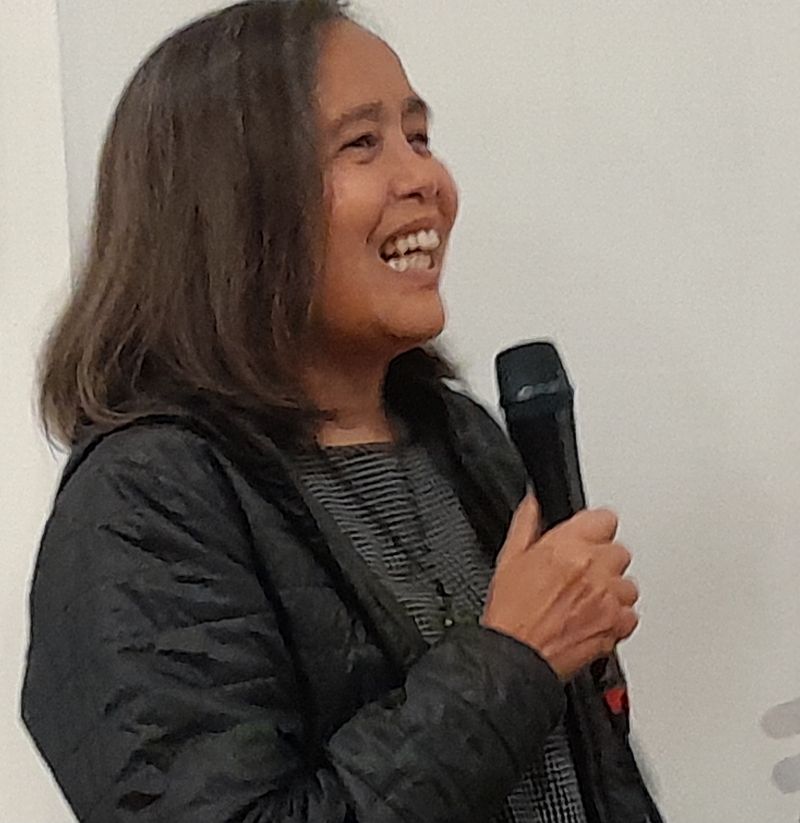
Kora Dandan Albano addresses exhibit guests.
That’s how it was when we turned up for the opening of her exhibition of archival reproductions of her paintings, Lugod, at Gypsy Baguio by Chef Waya in Quezon Hill, Baguio. It seemed like a clan reunion. Familiar faces in the literary and art scene in the city were present, giving their full support to the amiable Kora.
For a few hours there, while performer Nar Cabico strummed his guitar and accompanied assorted singing volunteers, the volatile world was suspended in space, an impending world war was cast aside by community singing.
It didn’t take much egging to make Didier Derouet, baker and owner of the popular French boulangerie L’Atelier Du Grain, sing Billy Joel’s I Love You Just the Way You Are. Miss Saigon alumna and author Lissa Romero de Guia obliged gamely with a couple of standards, including Moon River. Even Gypsy’s Waya Araos-Wijangco was prevailed upon to sing the Joey Ayala anthem Walang Hanggang Paalam, with the audience joining the chorus. There was improvisational artist Gabe Mercado doing a cover of a Simon and Garfunkel song. Nobody left. Each one stayed until the last note.
When the mic was handed to Kora, she blushed like a crimson rose, thinking she was next in the sing-along. Instead, she announced her thanks to everyone for coming on a Friday night, especially to Manila-based Nar to whom she promised one of the 56 works hanging on the wall, in appreciation for hosting the evening and making everything light.
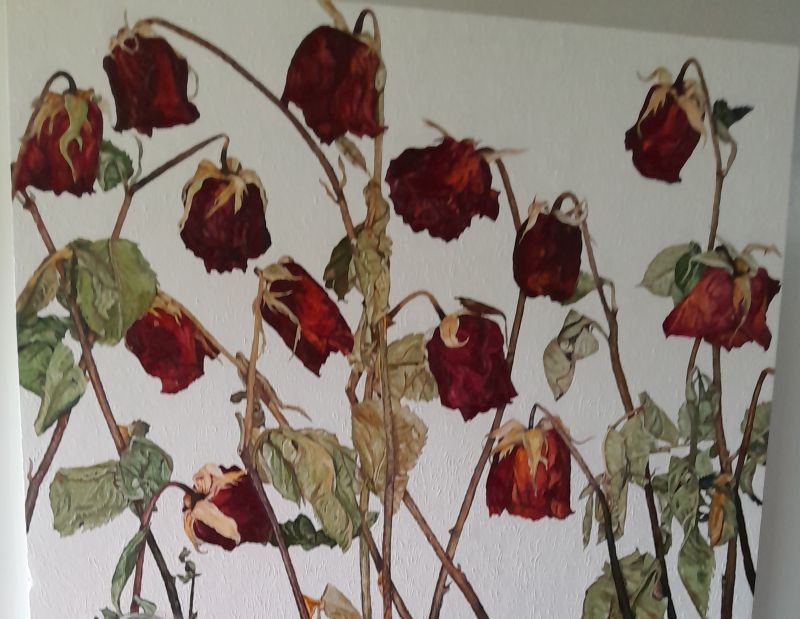
Large-scale still-life of wilted roses, a departure from Kora’s children
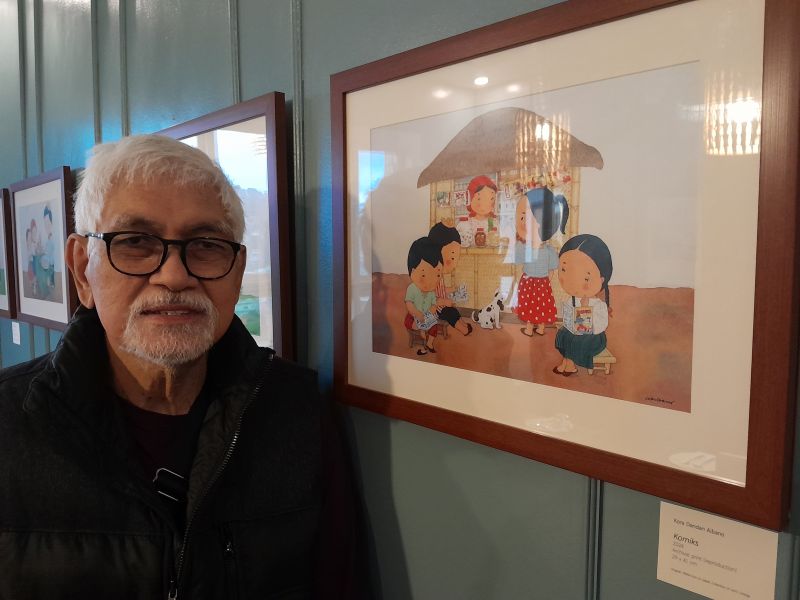
Journalist Rolly Fernandez poses beside ‘Komiks,’ the original of which is in the collection of his brother-in-law Junic Lolarga.
On another day, we conversed online with Kora. There’s something about her wide-eyed, smiling children that entrances both her and her viewers. When asked why they are her frequent subjects, she answered, “Honestly, after illustrating children’s books for over two decades, it felt like a natural transition. I’ve always been drawn to that universal search for something pure and beautiful, and I think childhood innocence is the closest link to that. We all look for that feeling in different ways. Maybe for you, it’s writing poetry and listening to classical music; for Rolly, it’s tending to his garden and collecting art and books. For me, it’s capturing that sense of wonder on canvas.”
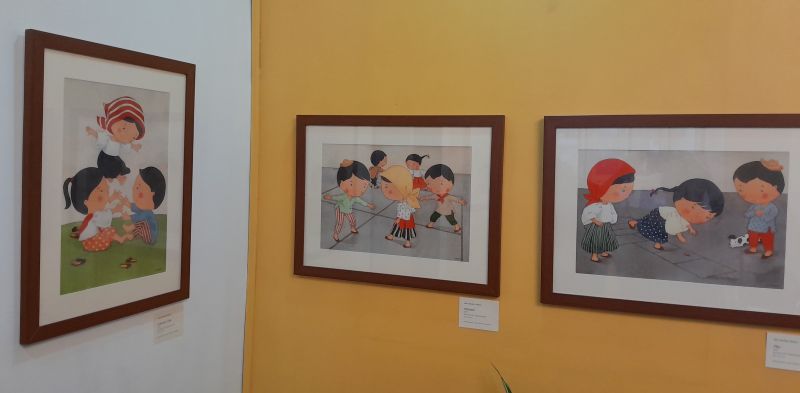
Kora captures Filipino childhood games
‘We were a one-income family of 11, so things like TV and children’s books were luxuries that we couldn’t afford’
Many things in her childhood served as materials for her works, apart from the research she has done on Filipino food and games. She said that her childhood was “far from perfect, but it was rich in other ways. We were a one-income family of 11, so things like TV sets and children’s books were luxuries that we couldn’t afford. The only books in the house were grown-up titles like Of Mice and Men or The Gulag Archipelago. But being the sixth of nine kids, I never felt lonely. We spent our school summer breaks outdoors. Our house was right in the middle of the subdivision, so it became the neighborhood hub once the sun went down in the late afternoon. We were always active playing patintero, siyato, moro-moro, sungka, jackstones, etc. I played every game and ate (and sometimes cooked!) the traditional snacks you see in my paintings today.”
This University of the Philippines Fine Arts graduate credits other artists for pushing her artistry: “I love the work of my late friend Robert Alejandro. His work has always been an inspiration. Sergio Bumatay III is another favorite of mine. They both have a wonderful touch when it comes to subjects that feel nostalgic and very Pinoy.”
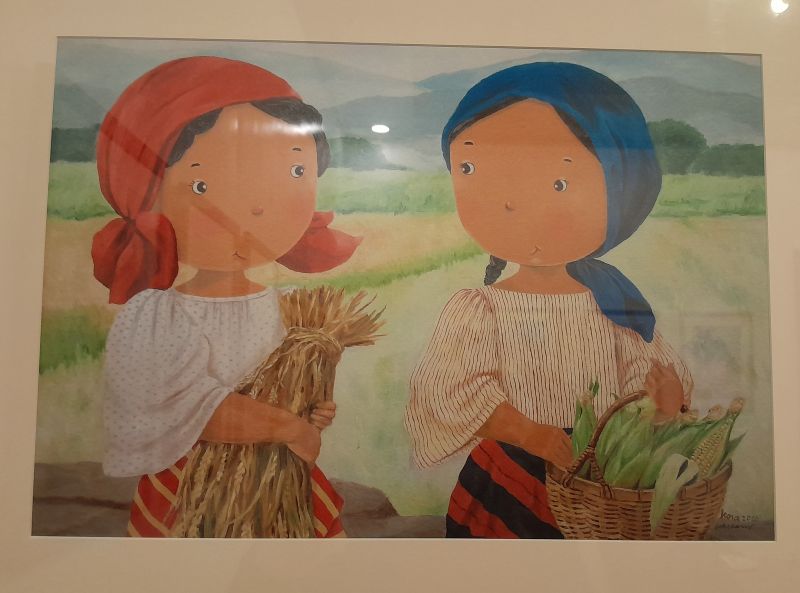
‘Ani’ seems like a homage to Amorsolo.
These days, however, she is taking an indefinite break from commissions and book illustrations. She explained, “I think I just reached a point where I needed a breather, medyo napagod at nasuya (burnout). Lately, I’ve gone back to doing large-scale oil paintings. I think I missed working on big canvasses just like when I was a Fine Arts student at UP. I’m painting wilted flowers because I love the deep colors and the intricate textures you find in the drying petals and leaves. They have so much personality.”
Her family’s move to Baguio 11 years ago has been incredibly conducive to her work, especially during the pandemic. She said, “Looking back, it’s been my most productive decade. All 56 art prints in the Lugod exhibit were painted here over the last eight years. On top of that, I’ve also illustrated five children’s books and even published my first three books as an author, the first of which actually bagged a National Children’s Book Award in 2018.”
She weighed the advantages and disadvantages of living and working in Baguio: “The main advantage is the peace which means less distractions. It’s far enough from Manila that I can choose my engagements and focus on the work. The cool climate also keeps me energized. The fresh vegetables available in the market are also a bonus. As for disadvantages? The nepnep season in July can be a bit much. The gloom sometimes dampens my creativity, buti na lang it only lasts for a few weeks.”
Nepnep is the local term for unceasing wind and rain during the monsoon months.
“Lugod” is on show until May 31 this year. Gypsy Baguio by Chef Waya is at No. 6 Road 2, Quezon Hill, Baguio City. Restaurant hours are from 11 a.m. to 9 p.m.


