
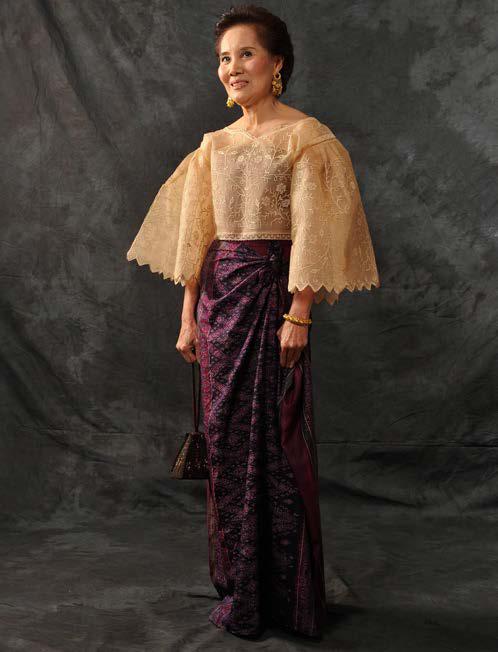
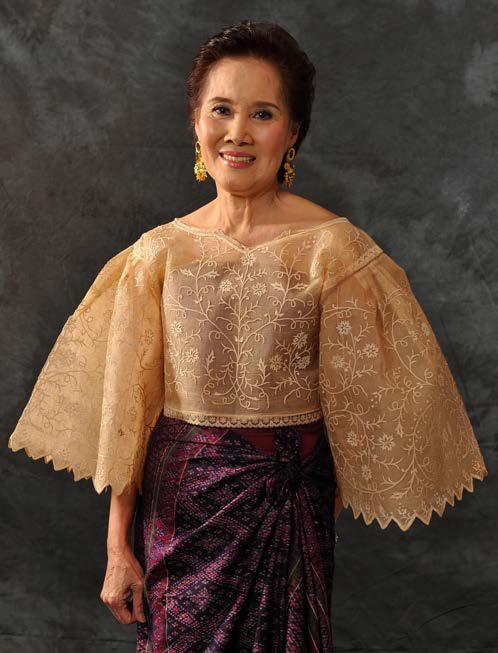
Kit Roxas wearing an antique camisa of piña textile (late 1800s) and a patadyong fashioned by the late designer, Joe Salazar. Roxas was one of the last respected dealers in Philippine antiques (along with the late Ramon Villegas, Viring de Asis, Tony Martino, Terry Baylosis, Floy Quintos, etc). She wore this ensemble to the book launch of Fashionable Filipinas in 2015. (Photo by Patrick Uy)
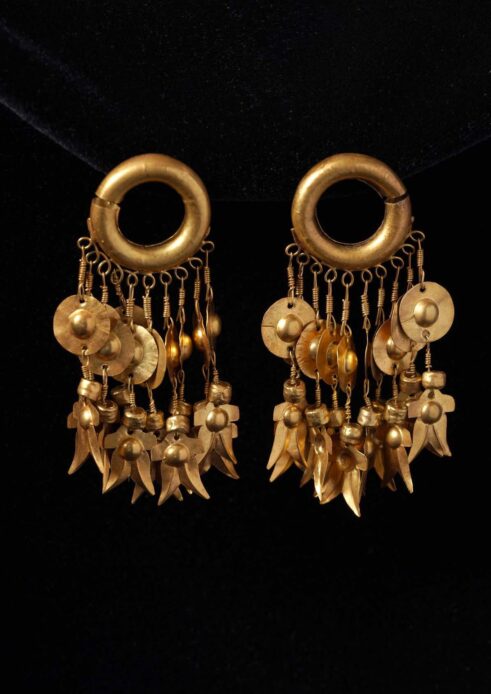
The Kit Roxas’ gold earrings and Garuda ornaments will go on the block in The Magnificent September Auction 2026 at Leon Gallery on Sept. 12, 2026.
This striking pair of articulated gold ear ornaments was created for the Manila art and antiques dealer, the late Maria Cristina Consing Ongpin–Roxas (1942-2026), known as “Kit Roxas,” by her friend, Ramon Nazareth Villegas (“Boy” Villegas).
A jeweler, antiquarian, scholar, and leading authority on Philippine antique jewelry, Villegas composed the earrings from genuine excavated pre-colonial gold elements and adapted them for contemporary wear. Each earring begins with a prominent annular gold element and opens into a richly articulated cascade of linked discs, domed bosses, beads, rosette-like forms, and elongated foliate pendants.
Fine wire loops join the individual components, allowing the ornaments to move freely and
creating an animated, light-catching surface. Villegas added the modern pin fittings, enabling the earrings to be worn without obscuring the exceptional visual character of the ancient gold components.
The earrings are of the Visayan tradition of patan-aw, or “look at me,” and related kayong-kayong ear ornaments.
These spectacular forms were conceived for display: their suspended elements would tremble and flash with the wearer’s movements, projecting abundance, rank, and ceremonial presence.
Comparable patan-aw ornaments are associated with Leyte, Cebu, and Bohol, while related articulated gold ear ornaments are known from the broader Visayan and northeastern Mindanao cultural sphere and can be found in the Bangko Sentral ng Pilipinas(BSP) pre-colonial gold collection.
Interest in excavated Philippine gold intensified after the accidental discovery in Surigao in April 1981 of a major assemblage of pre-colonial gold ornaments and accessories. This remarkable find brought wider attention to the artistry of Philippine pre-colonial gold work. The BSP characterizes this period as one of considerable political, economic, and social development, reflected in technically advanced gold ornaments and accessories of precious metal.
The Garuda in gold exquisite pre-colonial Philippine ornaments from the Kit Roxas legacy
By Emil Maranon III
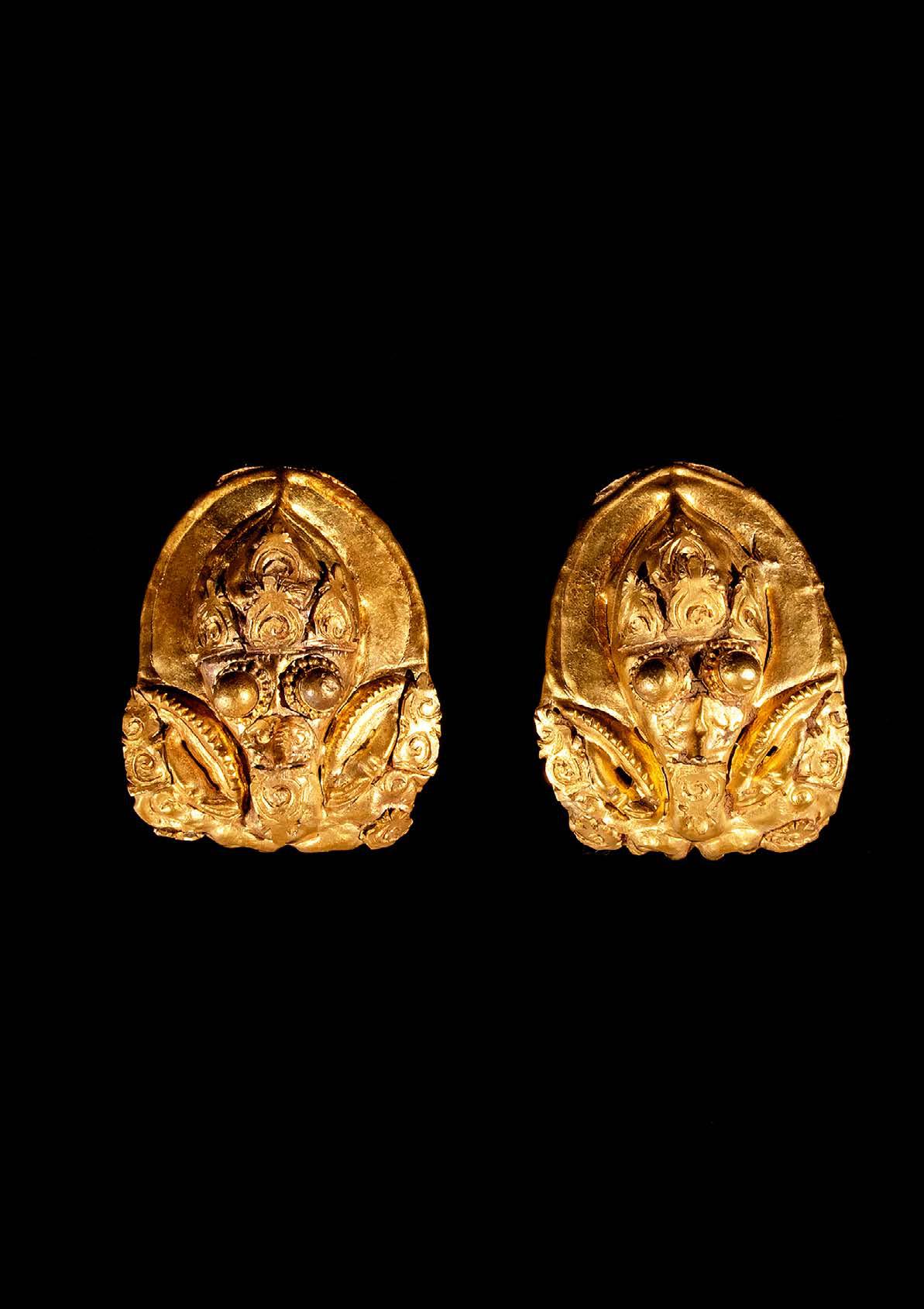
Pair of “Garuda” earrings, Stylistically 10th to the 13th century gold (total weight: 137.9 grams), Philippine-made, province of origin unknown
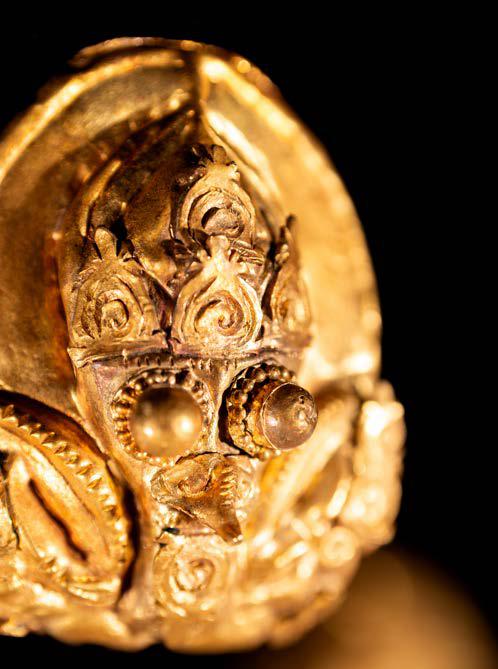
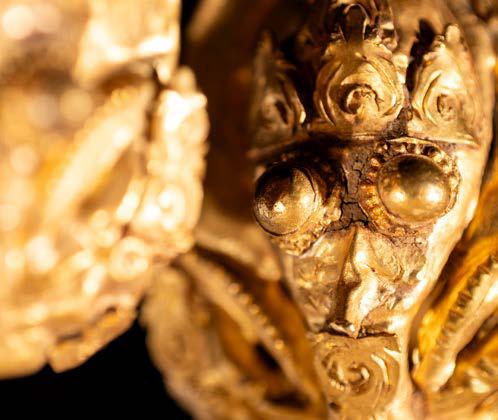
Details of the Garuda
One of the most spectacular ancient Philippine gold ornaments are the “Garuda” earrings. They are usually found in Northern Mindanao, in the provinces of Surigao and Agusan, but were also excavated in Samar, Leyte, Palawan and Sulu. Since the early days of antiquity collecting, Garuda earrings have been prized by collectors, and handsomely paid way above their gold value.
The iconography of the Garuda is of Hindu-Buddhist origin. The Garuda is a Hindu deity who is primarily depicted as the mount (vahana) of the Hindu god Vishnu. He is described as the king of birds, often portrayed in art in its zoomorphic form—as a giant eagle or predatory bird. Sometimes he is portrayed with fire, retelling the story of how he ascended to the Vajra Wheel Mountain, after his lifelong battle with darkness and poison accumulated from consuming serpents. There, his body self-immolated from within and what remained was a pure blue crystal heart—a symbol of clarity, enlightenment, and transcendence.
The Garuda iconography became popular in ancient Southeast Asia during the rise of Hinduism and Buddhism, particularly in the ancient empires of Srivijaya (7th to the 13th century) in Sumatra and the Majapahit (13th to the 16th century) in Java, which successively rose in power and dominated sea-trading in the region. The commercial, religious, and cultural influence of these ancient empires eventually reached the Philippines, particularly in Mindanao, the Visayas and Palawan, where Hinduism and Buddhism started to take root.
One of the earliest Garuda gold earring recoveries in the Philippines was in 1962. While the renowned anthropologist Dr. Robert B. Fox (1918–1985) was excavating a site in Uring Uring south of Brook’s Point on the east coast of Palawan, he was able to obtain a gold ornament from the descendants of Panglima Pisi, who recovered it in the 1930s from a grave site, and had since treasured and kept them hidden.
The single earring found by Dr. Fox, which he correctly associated with the Hindu deity “Garuda,” had an avian profile at the center, with bulging eyes, pronounced beak, suggestion of wings, and fire-like design around the bird figure. Since the publication of Dr. Fox’s find, the Garuda became the fancy and the dream of many collectors not only for their artistic merit, but also for their extreme rarity.
Unfortunately, the whereabouts of the Uring Uring Garuda remains unknown.
Similar Garuda gold earrings were found in Java, Sumatra, and other parts of Indonesia, where they are presumed to have originated from. Some of these imported earrings may have found their way to the Philippines through trade, but examination of the range of styles and make of different Philippine-found specimens would suggest that they were also locally copied and reproduced by artisans using abundant indigenous gold.
The ancient techniques (repoussé, chasing, chiseling, and cutting) employed in making them varies, which would also suggest that multiple workshops had produced them and for an extended period.
So far, it is believed that the more primitive types, such as the pair owned by Leandro and Cecilia Locsin, which was published in the book Philippines: an Archipelago of Exchange (2013), are earlier. The Locsin pair, which was found in Mindanao, is dated from the 10th to the 13th centuries, as it was found in association with late 10th-to-12th century material, including Yueh-type ceramics from Guandong. There are also specimens found, of materials from later period from the Yuan to the early Ming period.
The present pair of exemplary Garuda earrings being offered by Leon Gallery also has primitive qualities similar to the Locsin pair, except for the unusual beading decoration around the Garuda’s bulging eyes which makes this pair even more special. This specimen is in a very good condition and, more importantly, comes as a pair, which is extremely rare.
The pair was originally owned by a famous antiquity dealer and ceramics expert, Cristina “Kit” Ongpin-Roxas, who later sold it to its present owner, a distinguished collector and a celebrated public figure himself.


