
Amused was what Severino Reyes would have probably been at discovering I’d only learned about Lola Basyang’s stories after watching PETA’s production of Mga Kuwento ni Lola Basyang, which I was stoked to see. I’m more familiar with his zarzuela Walang Sugat that the American colonial authorities found subversive, and for which he was imprisoned (kahimyang.com).
PETA Theater Center was packed that afternoon of Sept. 30. Inside, there was a bit of a commotion when some students saw comedian-actor Melai Cantiveros, who signaled for quiet before posing for selfies with them.
The play had a limited engagement from Sept. 21 to 30, but it’s scheduled for a longer run in February, along with school and community tours. The stories staged were classic tales: Ang Prinsipeng Mahaba ang Ilong and Ang Binibining Tumalo sa Hari retold by Christine Bellen, and Ang Bantay ng Huling Buwan, a new story by J-mee (Joanna Marie) Katanyag.

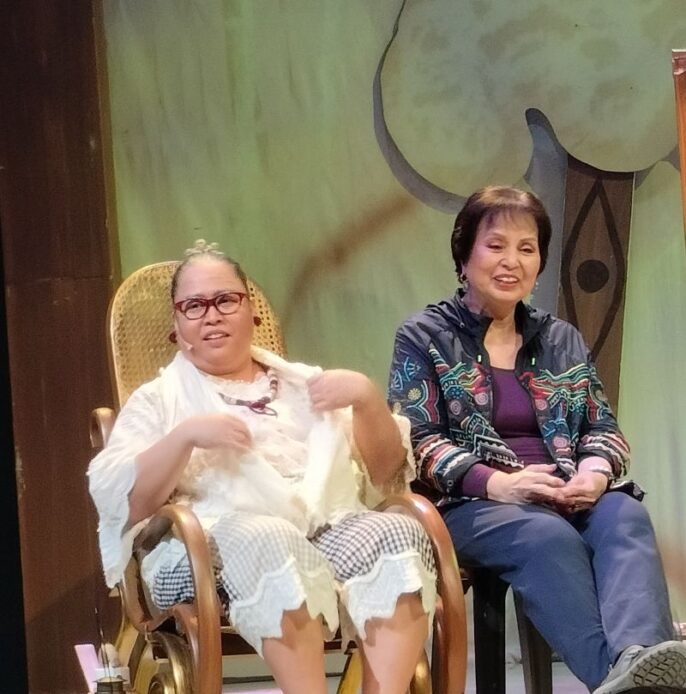
Lola B (center front) and Uriel (behind Lola B) with the ‘Mga Kuwento ni Lola Basyang’ cast
It isn’t surprising that the Lola Basyang known to today’s young people’s grandparents has returned after a long hiatus. “There’s always something new whenever Lola Basyang steps onto the stage to tell a story,” said Bellen. “She’s an ever-flowing source of imagination that liberates the minds of her audience.”
Interestingly, Maribel Legarda, director of the excerpt version, said reviving a classic didn’t necessarily mean staging it as it was. According to Legarda, “stories live and…speak to changing generations. With Peta…we take time to finesse certain elements so they can move meaningfully and responsibly for children and audiences today.”
Phil Noble, director of the full-length version, said he wanted children “to discover…the world of live theater and to open themselves to other possibilities in the stories and become part of the magical world of Lola B.”
Lola Basyang’s stories first came out in in 1925 in the literary magazine Liwayway owned by Ramon Roces and Severino Reyes. Reyes wrote about 400 Lola Basyang stories, and is believed to have based the Filipino storyteller on Gervacia Guzman de Zamora, his neighbor in Quiapo, Manila. Tandang Basyang, as she was called, was known for regaling her grandchildren with stories after dinner.
There have been several iterations of Lola Basyang through the years. In 1949, Reyes’ son Pedrito made a comic version of Lola Basyang. In 2005, PETA presented her stories adapted for stage by Bellen. In 2006, Anvil Publishing relaunched Mga Kuwento ni Lola Basyang as a series of children’s books based on Reyes’ tales and retold by Bellen. In 2008, Ballet Manila turned three stories into ballet: Ang Prinsipe ng Mga Ibon, Ang Kapatid ng Tatlong Maria, and Ang Mahiwagang Biyulin, choreographed by Osias Barroso Jr., Lisa Macuja- Elizalde, and Tony Fabella, respectively.
After 21 years, PETA has brought back Lola Basyang’s stories—and the timing couldn’t have been more opportune. Katanyag, Peta’s artistic director, said society has changed since Lola Basyang was introduced, with “stories arriving through…feeds, memes, videos, and algorithms, making it difficult to know what to believe, whom to listen to, and what stories matter.”
She added, “The stories invite young audiences to look again, ask questions, express an opinion, think, and get involved.”
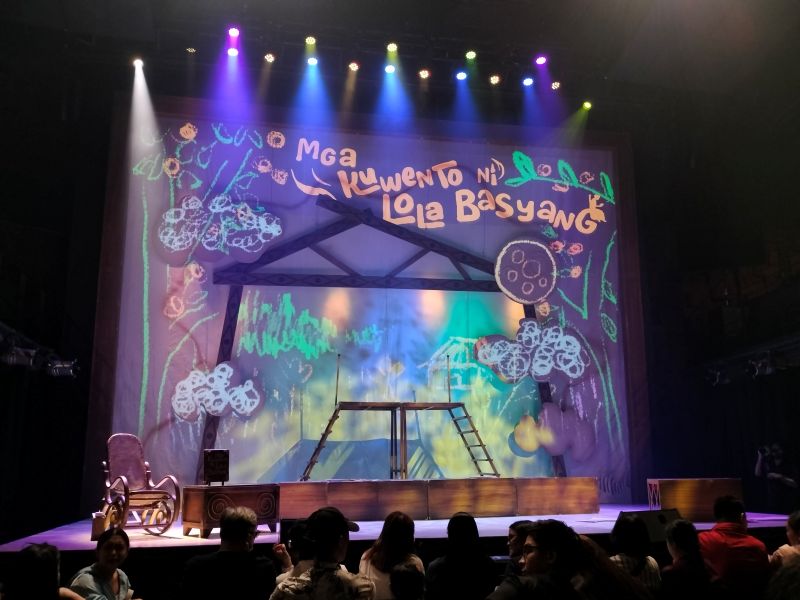
The stage changes from Lola B’s house to kingdoms in ‘Mga Kuwento ni Lola Basyang.’
Lola Basyang has gotten a makeover. Gone is the elderly woman wrapped in a balabal (shawl). In her place is an energetic Lola B (Kiki Baento) wearing culottes, a blouse, and a letter B pendant. Her hair’s swept back with a “peineta with fabric,” as costume designer Carlo Pagunaling described her hair clip. Pagunaling explained that Lola B’s necklace represented the “ethnolinguistic fabric of Luzon, Visayas, and Mindanao,” and that his costume designs were based on the concept of kumpletong di ganap (imperfectly complete) so they’d blend with set and property designer Julio Garcia’s vision of Lola B’s world.
Gone is the elderly woman wrapped in a ‘balabal’ (shawl). In her place is an energetic Lola B (Kiki Baento) wearing culottes, a blouse, and a letter B pendant
Katanyag had Lola B and Uriel (JC Sunto) of the young, tech-savvy generation engaging in conversations, blurring the hierarchy of elders vis-á-vis children. Uriel was grounded and wore Filipino-designed clothes. Her top, explained Pagunaling, was accented with baybayin, the pre-Spanish colonial script of the Philippine ethnic groups. Meanwhile, the costume of Sharay, the woman who outsmarted the king, was inspired by ukkil, he added. Ukkil/okir is a design pattern of the Muslims and Lumad people from Southern Philippines combining shapes (circle, diamond, square, and zigzag) with plant-based motifs.
Uriel’s planned livestream of the lunar eclipse went awry because of a power outage, giving Lola B the chance to show Uriel the power of storytelling and haraya (imagination).
In the show, Lola B broke the fourth wall by teaching the young audience theater etiquette (later, the moral lessons of the stories). She said to use only their ears and eyes, and to follow the quiet sign. She tested them, telling them to clap, after which she made the quiet sign. The enthusiastic clapping faded.
The stage changed from Lola B’s house into the kingdoms of the long-nosed prince and Sharay. In the Q&A, Garcia said his focus on the set design was understanding the materials, the “geography of Lola B’s house, what made it Filipino, and ‘playfulness’ in the ramps, boxes, and stairs.” He also integrated the design with the set changes, i.e., turning upstage left into a grassy area in the second story from Lola B’s house in the first.
The story of the long-nosed prince teemed with the quintessential fairy tale elements of a curse, mythical creatures, and true love’s power to convey the longstanding lesson of not judging a book by its cover.
Lola B narrated that a king was perturbed by the pet cat of the woman he was wooing because the cat hated him. The king sought the advice of his hermit-friend (aka Lola B), who told him to step on the cat’s tail and not let go, but the king bit the tail instead. A baffled Uriel interrupted the play to point out the king’s mistake. The king did it right and the cat morphed into an angry giant who, like the wicked fairy in Sleeping Beauty, cursed the lovers’ child to be born with a long nose, its length comparable to a bitter gourd.
The king and queen loved their son, who never stopped wondering why he looked different from everyone else in the kingdom. One day, continued Lola B, the prince was in the forest and met Gracia, a dark-skinned woman. Bungal (toothless) and Duling (cross-eyed) saw them and laughed at their appearances. Uriel gave chase to Bungal and Duling, who fell into an abyss. Lola B turned to the audience and asked five kids to come onstage to help Uriel pull the rope to save the two. The prince and Gracia fell in love and the prince’s nose became normal in size.
After the story ended, Lola B reminded the kids not to make fun of others who may look different, then taught them a new way to applaud, which was clapping and stomping the feet three times.
Lola B reminded the kids not to make fun of others who may look different
Lola B’s second story on discrimination revolved around Datu Abdul’s son Pido, who disobeyed his order of not seeing Sharay, a daughter of one of his servants. The Datu thought Sharay was dense—being a woman—and had her cook 12 dishes from a small sparrow, sell a sheep then return it to him, and milk a male water buffalo to prove her worthiness or face banishment from the kingdom. Like the miller’s daughter in Rumpelstiltskin, Sharay had plenty of moxie and completed the tasks.
After the play, Lola B asked the audience how a person could get smart. The kids yelled, “Study, sleep early, and eat nutritious food!” Similarly, she taught them a new way of applauding: clap, stomp their feet, sway their hips, and birit (belt out).
The production concluded with Ang Bantay ng Huling Buwan, with Katanyag using the bakunawa, a sea serpent in Philippine mythology known for swallowing the moon, as metaphor for darkness, fear, and misinformation.
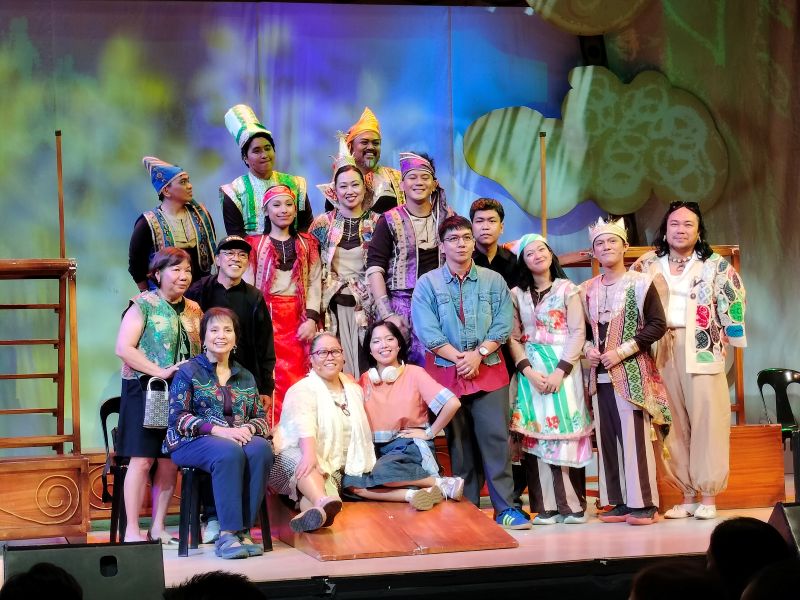
Director Maribel Legarda (standing leftmost, second row), set and property designer Julio
Garcia (in denim jacket), and costume designer Carlo Pagunaling (standing rightmost) with cast
members
Power had come back, and Uriel started streaming about the lunar eclipse as Lola B talked about the bakunawa. She said it came out during the lunar eclipse to steal the moon and was coming for his seventh moon. Uriel joined Lola B in urging the audience to make noise by clapping and stomping their feet so the bakunawa would regurgitate the moon. A few minutes later, Lola B, after thanking everyone for fighting the bakunawa, emphasized the importance of stories: “Stories are told to remind you about darkness and fear, lies, and anger. They don’t mislead you. You choose—share fear or light.”
(Surely it was clear, when the house lights were turned on, that the fight against the bakunawa was comparable to Filipinos’ protests against corruption, historical revisionism, misogyny, etc.)
Uriel opened the book Lola B left on the chest-table, and the hum of the haraya wafted overhead. Perhaps it’s Uriel’s turn now to narrate her stories and dreams.


