


Damodar Das Castillo and Mariel Ilusorio
MiraNila, the 95-year-old Benitez heritage house straddling the bustling centers of Cubao and San Juan, is starting to become a byword among music lovers and concert goers. Sitting atop a one-hectare land on the once bucolic hilltop of San Juan, the pre-war mansion gave a full view of the capital from its tower, eliciting the Spanish words “Mirar, Manila!” (Look, Manila!). Thus, MiraNila.

MiraNila today

California Mission Revival architecture of MiraNila (Gerard Lico archives)

MiraNila in Lamberto Avellana film ‘Satur’ (1951) (Patrick Flores’ Archives)
The ancestral home was built in 1929 by Conrado Francia Benitez, a pioneering educator and constitutionalist, and his wife, Francisca Tirona Benitez, a suffragist, and cofounder and president for 45 years of Philippine Women’s University (PWU). This school was the first university for women in Asia, founded by Asians.
Its California Mission Revival style, elegant gardens, and painstakingly preserved interiors escaped the ravages of war. For nine decades, MiraNila stood witness to events and personalities related to the writing of three Philippine Constitutions, the occupation of the country by Japanese imperial forces, the takeover by American armed forces, and many more. Presidents and members of congress as well as diplomats and cultural luminaries have graced the hallowed halls of MiraNila.
The mansion houses a collection of 4,000 books, including Filipiniana, reference and law books, and manuscripts, some dating back to the 1800s. It also houses over 1,000 pieces of priceless art, furniture, ceramics, and memorabilia. They were initially gathered by Conrado and Francisca, then by their daughter, Helena. Helena herself was an educator, founder of the iconic institution, Bayanihan Dance Troupe, a distinguished diplomat and senator.
The cultural and historical significance of MiraNila was recognized by the National Historical Commission of the Philippines, which declared it a historical landmark on April 7, 2011. Sen. Helena Benitez lived in the house until her death in 2016 at age 102.
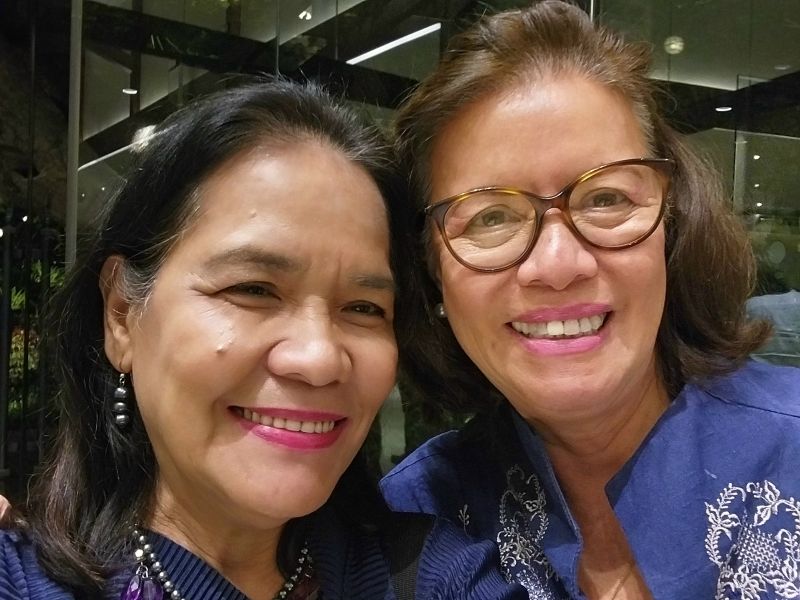
The author with Petty Benitez-Johannot, president of Benitez-Tirona MiraNila Foundation
Five years ago, I wrote a long story about MiraNila for a broadsheet to announce the opening of the Heritage House and Library to the public. Back then, Purissima (Petty) Benitez-Johannot, the senator’s niece and president of the Benitez-Tirona MiraNila Foundation (BTMNF), as well as its founding archivist and curator, talked about their intentions to work with partners and grow their audiences.
Fast forward, Johannot says, “We built an events space on the site of our small bungalow (formerly a garage). First onboard was the Bizu Group through Audrey Uy, who began to do catering for events that they organized for the events space they named the Pavilion. Audrey then brought in The Blue Leaf, the country’s leading events organizer whose CEO, Eugene Sandejas, agreed to help MiraNila. Blue Leaf enlarged the events space to fit their specifications. Audrey thereafter introduced Hanky Lee, CEO of The Henry Boutique Hotels. The design, feel, and look of what you now see as The Henry MiraNila is thanks to designer Eric Paras, who designed the space as a melding of the old and new.”
The cultural and historical significance of MiraNila was recognized by the National Historical Commission of the Philippines, which declared it a historical landmark on April 7, 2011
Aside from the original heritage house, library, and chapel, MiraNila now has Bizu MiraNila (a café), The Gallery MiraNila by The Blue Leaf (an events space), and The Henry MiraNila (a seven-room boutique hotel). What Johannot was just envisioning five years ago is now a reality: the confluence of their love for heritage and history made sustainable.
“With the support of those partners,” continues Johannot, “kept grounded by our operations staff (household staff from the time of Helena Z. Benitez, with special mention of administrator Delia Pineda, who manages the guided tour of the heritage house and library for no less than seven and no more than 20 pax at a time), tremendously helped by four MiraNila interns of these last months (Emman Degocena, Dianne Ganibo, Robeen Manalo, and Elisa Lim, our boots-on-the-ground), the concerts slowly took form.”
Opening the Main Hall in the house to small concerts and recitals has been the plan of Johannot and her collaborators for some time now, as there are “too few walls on which to hang (art) exhibitions, the field of my training and experience; and the Main Hall (our sala) is only just enough to seat 100 or so guests.”

Steinway Grand Piano at MiraNila
It was serendipitous that while BTMNF was using their savings to do structural repairs and conservation of objects in the house, an anonymous donor offered to partially fund the restoration of MiraNila’s 1904 grand piano majestically sitting on the elevated platform at the bottom of the winding staircase of the heritage house. The piano was listed as rare in the Steinway & Sons catalog, so Johannot wanted to have it no less than in concert-level condition. The work took 16 months, as all the parts were ordered and shipped from Canada and the US through concert pianist Rene Dalandan in New York and his Steinway-certified technician. The restoration was expertly undertaken by Danilo Lumabi, Cecille Licad’s Manila piano tuner.
The concerts, Strings of Gold 1 & 2, finally became a reality after funding came in from Rafael Rivera Benitez of the Erehwon Arts Center, and Jaime Ponce de Leon of the Leon Gallery. The launch of the Main Hall of MiraNila as concert venue featured Strings of Gold 1: Send-off Concert of Cellist Damodar Das Castillo with Pianist Mariel Ilusorio last September 19.

Damodar Das Castillo with the cello handcrafted by George Gerl

Jeffrey Solares and the Manila Symphony Junior Orchestra (Photo by ACM)
The 17-year-old Damodar, who started playing the cello at five years old, under the guidance of his cellist father, joined the Manila Symphony Junior Orchestra (MSJO) in 2015. He was a twice-recipient of the National Commission for Culture and the Arts’ (NCCA) Ani ng Dangal Award and first prize winner of five international music competitions.

The Manila Symphony Junior Orchestra at the Vienna Strauss Hall
Enrolled in pre-college at the Salzburg Mozarteum in Austria under Prof. Barbara Lubke-Herzl, he was offered a scholarship to further his studies under Prof. Valentin Radutiu at Carl Maria von Weber College of Music in Dresden. The scholarship was offered after his cello workshop with Radutiu, who told him he doesn’t have to audition to get the scholarship.
For his MiraNila concert, Dadomar used a cello made by George Gerl, a winner in the Luthier Competition in Germany. Ernesto Echauz of Standard Insurance Co. Inc. gave the cello to the prodigy, who played Bach’s Cello Suite No 3 Prelude and Chopin’s Sonata in G minor for Cello and Piano, Faye Miravite’s Transcendence, Abelardo’s Cavatina, Mancini’s Moon River, and Richard Roger’s Edelweiss. He ended his repertoire with the first movement of Cello Concerto in B-minor by Antonín Dvořák, followed by encore pieces by Ennio Morricone, the theme from The Mission, and Ennio and wife Andrea Morricone’s theme from Cinema Paradiso.

Jenny Juan, Miguel Benitez, the author, Bryan B. McClelland
Dadomar’s cello was beautifully and masterfully in sync with Ilusorio’s piano. The latter, a multi-awarded pianist and seasoned music educator, studied at the Juilliard School of Music in New York, the Oberlin Conservatory of Music in Ohio, and the State Academy of Music and Theater in Hannover. The intimate audience of 120 music lovers at MiraNila’s Main Hall included Sen. Frank Drilon, US Ambassador Michael Klecheski and his wife Eloisa, Swiss Ambassador Nicolas Bruehl and wife Denise, Austrian Ambassador Johann Brieger, Goethe Institute director Julian Christopher Fuchs, and some of the most discerning music enthusiasts in the metropolis. The spectacular program, emceed by two of the younger Benitez generation, Miguel Benitez and Bryan Benitez McClelland, benefited from the great acoustics of the high-ceilinged house, which produced ethereal and exhilarating music.
The spectacular program benefited from the great acoustics of the high-ceilinged house, which produced ethereal and exhilarating music
Two weeks after Dadomar’s concert, on Oct. 1, Strings of Gold 2: Manila Symphony Junior Orchestra’s Triumphant Return from Europe was held at The Gallery MiraNila. The MSJO, under the baton of Jeffey Solares, executive director of the Manila Symphony Orchestra Foundation and associate conductor of MSO, received the gold prize in addition to the Grand Prix in the 13th Bratislava International Youth Music in Slovakia last July. It was their first participation in the festival, which gave out only two Grand Prix in Bratislava this year—MSJO for the orchestra, and the Afrikaanse Hoër Meisieskool Pretoria from South Africa for their choir.
That same month, the MSJO went to Mozart’s Vienna and garnered the top prize at the prestigious 2024 Summa Cum Laude International Music Festival, a reprise of their golden win of 2021, besting 140 orchestras from 33 countries.
For their MiraNila concert attended by an enthusiastic audience of 170 music aficionados, MSJO played their winning pieces at Bratislava—Stephan Koncz’s A New Satisfaction, Antonin Dvorak’s Scherzo from Serenade for Strings, Ernani Cuenco’s Nahan arranged by Cyro Cloui Bon Moral, and Tagu-taguan by Ryle Nicole Custodio. They also played classical works for strings by Mozart, Violin Concerto No. 2 & 3, as well as popular classics by Harold Arlen, Ryan Cayabyab, Lucrecia Kasilag, BINI, David Anne, and Conrado del Rosario, whose piece Mahal for string orchestra drew prolonged applause and a standing ovation. Historian and music major and critic Fe Mangahas commented, “MSJO rendered a very refreshing concert—truly deserving of the Grand Prix from a European concert contest. For me, their rendition of Mahal by Conrado del Rosario and Nahan by Ernani Cuenco were particularly passionate, beautiful!”

Author with Jeffrey Solares, founder of the Manila Symphony Junior Orchestra
The MSJO is the string orchestra training program of the MSO Foundation, composed of the most advanced students of the MSO Music Academy and other qualified students aged 9 to 26 years old. Founder Jeffrey Solares says of this youth orchestra: “MSJO is a passion project. We started it in 2014 by volunteering our time. Teacher Sara Maria Gonzales and I didn’t even receive salary for our work. We just wanted to see our students play together as an ensemble. It was only when Mr. Ernesto Echauz and Standard Insurance decided to sponsor the group in 2017 when we started getting some compensation for our work. Due to their support, we were able to provide allowances and scholarships to the members, as well as high-quality instruments. This year, they even paid for a two-week European tour that would have been very difficult to organize if we didn’t have their sponsorship.”
Founder Jeffrey Solares says of this youth orchestra: ‘MSJO is a passion project. We started it in 2014 by volunteering our time…We just wanted to see our students play together as an ensemble’
Their passion extends to promoting interest in classical music and music education among the youth, and encouraging those with the means to support the pursuit of excellence in the field. Solares adds: “We don’t just complain and comment on the current lack of state support or apathy of the general public to culture and the arts. We have to do something about it. And usually, people respond positively once they witness and experience the joy of seeing how these programs transform and elevate the lives of people we touch.”
To date, several MSJO members are studying in top music schools in the United States and Europe, such as the Juilliard School in New York, the Cleveland State University, the Hochschule für Musik Hanns Eisler in Berlin, and the Mozarteum University in Salzburg. The MSJO is principally supported by Standard Insurance Inc. under its corporate motto “In Pursuit of Excellence.”
At MiraNila, we have been witnessing the excellence of Filipino talents through the concerts happening on its hallowed ground. Can the preserved past continue on through the future? Petty Johannot says, “While we continue to broaden audiences by making the compound more accessible to the public, we keep foremost the notion of sustainability for coming generations, i.e. not to tax the floor surfaces, protecting structures and objects from the elements, and securing against theft, among other concerns. I was many decades ago an intern at the Metropolitan Museum of Art in New York, and one memorable question at a gathering with the museum president went this way: If you were to have only three personnel left in the museum, who would they be? Then head of the Met William McComber replied without hesitation, a conservator and two security guards. Throughout the decades I’ve worked in museums in three continents, this notion of preserving the past for the future has remained foremost in my mind.”
The late William J. Murtagh, an American historian and so-called “Lion of Historic Preservation” indeed hit the nail on the head when he said, “At its best, preservation engages the past in a conversation with the present over a mutual concern for the future.”
At MiraNila, we have begun to meet and see the past, present, and future of arts and culture. It may yet be not just a concert hub, but a cultural center in our neck of the woods.
For tours, call tel. nos. (+632) 8722-0243, (+63945) 487-6827, or email HelenaZBenitez@gmail.com. For more information, visit Facebook page: miranilaheritage.org. To reserve for events, visit MiraNIla Heritage House Events.


